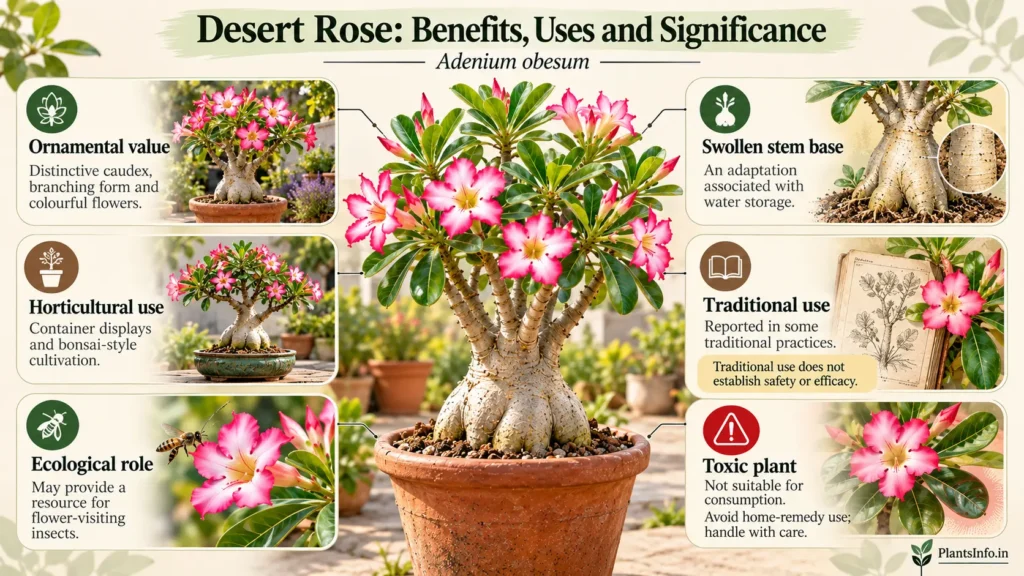
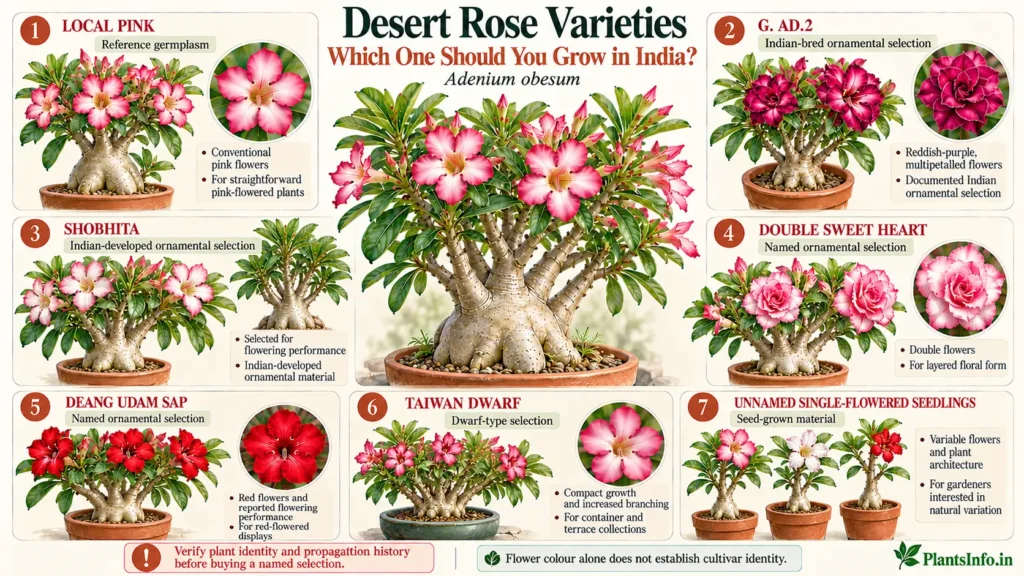
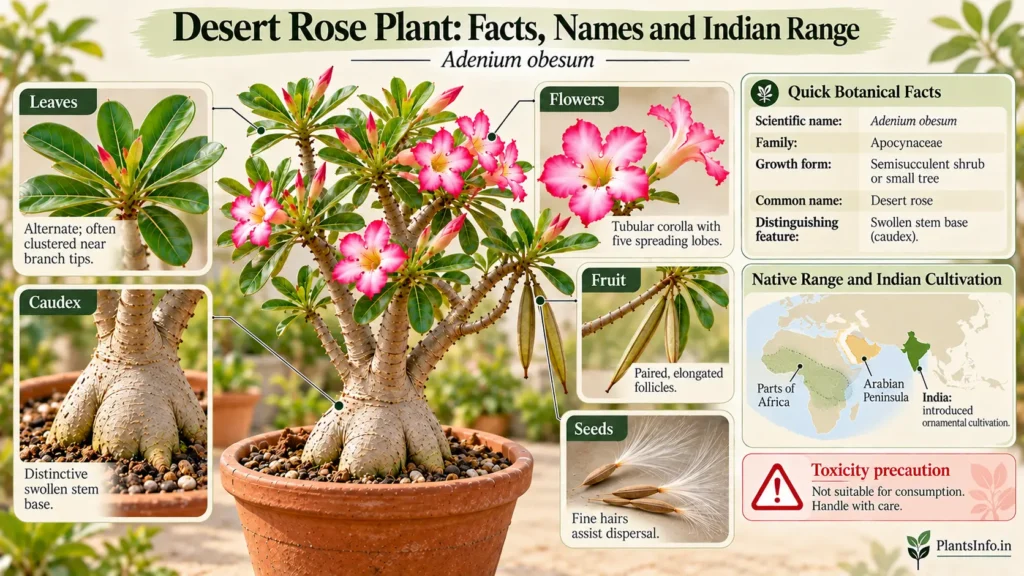
Desert Rose Varieties: Which One Should You Grow in India?
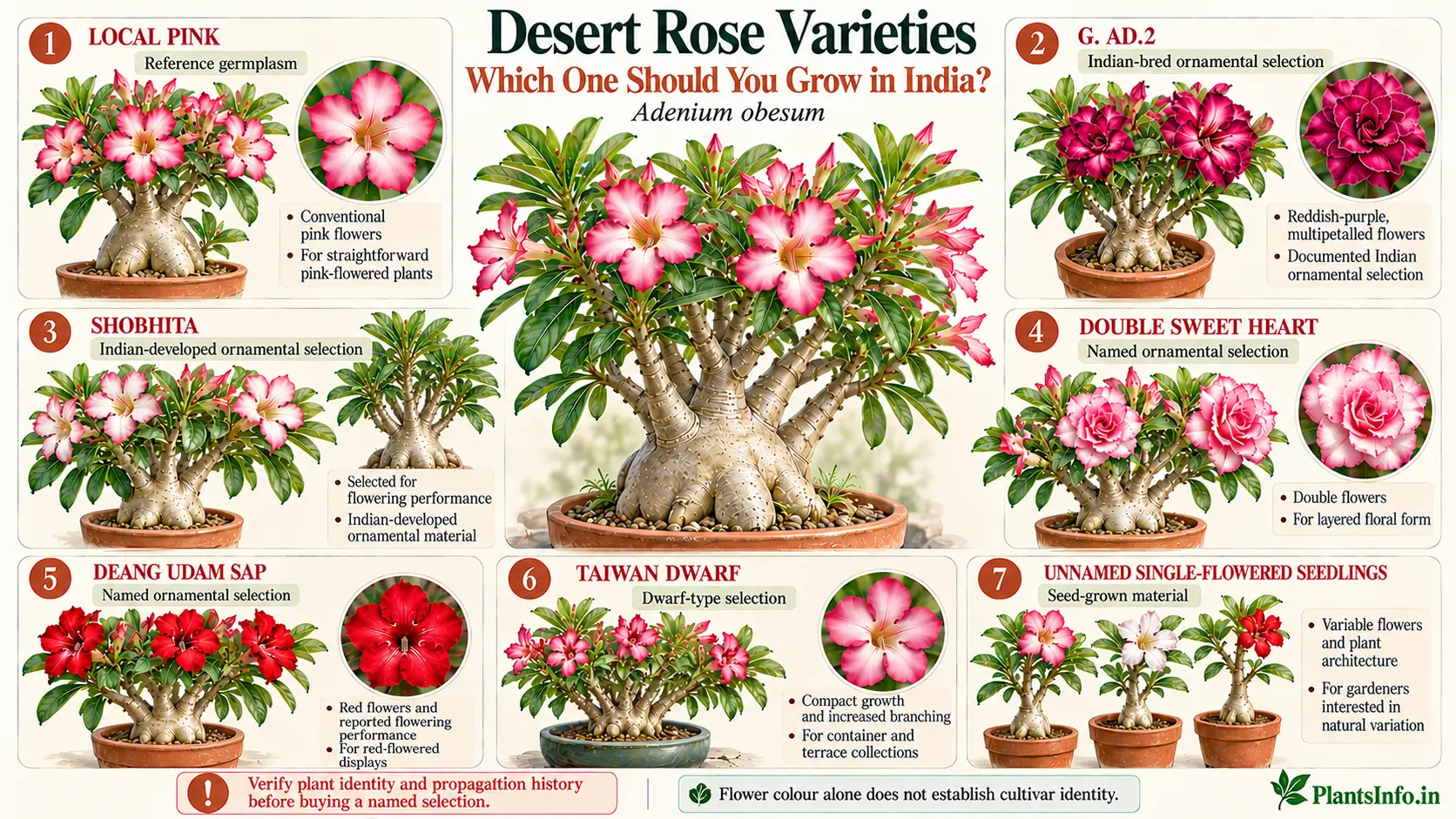
The best desert rose (Adenium obesum) selection depends on whether you prioritise distinctive flowers, compact growth or the natural variation of seed-grown plants. Named selections such as G. Ad.2 and Shobhita have documented Indian breeding histories, while seed-grown plants offer less predictable flower characteristics and plant architecture. Before buying a named selection, check its identity and propagation history rather than relying on flower colour or a nursery label alone.
See also: Adenium obesum plant profile, how to grow it, common problems, seasonal care, and its flowering season.
Quick Variety Selector
Indian adenium breeding research has documented selections including G. Ad.2 and Shobhita. Other names are associated with particular ornamental characteristics, while unnamed seedlings represent variable seed-grown material.
Recommended Products
Disclosure: As an Amazon Associate, PlantsInfo may earn from qualifying purchases.
🌱 Growing Essentials
The following products can help with container gardening, potting, root development, soil management, and healthy plant growth.
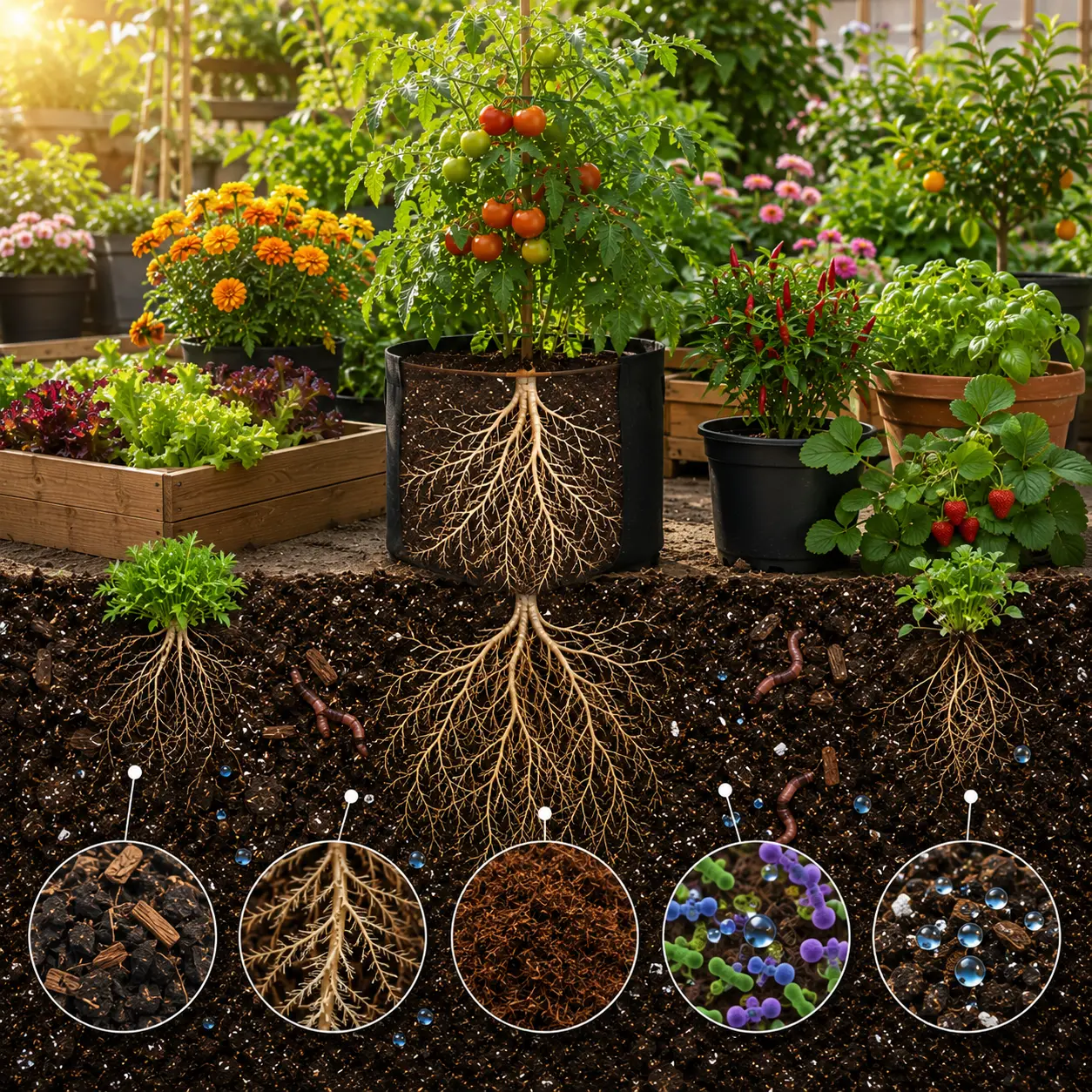
Organic Potting Soil Mix
Provides nutrients, structure, and healthy growing conditions for container plants.
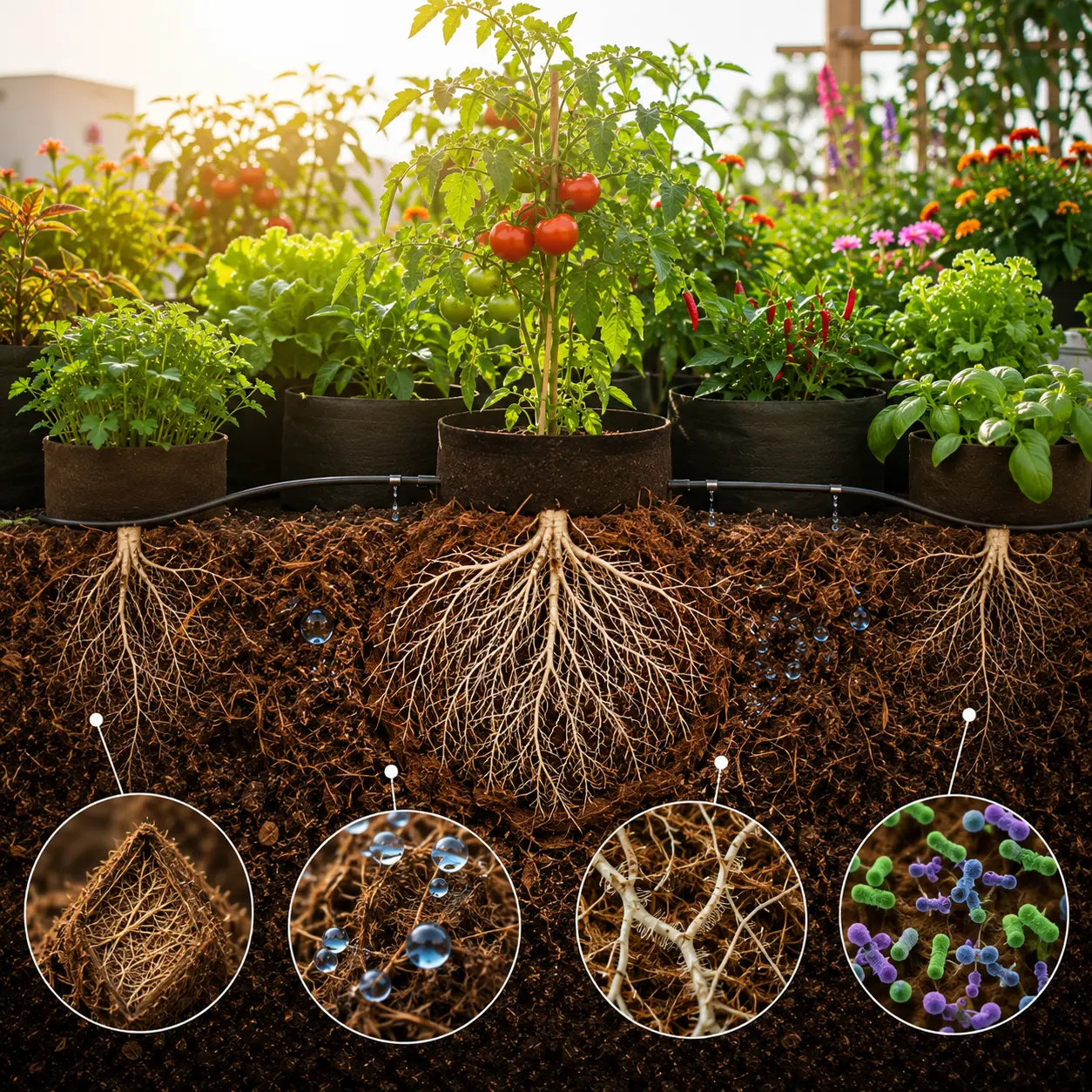
Coco Peat Growing Medium
Enhances moisture retention while maintaining excellent root-zone aeration.

Grow Bags for Plants
Improve drainage, root aeration, and vegetable production in limited spaces.

Plastic Pots for Plants
Ideal containers for seedlings, ornamentals, herbs, and balcony gardens.
| Variety or selection | Identity category | Distinguishing characteristic | Best suited to |
|---|---|---|---|
| Local Pink | Reference germplasm | Conventional pink flowers | Gardeners seeking a straightforward pink-flowered plant |
| G. Ad.2 | Indian-bred ornamental selection | Reddish-purple, multipetalled flowers | Collectors interested in a documented Indian selection |
| Shobhita | Indian-developed ornamental selection | Selected for flowering performance | Ornamental collections seeking named Indian-bred material |
| Double Sweet Heart | Named ornamental selection | Double flowers | Gardeners prioritising layered floral form |
| Deang Udam Sap | Named ornamental selection | Red flowers and reported flowering performance | Gardeners prioritising flower display |
| Taiwan Dwarf | Dwarf-type selection | Comparatively compact growth and increased branching reported in research | Container and terrace collections with limited display space |
| Unnamed single-flowered seedlings | Seed-grown material | Variable flowers and plant architecture | Gardeners interested in natural variation |
These categories do not imply that every plant sold under a given name is authentic or consistently available in Indian nurseries. The reported characteristics should be checked against the relevant breeding records or reliable descriptions of the original selection.
Varieties and Cultivars in Detail
G. Ad.2
G. Ad.2 is described in Indian adenium breeding research as an ornamental selection developed at Navsari Agricultural University, Gujarat, from a cross between Mung Siam and Double Sweet Heart. The source draft reports reddish-purple flowers with ten petals and favourable trial performance for flower number per cluster and flower longevity.
Its principal attraction is the combination of distinctive floral form and reported ornamental performance. These trial observations should not be interpreted as a guarantee that every plant will perform identically under different home-growing conditions.
For buyers, the main consideration is the identity of the planting material. A plant labelled G. Ad.2 should not be assumed authentic without credible propagation or labelling records.
Shobhita
Shobhita is described as an ornamental selection developed through breeding work at Navsari Agricultural University. The reported breeding programme involved a cross between Picottee and Deang Udam Sap, followed by multiplication through grafting and evaluation of flowering characteristics.
Its relevance lies in its documented breeding history and selection for ornamental flowering performance. However, a nursery label alone does not establish that a particular plant is authentic. Buyers interested in Shobhita should look for traceable propagation information and a description consistent with the original selection.
Local Pink
Local Pink is used as reference germplasm in Indian adenium breeding research. It represents pink-flowered material against which selected genotypes have been evaluated.
Its main appeal is its familiar flower colour rather than an unusual ornamental form. However, the name may refer to local plant material rather than one consistently identifiable clone.
Gardeners should therefore avoid assuming that all plants sold as Local Pink will have identical flower characteristics or genetic identity.
Double Sweet Heart
Double Sweet Heart is a named ornamental selection used in Indian breeding research. The source draft describes it as a double-flowered selection with approximately ten petals, distinguishing it from the typical five-lobed single flower.
Its principal appeal is its layered floral appearance. For collectors who prioritise double flowers, this characteristic may be more important than compact growth or other architectural traits.
As with other named selections, reliable propagation information is important when purchasing a plant under this name.
Deang Udam Sap
Deang Udam Sap has been evaluated in Indian research on potted adeniums and is associated in the source draft with red flowers and strong flowering performance under trial conditions.
These reported characteristics make it relevant to gardeners who prioritise flower display. However, performance observed in an experiment should not be treated as a guarantee of identical results across different climates, containers or growing environments.
Buyers should also verify the identity of nursery material rather than assuming that a plant’s red flowers establish its cultivar identity.
Taiwan Dwarf
Taiwan Dwarf is described in Indian morphological characterisation research as a dwarf-type adenium selection. The reported traits include comparatively short growth, increased branching and smaller leaves.
Its compact form may suit container displays, balconies and terraces where available space is limited. This makes it a useful selection to investigate when growth habit matters more than a particular flower form.
However, the name alone does not establish that a nursery plant matches the research material. Reliable identification remains important when compact architecture is the primary reason for buying the selection.
Unnamed Single-Flowered Seedlings
Seed-grown adeniums can show variation in flower characteristics and plant architecture, depending on their parentage. A seedling does not necessarily reproduce the characteristics of its parent plant faithfully.
This variability can be attractive to gardeners interested in observing differences in flowers, caudex development, and branching. However, seedlings are less suitable when the objective is to reproduce a particular named selection or obtain a predictable flower pattern.
Choose seed-grown plants when variation is acceptable rather than expecting the offspring to retain every characteristic of a named parent.
Head-to-Head Comparison
G. Ad.2 vs Local Pink
Choose G. Ad.2 if reddish-purple, multipetalled flowers and a documented Indian breeding history are priorities. Local Pink may be suitable when conventional pink flowers are sufficient, and a distinctive named selection is not essential.
The source draft reports stronger performance for selected floral traits in G. Ad.2 during Indian trials. This does not establish universal superiority under every home-growing condition.
Double Sweet Heart vs Taiwan Dwarf
These selections serve different ornamental priorities. Double Sweet Heart is relevant when double flowers are the main attraction, whereas Taiwan Dwarf is more relevant when compact architecture is the primary consideration.
Neither should be treated as the better choice in every situation. The decision depends on whether flower form or plant size matters more to the gardener.
Reliable, directly comparable data on retail price, growth speed, and availability across Indian regions are not established in the source material.
How to Choose a Desert Rose for Your Space
- Container or terrace garden: Consider Taiwan Dwarf when compact growth is the priority. If flower characteristics matter more, investigate a named selection such as G. Ad.2.
- Small garden plot: A compact selection or a modest-sized specimen may be more practical than a plant of uncertain eventual size.
- Larger garden or backyard: Consider a named flowering selection when a particular floral display is desired, or seed-grown material when variation in plant architecture is welcome.
- Ornamental collection: Prioritise traceable plant identity if you intend to compare or maintain particular named selections.
- Experimental growing: Seed-grown plants can be useful when observing variation is part of the objective rather than an unwanted uncertainty.
These recommendations are based on the stated ornamental characteristics and intended use. They are not the results of a comprehensive comparative trial of every selection under Indian home-garden conditions.
Regional Suitability in India
Regional suitability should be assessed using local conditions rather than flower colour alone. The available selection descriptions do not establish a universal ranking of adenium cultivars for every Indian region.
| Region or setting | Consideration when choosing a selection |
|---|---|
| North India | For outdoor or container collections, account for local winter temperatures before choosing where the plant will be kept. |
| South India | Named selections and seed-grown plants may be considered where local conditions support adenium cultivation. |
| Coastal regions | Consider local humidity and prolonged wet weather when assessing suitability. |
| Hill stations and high-altitude areas | Cold exposure may limit suitability; local temperature conditions should guide the decision. |
These are broad regional considerations, not evidence that a specific selection has outperformed others in comparative trials across these regions.
For detailed advice about planting, routine care, seasonal changes and environmental protection, consult the relevant PlantsInfo growing and seasonal-care guides.
Watch Out for Mislabeling
Descriptive nursery names do not always identify a formally documented cultivar. Terms such as “double red,” “black,” “dwarf,” and “rainbow” may describe a flower’s appearance or a seller’s category rather than a verified genetic identity.
Before purchasing a named selection:
- Ask for the exact selection or cultivar name.
- Check whether the seller can provide credible propagation or sourcing information.
- Compare the mature flower and growth characteristics with a reliable description of the selection.
- Ask whether the plant is grafted and, where relevant, which part of the plant carries the selected flowering material.
Grafted plants may have a flowering shoot with a different identity from the rootstock. A clear label and traceable propagation history therefore matter more than flower colour alone.
A photograph can help with preliminary comparison, but it cannot independently establish cultivar identity.
Where to Source Desert Rose Varieties in India
Potential sources include specialist ornamental nurseries, established adenium collections, horticultural institutions and university-linked plant sales where available.
For selections such as G. Ad.2 and Shobhita, ask whether the plant was propagated from authenticated material and whether its name can be traced to a credible description or breeding record.
Before buying, verify the label, propagation method, and available identity information. Do not assume that a selection is currently available merely because it appears in published research, and do not treat a seller’s use of a name as proof of authenticity.
Conclusion
Choosing a desert rose selection begins with identifying the trait that matters most: distinctive flowers, compact architecture, or the natural variation of seed-grown plants. G. Ad.2, Shobhita, Double Sweet Heart, Deang Udam Sap, Taiwan Dwarf and Local Pink represent different selection categories and ornamental priorities.
For a named selection, credible identity and propagation information are essential. When that information is unavailable, treat the nursery label as provisional rather than assuming that the plant will reproduce a documented selection’s characteristics.