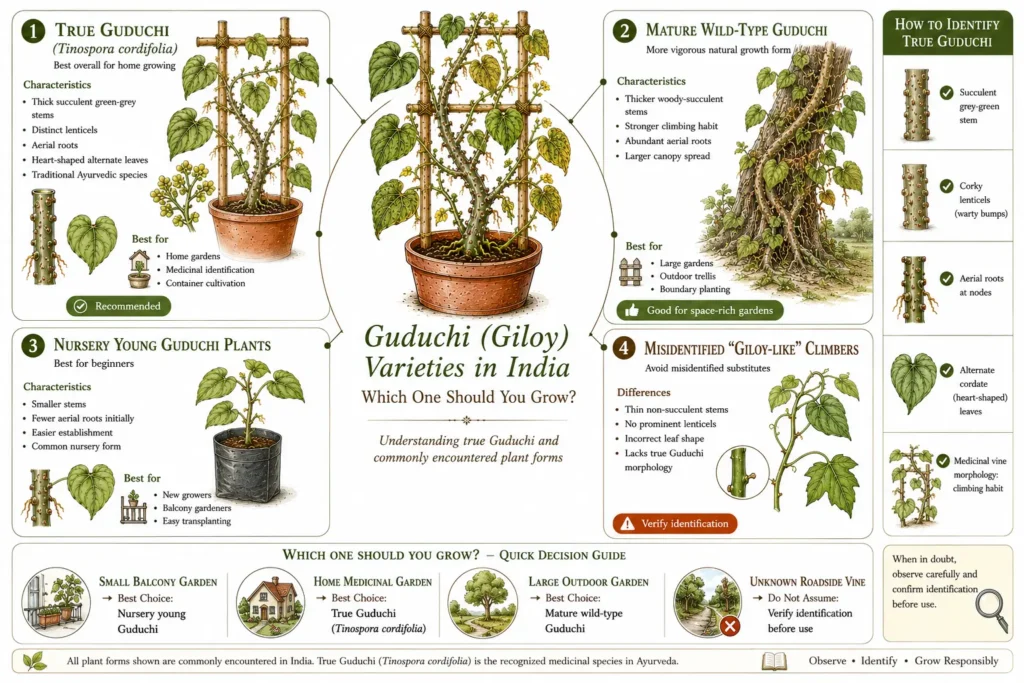
Guduchi (Giloy): Key Facts, Names, and What You Should Know
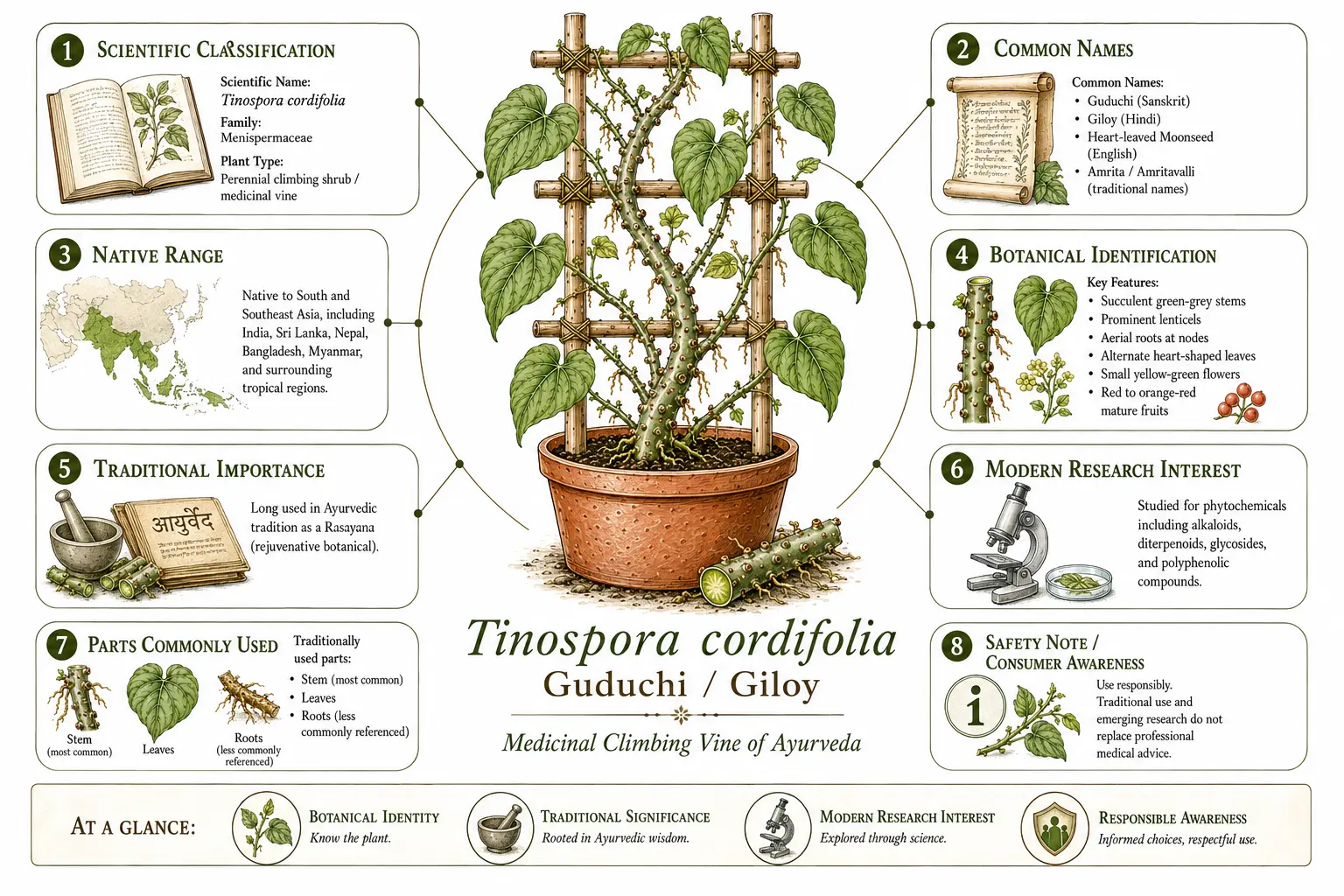
Break a fresh Guduchi stem and its yellowish interior is immediately noticeable — one of the features that makes this medicinal vine easy to recognise. This is a plant that announces itself even when you are not looking for it.
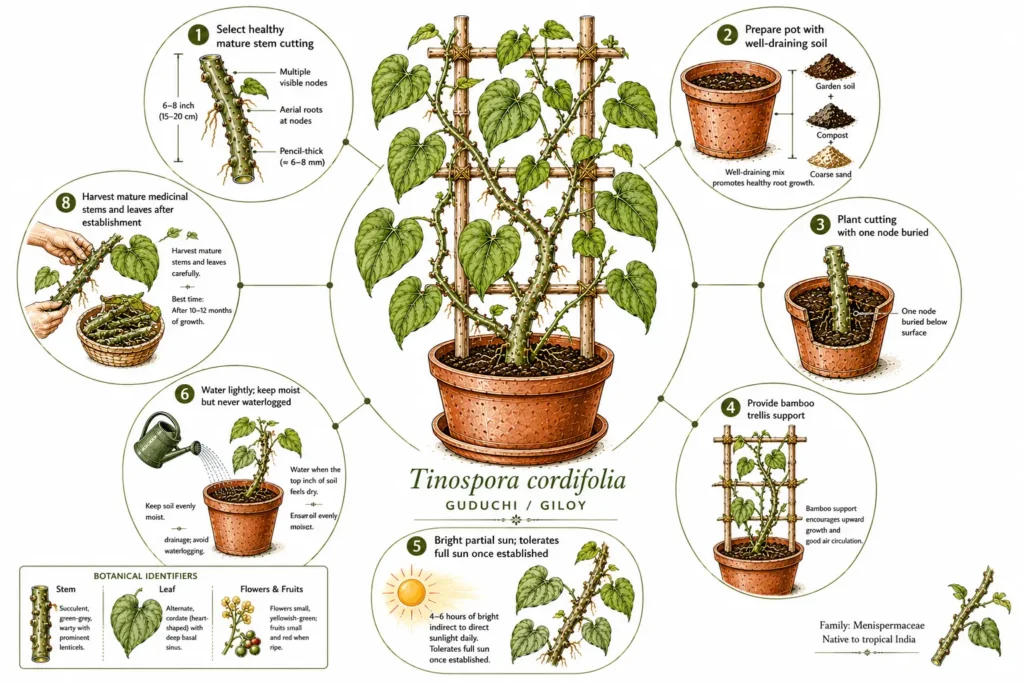
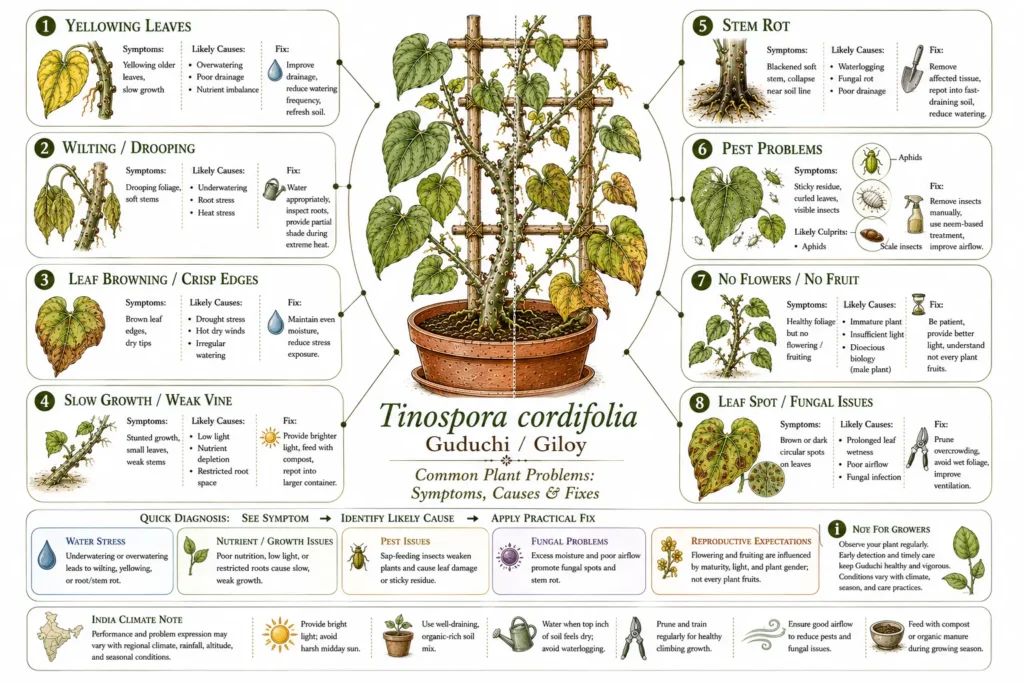
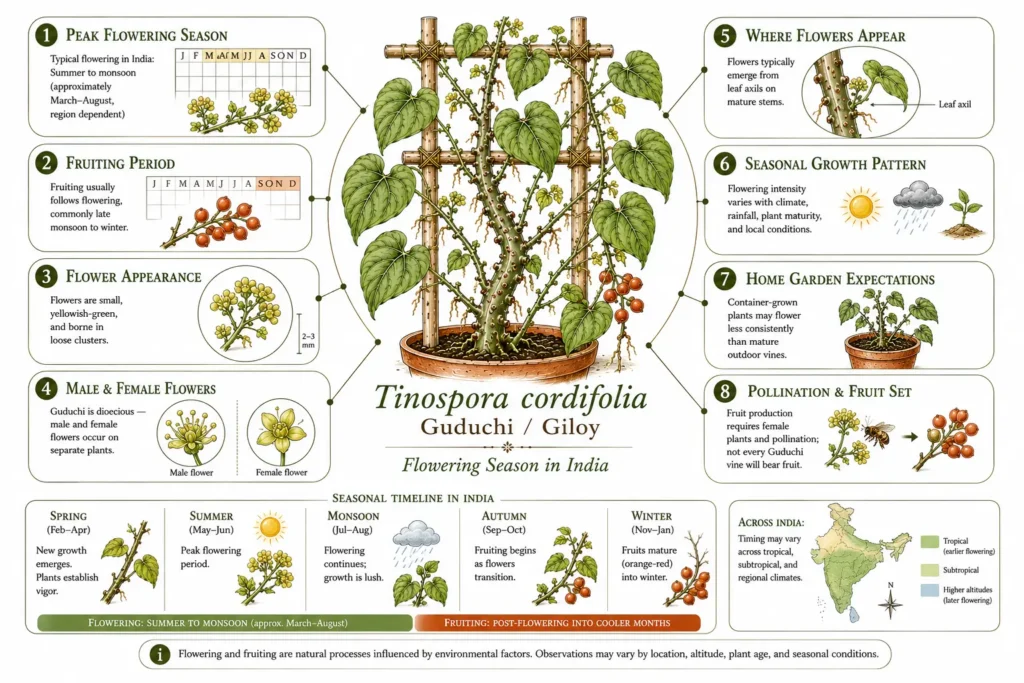
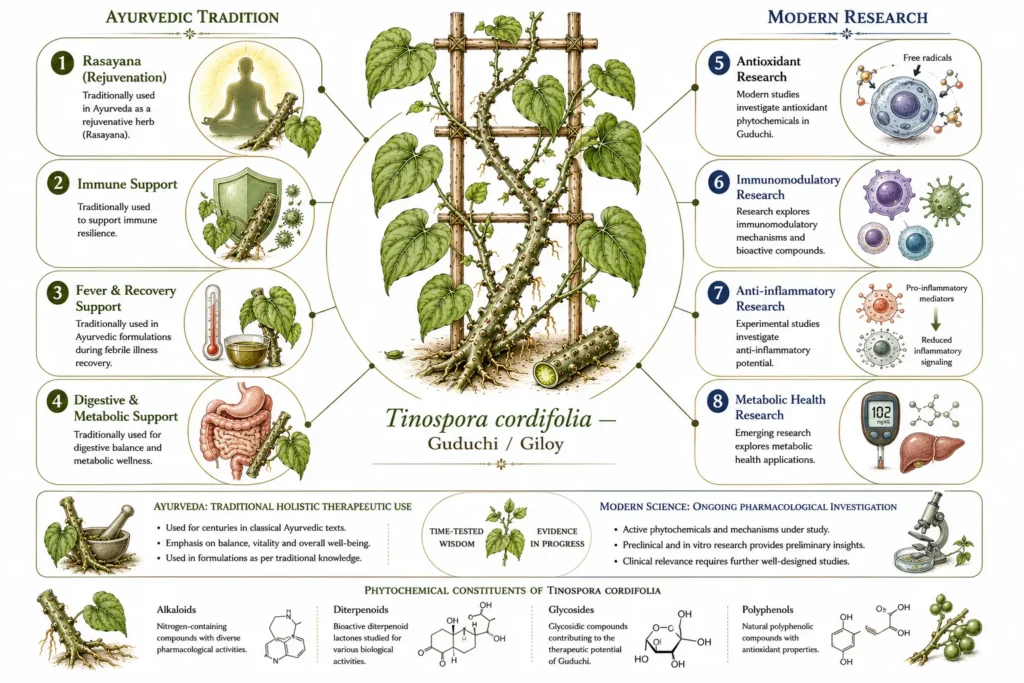
See also: Giloy plant profile, how to grow it, common problems, its flowering season, and its benefits.
Names in Different Languages
| Language | Name |
|---|---|
| English | Heart-leaved moonseed, Indian tinospora |
| Hindi | Giloy, Guduchi |
| Bengali | Guloncho, Gulancha |
| Tamil | Shindilakodi, Amritavalli |
| Telugu | Tippa-teega |
| Marathi | Guduchi, Gulvel |
| Kannada | Amrita balli |
| Malayalam | Chittamruthu, Amritavalli |
| Odia | Guluchi |
Scientific name: Tinospora cordifolia (Willd.) Miers
Family: Menispermaceae
Recommended Products
Disclosure: As an Amazon Associate, PlantsInfo may earn from qualifying purchases.
🌱 Growing Essentials
The following products can help with container gardening, potting, root development, soil management, and healthy plant growth.

Organic Potting Soil Mix
Provides nutrients, structure, and healthy growing conditions for container plants.

Coco Peat Growing Medium
Enhances moisture retention while maintaining excellent root-zone aeration.

Grow Bags for Plants
Improve drainage, root aeration, and vegetable production in limited spaces.

Plastic Pots for Plants
Ideal containers for seedlings, ornamentals, herbs, and balcony gardens.
Regional names vary widely across India, with Giloy, Guduchi, Gulvel, Gulancha, Tippa-teega, and Amritavalli among the commonly used names.
What Does It Look Like?
Guduchi is a large, fast-growing deciduous climbing vine. Left unpruned, it can grow several metres long, though garden-grown plants are usually kept smaller with regular pruning.
Its bark is creamy-grey, corky, and grooved, with distinctive warty swellings that make mature stems easy to identify even when the vine is leafless.
The leaves are broadly heart-shaped, smooth, and bright green above with a paler underside, often compared in shape to a betel leaf. In cooler or dry periods, the vine may shed part or all of its foliage before producing fresh growth again.
Flowers are small, pale greenish-yellow, and borne in slender drooping clusters. Guduchi is dioecious, meaning male and female flowers occur on separate plants. The fruits mature into glossy, bright red berries.
One of its most recognisable features is the production of long hanging aerial roots from older stems, especially in mature plants.
Where Does It Grow in India?
Guduchi is native to India and grows wild across the subcontinent up to approximately 1,200 m altitude. It is most commonly found in the tropical deciduous forests of Bihar, West Bengal, Madhya Pradesh, Karnataka, Kerala, and Rajasthan. In the northeast, it grows in Assam and along the foothills of the Himalayas.
The vine is equally at home in urban spaces — it is commonly found climbing compound walls, abandoned structures, and garden trees in towns across Central and South India. It grows in both dry and humid tropical climates, making it one of the most geographically adaptable medicinal plants in India.
Rural distribution is primarily through bird dispersal and natural regeneration from fallen fruit. Urban cultivation has expanded significantly since 2020 as household interest in immunity-supporting herbs increased.
What Is It Used For?
Guduchi is traditionally used in Ayurvedic medicine for a wide range of medicinal purposes, particularly in rejuvenative formulations and preparations associated with fever and recovery. Full medicinal details are covered in the Benefits Guide.
The stem is the primary medicinal part used, prepared traditionally as fresh juice, decoction, dried powder, or starch extract. In Ayurvedic practice, the starchy stem preparation known as Guduchi satva is used in specific traditional formulations.
Beyond medicinal use, Guduchi is also grown as an ornamental and functional climbing vine in home gardens, where it can be trained over trellises, walls, and support structures to provide seasonal green cover. Its mature berries may also be consumed by birds.
In Mythology and Ancient Texts
Guduchi has a longstanding cultural and mythological presence in Indian tradition. One of its best-known Sanskrit names, Amrita, meaning nectar of immortality, connects it to the Samudra Manthan — the mythological churning of the cosmic ocean described in Hindu tradition. According to this narrative, drops of divine nectar fell to earth and gave rise to the Guduchi vine, reinforcing its association with vitality and rejuvenation.
Classical Ayurvedic texts, including the Charaka Samhita and Sushruta Samhita, describe Guduchi as an important medicinal plant and a respected rasayana herb within traditional Ayurvedic practice, reflecting its longstanding place in the classical herbal tradition.
Is It Easy to Grow?
Yes — Guduchi is considered one of the easier medicinal climbing plants to establish in suitable Indian growing conditions. It grows readily from stem cuttings, adapts to a range of well-drained soils, and performs well in many tropical and subtropical climates.
It does best with warmth, sunlight or partial sun, and vertical support for climbing. Poor drainage, prolonged waterlogging, and deep shade can reduce plant vigour.
Because Guduchi is a climbing vine, it needs space and a support structure such as a trellis, fence, or wall. Without support, it tends to sprawl rather than climb. In containers, it performs best in a reasonably large pot that can support long-term root growth.
Special Flags
Species confusion:
Guduchi (Tinospora cordifolia) may be confused in trade with related Tinospora species, including Tinospora crispa. Because some Tinospora-based products have been associated with liver safety concerns, correct botanical identification and reputable sourcing are important.
Vigorous growth:
In warm, humid conditions, Guduchi can grow rapidly and quickly cover nearby supports or structures. Regular pruning helps keep it manageable in terraces and home gardens.
Frequently Asked Questions
Is Guduchi the same as Giloy?
Yes. Giloy is the most widely used Hindi name for Tinospora cordifolia, while Guduchi is its classical Sanskrit name. Both refer to the same plant.
Can Guduchi grow in colder climates like Himachal Pradesh or Uttarakhand?
Guduchi performs best in warmer lowland and lower hill climates. In colder high-elevation regions, growth may become slower, seasonal, or less reliable depending on winter severity.
Is the leaf safe to eat directly?
Guduchi leaves are used in some traditional preparations, but the stem remains the primary medicinal part in Ayurvedic practice. Medicinal use should follow reliable guidance rather than informal experimentation.
Guduchi is one of those plants that rewards familiarity — once you recognise its corky, warty stems, heart-shaped leaves, and hanging aerial roots, it becomes much easier to spot in suitable growing regions.