Guduchi Varieties: Which One Should You Grow in India?
Quick Answer: For almost every Indian home gardener, standard Tinospora cordifolia — grown on a neem tree wherever possible — is the correct and only choice. Two related species are sold as Guduchi but have important differences that matter for both medicinal use and safety.
See also: Giloy plant profile, how to grow it, common problems, its flowering season, and its benefits.
Most people buy whatever Guduchi cutting is available at the local nursery without knowing that the genus Tinospora has three species commonly traded in India, and that they are not interchangeable. The single most important factor separating them for an Indian home gardener is not yield or ornamental quality, but authenticity and safety. This guide fixes that.
Recommended Products
Disclosure: As an Amazon Associate, PlantsInfo may earn from qualifying purchases.
🌱 Growing Essentials
The following products can help with container gardening, potting, root development, soil management, and healthy plant growth.
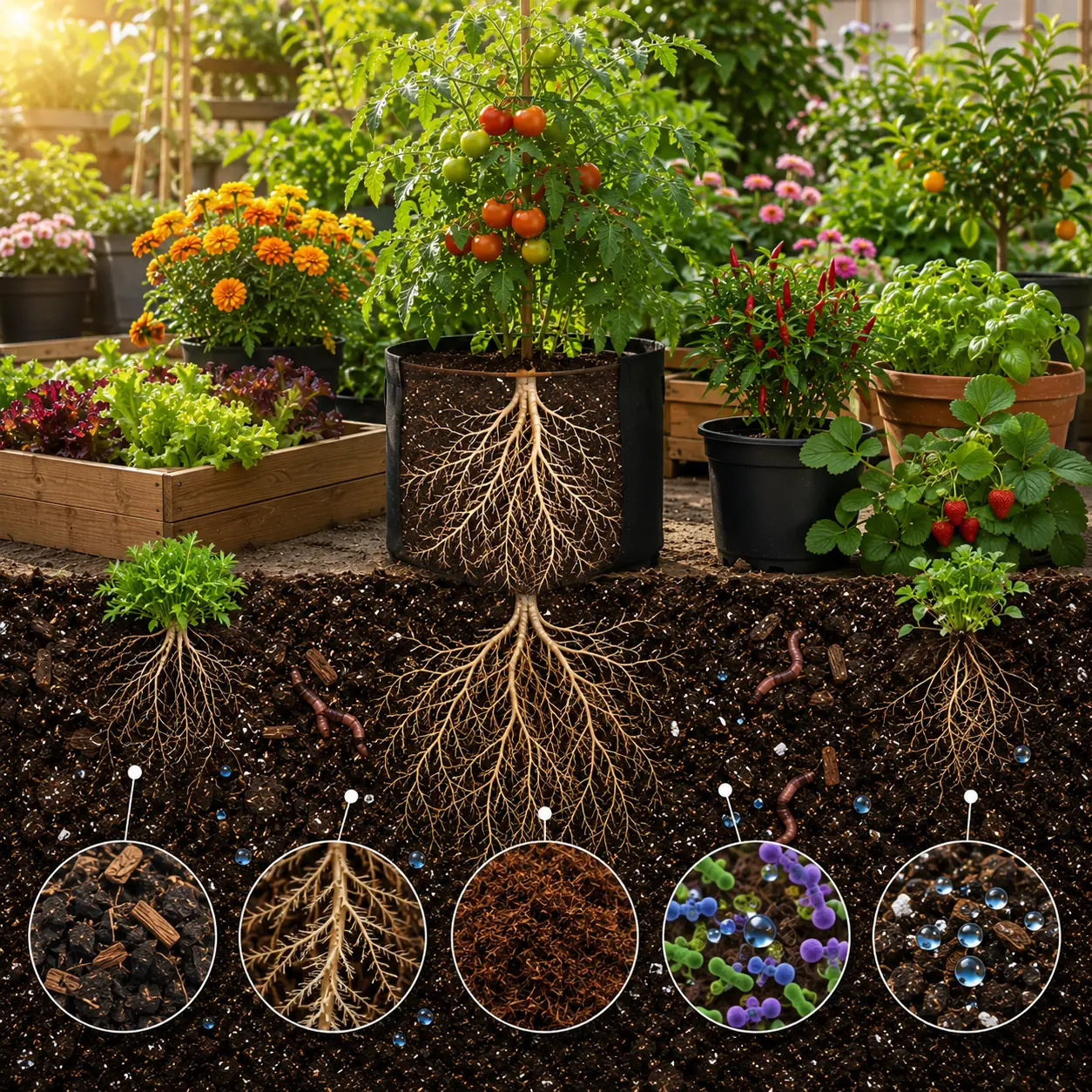
Organic Potting Soil Mix
Provides nutrients, structure, and healthy growing conditions for container plants.
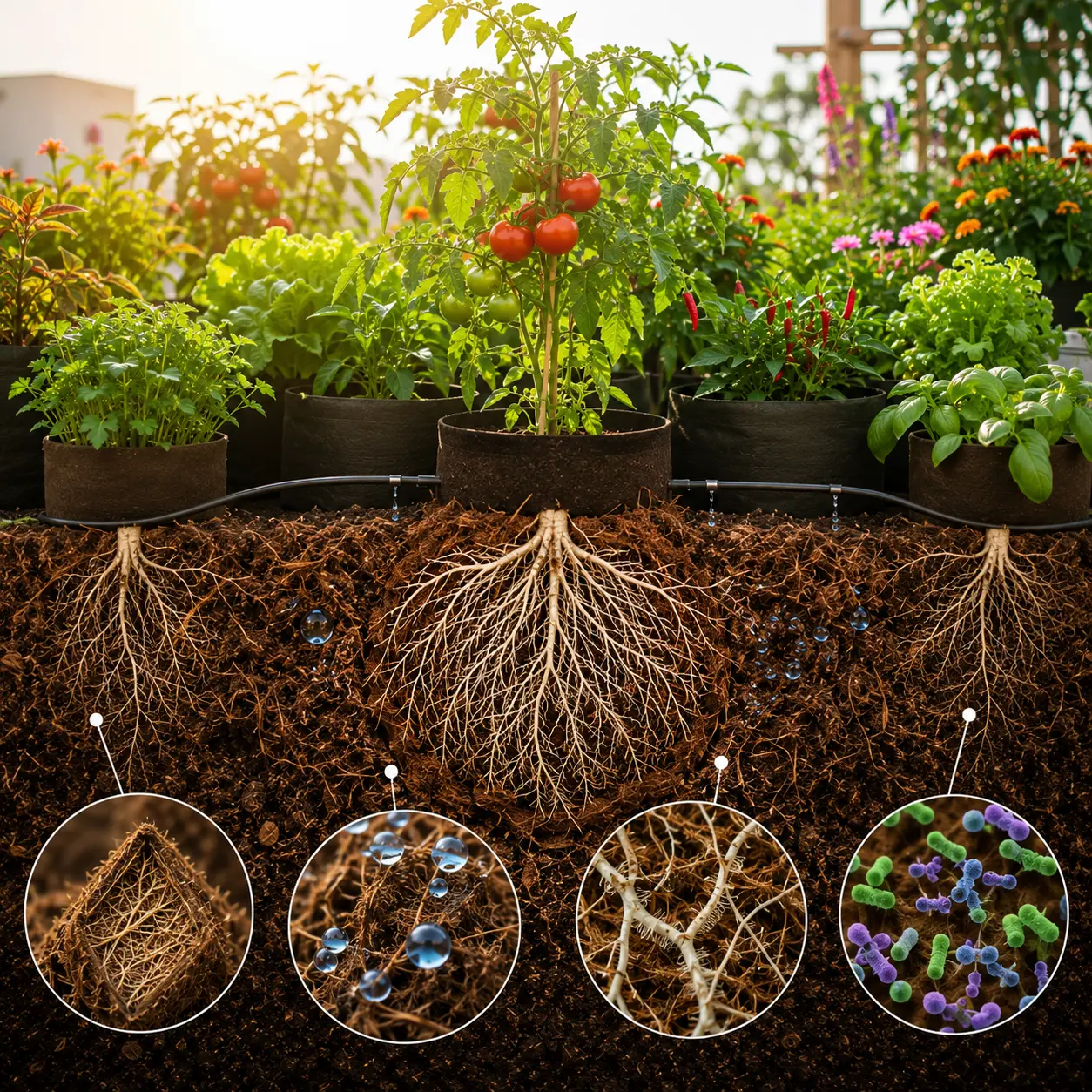
Coco Peat Growing Medium
Enhances moisture retention while maintaining excellent root-zone aeration.

Grow Bags for Plants
Improve drainage, root aeration, and vegetable production in limited spaces.

Plastic Pots for Plants
Ideal containers for seedlings, ornamentals, herbs, and balcony gardens.
Quick Variety Selector
| Variety / Species | Type | Plant Size | Best For | Suited To |
|---|---|---|---|---|
| T. cordifolia (standard) | Species (wild-type) | Large | Medicinal use, home garden | All India up to 1,200 m |
| T. cordifolia — Neem Giloy | Cultivated practice (grown on neem) | Large | Highest-potency medicinal use | All tropical India |
| T. sinensis (Padma Guduchi) | Related species | Large | Ornamental; research interest | Northeast India, Assam |
| T. crispa | Related species | Large | Not recommended for home use | Assam, Northeast India |
| Landrace / local material | Unimproved | Medium to large | General home cultivation | All India |
Varieties in Detail
Tinospora cordifolia — Standard (Wild-Type)
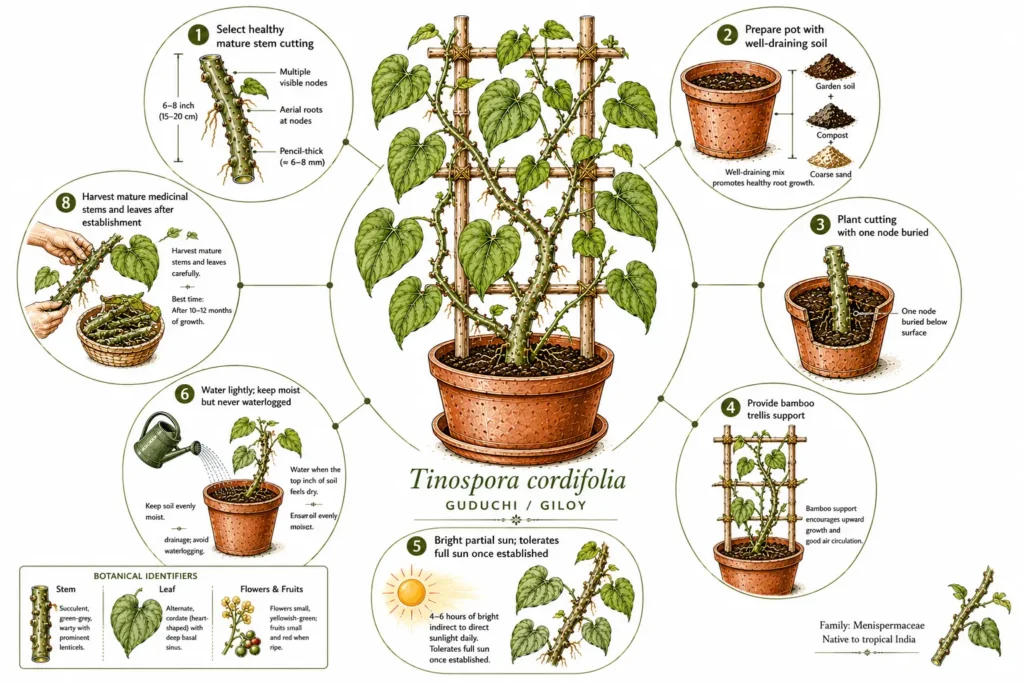
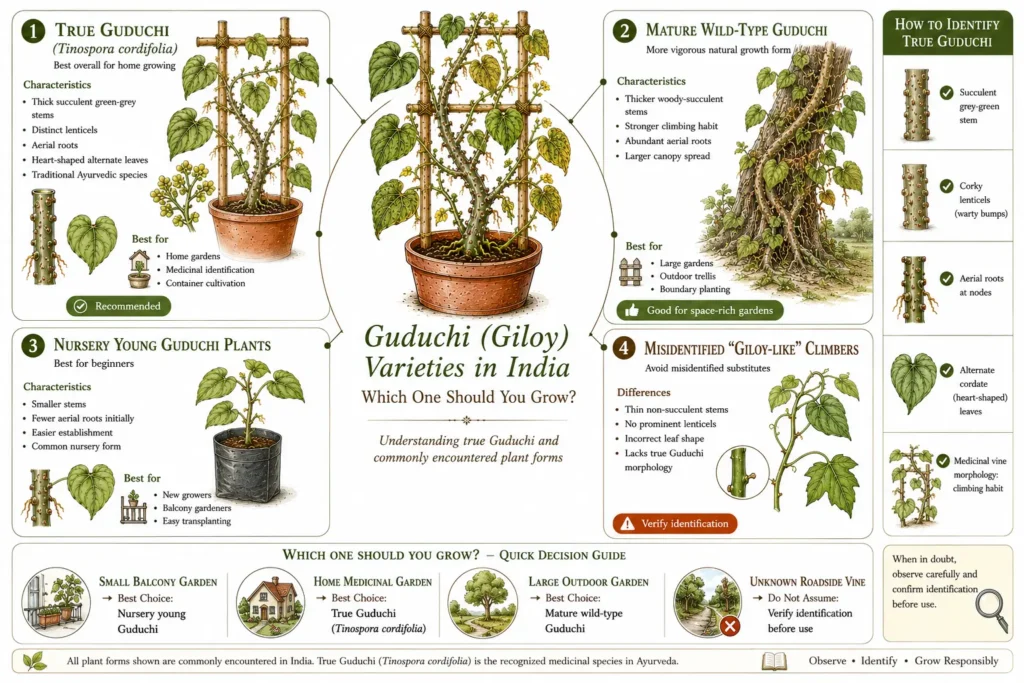
This is the authentic Guduchi of Ayurvedic texts and the species backed by the largest body of research. It is native to India and grows throughout the subcontinent. The vine has the characteristic corky, warty, pale grey-cream bark with pendulous aerial roots — features that distinguish it from related species.
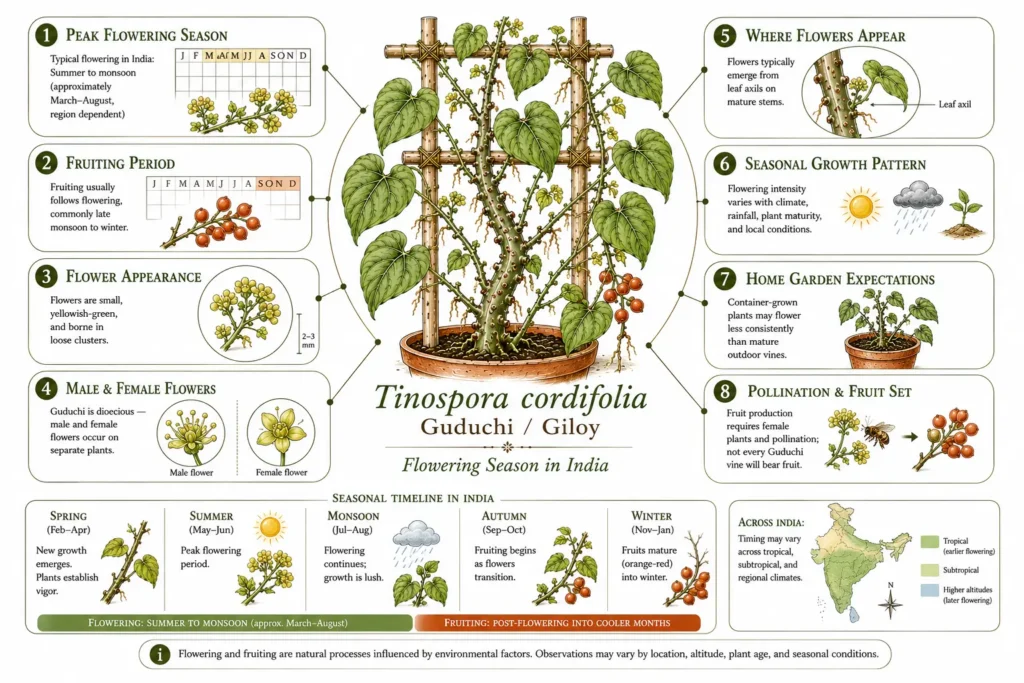
Its key strength is versatility: it grows in almost any Indian soil and climate, responds well to stem-cutting propagation, and can be started from material sourced from wild or cultivated plants. Its notable weakness is that it is dioecious — without both male and female plants nearby, berries will not set. For purely medicinal use (stem and bark), this does not matter. For seed collection or ecological planting, it does.
Propagation is entirely from stem cuttings; seed saving is possible but rarely practical for home gardeners. Standard T. cordifolia sourced from a reliable nursery or a known plant is the recommended choice for anyone growing Guduchi for household medicinal use.
Neem Giloy (T. cordifolia grown on Azadirachta indica)
Neem Giloy is not a separate species or cultivar — it is the same T. cordifolia grown with a neem tree as its host and climbing support. Ayurvedic tradition holds this to be the highest quality form of Guduchi, because the vine’s aerial roots penetrate the bark and absorb compounds from the neem tree, effectively enriching the stem’s phytochemical profile.
This is not exclusively folk belief. The rationale is phytochemically plausible — T. cordifolia is a hemi-parasite that derives compounds from its host — and Neem Giloy commands a premium in commercial Ayurvedic markets. Banyan Botanicals, one of the most reputed international Ayurvedic suppliers, specifically grows its Guduchi on neem trees in Rajasthan for this reason.
For a home gardener, producing Neem Giloy is simply a matter of planting a T. cordifolia cutting at the base of an established neem tree. No special effort; the vine does the rest. This is the single most impactful variety decision a home gardener can make.
Tinospora sinensis — Padma Guduchi / Kanda Guduchi
Tinospora sinensis is a closely related species found primarily in Northeast India, Assam, and parts of the eastern Himalayan foothills. It is known as Padma Guduchi or Kanda Guduchi in traditional texts. The leaves are notably larger and more triangular in shape than those of T. cordifolia.
Research suggests T. sinensis has some antiviral properties and is used in traditional medicine in Assam and Southeast Asia. However, it is not the species referred to in the classical Ayurvedic texts, and its phytochemical profile differs from T. cordifolia. It should not be used as a substitute for standard Guduchi in Ayurvedic preparations without specific guidance.
Home gardeners outside Northeast India are unlikely to encounter this species; it is rarely sold in nurseries in other regions.
Tinospora crispa — Giloe / Patha (caution required)
Tinospora crispa is the third species traded under the Guduchi/Giloy name in parts of India, particularly in Assam, and from some unverified commercial sources. It can be distinguished from T. cordifolia by its slightly larger, sometimes trilobed or hairy leaves and by differences in the stem surface texture.
Research has identified T. crispa as potentially hepatotoxic. Published case reviews have raised the possibility that some reported cases of liver injury attributed to Guduchi supplements may have involved T. crispa material that was mislabelled or substituted for authentic T. cordifolia.
This species is not recommended for home cultivation for medicinal use. If you are purchasing Guduchi plants and cannot verify the species, grow it first, compare with authenticated T. cordifolia images, and do not use it medicinally until you are certain of the species.
Head-to-Head Comparison
T. cordifolia vs. T. crispa — What Matters for Safety
Both species are sold as Guduchi in Indian markets and look broadly similar to the untrained eye. T. cordifolia has narrower, heart-shaped leaves with a smooth lower surface and the characteristic corky, warty stem bark. T. crispa leaves tend to be larger and occasionally trilobed or softly hairy on the underside; the stem surface may be smoother and less warty.
For medicinal use, T. cordifolia is the correct choice — it is the species referenced in all classical Ayurvedic texts and the one with the most substantial safety and efficacy research. T. crispa may have its own medicinal applications in regional traditions, but substituting it for T. cordifolia in standard preparations is not appropriate and carries a documented safety risk. In a home garden context: grow T. cordifolia, not T. crispa. The distinction is worth knowing before you plant.
Standard T. cordifolia vs. Neem Giloy
Standard T. cordifolia grown in open ground or on a neutral host (fence, bamboo trellis, mango tree) is a fully legitimate medicinal plant with good phytochemical activity. It is what the vast majority of home growers have, and it is fine. Neem Giloy is the same plant with an enhanced phytochemical profile resulting from its neem host. For a home gardener with a neem tree, growing Neem Giloy is a simple upgrade at zero additional cost. For a home gardener without a neem tree, standard T. cordifolia on any support is a good and sensible choice — do not let the absence of a neem tree deter you from growing the vine.
How to Choose for Your Space
Container or terrace garden: Standard T. cordifolia in a 20–25 litre container with a strong internal trellis or wall access. Expect a well-managed vine of 2–3 m. Focus on drainage above all else.
Small ground plot (under 100 sq ft): Plant one T. cordifolia cutting at the base of any existing tree or compound wall. Train it upward. One plant requires very little ground space — its footprint is vertical.
Larger garden or backyard: If you have a neem tree, plant Guduchi at its base and grow Neem Giloy. If not, train T. cordifolia across a pergola or compound fence. In a larger space, planting both a male and a female vine gives you the possibility of berries for seed collection and bird habitat.
Medicinal harvest focus: Standard T. cordifolia, confirmed species, grown on neem if possible. Harvest from year two onward.
Regional Suitability
North India (UP, Bihar, MP, Rajasthan): Standard T. cordifolia performs excellently. Neem trees are common, making Neem Giloy the natural choice in these states.
South India (Karnataka, Kerala, Tamil Nadu, AP, Telangana): Thrives year-round with minimal dormancy. All forms of T. cordifolia grow vigorously in the humid tropics.
Eastern India (West Bengal, Odisha, Jharkhand): The vine’s natural habitat. Wild T. cordifolia is common in these states. Home cultivation is straightforward.
Northeast India (Assam, Meghalaya, Manipur): Both T. cordifolia and T. sinensis are present. Take care to verify species if sourcing locally; T. crispa is also present in this region.
Coastal regions: High humidity and warm winters suit Guduchi well. Monitor for fungal issues during extended wet periods.
Hill stations above 1,200 m: T. cordifolia is not recommended. Below this altitude, it grows reliably.
Watch Out for Mislabelling
Mislabelling is a genuine and documented problem in the Guduchi market. T. crispa and T. sinensis are both traded under the Guduchi/Giloy name in parts of India, particularly in the northeast and in commercial herbal supplement products. Published research has explicitly flagged this as a public health concern.
For home growers, the most practical protection is to source planting material from a reputable nursery, a trusted gardener with a known plant, a Krishi Vigyan Kendra (KVK), or a government-registered medicinal plant nursery. When buying, look for the characteristic corky, warty, pale grey-cream stem bark and the clearly heart-shaped leaf with no trilobing or hairiness on the underside — these features are consistent with authentic T. cordifolia.
For commercial Guduchi products (juice, powder, tablets), look for products from AYUSH-registered manufacturers who specify the botanical name and part used on the label.
Where to Source These Varieties in India
State forest departments and Krishi Vigyan Kendras in most states maintain medicinal plant nurseries where authenticated T. cordifolia planting material is available at low cost or free of charge. These are the most reliable sources for confirmed species.
CSIR-CIMAP (Central Institute of Medicinal and Aromatic Plants) in Lucknow and its regional centres maintain authenticated Guduchi germplasm and can be a reference point for serious growers.
When purchasing from private nurseries, ask specifically for Tinospora cordifolia by scientific name, and look for the corky, warty stem as a visual verification of the species. A cutting that looks like smooth greenish vine bark without the characteristic warts and aerial roots should be questioned before planting.
Grow the right species from a confirmed source, plant it on a neem tree if you can, and Guduchi will serve your household faithfully for years — a living pharmacy that costs almost nothing to maintain.