
Mango Plant Facts: Origin, Names, and Overview for Indian Gardeners
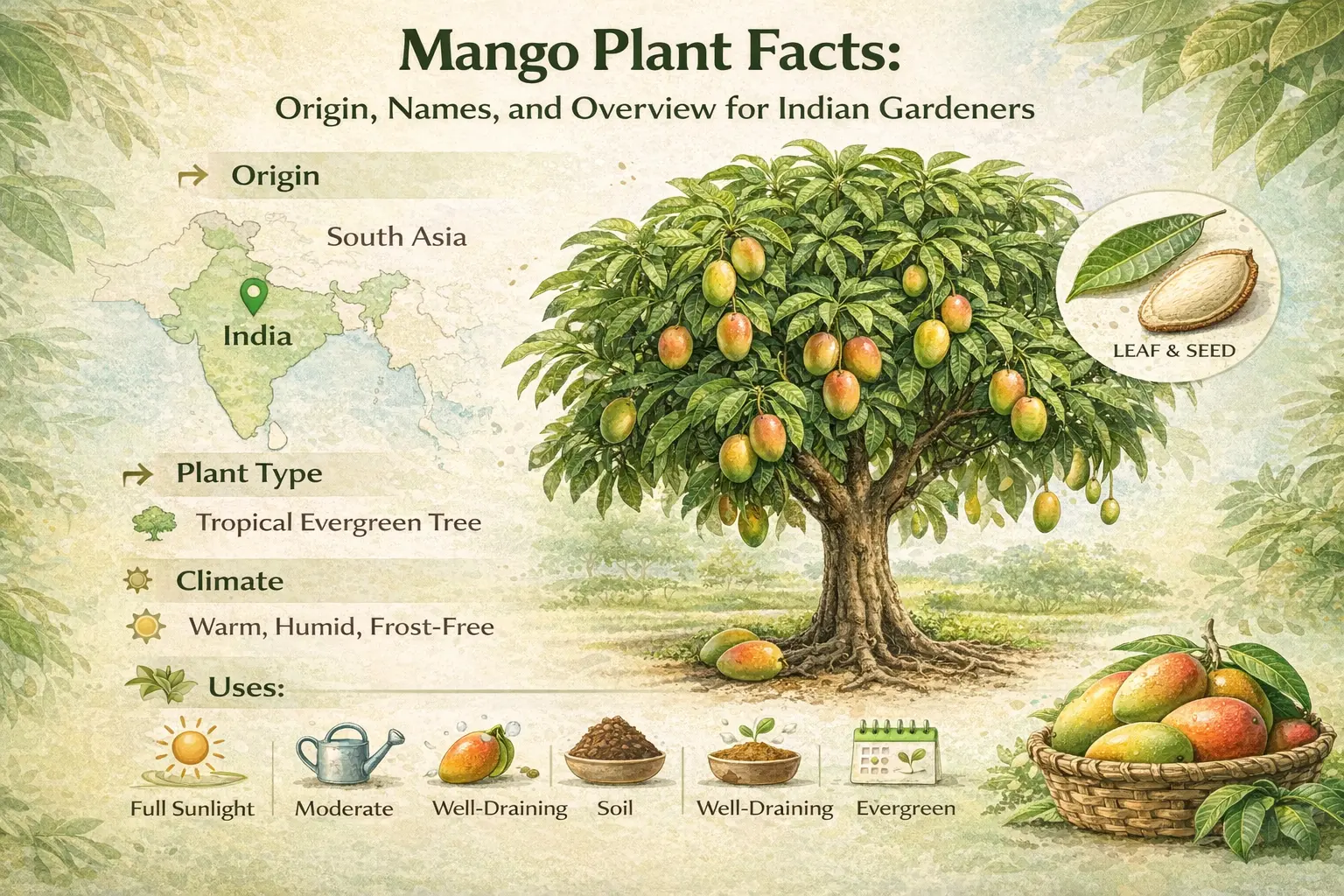
Quick Answer: Mango (Mangifera indica) is a tropical evergreen tree native to South Asia — primarily the Indian subcontinent and Myanmar — and has been cultivated in India for at least 4,000 years. It is India’s national fruit, the most widely grown fruit tree in the country, and one of the most culturally embedded plants in Indian life.
See also: Mango plant profile, how to grow it, common problems, its flowering season, and its benefits.
The word aam comes from the Sanskrit amra, and the word “mango” itself entered English through the Portuguese manga, which came from the Tamil māṅkāy — meaning unripe mango fruit. The etymology alone traces a trade history: Tamil merchants, Portuguese ships, and a fruit that moved around the world starting from India’s own coastline.
Recommended Products
Disclosure: As an Amazon Associate, PlantsInfo may earn from qualifying purchases.
🌱 Growing Essentials
The following products can help with container gardening, potting, root development, soil management, and healthy plant growth.
Organic Potting Soil Mix
Provides nutrients, structure, and healthy growing conditions for container plants.
Coco Peat Growing Medium
Enhances moisture retention while maintaining excellent root-zone aeration.

Grow Bags for Plants
Improve drainage, root aeration, and vegetable production in limited spaces.

Plastic Pots for Plants
Ideal containers for seedlings, ornamentals, herbs, and balcony gardens.
Plant at a Glance
| Feature | Detail |
|---|---|
| Scientific name | Mangifera indica L. |
| Family | Anacardiaceae |
| Origin | South Asia — Indian subcontinent and Myanmar |
| Plant type | Tropical evergreen fruit tree |
| Lifespan | 100–300+ years; commercially productive for 40–60 years |
| Height | 10–40 m (seedling); 4–8 m (grafted varieties) |
| Canopy spread | Up to 10 m in mature specimens |
| Flower colour | Pale yellow-green to pink, in large panicles |
| Fruit colour | Green, yellow, orange, red — variety-dependent |
| Root system | Deep taproot with wide lateral spread |
| Toxicity | Sap and bark can cause contact dermatitis in sensitive individuals |
Regional Names in India
Mango is perhaps the plant most uniformly known and loved across all of India’s linguistic regions — yet every language has its own name:
- Hindi / Urdu: Aam
- Bengali: Aam (আম)
- Tamil: Maa, Maanga (māṅkāy for raw fruit)
- Telugu: Mamidi, Māvidi
- Kannada: Mavu, Mavina Hannu
- Marathi: Amba, Aamba
- Malayalam: Manga, Maavu
- Gujarati: Keri, Ambo
- Punjabi: Amba, Amb
- Odia: Amba
- Sanskrit: Amra, Sahakara, Madhuduta (“messenger of spring”)
The Sanskrit name Sahakara — meaning “the helpful one” or “that which cooperates” — hints at the mango’s central role in Indian agricultural and cultural life for millennia.
Where Does It Grow in India?
Mango is cultivated commercially in virtually every Indian state below an altitude of 600 metres. The five largest producing states are Uttar Pradesh, Andhra Pradesh, Karnataka, Bihar, and Gujarat, which together account for the majority of India’s total mango output — the largest in the world [verify before publishing].
Uttar Pradesh (Malihabad, Lucknow) is the heartland of north Indian varieties: Dasheri, Langra, Chausa, and Safeda.
Maharashtra (Ratnagiri, Sindhudurg, Devgad) produces Alphonso (Hapus), considered by many the finest mango in the world and protected under a Geographical Indication.
Andhra Pradesh and Telangana are known for Banganapalli (Safeda), Imam Pasand, and Suvarnarekha.
Karnataka produces Alphonso in coastal districts and Badami (the local name for Alphonso) in the Dharwad region.
Gujarat (Gir Somnath, Junagadh) produces Kesar, another GI-tagged variety with a distinctive saffron-coloured pulp.
At altitudes above 600 m — parts of Himachal Pradesh, Uttarakhand, the northeastern hills — mango cultivation is limited or absent, as the tree cannot tolerate sustained frost.
How Many Varieties Exist?
India alone has over 1,000 named mango varieties, of which roughly 30–40 are of significant commercial importance. The total number of named varieties worldwide exceeds 500 [verify before publishing].
Some of the most significant Indian varieties and their regions:
- Alphonso / Hapus — Konkan coast (GI protected)
- Dasheri — Malihabad, UP
- Langra — Varanasi, UP / West Bengal
- Kesar — Gir, Gujarat (GI protected)
- Banganapalli / Safeda — Andhra Pradesh (GI protected)
- Chausa — UP / Bihar
- Amrapali — Hybrid; widely grown; suitable for containers
- Mallika — Hybrid; compact; suitable for containers
- Totapuri — South India; used extensively for pulp and pickles
What Does It Look Like?
The mango tree is a large, spreading evergreen with a dense, dark green canopy. Leaves are lance-shaped, 25–30 cm long, and emerge as a striking copper-red or purplish-red flush before maturing to glossy deep green.
In December–February, the tree produces large conical flower clusters (panicles) holding hundreds of tiny pale yellow-green flowers. The fragrance is faint and sweet, attractive to bees and flies that are the primary pollinators.
The fruit’s appearance varies dramatically by variety — from the small, kidney-shaped Chausa to the large, rounded Alphonso; from pale green Langra to deep red-blushed Kesar. What all have in common is the distinctive kidney or oval shape and a single large, flat seed inside.
What Is It Used For?
The mango is used in every stage of development — raw, ripe, dried, and processed — across Indian cuisine, medicine, and ritual.
Raw fruit: pickles (achaar), aam panna, kachumber, amchur powder, kairi dal.
Ripe fruit: fresh eating, juice, aamras, kulfi, lassi, murabba, dried fruit leather (aampapad).
Leaves: ceremonial use, cooking wraps in South India, and traditional medicine.
Seed kernel: amrabeeja preparations in Ayurveda; mango butter extraction for cosmetics.
Is It Easy to Grow?
Moderate in difficulty — primarily because of the long wait for fruit and the importance of choosing the right grafted variety from the start.
A grafted sapling planted in good conditions with reasonable care will fruit reliably in 3–5 years. After that, a mango tree largely manages itself, needing only seasonal care rather than constant attention.
⚠ Sap caution: The milky sap of mango stems, bark, and unripe fruit skin contains urushiol-related compounds. Direct skin contact can cause redness, itching, and blistering in sensitive individuals — a reaction sometimes confused with a fruit allergy. The ripe flesh itself does not contain these compounds.
⚠ Commonly confused with: Mangifera sylvatica (wild mango) and other Mangifera species are sometimes called “mango” in northeastern India and Southeast Asia, but produce very different, usually inedible fruit.
Frequently Asked Questions
What is India’s national fruit?
Mango (Mangifera indica) — officially designated India’s national fruit, a status reflecting both its economic importance and cultural significance.
How long does a mango tree live?
Mango trees are extraordinarily long-lived. Several specimens in India are documented at over 300 years old and still producing fruit. Commercially managed orchards are typically replanted every 40–60 years for productivity reasons, not because the tree dies.
Can a mango grow from a seed?
Yes, but only polyembryonic varieties will produce a plant true to the parent. Most commercial Indian varieties are monoembryonic — seed-grown trees will not replicate the parent’s fruit quality and will take 8–12 years to fruit. Always buy a grafted sapling.
Conclusion
The mango is far more than a fruit tree—it is a symbol of India’s agricultural heritage, cultural traditions, and tropical biodiversity. From its ancient origins in South Asia to its worldwide cultivation today, Mangifera indica continues to play an important role in food, horticulture, and everyday life.


