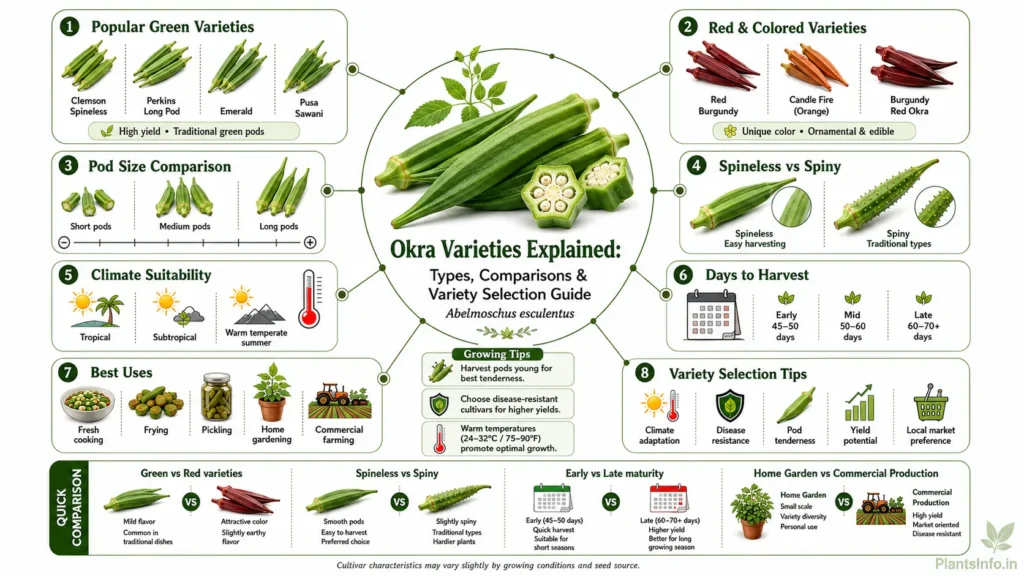
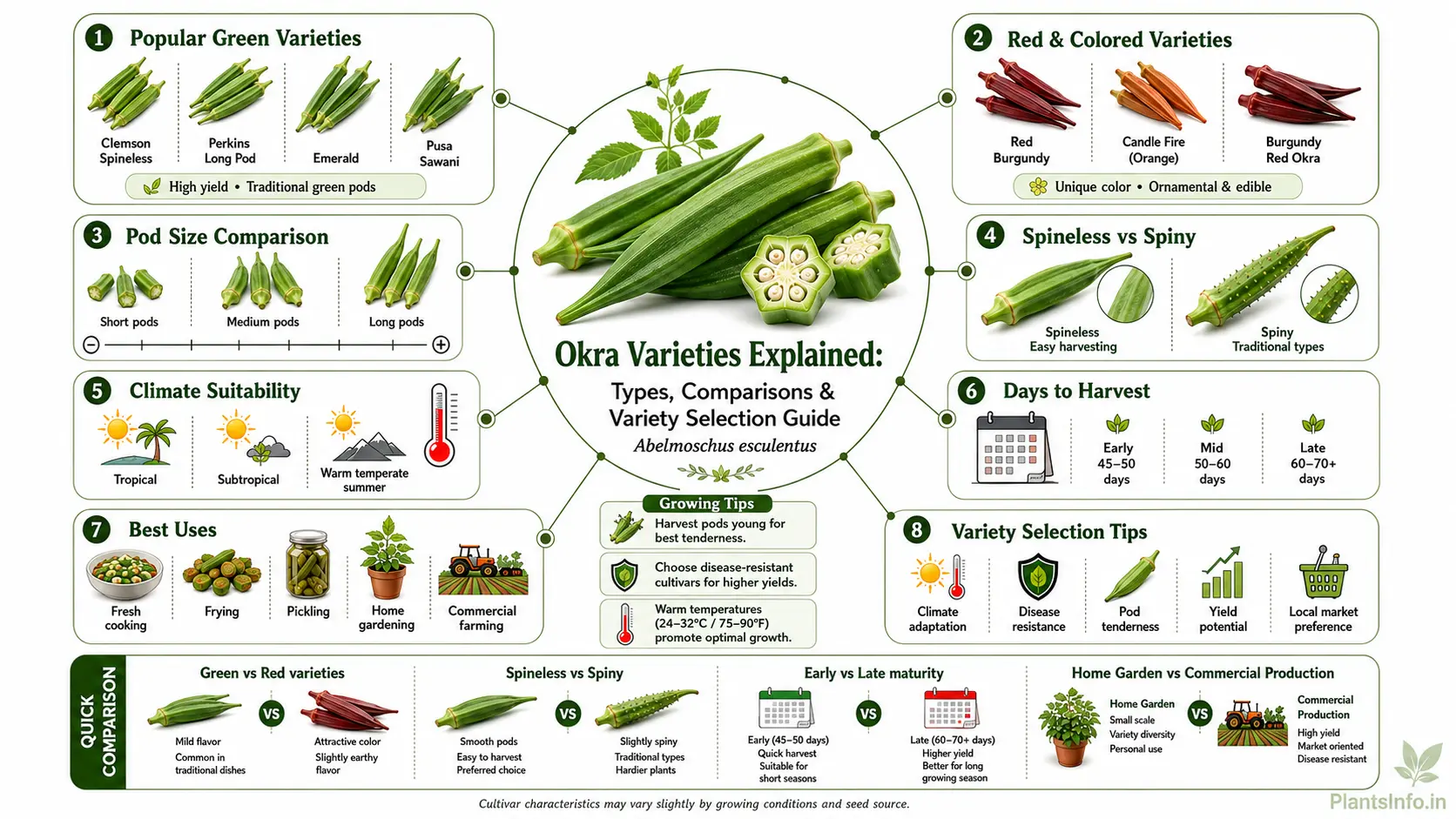
Okra Varieties Explained: Types, Comparisons & Variety Selection Guide
Introduction
| Feature | Information |
|---|---|
| Plant Species | Abelmoschus esculentus |
| Primary Purpose | Fresh vegetable production |
| Variety Diversity | Hundreds of cultivars grown worldwide |
| Major Breeding Goals | Higher yield, earlier maturity, improved pod quality, disease resistance, heat tolerance, and uniform production |
| Main Users | Home gardeners, commercial growers, seed producers, and researchers |
| Guide Focus | Variety selection and comparison only |
Although all okra varieties produce edible pods, they have been developed to meet different production goals. Some mature quickly in short growing seasons, while others prioritize high yields, extended harvest periods, disease resistance, or improved pod quality for commercial markets.
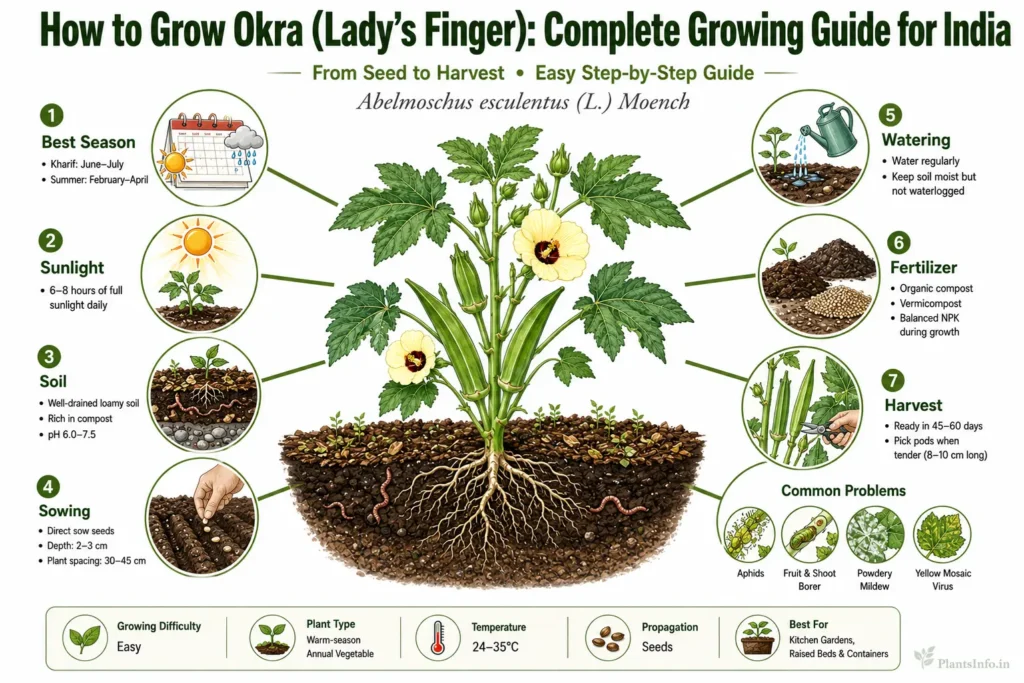
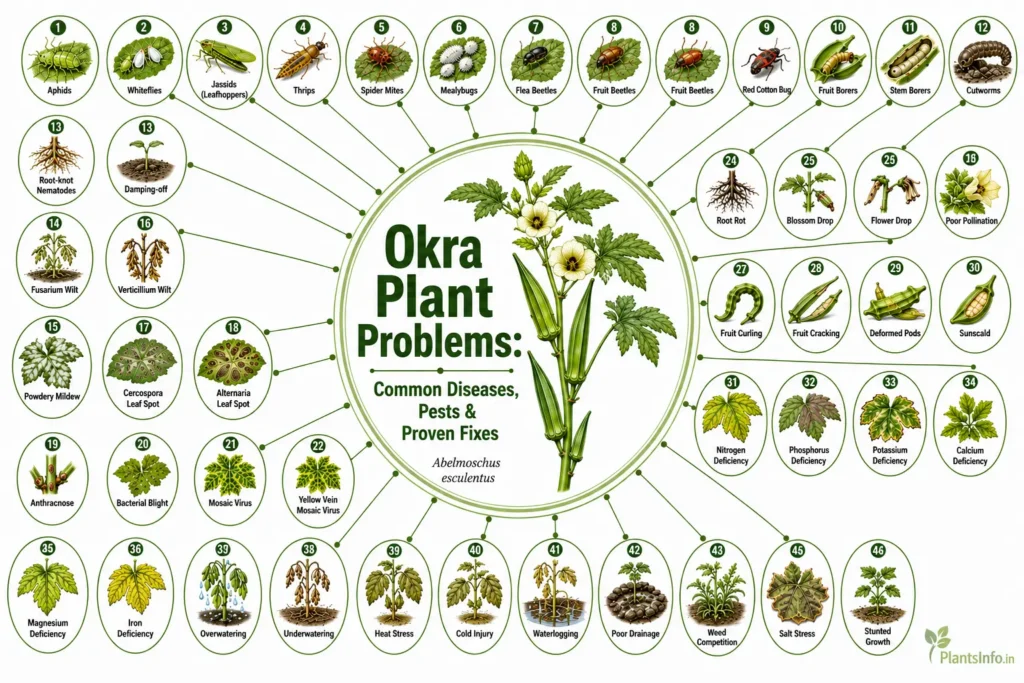
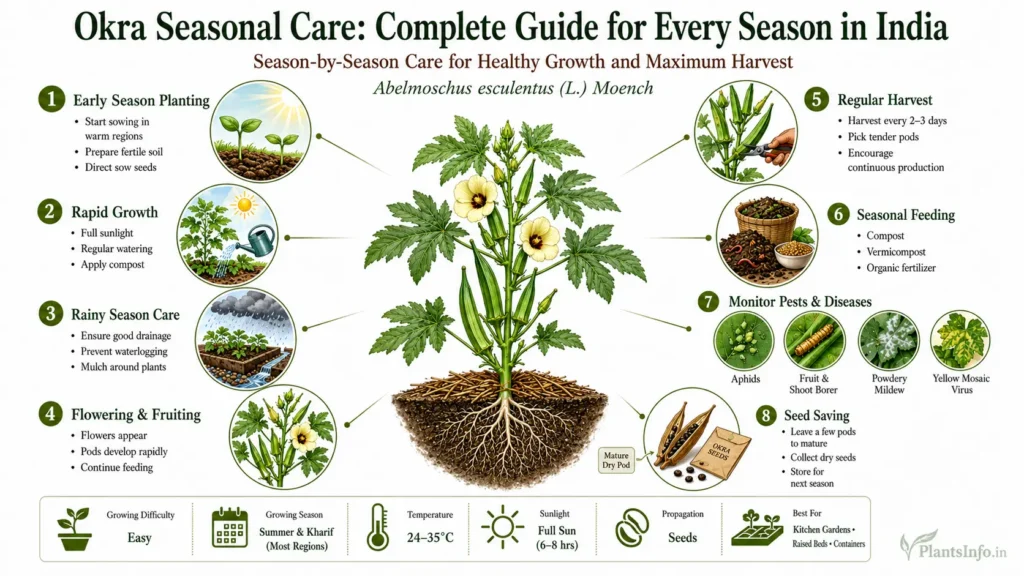
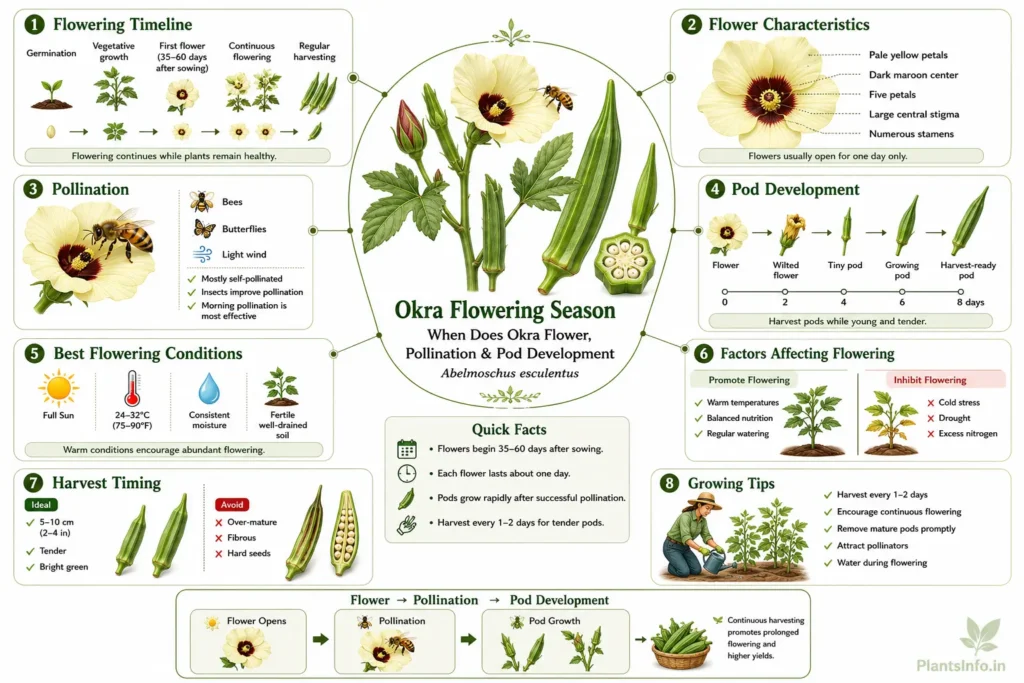
See also: Okra plant profile, how to grow it, common problems, seasonal care, and its flowering season.
Modern breeding programmes have also introduced hybrids with improved vigour, more uniform growth, and greater tolerance to common production challenges. At the same time, wide traditional open-pollinated varieties remain popular because they allow gardeners to save seed and often perform reliably under local growing conditions.
Recommended Products
Disclosure: As an Amazon Associate, PlantsInfo may earn from qualifying purchases.
🌱 Growing Essentials
The following products can help with container gardening, potting, root development, soil management, and healthy plant growth.
Organic Potting Soil Mix
Provides nutrients, structure, and healthy growing conditions for container plants.
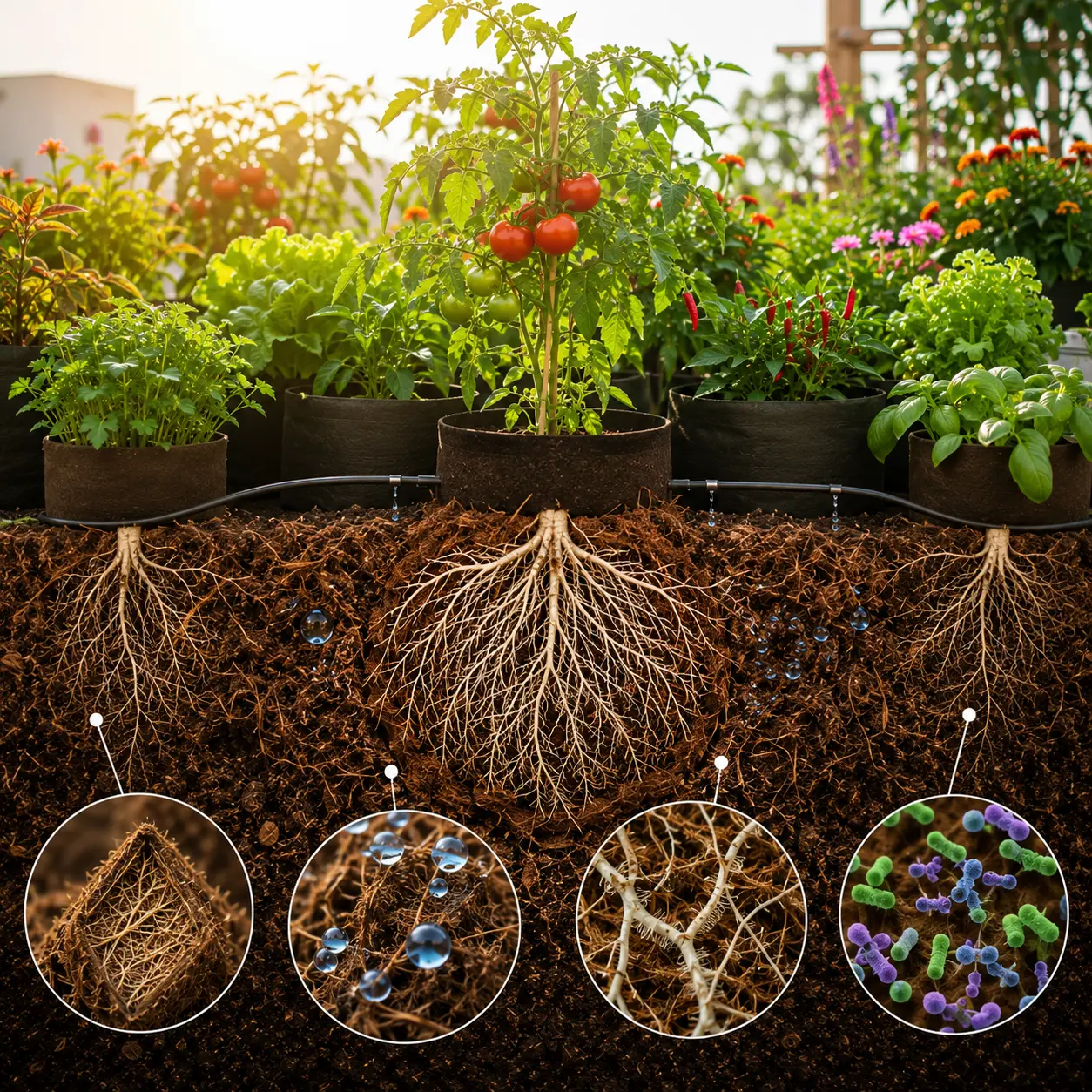
Coco Peat Growing Medium
Enhances moisture retention while maintaining excellent root-zone aeration.

Grow Bags for Plants
Improve drainage, root aeration, and vegetable production in limited spaces.

Plastic Pots for Plants
Ideal containers for seedlings, ornamentals, herbs, and balcony gardens.
Rather than asking which variety is the “best,” growers should select cultivars that best match their climate, production objectives, and preferred pod characteristics.
Variety Classification
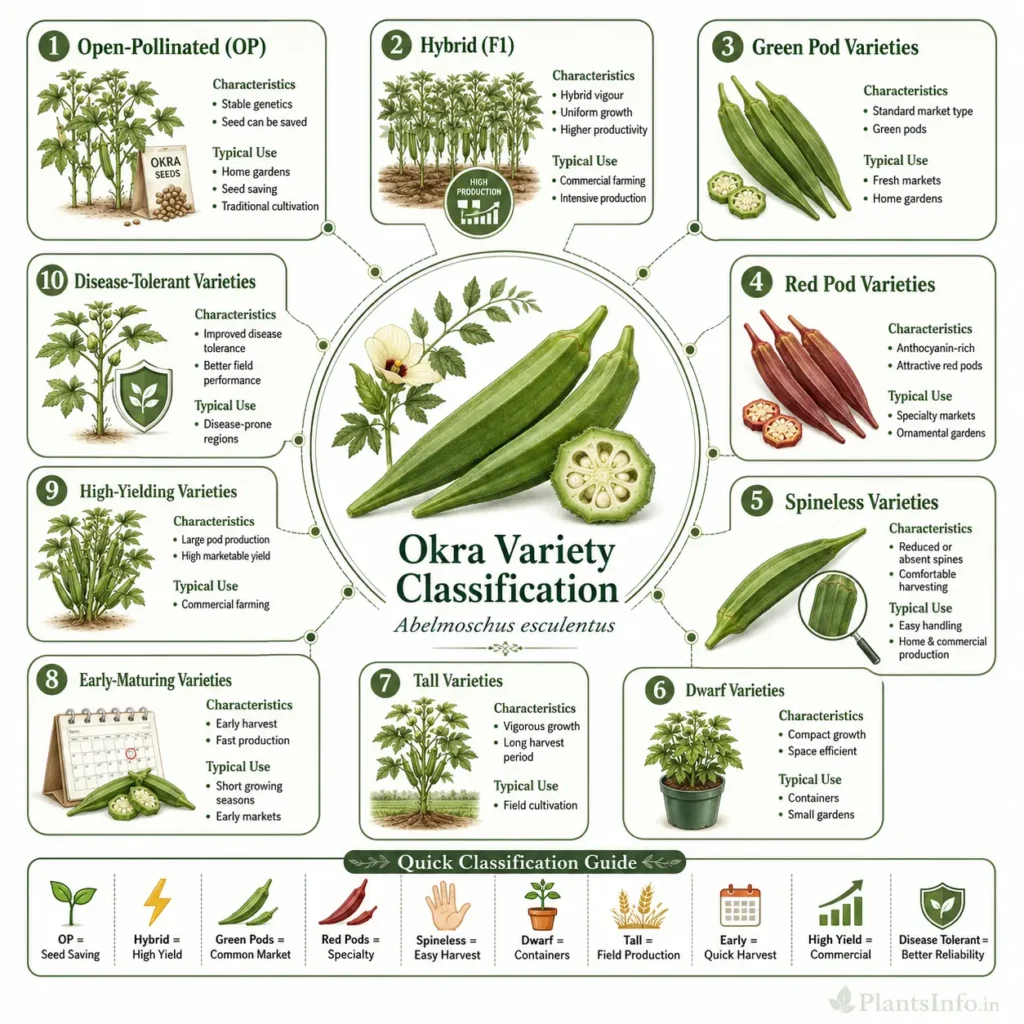
| Variety Group | Primary Characteristics | Typical Use |
|---|---|---|
| Open-Pollinated (OP) | Stable genetics, seed can be saved | Home gardens, seed saving, traditional cultivation |
| Hybrid (F1) | Uniform growth, hybrid vigour, higher productivity | Commercial farming and intensive production |
| Green Pod Varieties | Standard market type with green pods | Fresh markets and home gardens |
| Red Pod Varieties | Red or burgundy pods containing anthocyanins | Specialty markets and ornamental gardens |
| Spineless Varieties | Reduced or absent stem and pod spines | Easier harvesting and handling |
| Dwarf Varieties | Compact plants requiring less space | Containers and small gardens |
| Tall Varieties | Vigorous plants with longer harvest periods | Field cultivation |
| Early-Maturing Varieties | Begin harvesting sooner | Short growing seasons and early markets |
| High-Yielding Varieties | Produce large numbers of marketable pods | Commercial production |
| Disease-Tolerant Varieties | Improved tolerance to selected diseases | Regions with recurring disease pressure |
Okra varieties are generally classified according to their breeding method, plant growth habit, pod characteristics, and intended production system. These categories often overlap. For example, a single cultivar may be both a hybrid and spineless, or both open-pollinated and early-maturing.
Understanding these classifications makes it easier to compare cultivars and select varieties suited to specific growing conditions and production goals.
Variety Comparison Table
| Characteristic | Open-Pollinated | Hybrid (F1) |
|---|---|---|
| Seed Saving | Yes | No (does not grow true-to-type) |
| Genetic Uniformity | Moderate | High |
| Yield Potential | Moderate to high | Generally higher |
| Plant Uniformity | Variable | Very consistent |
| Pod Uniformity | Moderate | Excellent |
| Disease Tolerance | Varies by cultivar | Often improved through breeding |
| Seed Cost | Lower | Higher |
| Best For | Home gardens, seed conservation | Commercial production |
| Long-Term Cost | Lower | Higher because new seed is purchased each season |
| Popularity | Traditional farming and home gardening | Commercial vegetable production |
Neither open-pollinated nor hybrid varieties are universally superior. Open-pollinated cultivars offer flexibility and allow seed saving, while hybrids are bred to maximise uniformity, productivity, and market quality. The best choice depends on the grower’s objectives rather than the breeding method alone.
Open-Pollinated vs Hybrid Varieties
| Feature | Open-Pollinated | Hybrid |
|---|---|---|
| Breeding Method | Naturally stable through repeated selection | Produced by crossing selected parent lines |
| Seed Viability | Suitable for saving and replanting | New seed required each season |
| Genetic Diversity | Greater | More uniform |
| Yield Stability | Good under diverse conditions | Often higher under favourable management |
| Pod Consistency | Moderate | Excellent |
| Cost | Generally lower | Usually higher |
| Suitable For | Home gardeners, traditional farming, conservation | Commercial production, uniform harvests |
Open-Pollinated Varieties
Open-pollinated (OP) varieties reproduce true-to-type when isolated from other compatible cultivars. This allows growers to collect seed from healthy plants and maintain the variety over successive generations.
Many traditional cultivars grown throughout India belong to this category. They are valued for their adaptability, lower seed cost, and ability to perform reliably across a wide range of environments. Their greater genetic diversity may also provide resilience under variable growing conditions.
Open-pollinated varieties are particularly suitable for home gardeners, community seed-saving programmes, and growers interested in preserving locally adapted cultivars.
Hybrid Varieties
Hybrid (F1) varieties are produced by crossing carefully selected parent lines to combine desirable characteristics such as higher yield, improved uniformity, earlier maturity, or enhanced disease tolerance.
Hybrid plants typically exhibit strong vigour and produce more consistent pods, making them popular with commercial vegetable producers supplying fresh markets.
However, seed collected from hybrid plants does not reliably reproduce the same characteristics in the next generation. For this reason, growers normally purchase fresh certified seed for each planting season.
Neither breeding method guarantees superior performance. Environmental conditions, cultivar selection, and crop management all influence productivity.
Green Pod Varieties
| Characteristic | Description |
|---|---|
| Pod Colour | Medium green to dark green |
| Market Demand | Highest worldwide |
| Common Use | Fresh vegetables, processing, freezing, and home cooking |
| Availability | Most widely available |
| Yield Potential | Varies by cultivar |
| Suitable For | Home gardens and commercial production |
Green-podded okra varieties dominate commercial production because they meet consumer preferences in most markets and are available in a wide range of plant types, maturity periods, and production systems.
These cultivars include both traditional open-pollinated lines and modern hybrids developed for improved yield, pod quality, and disease tolerance.
Common Characteristics
| Feature | Typical Characteristics |
|---|---|
| Pod Texture | Smooth to lightly ridged |
| Pod Length | Varies by cultivar |
| Plant Height | Compact to tall |
| Harvest Period | Short or extended depending on cultivar |
| Culinary Uses | Suitable for curries, stir-fries, soups, stews, freezing, and processing |
Green pod varieties are available in almost every major breeding category, including spineless, dwarf, early-maturing, and high-yielding cultivars. Because of this diversity, growers should compare individual cultivars rather than assuming all green varieties perform similarly.
Advantages
| Advantage | Benefit |
|---|---|
| Broad market acceptance | High consumer demand |
| Extensive cultivar choice | Suitable for diverse climates and production systems |
| Available as OP and hybrid | Greater flexibility for growers |
| Widely adapted | Performs well across tropical and subtropical regions |
| Suitable for fresh and processed markets | Supports multiple production objectives |
Green pod varieties remain the benchmark for both home gardeners and commercial producers because they combine proven performance with the widest selection of cultivars. Individual variety recommendations, including high-yielding, spineless, red-podded, dwarf, and region-specific cultivars, are covered in the following sections of this guide.
Red Pod Varieties
| Characteristic | Description |
|---|---|
| Pod Colour | Red, burgundy, or deep purple-red |
| Pigment | Anthocyanins in the pod skin |
| Market Type | Specialty and premium fresh markets |
| Culinary Use | Similar to green okra |
| Colour After Cooking | Often fades to green or olive during cooking |
| Suitable For | Home gardens, specialty growers, edible landscapes, and niche markets |
Red-podded okra varieties are distinguished by their striking pod colour, which results from naturally occurring anthocyanin pigments. Although less common than green varieties, they have become increasingly popular among home gardeners and specialty vegetable growers because of their ornamental appeal and market value.
In terms of cultivation and culinary use, red pod varieties are generally similar to green cultivars. They are harvested while young and tender and can be prepared using the same cooking methods. However, the attractive red colour often fades during cooking, making these varieties especially appealing for fresh harvest displays and ornamental kitchen gardens.
Common Characteristics
| Feature | Typical Characteristics |
|---|---|
| Plant Height | Medium to tall, depending on cultivar |
| Pod Shape | Cylindrical or slightly tapered |
| Pod Tenderness | Comparable to green varieties when harvested young |
| Harvest Period | Similar to green cultivars |
| Seed Availability | Available as both open-pollinated and hybrid cultivars |
Advantages
| Advantage | Benefit |
|---|---|
| Attractive appearance | Adds ornamental value to vegetable gardens |
| Premium market appeal | Often sold as a specialty vegetable |
| Rich anthocyanin pigmentation | Distinctive visual characteristic |
| Suitable for edible landscaping | Combines decorative and productive qualities |
| Culinary versatility | Prepared similarly to standard green okra |
Red pod varieties are an excellent choice for gardeners seeking visual interest without sacrificing productivity. However, availability is generally more limited than for standard green cultivars.
Dwarf & Container Varieties
| Characteristic | Description |
|---|---|
| Growth Habit | Compact and bushy |
| Typical Height | Approximately 60–100 cm (varies by cultivar) |
| Best Growing System | Containers, raised beds, balconies, patios, and small gardens |
| Harvest Period | Generally earlier than many tall cultivars |
| Space Requirement | Lower than standard field varieties |
| Suitable For | Urban gardening and limited growing spaces |
Compact okra varieties have been developed for gardeners with limited growing space. Their shorter stature makes them easier to manage while still producing regular harvests under suitable growing conditions.
Although dwarf cultivars produce fewer pods per individual plant than vigorous tall varieties, their compact growth allows more plants to be grown in small areas, partially offsetting lower per-plant production.
Characteristics
| Feature | Typical Characteristics |
|---|---|
| Plant Size | Compact |
| Branching | Moderate |
| Pod Production | Consistent under suitable conditions |
| Harvesting | Easy because of reduced plant height |
| Maintenance | Convenient for small-space gardening |
Advantages
| Advantage | Benefit |
|---|---|
| Space efficient | Ideal for balconies and patios |
| Easier harvesting | Pods remain within comfortable reach |
| Suitable for containers | Performs well in appropriately sized containers |
| Better accessibility | Useful for gardeners with limited mobility |
| Attractive appearance | Fits well into edible landscape designs |
Dwarf varieties are recommended for gardeners prioritising efficient use of space rather than maximum field production.
Spineless Varieties
| Characteristic | Description |
|---|---|
| Defining Feature | Reduced or absent spines on pods and stems |
| Harvest Comfort | Improved compared with traditional varieties |
| Market Use | Fresh market and home gardening |
| Availability | Open-pollinated and hybrid cultivars |
| Suitable For | Frequent harvesting and commercial production |
Some traditional okra varieties possess small hairs or spines that may cause skin irritation during harvesting. Spineless cultivars have been developed to minimise this characteristic, making harvesting more comfortable and efficient.
The absence of spines does not significantly affect pod quality or culinary use. Instead, it improves harvesting efficiency, particularly where frequent picking is required.
Characteristics
| Feature | Typical Characteristics |
|---|---|
| Pod Surface | Smooth or nearly smooth |
| Harvesting | Easier and more comfortable |
| Plant Vigour | Comparable to standard varieties |
| Pod Quality | Similar to conventional cultivars |
| Yield | Depends on individual cultivar |
Advantages
| Advantage | Benefit |
|---|---|
| Comfortable harvesting | Reduces skin irritation |
| Faster picking | Improves labour efficiency |
| Better handling | Easier during grading and packing |
| Popular with home gardeners | More pleasant for regular harvesting |
| Commercial suitability | Supports repeated harvests throughout the season |
Spineless varieties are particularly valuable where harvesting occurs every few days, as is typical in commercial and home production.
High-Yielding Varieties
| Characteristic | Description |
|---|---|
| Primary Goal | Maximum marketable pod production |
| Common Type | Mostly hybrid cultivars, although some OP varieties are also productive |
| Harvest Duration | Often extended |
| Pod Quality | Uniform size and appearance |
| Suitable For | Commercial farming and intensive production |
High-yielding cultivars have been bred to maximise the production of marketable pods while maintaining acceptable pod quality and plant vigour.
Yield potential depends not only on genetics but also on environmental conditions, crop management, and growing season length. Therefore, no single variety consistently outperforms all others across every region.
Characteristics
| Feature | Typical Characteristics |
|---|---|
| Plant Vigour | Strong |
| Flower Production | Abundant |
| Pod Set | High |
| Harvest Uniformity | Good to excellent |
| Commercial Quality | High |
Advantages
| Advantage | Benefit |
|---|---|
| Increased productivity | Higher potential harvest |
| Uniform pods | Preferred by wholesale markets |
| Extended harvesting | Supports continuous production |
| Better market consistency | Easier grading and marketing |
| Suitable for commercial cultivation | Reliable under appropriate management |
When selecting a high-yielding variety, growers should also consider maturity period, disease tolerance, market requirements, and regional adaptability rather than focusing solely on total yield.
Disease-Resistant Varieties
| Characteristic | Description |
|---|---|
| Breeding Objective | Improved tolerance or resistance to important diseases |
| Resistance Level | Varies among cultivars |
| Common Targets | Yellow vein mosaic virus, powdery mildew, Cercospora leaf spot, and Fusarium wilt |
| Best Use | Areas with recurring disease pressure |
| Important Note | Resistance reduces risk but does not guarantee immunity |
Plant breeders have developed okra cultivars with improved resistance or tolerance to several economically important diseases. These varieties can reduce crop losses but should be considered one component of an integrated production system rather than a complete solution.
Resistance levels differ between cultivars and may vary under different environmental conditions or disease pressures.
Benefits
| Benefit | Explanation |
|---|---|
| Lower disease losses | Reduces the impact of common diseases |
| Improved productivity | Healthier plants often maintain production longer |
| Greater production stability | Particularly valuable in disease-prone regions |
| Reduced crop risk | Helps improve harvest reliability |
| Supports integrated management | Complements good cultural and sanitation practices |
Because pathogens evolve, growers should select resistant cultivars recommended for their region and regularly review updated recommendations from agricultural research institutions.
Climate & Regional Suitability (India-Focused)
| Region | Recommended Variety Characteristics | Production Priorities |
|---|---|---|
| Northern Plains | Early-maturing, heat-tolerant, disease-resistant | Maximise production during the warm growing season |
| Southern India | Heat- and humidity-tolerant, extended-harvest cultivars | Continuous harvesting and disease tolerance |
| Western India | Heat- and drought-tolerant varieties | Reliable production under high temperatures |
| Eastern India | Disease-tolerant and humidity-adapted cultivars | Performance under high rainfall and humidity |
| Central India | High-yielding, broadly adapted cultivars | Stable production across variable conditions |
| Hills and Plateau Regions | Early-maturing varieties suited to shorter warm seasons | Reliable crop establishment and harvest |
Although okra is widely cultivated throughout India, regional differences in temperature, humidity, rainfall, and disease pressure influence variety performance. Selecting cultivars adapted to local conditions generally improves productivity and harvest quality.
Northern India
| Characteristic | Recommendation |
|---|---|
| Growing Season | Warm spring to autumn |
| Preferred Traits | Early maturity, heat tolerance, disease resistance |
| Suitable Types | Open-pollinated and hybrid cultivars |
In northern states, varieties capable of rapid establishment and reliable production during the warmer months are generally preferred.
Southern India
| Characteristic | Recommendation |
|---|---|
| Climate | Warm to hot for much of the year |
| Preferred Traits | Heat tolerance, humidity tolerance, extended harvest period |
| Suitable Types | Hybrid and improved open-pollinated cultivars |
Long growing seasons allow repeated harvesting, making varieties with sustained productivity especially valuable.
Western India
| Characteristic | Recommendation |
|---|---|
| Climate | Hot and comparatively dry in many areas |
| Preferred Traits | Heat tolerance and efficient performance under moisture stress |
| Suitable Types | Heat-adapted cultivars |
Varieties capable of maintaining pod quality under prolonged high temperatures are often preferred.
Eastern India
| Characteristic | Recommendation |
|---|---|
| Climate | Warm, humid, and high rainfall |
| Preferred Traits | Disease tolerance and vigorous growth |
| Suitable Types | Cultivars adapted to humid conditions |
Because prolonged humidity can favour disease development, growers often prioritise cultivars with improved tolerance to common regional diseases.
Central India
| Characteristic | Recommendation |
|---|---|
| Climate | Variable warm-season conditions |
| Preferred Traits | Broad adaptability, consistent yield, disease tolerance |
| Suitable Types | Widely adapted hybrids and open-pollinated cultivars |
Cultivars with stable performance across varying weather conditions are generally preferred.
Selecting varieties that match regional growing conditions is often more important than choosing the highest-yielding cultivar alone. A well-adapted variety typically provides more consistent production, improved pod quality, and greater resilience under local environmental conditions.
Home Garden vs Commercial Production
| Feature | Home Garden Varieties | Commercial Production Varieties |
|---|---|---|
| Primary Goal | Fresh household harvest | High marketable yield and profitability |
| Preferred Type | Open-pollinated or compact hybrids | High-yielding hybrids and improved cultivars |
| Plant Size | Compact to medium | Medium to tall |
| Seed Saving | Often desirable | Generally not a priority |
| Pod Uniformity | Moderate | Excellent |
| Harvest Frequency | As needed for household use | Frequent harvesting for market supply |
| Seed Cost | Lower preferred | Higher cost acceptable if productivity improves |
| Best For | Kitchen gardens, containers, small plots | Large-scale field production and fresh markets |
The ideal variety depends largely on the intended purpose. Home gardeners often prioritise flavour, ease of harvesting, compact growth, and the ability to save seed, while commercial growers typically focus on uniformity, productivity, market acceptance, and consistent harvest quality.
Home Garden Varieties
| Preferred Characteristic | Benefit |
|---|---|
| Open-pollinated cultivars | Allows seed saving for future seasons |
| Compact growth habit | Suitable for limited space |
| Spineless pods | More comfortable harvesting |
| Extended harvesting | Continuous supply for household use |
| Attractive appearance | Suitable for edible landscapes |
For home gardens, reliability and ease of management are often more important than achieving maximum yield. Open-pollinated varieties are particularly popular because they allow gardeners to maintain their own seed stock while preserving locally adapted cultivars.
Commercial Production Varieties
| Preferred Characteristic | Benefit |
|---|---|
| Hybrid vigour | Higher productivity and uniform growth |
| Uniform pods | Easier grading and better market acceptance |
| Disease tolerance | Reduced production risk |
| Extended harvesting | Improved market supply |
| Consistent plant habit | Simplifies crop management and harvesting |
Commercial growers generally benefit from varieties that produce uniform, marketable pods over an extended harvesting period. Although hybrid seed is more expensive, improved yield and consistency often compensate for the higher initial investment.
Choosing the Right Variety
| Selection Factor | Why It Matters |
|---|---|
| Climate | Determines adaptability and production potential |
| Growing Season | Influences maturity requirements |
| Available Space | Helps determine plant size requirements |
| Intended Use | Fresh consumption, processing, seed saving, or market production |
| Disease Pressure | May influence cultivar selection |
| Market Preference | Pod colour, size, and appearance affect demand |
| Seed Availability | Quality certified seed improves crop establishment |
No single okra variety performs best under every growing condition. The most suitable cultivar is one that matches local environmental conditions, production goals, and market requirements.
Before selecting a variety, consider:
- Local temperature and rainfall patterns
- Length of the growing season
- Available growing space
- Preferred pod colour and size
- Whether seed saving is important
- Expected market demand (for commercial production)
Choosing a well-adapted variety generally produces better long-term results than simply selecting the highest-yielding cultivar.
Variety Selection by Purpose
| Growing Objective | Recommended Variety Characteristics |
|---|---|
| Home gardens | Open-pollinated, compact, spineless |
| Containers | Dwarf or compact cultivars |
| Commercial farming | High-yielding hybrids with uniform pods |
| Fresh vegetable markets | Uniform green pods with good shelf appeal |
| Specialty markets | Red pod cultivars and premium-quality varieties |
| Seed saving | Open-pollinated cultivars |
| Extended harvesting | Vigorous varieties with prolonged pod production |
| Disease-prone regions | Cultivars with improved disease tolerance |
| Small urban gardens | Compact or dwarf varieties |
| Edible landscaping | Red-podded or ornamental cultivars |
Selecting varieties according to their intended purpose helps maximise productivity, improve harvest quality, and simplify crop management. Rather than searching for a universally superior cultivar, growers should match plant characteristics to their individual needs and growing conditions.
Frequently Asked Questions
Which type of okra variety is best for beginners?
Open-pollinated and spineless varieties are often well suited to beginners because they are widely available, reliable, and allow seed saving while providing comfortable harvesting.
Are hybrid okra varieties better than open-pollinated varieties?
Not necessarily. Hybrid varieties generally offer greater uniformity and higher yield potential, while open-pollinated cultivars allow seed saving and often perform reliably under a wider range of local conditions. The better choice depends on the grower’s objectives.
Can I save seeds from hybrid okra?
Seed can be collected from hybrid plants, but the next generation is unlikely to remain true to the parent variety. Growers wishing to save seed should generally select open-pollinated cultivars.
Which okra varieties are best for containers?
Compact or dwarf varieties are usually the most suitable because they require less space while remaining productive in appropriately sized containers.
Are red okra varieties different from green varieties?
Red pod varieties differ primarily in pod colour, which results from naturally occurring anthocyanin pigments. Their cultivation requirements and culinary uses are generally similar to those of green-podded varieties.
Which varieties are best for commercial production?
Commercial growers often prefer hybrid cultivars that produce uniform pods, maintain consistent quality, and offer high yield potential with improved tolerance to common production challenges.
Do disease-resistant varieties eliminate plant diseases?
No. Disease-resistant varieties reduce the likelihood or severity of certain diseases but do not provide complete immunity. Good crop management remains important for maintaining healthy plants.
Which variety should I choose for Indian conditions?
The most suitable variety depends on the region, climate, growing season, and production objectives. Growers should select cultivars recommended for their local conditions rather than relying on a single variety for all environments.
What is the difference between spineless and regular okra?
Spineless varieties have few or no irritating hairs on the pods and stems, making harvesting more comfortable. Pod quality and culinary use are generally similar to traditional varieties.
Can different okra varieties be grown together?
Yes. Different cultivars can be grown in the same garden or field. However, growers intending to save seed from open-pollinated varieties should be aware that cross-pollination may occur between nearby flowering cultivars.
Conclusion
| Key Takeaway | Summary |
|---|---|
| Variety Diversity | Okra includes open-pollinated, hybrid, green, red, spineless, dwarf, and specialty cultivars. |
| Best Choice | The ideal variety depends on climate, available space, production goals, and market requirements. |
| Home Gardens | Compact, spineless, and open-pollinated varieties are often preferred. |
| Commercial Farming | Hybrid cultivars are widely selected for their uniformity, productivity, and market quality. |
| Final Recommendation | Choose a variety adapted to local conditions rather than focusing solely on yield. |
Selecting the right okra variety is one of the most important decisions for achieving reliable harvests and consistent pod quality. Although all cultivars belong to Abelmoschus esculentus, they differ considerably in plant size, maturity period, pod characteristics, yield potential, and adaptability to different growing environments.
Open-pollinated varieties remain valuable for home gardeners and seed savers, while hybrids are widely used in commercial production because of their vigour, uniformity, and productivity. Red-podded, spineless, dwarf, and disease-tolerant cultivars further expand the choices available for specific growing conditions and production goals.
Rather than searching for a single “best” variety, growers should select cultivars that match their local climate, available space, intended use, and regional recommendations. Well-adapted varieties typically provide more consistent performance, improved harvest quality, and greater long-term success than those chosen solely for high yield or popularity.