How to Grow Okra at Home: Complete Growing Guide for India
Quick Info
| Aspect | Recommendation |
|---|---|
| Difficulty | Easy to grow |
| Best Climate | Tropical, subtropical, and warm temperate regions |
| Growing Season (India) | Primarily spring, summer, and monsoon depending on the region |
| Sunlight | At least 6–8 hours of direct sunlight daily |
| Soil | Well-drained loamy or sandy loam soil rich in organic matter |
| Soil pH | 6.0–7.5 |
| Water Requirement | Moderate with consistent soil moisture |
| Time to First Harvest | Approximately 45–60 days after sowing, depending on cultivar and growing conditions |
| Container Growing | Suitable in large containers (minimum 30–40 cm deep) |
| Biggest Success Factor | Warm temperatures combined with excellent soil drainage |
Quick Answer
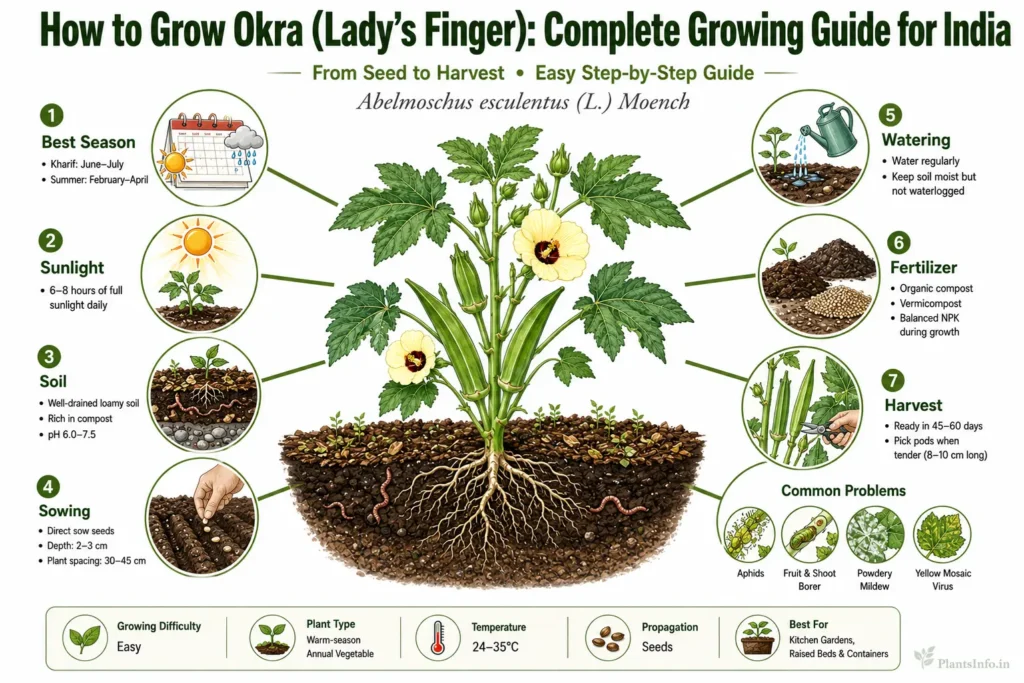
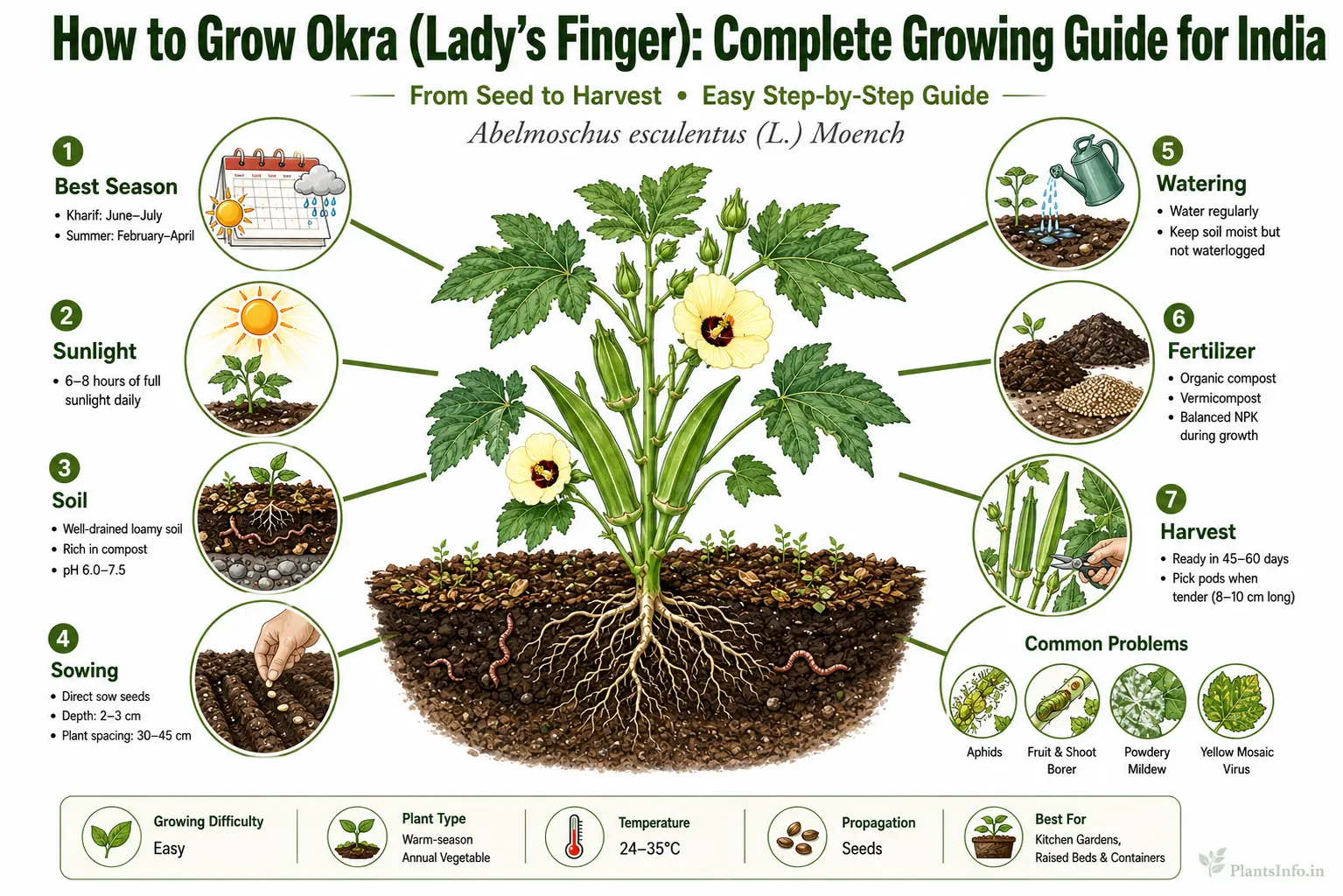
Okra (Abelmoschus esculentus) is one of the easiest vegetable crops for home gardeners in India when grown during warm weather. It grows rapidly, tolerates summer heat better than many vegetables, and produces pods continuously if harvested regularly. Success depends more on choosing the right season and providing full sunlight than on intensive maintenance.
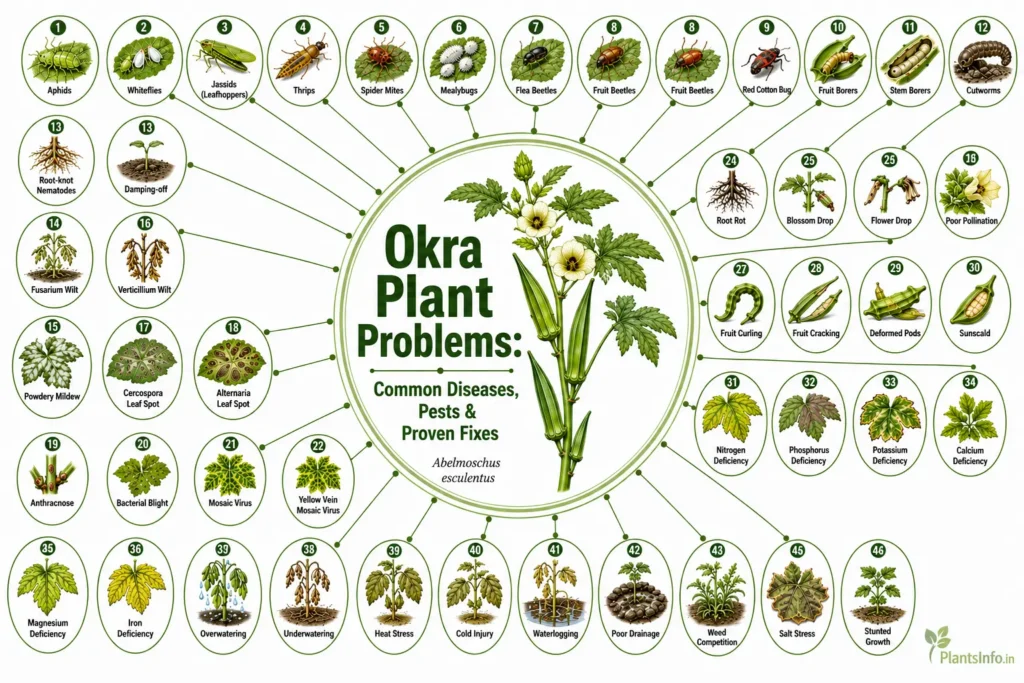
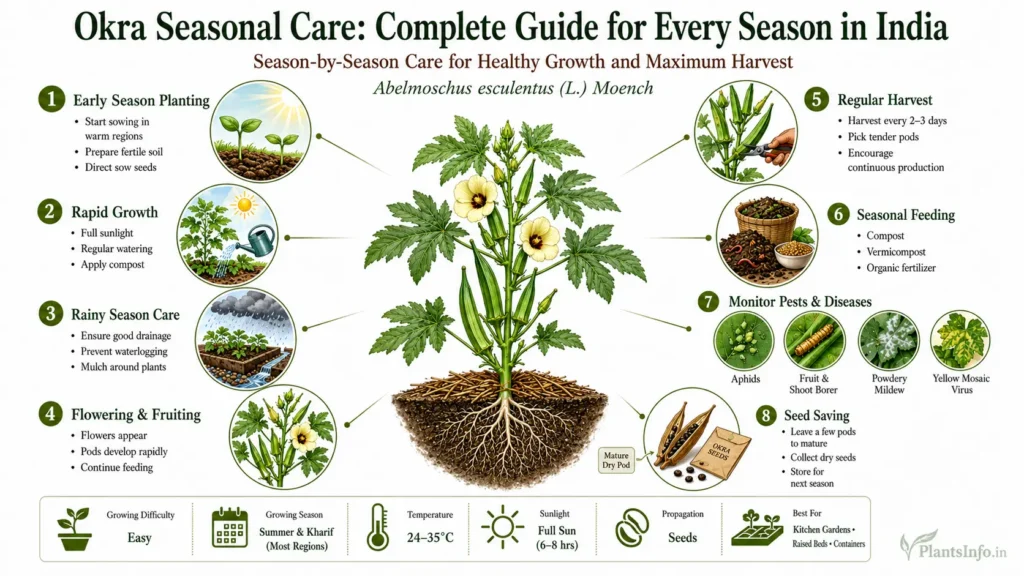
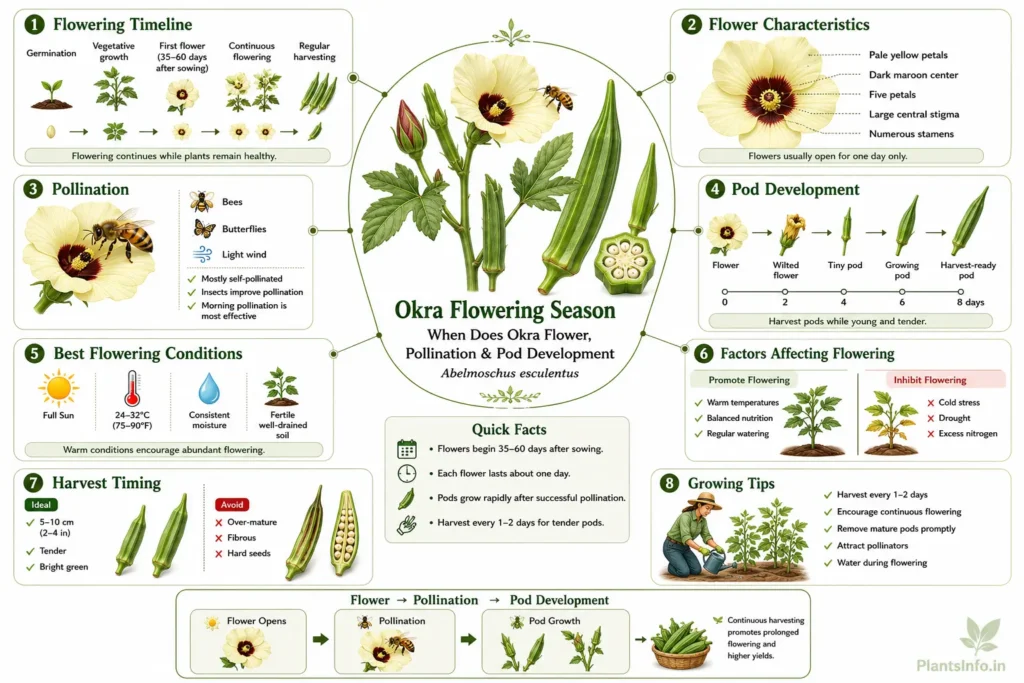
See also: Okra plant profile, common problems, seasonal care, its flowering season, and its benefits.
Unlike leafy vegetables, okra performs best in consistently warm soil. Sowing too early in cool conditions often results in poor germination and slow growth, whereas planting after the soil has warmed encourages vigorous development and higher yields.
Recommended Products
Disclosure: As an Amazon Associate, PlantsInfo may earn from qualifying purchases.
🌱 Growing Essentials
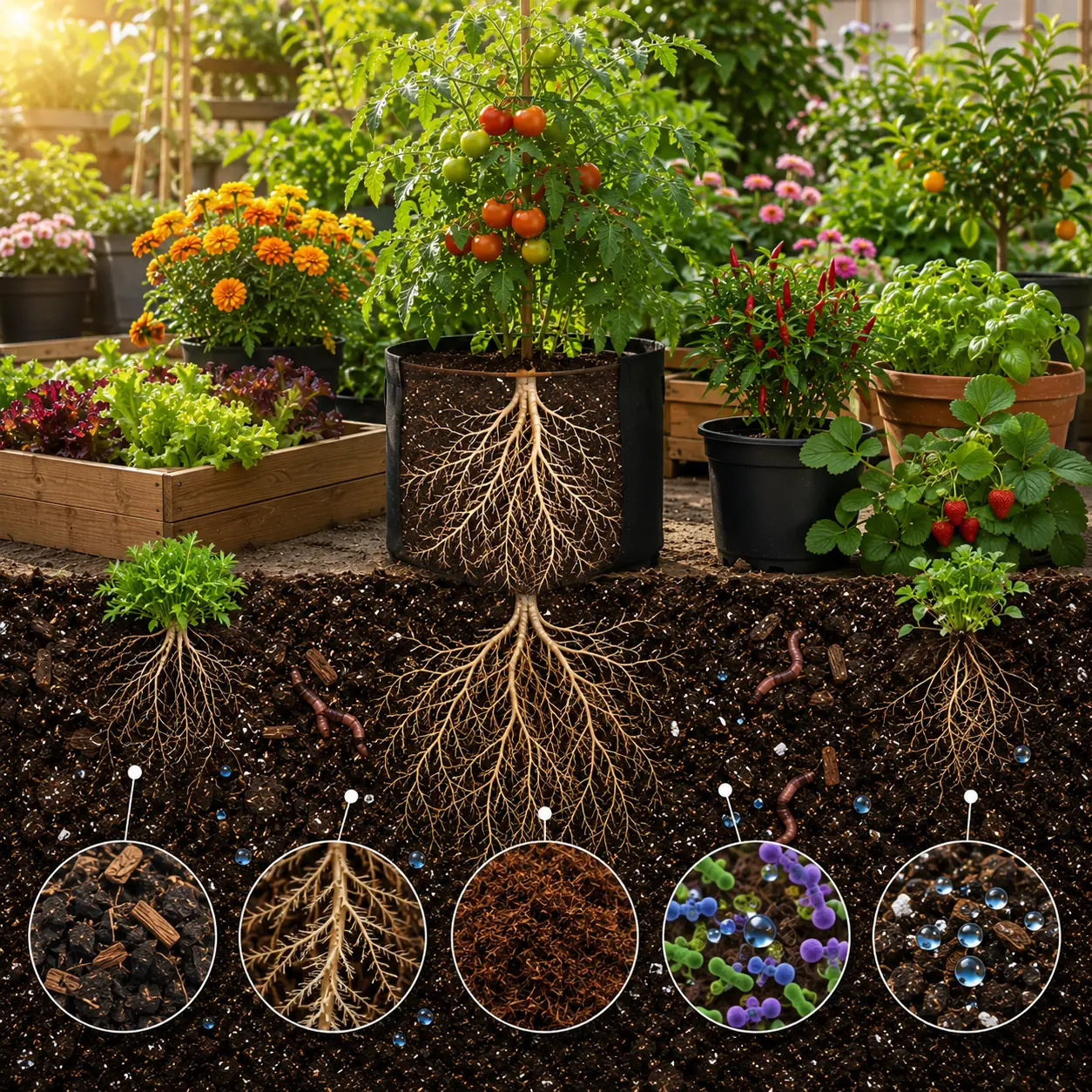
The following products can help with container gardening, potting, root development, soil management, and healthy plant growth.
Organic Potting Soil Mix
Provides nutrients, structure, and healthy growing conditions for container plants.
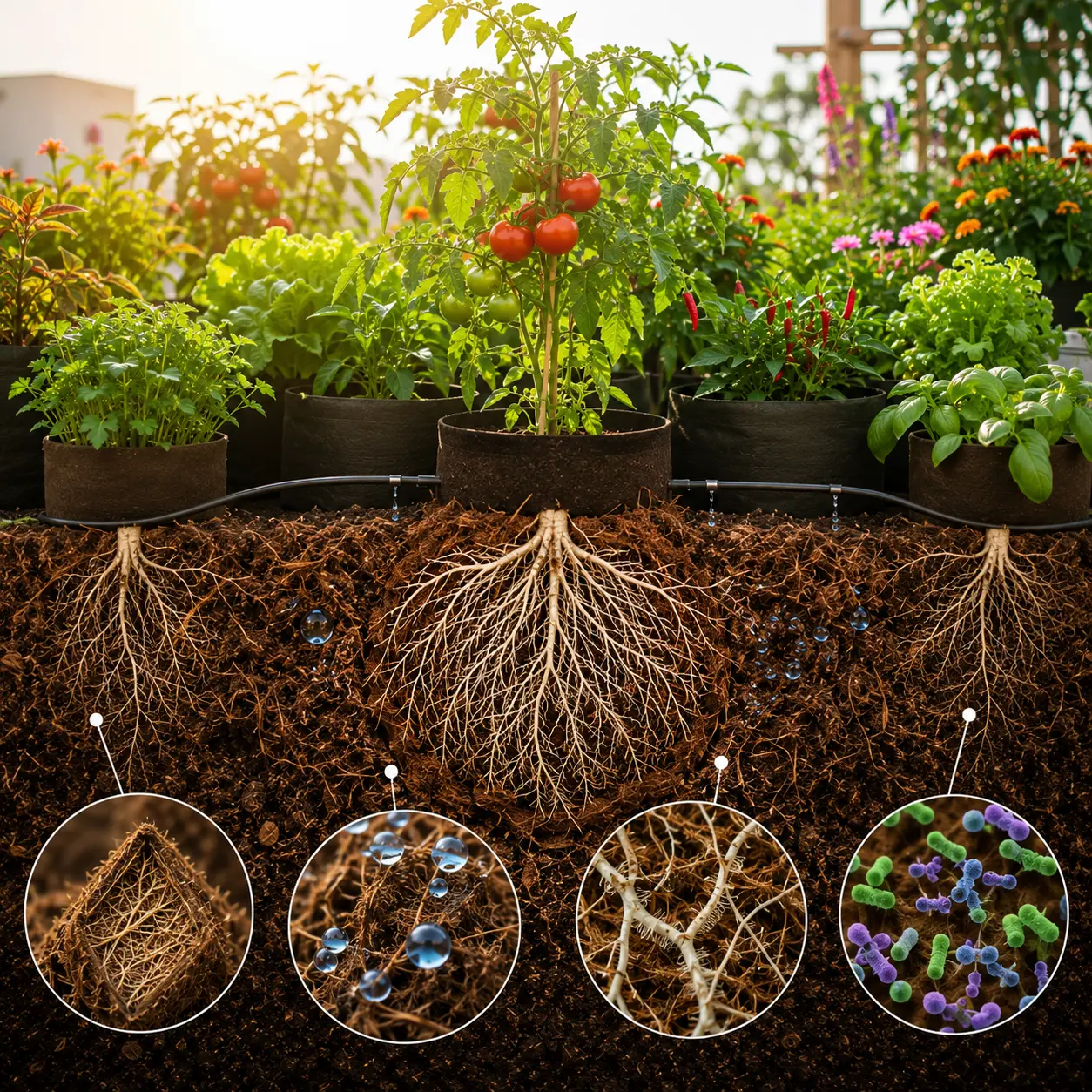
Coco Peat Growing Medium
Enhances moisture retention while maintaining excellent root-zone aeration.

Grow Bags for Plants
Improve drainage, root aeration, and vegetable production in limited spaces.

Plastic Pots for Plants
Ideal containers for seedlings, ornamentals, herbs, and balcony gardens.
Introduction
| Plant Characteristic | Information |
|---|---|
| Botanical Name | Abelmoschus esculentus |
| Family | Malvaceae |
| Plant Type | Annual herbaceous vegetable |
| Growth Habit | Upright, moderately branching |
| Mature Height | Usually 1–2.5 m, depending on cultivar and growing conditions |
| Growth Rate | Fast |
| Primary Propagation | Seeds |
| Best Use | Kitchen gardens, home gardens, containers, and commercial cultivation |
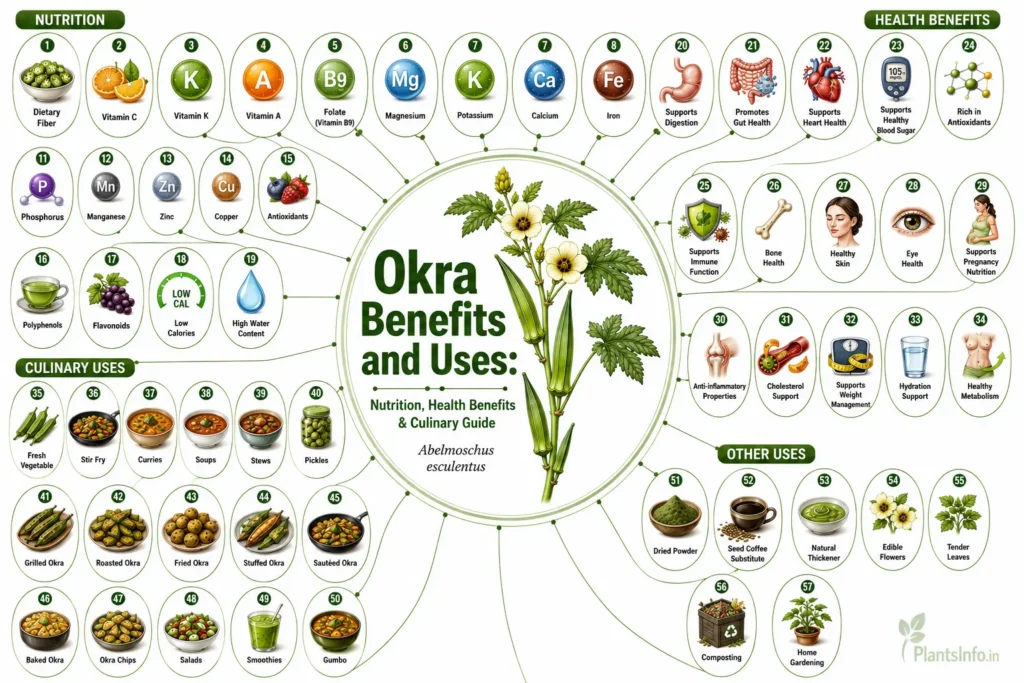
Okra (Abelmoschus esculentus), commonly known as lady’s finger or bhindi, is one of the most widely grown warm-season vegetables in India. It is valued for its tender edible pods, rapid growth, and long harvesting period, making it a popular choice for both home gardens and commercial cultivation.
The crop is well adapted to tropical and subtropical climates and performs reliably during warm weather. Healthy plants produce pods continuously over several weeks when harvested regularly, providing a steady supply for the kitchen. Okra is also suitable for container gardening, provided deep containers and adequate sunlight are available.
Before You Start
| Requirement | Ideal Situation |
|---|---|
| Climate | Warm and frost-free |
| Daily Sunlight | Minimum 6–8 hours |
| Available Space | Sunny garden bed or large container |
| Soil Drainage | Excellent |
| Water Availability | Regular but not excessive |
| Growing Experience | Suitable for beginners |
Before sowing okra, ensure that the growing location remains warm throughout most of the crop’s life cycle. The plant grows poorly in cold weather, and even brief exposure to low temperatures can slow development considerably.
Choose a location that receives uninterrupted sunlight throughout the day. Although okra can survive under partial shade, reduced sunlight generally results in taller plants, fewer flowers, and lower pod production.
If your garden has heavy clay soil, improving drainage before planting is one of the most valuable preparations you can make. Mixing generous quantities of compost and coarse organic matter into the soil helps create better aeration and healthier root development.
For container gardening, use deep pots rather than shallow planters because okra naturally develops a strong taproot. Restricting root growth often limits plant size and overall productivity.
Before planting, confirm that you have:
- A warm growing season ahead
- Full sun throughout the day
- Well-drained fertile soil
- Adequate spacing between plants
- Access to regular irrigation during dry periods
Meeting these basic requirements greatly improves the chances of a productive crop.
Biggest Success Factor
| Success Factor | Importance | Why It Matters |
|---|---|---|
| Warm soil | Critical | Encourages rapid germination and vigorous early growth |
| Drainage | Critical | Prevents root stress and poor plant establishment |
| Full sunlight | High | Maximises flowering and pod production |
| Regular harvesting | High | Stimulates continued pod development |
The single most important factor in growing successful okra is maintaining warm growing conditions in well-drained soil.
Many beginners focus primarily on watering or fertiliser, but temperature and drainage influence almost every stage of plant development. Seeds germinate much more reliably in warm soil, roots establish faster, and flowering begins earlier when temperatures remain consistently favourable.
Equally important is avoiding waterlogged soil. Although okra requires regular moisture, its roots perform poorly in poorly drained conditions where oxygen becomes limited. Plants growing in saturated soil often remain stunted and produce fewer pods.
Once these two conditions are met, routine care becomes relatively straightforward, making okra one of the more dependable vegetable crops for Indian home gardens.
Growing Essentials

| Growing Factor | Recommendation |
|---|---|
| Difficulty | Easy |
| Climate | Tropical to warm subtropical |
| USDA Equivalent | 9–11 |
| Sunlight | Full sun |
| Temperature | Optimum 20–35°C |
| Soil | Well-drained fertile loam or sandy loam |
| Soil pH | 6.0–7.5 |
| Water Requirement | Moderate |
| Humidity | Moderate to high |
| Growth Rate | Fast |
| Container Friendly | Yes |
| Time to Harvest | About 45–60 days from sowing |
| Harvest Frequency | Every 2–3 days during peak production |
These growing conditions provide the best balance between healthy vegetative growth and continuous pod production. While okra tolerates short periods of heat and moderate drought once established, maintaining favourable conditions throughout the growing season results in more tender pods and longer harvests.
Climate Suitability
| Indian Region | Suitability | Notes |
|---|---|---|
| Kerala | Excellent | Nearly year-round cultivation possible |
| Tamil Nadu | Excellent | Multiple growing seasons |
| Karnataka | Excellent | Performs well in warm districts |
| Andhra Pradesh & Telangana | Excellent | High productivity with irrigation |
| Maharashtra | Excellent | Excellent during warm months |
| Gujarat | Excellent | Requires irrigation in dry periods |
| Odisha | Excellent | Thrives during warm growing seasons |
| West Bengal | Excellent | Productive in spring and monsoon crops |
| Bihar | Very Good | Best during warm months |
| Uttar Pradesh | Very Good | Avoid winter cultivation |
| Punjab & Haryana | Good | Mainly summer crop |
| Rajasthan | Moderate to Good | Irrigation essential in hot, dry regions |
| Himachal Pradesh (lower hills) | Moderate | Limited by cooler temperatures |
| High Himalayan regions | Poor | Growing season generally too short |
Okra is naturally adapted to warm climates and performs exceptionally well across most of India. States with long, hot summers generally produce the highest yields because the plant continues flowering and setting pods over an extended period.
In southern India, staggered sowing allows gardeners to harvest fresh pods during much of the year, whereas northern India generally relies on spring and summer planting after the risk of low temperatures has passed.
Gardeners in regions experiencing heavy monsoon rainfall should pay particular attention to drainage. Raised beds often perform better than flat planting because they reduce the likelihood of prolonged soil saturation around the root system.
Choosing a Location
| Site Factor | Ideal Condition |
|---|---|
| Sun Exposure | Open, unobstructed full sun |
| Air Circulation | Good airflow |
| Soil Drainage | Excellent |
| Water Access | Easy irrigation |
| Wind Exposure | Moderate protection from strong winds |
| Previous Crop | Avoid repeated planting in the same location each year |
Choosing the right planting site has a greater influence on yield than many later management practices.
Select an open area where neighbouring trees, walls, or buildings will not cast shade during the middle of the day. Good air circulation also helps maintain healthy foliage while reducing prolonged surface moisture after rainfall.
Avoid low-lying sections of the garden where rainwater naturally accumulates. Even short periods of standing water can reduce root function and slow plant growth.
Crop rotation is also beneficial. Growing okra repeatedly in the same location may gradually increase soil-borne pest and disease pressure. Rotating with unrelated vegetable families helps maintain healthier soil over the long term.
Sunlight Requirements
| Light Factor | Recommendation |
|---|---|
| Daily Direct Sun | 6–8 hours minimum |
| Ideal Exposure | Full-day sunlight |
| Partial Shade | Tolerated but not recommended |
| Deep Shade | Unsuitable |
Okra is a true sun-loving crop. Strong sunlight fuels rapid growth, abundant flowering, and continuous pod production throughout the growing season.
Plants grown in partial shade often become taller and weaker as they stretch toward available light. Flower production usually decreases, resulting in fewer harvestable pods.
Where summer temperatures become extremely high, temporary afternoon heat stress may cause slight wilting. In healthy plants growing in moist soil, this is usually a temporary physiological response rather than a sign of inadequate watering. Growth generally resumes once temperatures decline later in the day.
Soil Requirements
| Soil Property | Recommendation |
|---|---|
| Texture | Loam or sandy loam |
| Drainage | Excellent |
| Organic Matter | High |
| Soil pH | 6.0–7.5 |
| Fertility | Moderate to high |
| Water-Holding Capacity | Good but well-aerated |
Healthy soil is the foundation of productive okra cultivation. The crop performs best in loose, fertile soils that allow roots to penetrate deeply while still retaining enough moisture between irrigations.
Loamy and sandy loam soils are generally ideal because they balance drainage with moisture retention. Heavy clay soils can also support okra if improved with well-decomposed compost or other organic materials before planting.
Organic matter plays several important roles beyond supplying nutrients. It improves soil structure, increases beneficial microbial activity, enhances water-holding capacity, and reduces compaction around the developing taproot.
A slightly acidic to neutral soil pH between 6.0 and 7.5 supports efficient nutrient uptake. If soil testing indicates strongly acidic or alkaline conditions, corrective amendments before planting are generally more effective than attempting adjustments after the crop has become established.
Finally, avoid freshly waterlogged or compacted soils. Good soil aeration is just as important as fertility because healthy roots require a continuous supply of oxygen for vigorous growth and sustained pod production.
Planting
| Planting Factor | Recommendation |
|---|---|
| Propagation Method | Direct sowing from seeds |
| Best Planting Time | Warm season after soil temperatures rise |
| Seed Sowing Depth | 2–3 cm |
| Plant Spacing | 30–45 cm between plants |
| Row Spacing | 45–60 cm |
| Germination Time | Usually 5–10 days under warm conditions |
| Soil Temperature for Germination | Above 20°C for reliable emergence |
Okra develops a strong taproot early in its life, making direct sowing the preferred planting method. Unlike many vegetables, it generally does not transplant well because disturbing the taproot can delay establishment and reduce early growth.
Prepare the planting bed by loosening the soil to a depth of at least 20–30 cm and incorporating well-decomposed compost or farmyard manure several weeks before sowing. This improves soil structure while supplying a steady source of nutrients during the early stages of growth.
Sow two or three seeds at each planting spot approximately 2–3 cm deep. Once seedlings develop two to three true leaves, retain the strongest seedling and remove the weaker ones. Thinning reduces competition for sunlight, nutrients, and moisture while improving air circulation.
Maintain adequate spacing between plants. Crowded okra plants often produce taller stems with fewer branches and lower overall yields. Good spacing also makes harvesting easier and helps maintain healthier foliage throughout the growing season.
Although seeds usually germinate quickly under warm conditions, cooler soils may delay emergence significantly. Patience is often preferable to repeated watering, as excessive moisture in cool soil can reduce germination success.
Watering
| Plant Stage | Water Requirement | Frequency |
|---|---|---|
| Germination | Keep the soil consistently moist | Light irrigation as needed |
| Young Seedlings | Moderate | Every 2–4 days, depending on weather |
| Vegetative Growth | Moderate | Water deeply when the topsoil begins to dry |
| Flowering & Pod Development | Moderate to high | Maintain consistent soil moisture without waterlogging |
| Mature Plants | Moderate | Reduce irrigation during prolonged rainy periods |
Consistent soil moisture is important for healthy growth and good pod quality, particularly during flowering and pod development. Although established okra plants tolerate short dry spells better than many shallow-rooted vegetables, prolonged moisture stress can reduce flowering and produce smaller, tougher pods.
Water thoroughly so moisture reaches the root zone, then allow the upper few centimetres of soil to dry slightly before watering again. Avoid keeping the soil continuously wet, as poorly drained conditions reduce root health and overall plant vigour.
During the monsoon season, adjust irrigation according to rainfall rather than following a fixed schedule. Monitoring soil moisture before watering helps prevent both drought stress and overwatering.
Fertilizing
| Growth Stage | Fertilizer Recommendation |
|---|---|
| Before Planting | Well-rotted compost or farmyard manure incorporated into the soil |
| Early Vegetative Growth | Balanced fertilizer if soil fertility is moderate |
| Flowering Stage | Moderate potassium support where soil tests indicate deficiency |
| Throughout Season | Additional compost around plants if required |
Okra responds well to fertile soils but generally does not require excessive fertilizer when organic matter has been incorporated before planting.
Preparing the soil with compost or well-decomposed manure provides a slow-release nutrient source while improving soil structure and microbial activity. This forms the nutritional foundation for healthy growth.
Where soils are naturally less fertile, a balanced fertilizer applied after seedlings become established supports vigorous vegetative growth. Avoid excessive nitrogen applications, as they often encourage lush foliage while reducing flowering and pod production.
As flowering begins, nutrient demand increases. Potassium plays an important role in supporting flower development and overall crop productivity, particularly in soils with moderate or low potassium reserves. Soil testing remains the most reliable method for determining whether supplemental nutrients are necessary.
Home gardeners can also maintain fertility by applying additional compost as a surface dressing during the growing season. Organic amendments gradually release nutrients while improving moisture retention and encouraging beneficial soil organisms.
Mulching
| Mulching Factor | Recommendation |
|---|---|
| Recommended | Yes |
| Organic Mulches | Straw, dry leaves, grass clippings, compost |
| Mulch Thickness | Approximately 5–8 cm |
| Distance from Stem | Keep a small gap around the stem base |
Mulching offers several important benefits for okra, particularly during India’s hot summer months.
A layer of organic mulch helps conserve soil moisture by reducing evaporation, allowing irrigation water to remain available to the roots for longer periods. This is especially valuable during flowering and pod development when consistent soil moisture contributes to better yields.
Mulch also suppresses weed growth, reducing competition for nutrients and water. Fewer weeds mean less disturbance around the shallow surface roots during manual weeding.
Organic mulches gradually decompose over time, adding valuable organic matter back into the soil and improving long-term soil health.
Avoid piling mulch directly against the plant stem. Leaving a small gap improves air circulation around the stem base and reduces the likelihood of excessive moisture accumulation in that area.
Pruning
| Pruning Practice | Recommendation |
|---|---|
| Routine Pruning | Usually unnecessary |
| Removal of Damaged Leaves | Recommended |
| Dead or Diseased Growth | Remove promptly |
| Harvest Management | Frequent harvesting is more important than pruning |
Unlike many fruiting vegetables, okra generally requires very little routine pruning.
The primary maintenance task involves removing damaged, yellowing, or naturally ageing leaves when they begin to decline. This improves air circulation and directs more energy toward healthy growth and pod production.
Plants that become excessively crowded due to branching may benefit from limited thinning where necessary to improve light penetration, although most home-grown okra develops satisfactorily without structural pruning.
Frequent harvesting has a greater influence on continued productivity than pruning. Mature pods left on the plant signal the plant to divert resources toward seed production, reducing the formation of new pods. Harvesting young pods every two to three days encourages continued flowering and prolongs the productive period.
Always use clean, sharp tools when removing stems or leaves to minimise unnecessary tissue damage.
Container Growing
| Container Requirement | Recommendation |
|---|---|
| Minimum Container Depth | 30–40 cm |
| Minimum Width | 30 cm |
| Drainage Holes | Essential |
| Potting Mix | Well-drained, compost-rich growing medium |
| Plants per Container | One healthy plant per container |
| Best Location | Full sun |
Okra adapts surprisingly well to container cultivation provided the containers are sufficiently deep to accommodate its taproot.
Choose sturdy pots with excellent drainage holes and fill them with a fertile, well-drained growing medium containing compost and coarse material for improved aeration. Heavy garden soil alone is generally unsuitable because it tends to compact within containers.
Limit each container to a single healthy plant. Crowding multiple plants into one pot restricts root development and substantially reduces yield.
Container-grown okra dries out faster than plants growing in open ground, especially during hot weather. Monitor soil moisture regularly and irrigate whenever the upper layer begins to dry, while avoiding prolonged waterlogging.
Because nutrients leach more rapidly from containers, occasional supplemental feeding with balanced organic or inorganic fertilizers may be beneficial during active growth, depending on the fertility of the potting mix.
Harvesting
| Harvest Factor | Recommendation |
|---|---|
| First Harvest | Approximately 45–60 days after sowing |
| Ideal Pod Length | Usually 7–10 cm, depending on cultivar |
| Harvest Frequency | Every 2–3 days |
| Best Harvest Time | Morning |
| Harvest Method | Cut or snap pods carefully without damaging stems |
Harvest okra while the pods are still young, tender, and immature. Delaying harvest causes the pods to become fibrous and less suitable for cooking.
Begin checking plants regularly soon after flowering, as pods develop quickly in warm weather and can become overmature within a few days. Harvest every two to three days to maintain pod quality and encourage continued flowering and pod production.
Harvesting in the morning helps preserve freshness. Use clean scissors, pruning snips, or carefully snap pods from the stem without damaging nearby flowers or developing pods. Some varieties have fine hairs on the stems and pods that may irritate sensitive skin, so lightweight gardening gloves can make harvesting more comfortable.
With regular harvesting and proper care, healthy plants can remain productive for several weeks or even months under favourable growing conditions.
Seasonal Care Overview
| Season | General Care Priority |
|---|---|
| Spring | Prepare soil and sow seeds in suitable regions |
| Summer | Maintain consistent watering and harvest regularly |
| Monsoon | Ensure good drainage and reduce irrigation if rainfall is adequate |
| Autumn | Continue harvesting while warm conditions persist |
| Winter | Grow only in frost-free regions or wait for warmer weather before sowing |
Okra is a warm-season crop, so its care requirements vary mainly with temperature and rainfall. During spring and summer, focus on establishing healthy plants, maintaining consistent soil moisture, and harvesting pods regularly. In the monsoon, good drainage becomes the priority to prevent waterlogging, while irrigation is often reduced. In regions with warm autumn conditions, harvesting may continue until cooler weather slows growth. Winter cultivation is generally suitable only in frost-free parts of southern India.
Common Mistakes
| Common Mistake | Likely Result | Better Practice |
|---|---|---|
| Sowing into cold soil | Poor germination and slow growth | Wait until the soil has warmed sufficiently |
| Overwatering | Weak root growth and reduced vigour | Water deeply only when needed |
| Poor drainage | Stunted plants and reduced productivity | Improve soil drainage before planting |
| Insufficient sunlight | Fewer flowers and lower yields | Grow in full sun for at least 6–8 hours daily |
| Harvesting pods too late | Tough, fibrous pods | Harvest every 2–3 days while pods remain tender |
| Overcrowding plants | Poor airflow and reduced production | Maintain the recommended spacing |
| Excessive nitrogen fertiliser | Vigorous foliage but fewer pods | Apply balanced nutrition based on soil fertility |
| Using shallow containers | Restricted root development | Choose deep containers with adequate drainage |
Most cultivation problems result from a few avoidable mistakes rather than difficult growing conditions. Planting into cool soil often delays germination, while poor drainage and overwatering reduce root health and plant vigour. Insufficient sunlight also limits flowering and pod production, even in fertile soil.
Harvesting pods regularly is equally important. Young pods remain tender and encourage continued flowering, whereas mature pods quickly become fibrous and signal the plant to divert energy towards seed production.
Frequently Asked Questions
Can okra be grown throughout the year in India?
Only in frost-free tropical regions with consistently warm temperatures. In most parts of India, okra is grown as a spring, summer, or monsoon crop.
How long does okra take to produce its first harvest?
Most cultivars produce harvestable pods about 45–60 days after sowing under favourable growing conditions.
Is direct sowing better than transplanting?
Yes. Direct sowing is generally recommended because okra develops a deep taproot that is easily disturbed during transplanting.
How much sunlight does okra need?
Okra grows best with at least 6–8 hours of direct sunlight each day.
How often should I water okra?
Water when the upper layer of soil begins to dry. The exact frequency depends on temperature, soil type, and rainfall.
Can okra be grown in pots?
Yes. Choose a container at least 30–40 cm deep with good drainage and grow one healthy plant per container.
Why should pods be harvested frequently?
Harvesting every 2–3 days keeps pods tender and encourages the plant to continue producing flowers and new pods.
What type of soil is best for okra?
Well-drained loamy or sandy loam soil rich in organic matter with a pH of approximately 6.0–7.5 provides the best growing conditions.
Does okra require regular pruning?
Routine pruning is usually unnecessary. Remove only damaged or ageing leaves as needed and prioritise regular harvesting.
Is mulching beneficial for okra?
Yes. Organic mulch helps conserve soil moisture, suppress weeds, moderate soil temperature, and gradually improves soil structure as it decomposes.
Can okra tolerate drought?
Established plants tolerate short dry periods better than many vegetables, but prolonged moisture stress reduces flowering and pod quality.
How long will an okra plant continue producing pods?
With regular harvesting and favourable warm conditions, healthy plants can remain productive for several weeks or even months, depending on the cultivar and growing season.
Conclusion
Growing okra is straightforward when its basic requirements are met. Warm weather, ample sunlight, well-drained fertile soil, and consistent care provide the foundation for healthy plants and dependable harvests.
With regular harvesting and simple routine maintenance, okra can produce tender pods continuously for several weeks or even months, making it one of the most rewarding vegetables for home gardens. Whether grown in garden beds, raised beds, or deep containers, it is well suited to the diverse growing conditions found across much of India.
By following the recommendations in this guide, gardeners of all experience levels can grow vigorous plants and enjoy a steady supply of fresh, high-quality okra throughout the growing season.