Pudina Varieties: Which One Should You Grow in India?
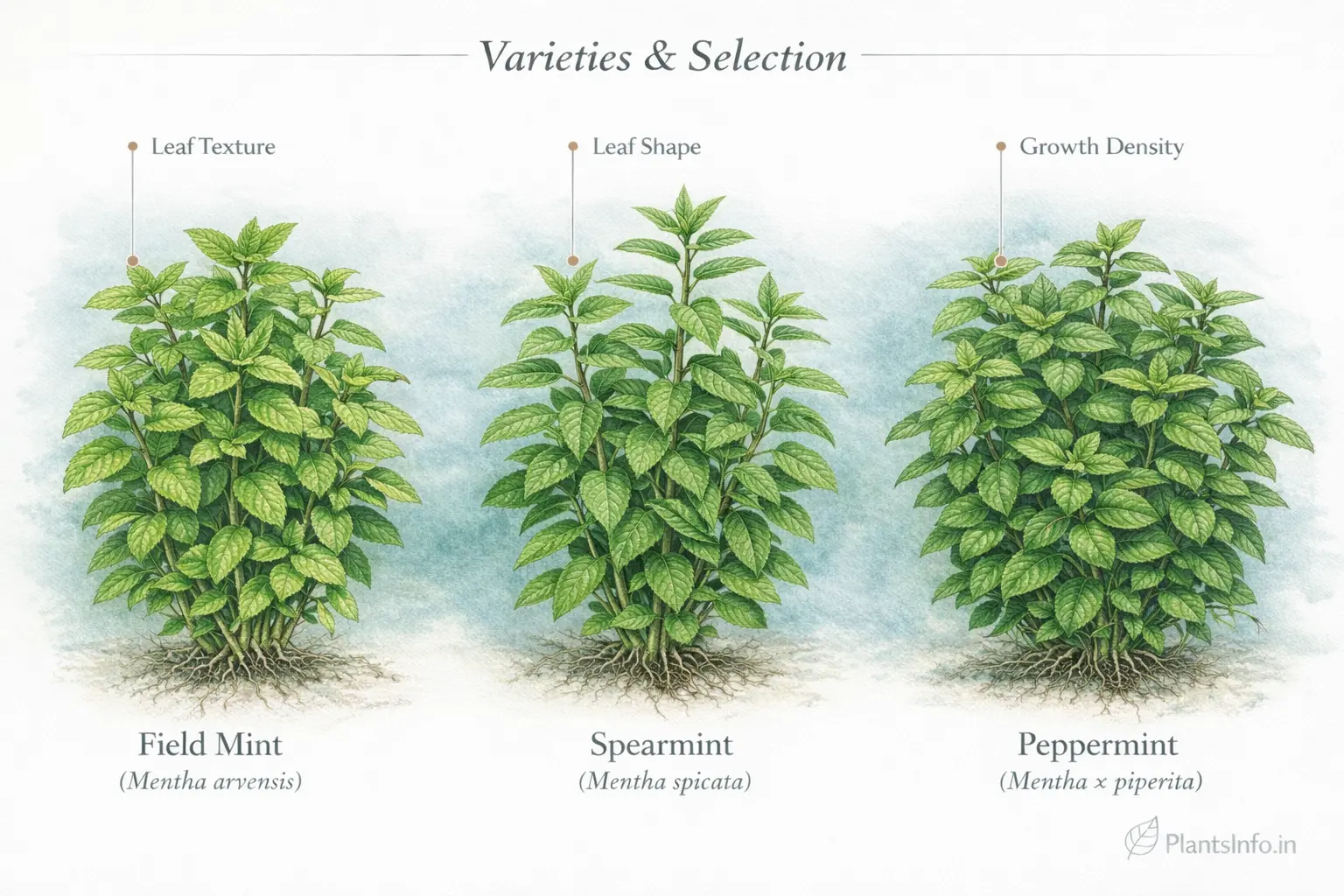
Quick Answer: Most pudina sold in Indian markets is spearmint (Mentha spicata) or a hybrid of it — but several distinct varieties exist, and they differ meaningfully in flavour, climate tolerance, and what you can use them for. Knowing which one you have changes how you grow it and what you cook with it.
See also: Mint Plant plant profile, how to grow it, common problems, its flowering season, and its benefits.
The reason most Indian gardeners buy whatever cutting is available at the local nursery is that almost every pudina plant sold in India is simply labelled “pudina” — no variety name, no species information. That approach works until you try to grow a peppermint plant in Chennai’s heat, or use Japanese mint in a chutney and wonder why it tastes medicinal. The variety matters more than the market acknowledges.
Recommended Products
Disclosure: As an Amazon Associate, PlantsInfo may earn from qualifying purchases.
🌱 Growing Essentials
The following products can help with container gardening, potting, root development, soil management, and healthy plant growth.
Organic Potting Soil Mix
Provides nutrients, structure, and healthy growing conditions for container plants.
Coco Peat Growing Medium
Enhances moisture retention while maintaining excellent root-zone aeration.

Grow Bags for Plants
Improve drainage, root aeration, and vegetable production in limited spaces.

Plastic Pots for Plants
Ideal containers for seedlings, ornamentals, herbs, and balcony gardens.
Quick Variety Selector
| Variety | Type | Plant Size | Best For | Suited To |
|---|---|---|---|---|
| Spearmint (M. spicata) | Open-pollinated / species | Medium | Cooking, chutney, drinks | All India |
| Peppermint (M. × piperita) | Natural hybrid | Medium–large | Herbal tea, aromatherapy | North India, hills, cooler regions |
| Japanese / Cornmint (M. arvensis) | Open-pollinated / species | Large | Menthol extraction, medicinal | North India; UP, Punjab, Uttarakhand |
| Spearmint ‘Indian’ / ‘Desi’ | Landrace | Compact–medium | Kitchen herb, containers | All India; heat-tolerant |
| Pennyroyal (M. pulegium) | Open-pollinated / species | Compact | Ground cover, insect repellent | South India, coastal, mild climates |
| Apple Mint (M. suaveolens) | Open-pollinated / species | Large | Teas, ornamental, mild flavour | All India; tolerates heat well |
| Water Mint (M. aquatica) | Open-pollinated / species | Large | Waterlogged or pond margins | Coastal and wet regions |
Varieties in Detail
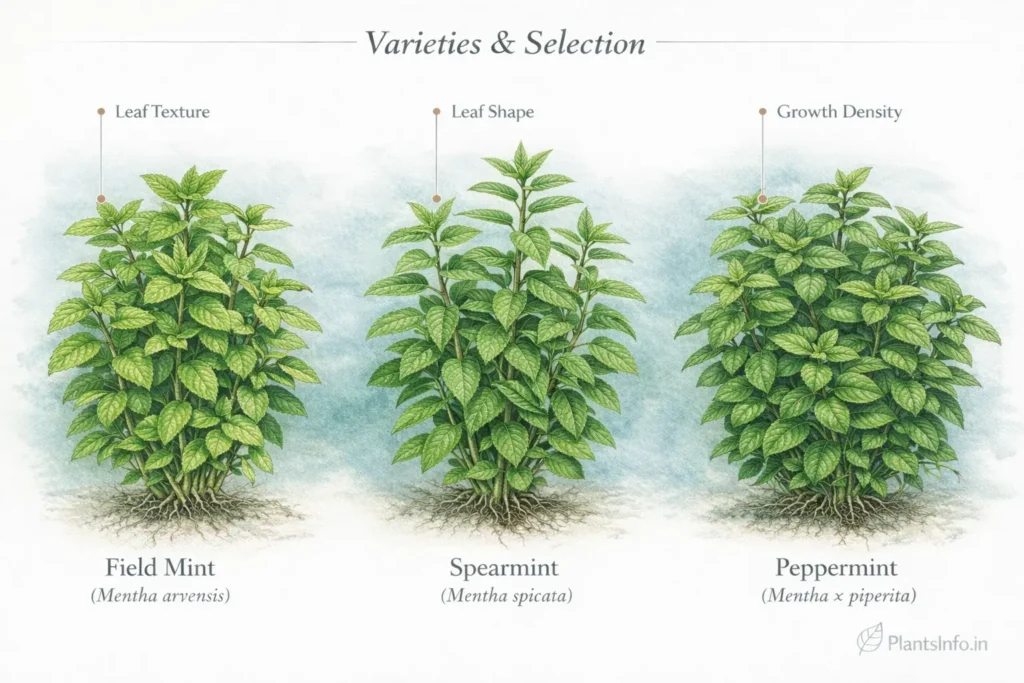
Spearmint (Mentha spicata) is the default pudina of the Indian kitchen — the one in your chutney, your raita, your chai. Its flavour is clean and bright with a mild sweetness and the characteristic cool finish that comes from carvone rather than menthol.
It is the most heat-tolerant of the commonly grown mint species, which makes it the right choice for most of India. Spearmint grows vigorously in both containers and beds, spreads aggressively via underground runners, and recovers quickly from hard cutting.
Its weakness is susceptibility to mint rust during humid monsoon conditions. It is the most widely available variety in Indian nurseries — if you buy a cutting without a label, it is almost certainly this.
Peppermint (Mentha × piperita) is a natural hybrid of spearmint and water mint with a significantly higher menthol content than spearmint. The flavour is sharp, cooling, and distinctly medicinal — excellent in herbal teas and preparations, but overpowering in most Indian cooking where spearmint is the expected flavour.
Peppermint prefers cooler conditions and performs best in North India, hill stations, and the Deccan plateau. It struggles in the persistent heat of South Indian summers and coastal plains.
Because it is a sterile hybrid, it does not set viable seed and must be propagated from cuttings. Availability in Indian nurseries is uneven; more reliably sourced online or through speciality herb nurseries.
Japanese mint / Cornmint (Mentha arvensis) is the commercially dominant mint of India by area cultivated, though most home gardeners have never knowingly grown it. It is the primary source of natural menthol and menthol oil produced in Uttar Pradesh, Uttarakhand, and Punjab, India, being one of the world’s largest producers.
The plant is tall, vigorous, and strongly menthol-scented. As a kitchen herb, it is too intense for most culinary uses; its flavour is medicinal rather than fresh. For a home gardener, its value is in its robust growth, high essential oil content for home preparations, and its tolerance of North Indian conditions, including cold winters. It is not commonly sold in retail nurseries but is widely available as cuttings in the mint-growing belt of UP and Uttarakhand.
Desi / Indian spearmint refers to the locally adapted landrace selections of M. spicata that have been grown and propagated from cuttings across Indian kitchen gardens for generations. These are not formally named cultivars — they are simply the spearmint plants that Indian gardeners have been passing between households, each slightly adapted to its local conditions.
Desi pudina tends to be more compact, more heat-tolerant, and more reliable under variable watering conditions than commercially introduced varieties. If an older relative gives you a cutting from their garden, this is almost certainly what you are receiving — and it is often better suited to Indian home conditions than anything you will find at a nursery.
Apple Mint (Mentha suaveolens) has rounded, slightly fuzzy leaves and a mild, fruity-mint scent that is less sharp than spearmint. It is more heat-tolerant than peppermint and grows vigorously across most of India.
Its flavour is too subtle for heavy-handed use in chutney but works well in teas, desserts, and as a garnish where a gentler mint flavour is wanted. It is also more ornamental than other varieties — the fuzzy leaf texture and compact form make it attractive in a container. Availability is limited to larger nurseries and online sellers.
Pennyroyal (Mentha pulegium) is a compact, low-growing mint with a sharp, strongly camphor-like scent. In India, it is grown primarily as a ground cover and natural insect repellent rather than as a culinary herb.
It is toxic in large quantities and should not be consumed as a food herb — this is important, as it is occasionally sold without adequate labelling. Its value in an Indian garden is as a pest-deterrent border plant. It performs best in the mild, humid conditions of South India and coastal regions.
Water Mint (Mentha aquatica) is the most moisture-tolerant mint species and one of the parents of peppermint. It thrives in waterlogged or seasonally flooded conditions that would kill other mint varieties, making it useful along pond margins, drainage channels, or in consistently wet garden areas.
Flavour is similar to peppermint but coarser. It is rarely sold in Indian nurseries and is primarily of interest to gardeners with wet microclimates or water features.
Head-to-Head Comparison
Spearmint vs. peppermint is the comparison that matters most for Indian home gardeners. Spearmint wins for the kitchen — its flavour is what Indian cooking, street food, and beverages expect from pudina, and it handles Indian heat far better than peppermint. Peppermint wins for teas, home remedies, and aromatherapy preparations where a stronger menthol character is the goal.
For anyone in South India, coastal regions, or anywhere with consistently hot summers: choose spearmint. For gardeners in North India with cooler winters who primarily want mint for tea and medicinal use, peppermint is worth growing alongside spearmint. Growing both in separate containers is a practical solution for those who want culinary and medicinal use covered.
Desi spearmint vs commercial spearmint is rarely discussed but practically significant. Commercial spearmint cuttings from nurseries are often sourced from faster-growing, higher-yield selections that perform well in the short term but may be less adapted to local conditions over successive seasons.
Desi cuttings — sourced from a neighbour’s established plant — are slower to establish but tend to be more disease-resistant, more heat-tolerant, and better adapted to the local water and soil. If you can source a desi cutting, it is almost always the better long-term choice for a kitchen garden. Commercial cuttings win on availability and initial vigour.
How to Choose for Your Space
Container or balcony garden: Desi spearmint or Apple Mint. Both stay manageable in containers, tolerate the variable watering patterns of balcony gardening, and do not become invasive in a pot the way vigorous spearmint selections can. Use a pot of at least 10 inches in diameter — mint needs horizontal space more than depth.
Small ground plot: Spearmint, but contained. Plant it inside a buried plastic pot or a root barrier — spearmint’s underground runners will colonise an entire bed within one season if not physically restricted. This is the most important practical point for any ground-bed mint planting in India.
Larger garden or kitchen herb bed: Japanese mint for essential oil and medicinal use in the North Indian belt; spearmint for culinary use everywhere else. Water Mint in areas with persistently wet soil or near water features.
Primarily for tea and home remedies: Peppermint in cooler regions (North India, hills); spearmint in warmer regions where peppermint struggles. Japanese mint for menthol-forward preparations anywhere in the North Indian plains.
Regional Suitability
North India (Delhi, UP, Haryana, Punjab): Spearmint and Japanese mint both perform excellently. Peppermint grows well through winter and spring but may struggle through peak summer — grow it in a shaded spot or treat it as a cool-season herb. Japanese mint thrives in the same conditions as the agricultural mint belt.
South India (Tamil Nadu, Karnataka, Kerala, Andhra Pradesh): Spearmint — specifically heat-tolerant desi selections — is the right choice. Peppermint is unreliable in sustained heat above 35°C. Apple Mint handles South Indian conditions better than peppermint.
Coastal regions (Mumbai, Goa, Kochi, Chennai): Spearmint and Apple Mint. High humidity increases rust risk for all varieties — prioritise good air circulation and preventive care regardless of which variety you grow.
Hill stations and high-altitude zones (Himachal, Uttarakhand, Nilgiris, Ooty): Peppermint excels here and is worth growing as a primary variety. Japanese mint also performs well at altitude. All varieties benefit from the cooler temperatures and grow more vigorously than at lower elevations.
Desi vs Hybrid — What Nobody Tells You
Peppermint is a sterile hybrid — it cannot be grown from seed, and every plant is a cutting from the same genetic lineage. This means there is no flavour or characteristic variation between peppermint plants, but it also means no adaptation to local conditions over time.
Spearmint and Japanese mint can be grown from seed, but in practice, virtually all Indian home gardeners propagate from cuttings. This matters because it means the plant in your neighbour’s garden may be meaningfully better adapted to your local conditions than a cutting from a nursery that sources from a distant production facility.
The honest recommendation: for most Indian kitchen gardeners, a well-established desi spearmint cutting from a reliable local source outperforms any named commercial cultivar. The commercial advantage — uniformity and initial vigour — is irrelevant for a home herb garden where one or two plants are all you need.
Watch Out for Mislabelling
Mislabelling is endemic in the Indian pudina market because the word “pudina” is applied to the entire genus without distinction. The most common issue: peppermint and spearmint are sold interchangeably, which matters because their flavour profiles, climate requirements, and culinary uses are genuinely different.
Pennyroyal is the mislabelling concern that carries a safety implication — it is occasionally sold as culinary mint without adequate labelling. Pennyroyal has distinctly small, oval leaves with a strongly camphor-like (not fresh-minty) scent. If a plant labelled “pudina” smells sharply medicinal or camphor-like rather than fresh and cool, do not use it in cooking.
To verify after purchase: crush a leaf and smell it directly. Spearmint has a clean, sweet, cooling scent. Peppermint is noticeably sharper and more intensely cool — almost medicinal. Japanese mint smells strongly of menthol with little sweetness. Apple mint has a soft, rounded scent with a faint fruity note. Pennyroyal smells sharply of camphor. The nose is more reliable than the label.
For named varieties — particularly peppermint or Japanese mint — state agriculture department nurseries, KVK outlets, and established herb nurseries are more reliable than roadside vendors. Online sellers who provide botanical names (Mentha spicata, M. × piperita, etc.) on their listings are a reasonable secondary source.
Frequently Asked Questions
Can I grow multiple mint varieties in the same pot?
Not recommended. Mint varieties cross-pollinate readily, and more practically, their runners intertwine underground within weeks, making separation impossible. Grow each variety in a separate container.
Why does my pudina taste different from the one at the market?
Market pudina is almost always spearmint harvested young. If your home-grown pudina tastes more intense or slightly different, it is likely a different variety, more mature at harvest, or grown in different soil conditions — all of which affect flavour.
Is pudina grown from seed reliable?
Spearmint and most species of mint can be grown from seed, but germination is slow, and seedlings are variable in flavour. Cuttings are faster, more reliable, and true to the parent plant’s flavour. Seed is a reasonable option only when cuttings are unavailable.
For most Indian home gardeners, the answer is straightforward: get a desi spearmint cutting from a trusted local source, grow it in a well-drained container, and harvest it regularly. Add peppermint in a separate pot if you drink a lot of herbal tea. Everything else is refinement.