Tomato Flowering and Fruiting Season Guide for India
Quick Answer
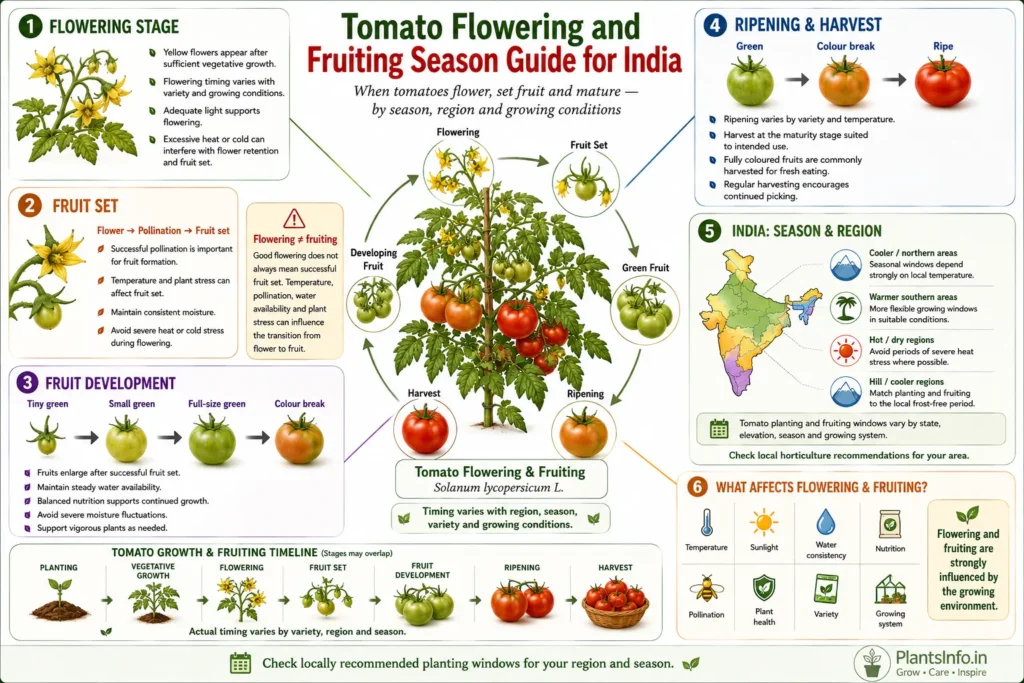
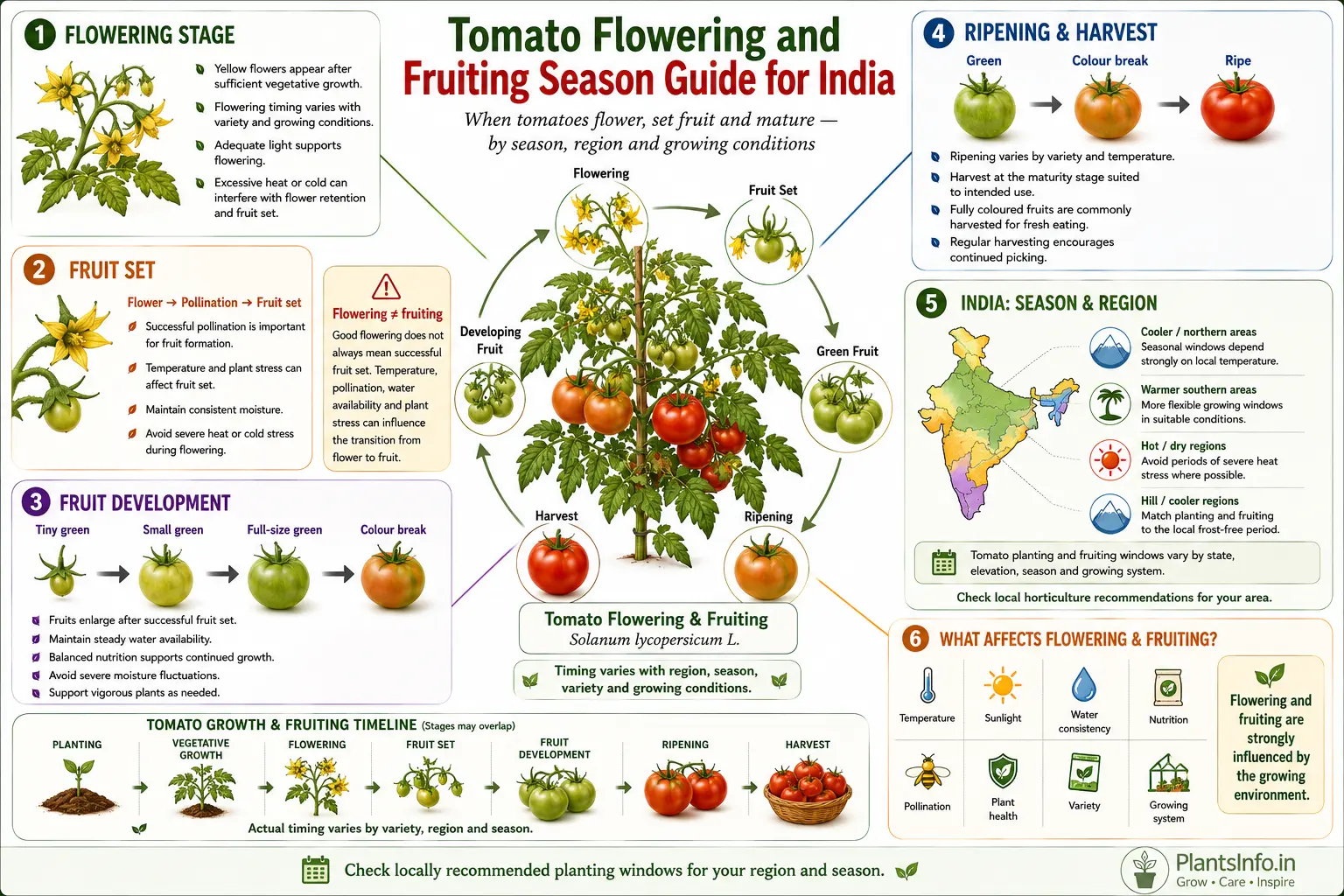
Tomato can flower and fruit during different crop windows across India. The timing depends mainly on when the crop is established, local temperature, cultivar, growing system and moisture conditions. In many regions, cooler-season crops established after the monsoon or during winter can progress through flowering, fruit set and ripening, while warmer, colder and hill regions may follow different schedules.
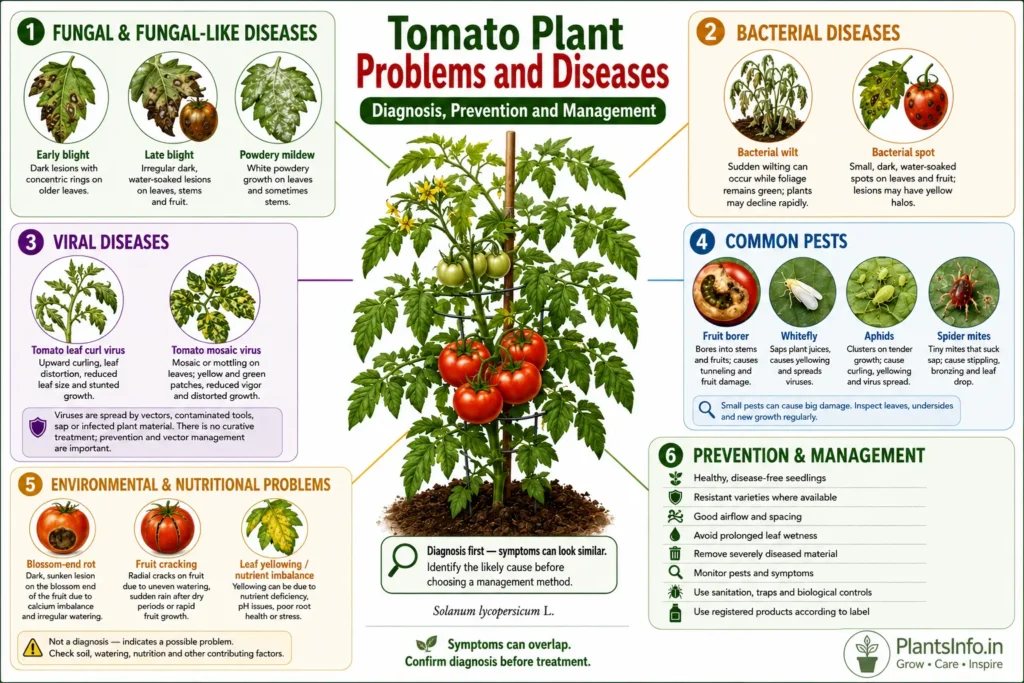
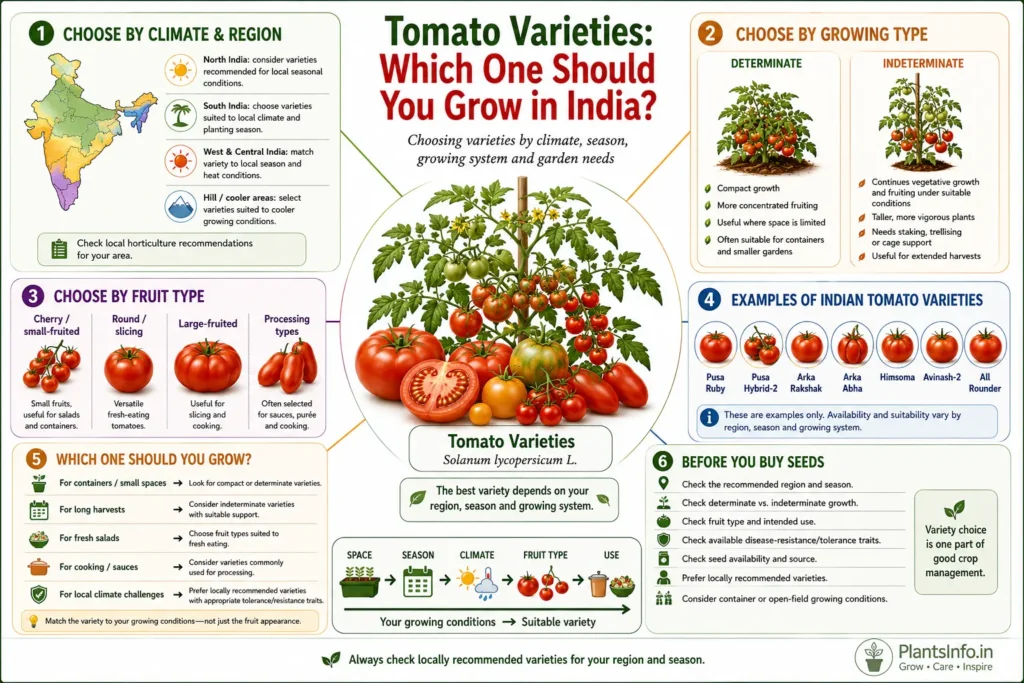
See also: Tomato Plant plant profile, how to grow it, common problems, its benefits, and its varieties.
Tomato does not have one universal flowering month in India. The same plant can flower and fruit at different times depending on when it was transplanted and whether temperatures remain suitable for reproductive growth.
Recommended Products
Disclosure: As an Amazon Associate, PlantsInfo may earn from qualifying purchases.
🌱 Growing Essentials
The following products can help with container gardening, potting, root development, soil management, and healthy plant growth.
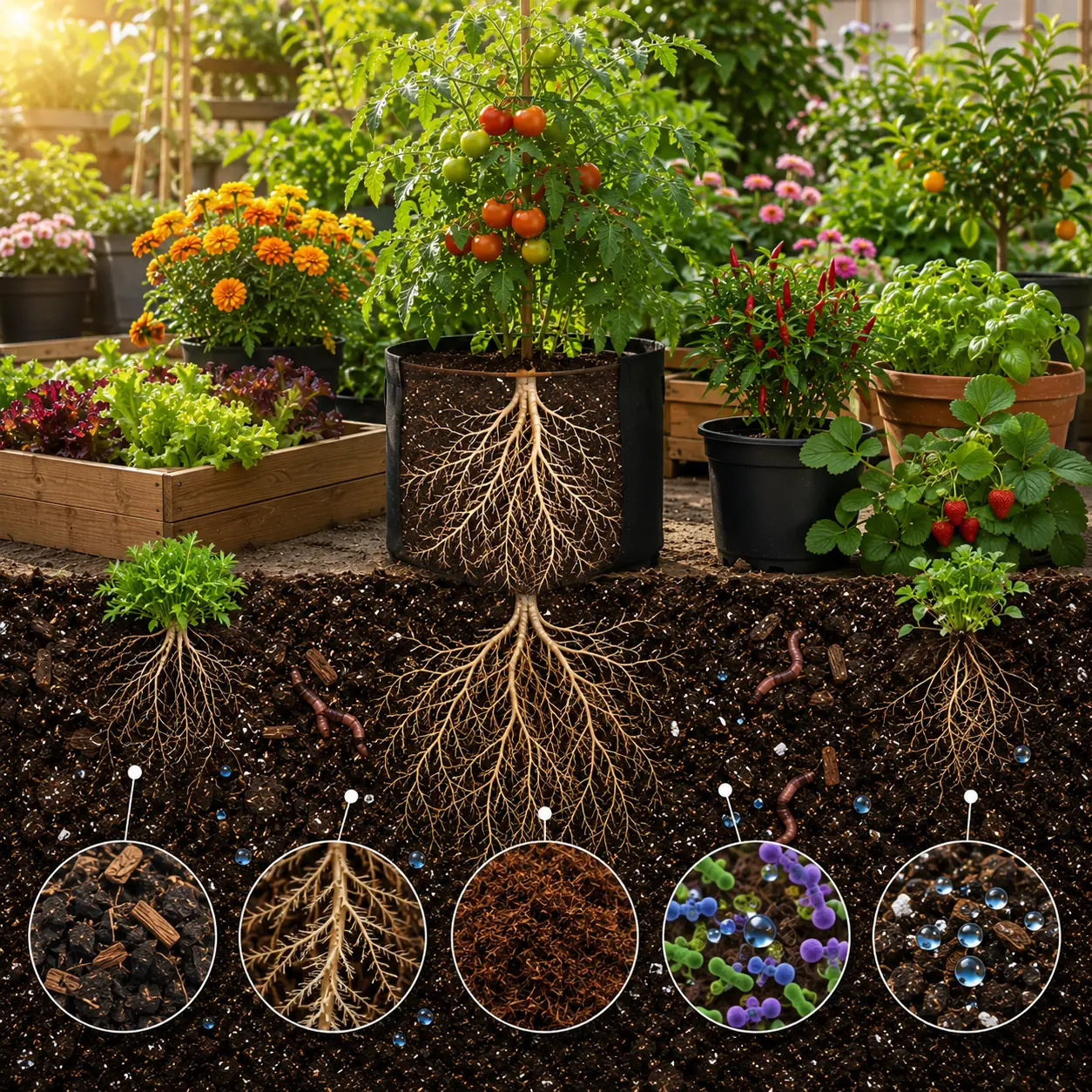
Organic Potting Soil Mix
Provides nutrients, structure, and healthy growing conditions for container plants.
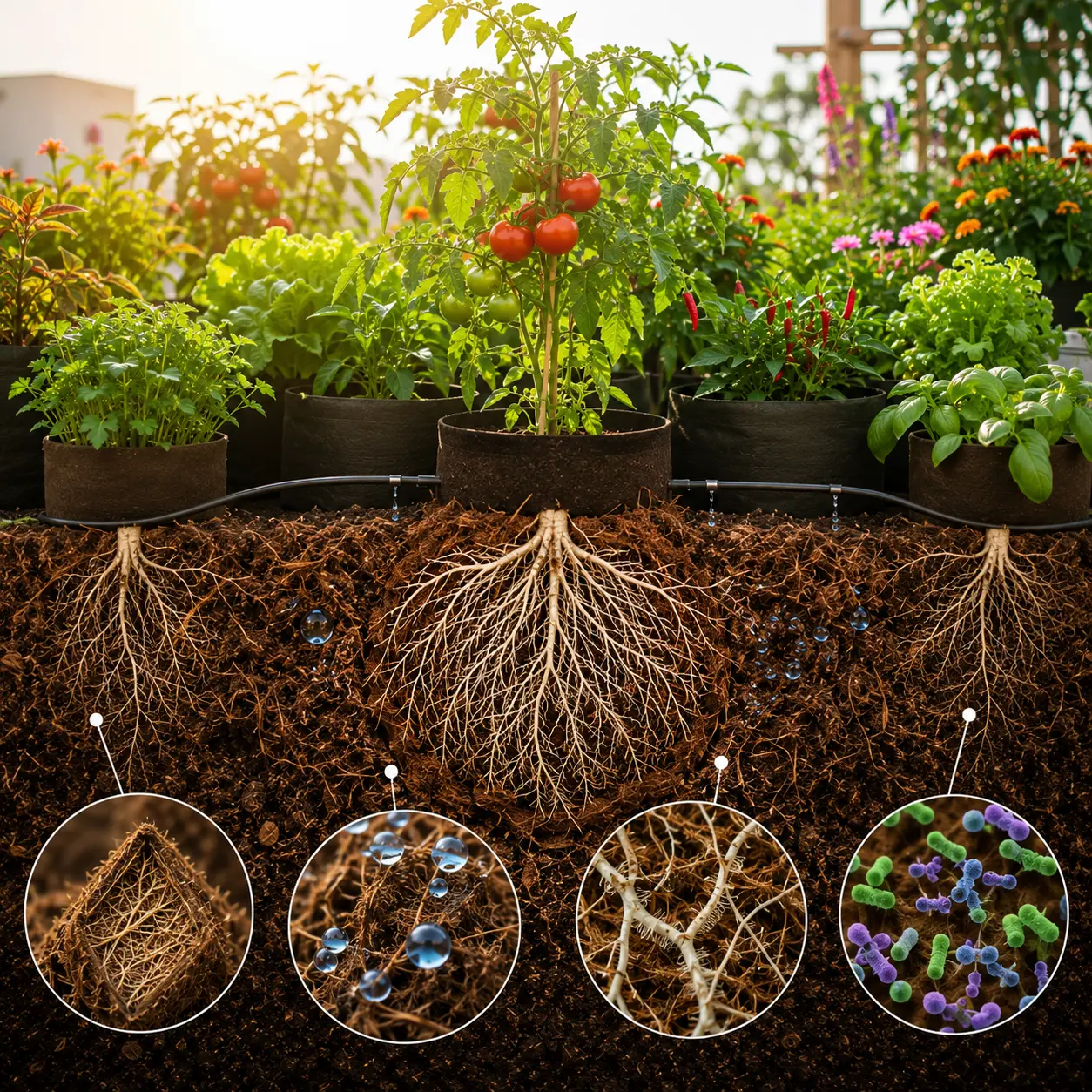
Coco Peat Growing Medium
Enhances moisture retention while maintaining excellent root-zone aeration.

Grow Bags for Plants
Improve drainage, root aeration, and vegetable production in limited spaces.

Plastic Pots for Plants
Ideal containers for seedlings, ornamentals, herbs, and balcony gardens.
Flowering does not guarantee fruit set. A plant may produce many flowers but set relatively few fruits when temperature, moisture, pollination conditions, or plant health are unsuitable.
Biological Timing at a Glance
| Biological stage | Typical period |
|---|---|
| Establishment | First few weeks after transplanting |
| Visible flower clusters | Often several weeks after transplanting under suitable conditions |
| Flowering | Progressive, with new clusters developing as the plant grows |
| Fruit set | Within a few days after successful pollination |
| Fruit enlargement | Several weeks after fruit set |
| Ripening | Several weeks after fruit development begins |
| Harvest | Progressive as individual fruits reach the desired maturity stage |
These are general biological stages rather than fixed calendar dates. Cultivar, temperature, plant age, growing conditions, and production system can shift the timing substantially.
Tomato flowers are small and yellow, and several flowers can develop within each cluster. Flowering is progressive rather than a single annual event.
India’s Seasons and This Plant
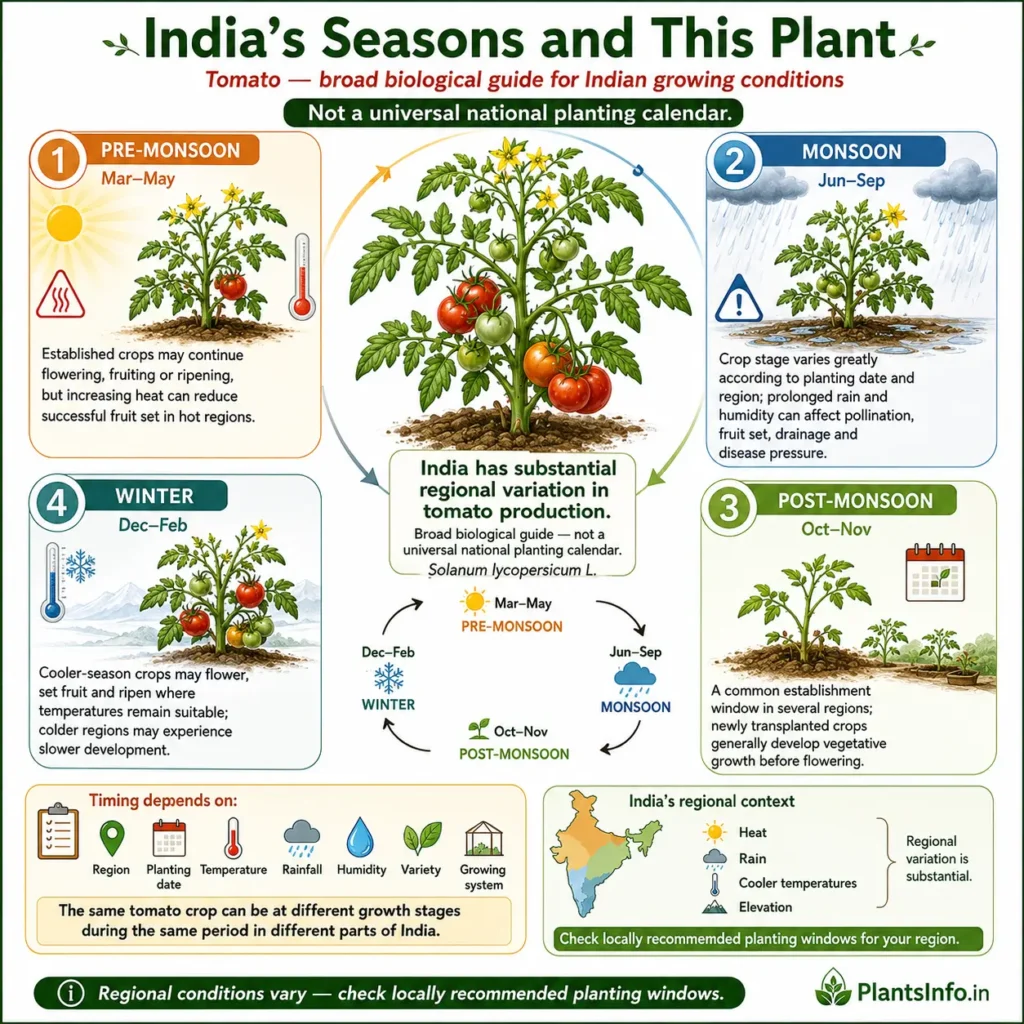
India has substantial regional variation in tomato production. The following table is therefore a broad biological guide, not a universal national planting calendar.
| Period | Typical possibilities |
|---|---|
| Pre-monsoon (Mar–May) | Established crops may continue flowering, fruiting or ripening, but increasing heat can reduce successful fruit set in hot regions |
| Monsoon (Jun–Sep) | Crop stage varies greatly according to planting date and region; prolonged rain and humidity can affect pollination, fruit set, drainage and disease pressure |
| Post-monsoon (Oct–Nov) | A common establishment window in several regions; newly transplanted crops generally develop vegetative growth before flowering |
| Winter (Dec–Feb) | Cooler-season crops may flower, set fruit and ripen where temperatures remain suitable; colder regions may experience slower development |
The crop’s establishment date is more useful for predicting flowering than the calendar month alone.
Flowering Season in Detail
Tomato develops flower clusters after sufficient vegetative growth. The individual flowers are small, yellow, and typically bisexual, with several flowers developing within a cluster.
Flowering is progressive rather than a single event. New clusters can appear while earlier flowers are developing into fruit. Under suitable conditions, the plant can therefore have flowers, developing fruit and ripening fruit at the same time.
Temperature and Flowering
Temperature strongly regulates flowering, pollen performance, fruit set and ripening.
Prolonged high temperatures can reduce pollen performance, flower retention and successful fruit set. Low temperatures can also slow reproductive development.
A temperature range around 20–25°C is often favourable for tomato fruit set and colour development, although the optimum varies with cultivar and production conditions.
Rainfall is not a simple flowering trigger. Its main effects are through changes in humidity, leaf wetness, soil moisture, temperature and pollination conditions.
Pollination and Fruit Set
Tomato is predominantly self-pollinating. Pollen from a flower can fertilise the same flower, while vibration from wind and other movement can assist pollen release.
Individual flowers remain receptive for a relatively short period, so successful fruit production depends on conditions during flowering rather than simply on the presence of flowers.
Why Flowers May Fail to Become Fruit
Flower production can remain high while fruit set is poor because of:
- prolonged high temperatures;
- unusually low temperatures;
- severe water stress;
- excessive moisture or poor root health;
- inadequate plant nutrition;
- poor plant health;
- transplant stress; or
- unsuitable growing conditions.
Therefore:
More flowers do not necessarily mean more tomatoes.
Healthy plants under suitable temperatures and consistent moisture are more likely to convert flowers into productive fruit.
Fruiting Season
Fruit begins to enlarge after successful pollination and fertilisation. It initially appears as a small green structure behind the flower and then gradually increases in size before entering the ripening stage.
Ripening is visible through a change from green toward the mature colour of the cultivar. Red is common, but ripe tomatoes may also be yellow, orange, pink or other colours.
Fruit generally becomes softer as it approaches full ripeness.
From fruit set to ripe fruit takes several weeks, with cultivar and temperature affecting the interval. Fruits on the same plant can therefore reach harvest maturity progressively rather than all at once.
Once fruiting begins, harvest can continue for several weeks and, in suitable indeterminate plants, may continue through successive flowering and fruiting flushes.
If ripe fruit remains on the plant beyond its useful harvest window, it can become increasingly soft and may crack or deteriorate under unsuitable conditions.
Harvest timing only — harvest method: see the Growing Guide.
Determinate vs Indeterminate Fruiting
Growth habit strongly influences the length and pattern of the flowering and fruiting period.
Determinate Tomatoes
Determinate varieties generally have a more compact growth pattern and produce a relatively concentrated crop. Flowering and fruiting can therefore occur over a more defined period.
Indeterminate Tomatoes
Indeterminate varieties continue producing new shoots and flower clusters for longer under suitable conditions. They can therefore maintain flowering and fruit production over successive flushes when temperature, moisture, nutrition and plant health remain favourable.
This distinction is important when interpreting the phrase “tomato flowering season.” A determinate plant and an indeterminate plant established on the same date may not have the same productive duration.
Best Time to Plant
There is no single best tomato planting window for all of India.
In many regions, tomatoes are grown during cooler periods, including post-monsoon and winter windows. Other regions use spring, early-monsoon, or other locally adapted schedules according to temperature, rainfall, cultivar, and production system.
For example, agricultural recommendations can provide different planting windows for different production regions and systems rather than one national calendar.
The best approach is therefore to choose the planting date according to:
- local temperature;
- expected heat or cold during flowering;
- rainfall pattern;
- cultivar;
- elevation;
- growing system; and
- whether the crop is grown outdoors or under protection.
Plant according to local climate, not the calendar alone.
Month-by-Month Biological Calendar
Important: This is a broad biological guide, not a universal planting calendar for India. Actual flowering and fruiting depend on the crop’s planting date, local climate, cultivar, elevation and growing system.
| Month | Broad season | What the plant may be doing |
|---|---|---|
| January | Winter | Established crops may be flowering, setting fruit or ripening in suitable regions |
| February | Winter | Flowering and fruit development may continue where temperatures remain suitable |
| March | Pre-monsoon | Established crops may continue flowering, fruit development or ripening; rising temperatures increasingly affect reproductive performance |
| April | Pre-monsoon | Flowering and fruit set may continue, but heat stress becomes increasingly important in warmer regions |
| May | Pre-monsoon | Prolonged high temperatures can reduce flower retention, pollen performance and successful fruit set |
| June | Monsoon | Crop stage varies widely according to planting date and region; rainfall and humidity increasingly influence disease and root-zone conditions |
| July | Monsoon | Active crops may be vegetative, flowering or fruiting depending on their establishment date |
| August | Monsoon | Flowering and fruiting remain dependent on crop timing, local temperature, rainfall and plant health |
| September | Monsoon | Existing crops may continue reproductive development as rainfall and temperatures change |
| October | Post-monsoon | Newly transplanted crops in suitable regions may be establishing vegetative growth |
| November | Post-monsoon | Newly established plants may progress toward visible flowering as sufficient vegetative growth develops |
| December | Winter | Earlier plantings may be flowering, setting fruit or entering ripening where temperatures remain suitable |
This calendar describes possible biological stages, not what every tomato plant in India will be doing during that month.
What Can Go Wrong Seasonally?
Heat-Related Poor Fruit Set
Prolonged high temperatures can interfere with pollen performance, flower retention, and successful fruit set.
This is particularly important during hot pre-monsoon periods in warmer regions.
Maintain consistent root-zone moisture and avoid unnecessary plant stress. Temporary protection from severe afternoon heat may help vulnerable container or young plants where practical.
Cold-Related Flowering Delay
Low temperatures can slow vegetative and reproductive development.
This is particularly relevant in colder northern and hill regions during winter.
Planting dates should allow the main flowering and fruit-setting period to occur under conditions suitable for the selected variety.
Rain-Related Reproductive Disruption
Prolonged wet weather can interfere with flowering and fruit development through excessive humidity, reduced pollination conditions, soil saturation and persistent leaf wetness.
Heavy or prolonged rainfall can also increase disease pressure.
Good drainage, appropriate spacing and avoiding unnecessary foliage wetting become particularly important during wet periods.
Disease symptoms — see the Problems Guide.
Continued Flowering and Fruiting
Where temperatures remain suitable, tomato plants can continue producing new flower clusters after earlier fruits have formed or ripened.
This is especially characteristic of indeterminate varieties, which can continue vegetative and reproductive growth for an extended period under favourable conditions.
The productive period may therefore consist of several overlapping cycles:
new flowers → fruit set → fruit enlargement → ripening → harvest
rather than one short flowering event followed by one harvest.
Determinate varieties generally have a more concentrated reproductive period.
Containers vs Ground Growing
The basic biological sequence is similar in containers and ground beds when plants experience comparable conditions.
However, container plants can experience greater fluctuations in:
- root-zone temperature;
- moisture;
- nutrient availability; and
- available root volume.
These factors can alter the rate of growth and reproductive development.
Large containers with adequate drainage provide greater buffering than small containers, particularly during hot weather.
How to Encourage Successful Flowering and Fruiting
The best way to support reproductive performance is to maintain stable growing conditions rather than attempting to force flowering.
Focus on:
- adequate direct sunlight;
- suitable planting dates;
- consistent root-zone moisture;
- good drainage;
- balanced nutrition;
- adequate root space;
- suitable plant spacing;
- appropriate support and training;
- monitoring for pests and diseases; and
- protection from severe temperature stress where practical.
Avoid excessive nitrogen simply to accelerate vegetative growth. A very lush plant is not necessarily a highly productive plant.
Frequently Asked Questions
How long after planting does a tomato start flowering?
Under suitable conditions, visible flower clusters commonly appear several weeks after transplanting, but the timing varies with cultivar, seedling age, temperature and growing conditions.
There is no single flowering day that applies to every tomato plant.
How long after flowering do tomatoes appear?
After successful pollination and fertilisation, a small developing fruit becomes visible within a short period. The fruit then enlarges over the following weeks before entering the ripening stage.
Why does my tomato flower but not produce fruit?
Flowering does not guarantee fruit set.
Common causes include prolonged heat, cold, water stress, poor plant health and unsuitable growing conditions. Examine the temperature and moisture conditions during flowering before assuming the plant needs more fertiliser.
Can tomatoes flower more than once?
Yes.
Tomato flowering is progressive. New flower clusters can develop while earlier flowers are setting fruit and previous fruits are ripening.
Indeterminate varieties can continue producing new clusters for a particularly long period under suitable conditions.
Does rain make tomatoes flower?
No.
Rain is not a direct flowering trigger. Its effects are mainly through changes in temperature, humidity, soil moisture, leaf wetness, and pollination conditions.
Prolonged wet weather can actually interfere with fruit production and increase disease pressure.
Do tomatoes fruit in winter in India?
They can in many regions where winter temperatures remain suitable.
However, colder northern and hill regions may experience slower growth and delayed flowering or fruit development. The appropriate planting window therefore varies by location and cultivar.
Can a tomato plant fruit throughout the year?
Not reliably in all Indian climates.
Indeterminate plants can produce for an extended period when temperature, light, moisture and plant health remain favourable, but seasonal heat, cold, disease pressure and the plant’s natural growth habit eventually limit production.
Conclusion
Tomato’s flowering and fruiting calendar is best understood as a temperature-sensitive biological sequence, not a single flowering date.
The crop moves progressively from vegetative growth to flowering, fruit set, fruit enlargement, and ripening, with several stages often occurring simultaneously on the same plant.
Across India, the actual timing depends on planting date, local temperature, cultivar, elevation, rainfall, and growing system. Cooler-season windows are suitable in many regions, but there is no single national tomato calendar.
For the most reliable crop, choose the planting window so that the main flowering and fruit-setting period occurs under favourable local conditions, then maintain consistent moisture, sunlight, nutrition, and plant health throughout the reproductive cycle.