Money Plant Varieties: Which One Should You Grow in India?
Quick Answer: There are nearly a dozen money plant varieties sold in India, but they differ mainly in leaf pattern and light requirement — not in how you care for them. Choosing the right one comes down to your light conditions and how much visual contrast you want, not your skill level.
See also: Money Plant plant profile, how to grow it, common problems, its flowering season, and its benefits.
Walk into any nursery in Mumbai, Bangalore, or Delhi, and you will find at least four different plants all sold under the name “money plant.” Some are compact and suited to low-light bathrooms. Others are aggressive growers that will cover a wall in one season. The variety matters more than most people realise — and most gardeners buy whatever looks good in the pot rather than what suits their space. This spoke fixes that.
Recommended Products
Disclosure: As an Amazon Associate, PlantsInfo may earn from qualifying purchases.
🌱 Growing Essentials
The following products can help with container gardening, potting, root development, soil management, and healthy plant growth.
Organic Potting Soil Mix
Provides nutrients, structure, and healthy growing conditions for container plants.
Coco Peat Growing Medium
Enhances moisture retention while maintaining excellent root-zone aeration.

Grow Bags for Plants
Improve drainage, root aeration, and vegetable production in limited spaces.

Plastic Pots for Plants
Ideal containers for seedlings, ornamentals, herbs, and balcony gardens.
Quick Variety Selector
| Variety | Type | Plant Size | Best For | Suited To |
|---|---|---|---|---|
| Golden Pothos | Open-pollinated / species | Large | All India struggles in very low light | All India |
| Marble Queen | Open-pollinated / cultivar | Medium | Indoor décor, bright rooms | All India, best in South and coastal regions |
| Neon Pothos | Cultivar | Medium | Statement plant, well-lit spaces | All India prefers stable humidity |
| Manjula Pothos | Cultivar | Compact–medium | Containers, shelves | All India; not suitable for very hot, dry climates |
| Pearls and Jade | Cultivar | Compact | Small spaces, terrace pots | All India prefers consistent indirect light |
| Silver / Satin Pothos | Species (Scindapsus pictus) | Medium | Bathrooms, medium-light rooms | All India; excellent in humid coastal regions |
| Cebu Blue | Cultivar | Large | Climbing walls, larger spaces | South India, coastal, humid zones |
| N’Joy Pothos | Cultivar | Compact | Small containers, shelves | All India; prefers consistent indirect light |
Varieties in Detail
Golden Pothos
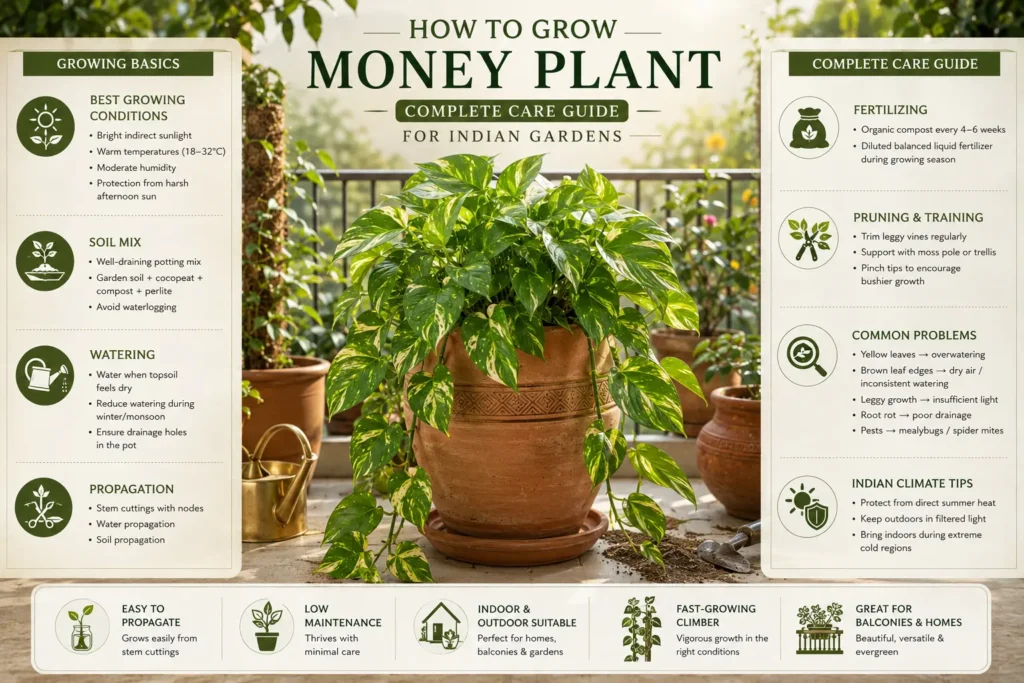
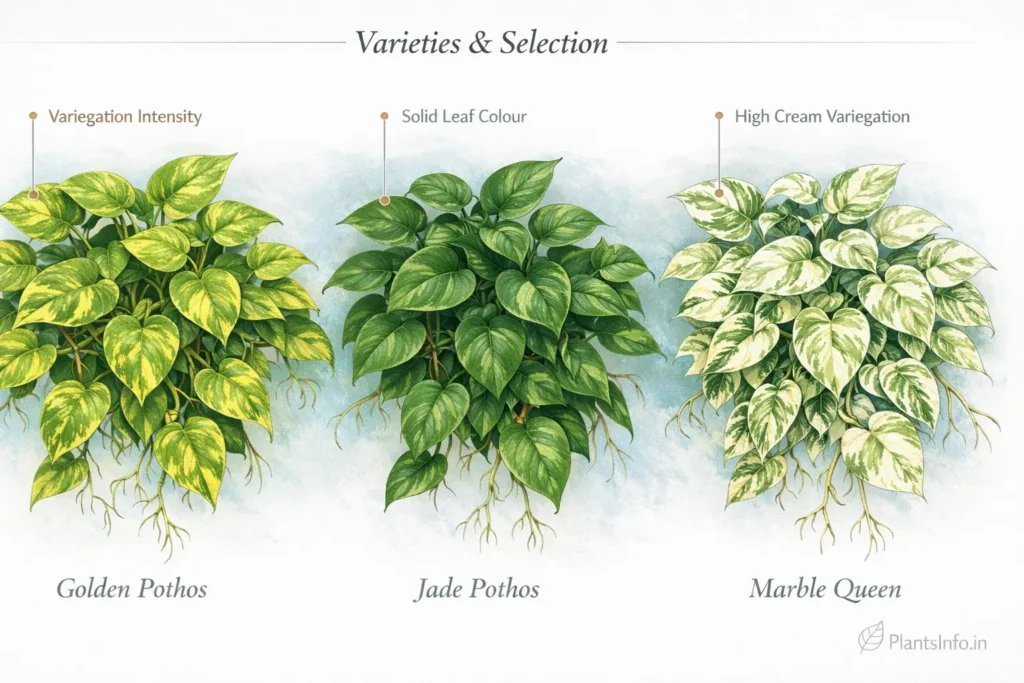
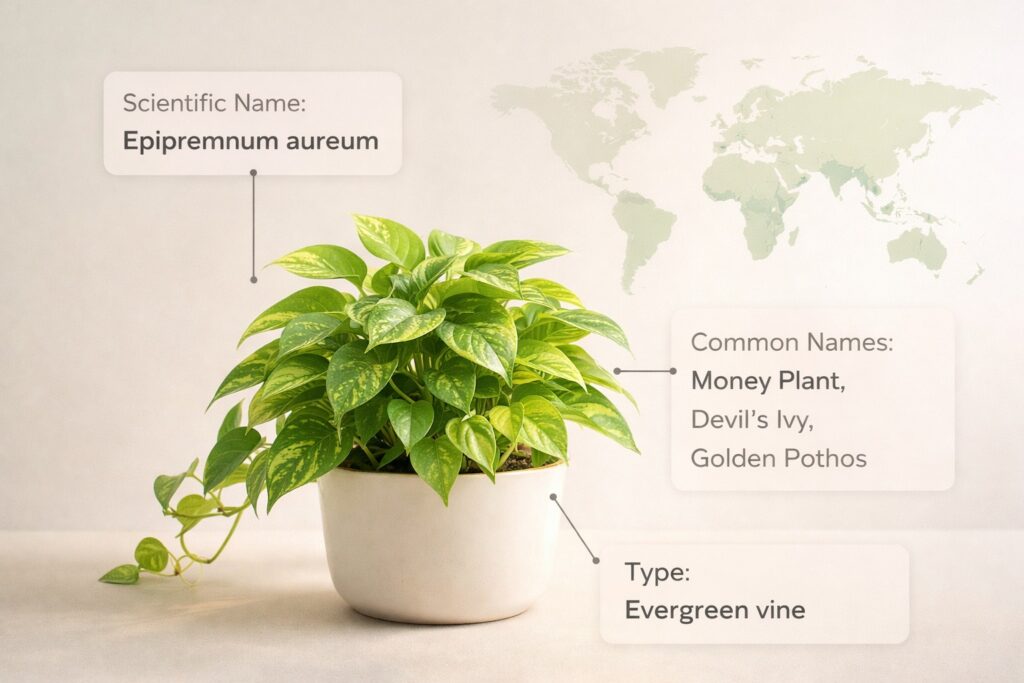
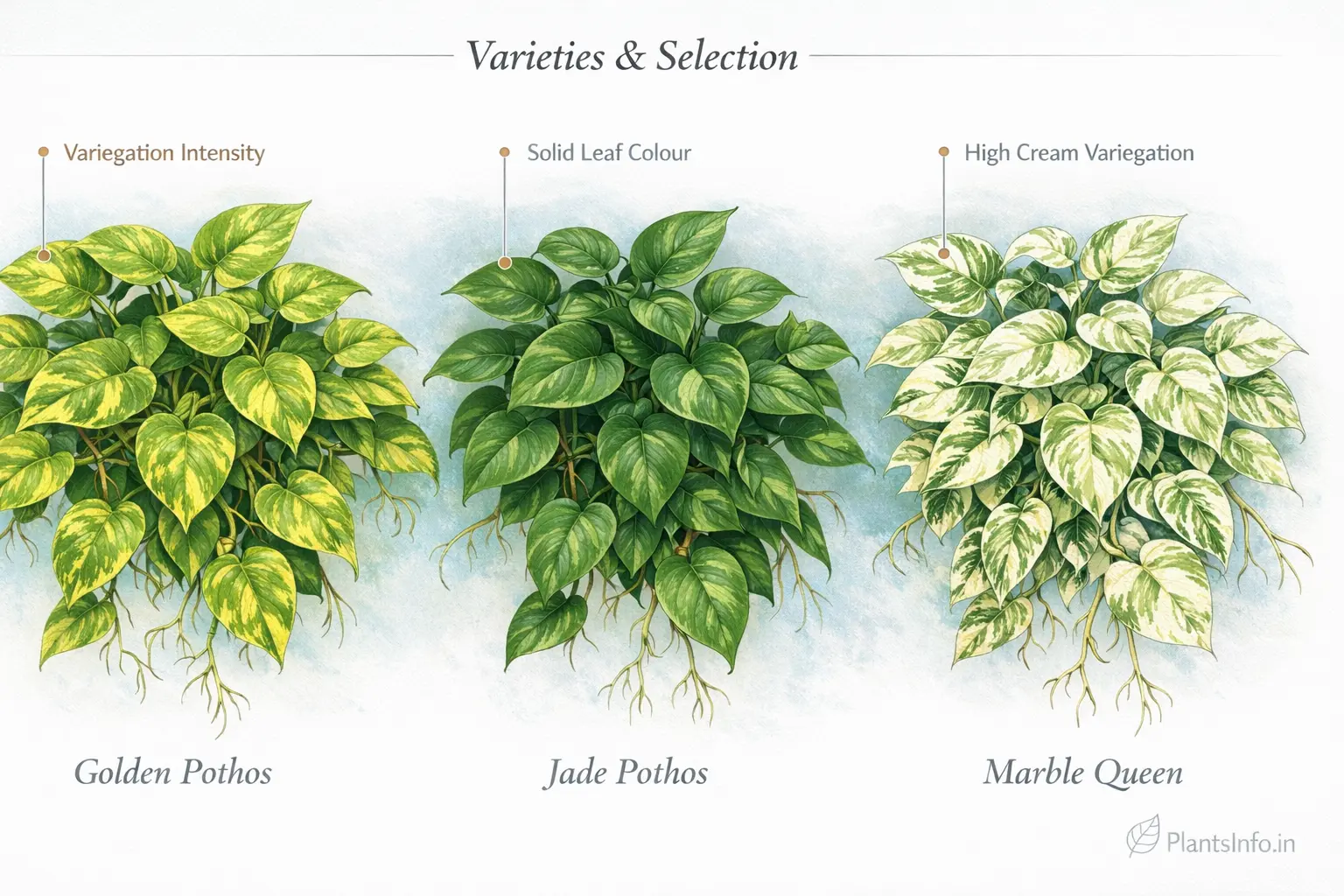
Golden Pothos (Epipremnum aureum) is the plant most Indians have grown up seeing in homes, offices, and temple corridors. It is the default “money plant” of the Indian market — deep green leaves splashed with yellow-gold variegation, fast-growing, and genuinely tolerant of neglect, low light, and irregular watering. Its weakness is that the variegation fades in poor light, leaving mostly green leaves. It is the most widely available variety across India and the safest choice for a first-time grower.
Marble Queen
Marble Queen is a slower-growing cultivar with heavily variegated leaves in white and green. The high white content means it needs more light than Golden Pothos to maintain its pattern — in low light, it reverts toward plain green and grows sluggishly. Its strength is visual impact: a well-lit Marble Queen on a shelf is one of the most striking easy-care indoor plants available. It is widely sold across Indian nurseries but is often mislabelled as a separate species entirely.
Neon Pothos
Neon Pothos produces uniformly chartreuse-yellow leaves with no variegation — an unusual look that works best as a contrast plant against darker foliage. It is not a beginner variety in the sense that its colour requires consistent bright indirect light; in low light, the neon fades to a flat yellow-green that looks unhealthy rather than striking. It grows at a similar rate to Golden Pothos. Widely available in South Indian nurseries; less common in smaller North Indian markets.
Manjula Pothos
Manjula Pothos is a patented cultivar with wavy-edged leaves showing cream, white, and green marbling — no two leaves look identical. It grows more slowly than Golden or Marble Queen and is less forgiving of erratic watering. Its compact size makes it well-suited to containers and shelves where a slower, tidier grower is preferable. Availability in India has improved over the last few years, with most larger urban nurseries stocking it.
Pearls and Jade
Pearls and Jade is a compact cultivar with small, distinctly patterned leaves — green with white and grey-green margins. It stays significantly smaller than Golden or Marble Queen, which makes it genuinely useful for small balconies and terrace pots where other varieties quickly outgrow their space. It is more sensitive to direct sun and hot, dry conditions than hardier varieties. Availability is uneven — found easily in metro nurseries, harder to source in smaller towns.
Silver Pothos / Satin Pothos
Silver Pothos / Satin Pothos (Scindapsus pictus) is technically a different genus, but is universally sold as money plant in India. Its dark green leaves have silver-grey splashes that look painted on, and it performs exceptionally well in the high-humidity conditions of coastal cities like Chennai, Kochi, and Mumbai. It tolerates lower light than most variegated varieties and is one of the best choices for bathrooms with a small window. Growth is moderate rather than aggressive.
Cebu Blue
Cebu Blue (Epipremnum pinnatum ‘Cebu Blue’) has narrow, elongated blue-grey-green leaves — very different from the heart-shaped leaves of standard pothos. It is a vigorous climber, and given a moss pole or wall, it will develop much larger, fenestrated leaves over time. It suits larger spaces and does best in the humidity of South India and coastal regions. Availability is limited; primarily found in specialist nurseries and online plant sellers.
N’Joy Pothos
N’Joy Pothos is a compact cultivar with clearly delineated white and green patches — less blended than Marble Queen, more graphic in appearance. It grows slowly, stays tidy, and suits small containers well. Its consistent indirect light requirement means it is not the best choice for dark rooms. Available in most large urban nurseries.
Head-to-Head Comparison
- Golden Pothos vs Marble Queen is the most common comparison Indian buyers face. Golden Pothos wins on resilience — it tolerates low light, irregular watering, and temperature swings better than almost any other variety. Marble Queen wins on appearance — the white-heavy variegation is more dramatic and works better as a display plant in a well-lit room. For a first plant, a bathroom, or a room with limited light, choose Golden. For a shelf or desk near a bright window where you want visual impact, choose Marble Queen. Marble Queen grows about 30–40% slower than Golden Pothos under identical conditions, which means it stays manageable in small spaces longer.
- Neon Pothos vs Manjula Pothos comes down to the kind of statement you want to make. Neon Pothos is bold and uniform — one colour, high impact, best as a single specimen in a bright spot. Manjula Pothos is intricate — each leaf is different, the growth is slower, and it rewards close attention. For a terrace or bright living room where you want one show plant, Neon wins. For a shelf or study where you want something interesting at arm’s length, Manjula is the better choice. Neon is significantly easier to find in Indian nurseries than Manjula.
How to Choose for Your Space
Container or terrace garden: Pearls and Jade, N’Joy, or Manjula. All three stay compact, grow slowly enough not to overwhelm a pot, and tolerate the temperature swings of an outdoor terrace better than more delicate cultivars. Avoid Cebu Blue in containers — it wants to climb and will become unmanageable.
Small ground plot or indoor wall: Golden Pothos is the clear choice. Given a surface to climb, it grows fast, covers evenly, and needs minimal intervention. Marble Queen works too, but will cover the same area in roughly twice the time.
Larger garden, backyard, or compound wall: Cebu Blue or Golden Pothos trained on a structure. Cebu Blue will develop impressive fenestrated leaves as it matures and climbs. Golden Pothos is more widely available and more tolerant of the variable outdoor conditions of Indian gardens.
Home with low-light rooms: Silver Pothos (Scindapsus pictus) outperforms every true pothos variety in genuinely low-light conditions and is the honest recommendation for bathrooms, interior corridors, and north-facing rooms. Among true pothos, Golden Pothos is the most tolerant of low light, but no variety thrives in near-darkness.
Regional Suitability
North India (Delhi, UP, Punjab, Rajasthan): Golden Pothos and Marble Queen perform well through most of the year. Protect all varieties from cold, dry winds and temperatures below 10°C in December–January. Avoid keeping Cebu Blue outdoors through North Indian winters.
South India (Tamil Nadu, Karnataka, Kerala, Andhra Pradesh): All varieties grow well. Silver Pothos and Cebu Blue are particularly well-suited to the year-round humidity of coastal South India. Neon Pothos maintains its colour better here than in the dry North.
Coastal regions (Mumbai, Goa, Kochi, Chennai): Ideal conditions for almost all varieties. High humidity supports faster growth and better variegation retention. Monitor more carefully for fungal issues during the monsoon.
Hill stations and high-altitude zones (Himachal, Uttarakhand, Nilgiris): Money plant can be grown here, but most varieties slow significantly below 15°C. Bring containers indoors or under cover during cold months. Golden Pothos is the most cold-tolerant of the common varieties.
Desi vs Hybrid — What Nobody Tells You
The money plant sold in India is almost entirely propagated from cuttings — there is no meaningful “desi vs hybrid” distinction in the way that exists for vegetables or fruit trees. What matters instead is whether the plant is tissue-culture propagated or cutting-propagated.
Tissue-culture plants — increasingly available through online sellers — are disease-free, uniform, and often more vigorous in the first year. Their weakness is a transition period of 2–4 weeks after purchase, where they are adjusting from sterile lab conditions to home conditions and may look stressed. Do not discard a TC plant that looks unhappy in its first month.
Cutting-propagated plants from nurseries are the norm across India and are perfectly reliable. The risk is that cuttings taken from an unhealthy mother plant carry forward any pest or disease problems, which is why inspecting before purchase matters.
Watch Out for Mislabelling
Mislabelling is common in the Indian money plant market, partly because the name “money plant” is applied loosely to several unrelated species, and partly because cultivar names are rarely standardised at the nursery level.
The most common mislabelling: Marble Queen sold as a separate species, Silver Pothos (Scindapsus pictus) sold as a money plant variety when it is a different genus entirely, and Cebu Blue sold simply as “blue pothos” with no cultivar information. This matters because Silver Pothos and true pothos have slightly different care needs — Silver Pothos prefers to dry out more between waterings and is more sensitive to overwatering than Golden Pothos.
To verify after purchase: Golden Pothos has a channelled petiole (the leaf stem has a groove running along it). Scindapsus pictus has a rounded petiole and a slightly matte, velvety leaf texture. If you bought a “money plant” and the leaf surface feels subtly different from standard pothos, it is almost certainly Scindapsus — care for it accordingly.
For reliable sourcing, state-run nurseries, Krishi Vigyan Kendras (KVKs), and established urban nurseries with labelled stock are more consistent than roadside vendors and unverified online sellers for named cultivars.
Frequently Asked Questions
Can all money plant varieties grow in water?
Yes — all pothos varieties and Silver Pothos propagate and grow in water indefinitely, though growth will be slower than in soil. Change the water every 7–10 days to prevent bacterial buildup.
Why is my Marble Queen turning green?
Insufficient light. Marble Queen reverts toward green in low-light conditions — move it to bright indirect light and new leaves will emerge with stronger white variegation.
Is Cebu Blue the same as a regular money plant?
No. Cebu Blue is Epipremnum pinnatum, a different species from the standard money plant (E. aureum), though both are sold under the money plant name in India.
Choose the variety that matches your light conditions first, your space second, and your aesthetic preference last — in that order. A Golden Pothos in the right spot will always outperform a Marble Queen in the wrong one.
Conclusion
Choose the variety that matches your light conditions first, your space second, and your aesthetic preference last.