Money Plant (Pothos) Flowering Season: When and What to Expect in India
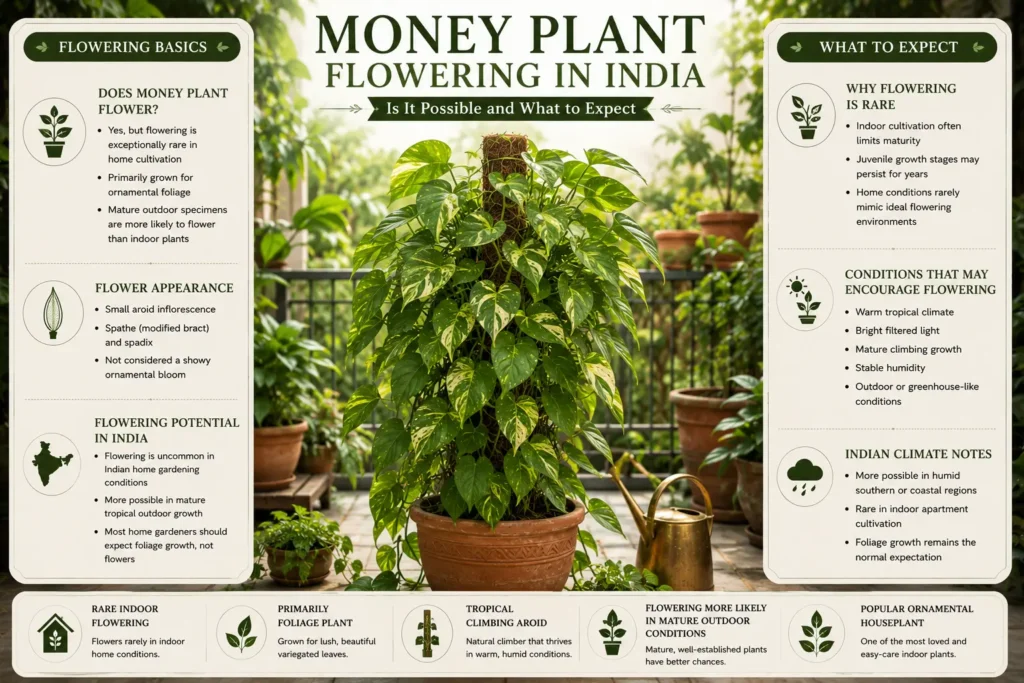
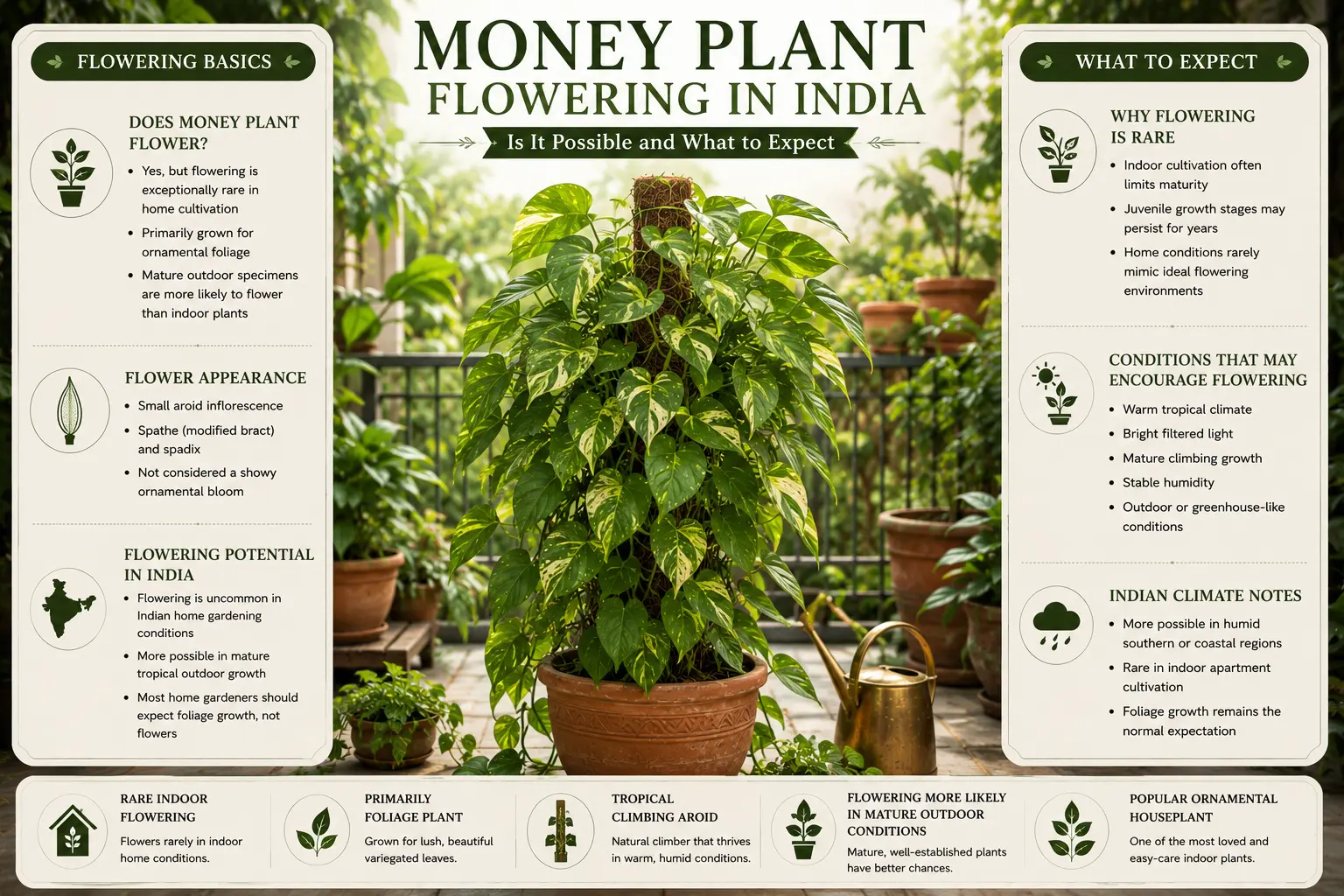
Quick Answer: Money plant almost never flowers in cultivation — anywhere in the world, including India. This is not a care failure; it is a known genetic trait. Grow it entirely for its foliage. The best time to plant a new cutting in India is at the start of monsoon (June–July) or in early winter (October–November). Rather than producing seasonal flowers, Money Plant follows a seasonal growth cycle. Understanding when it grows most actively is far more useful for gardeners than waiting for blooms.
See also: Money Plant plant profile, how to grow it, common problems, its benefits, and its varieties.
There is a genetic reason your money plant has never flowered, and there is nothing you can do about it. A gene responsible for producing the hormones that trigger flowering is non-functional in Epipremnum aureum — researchers confirmed this specifically. Every single money plant in cultivation worldwide shares this trait. Knowing this upfront saves months of frustration, adjusted light schedules, and fertilizer experiments that will not change anything.
Recommended Products
Disclosure: As an Amazon Associate, PlantsInfo may earn from qualifying purchases.
🌱 Growing Essentials
The following products can help with container gardening, potting, root development, soil management, and healthy plant growth.
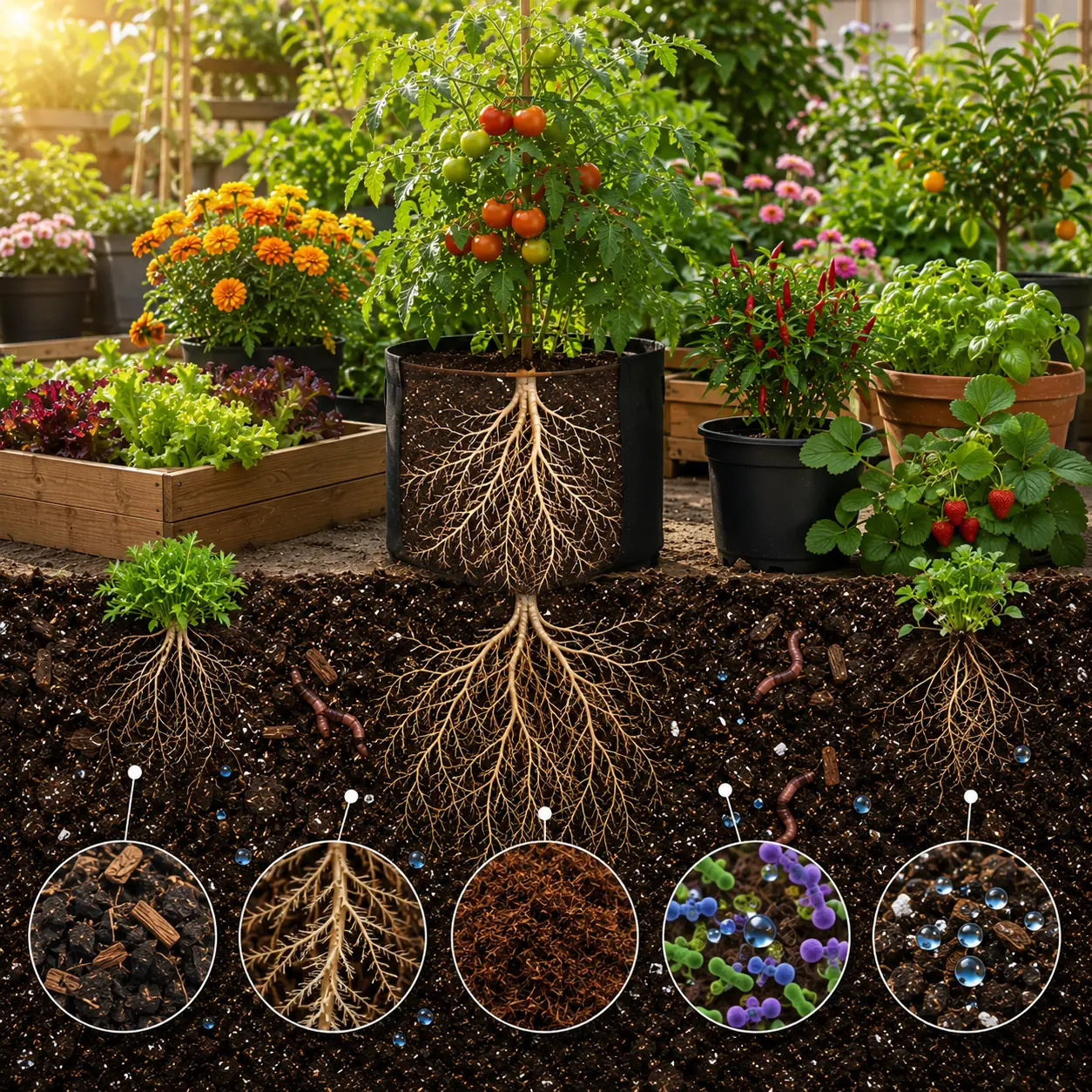
Organic Potting Soil Mix
Provides nutrients, structure, and healthy growing conditions for container plants.
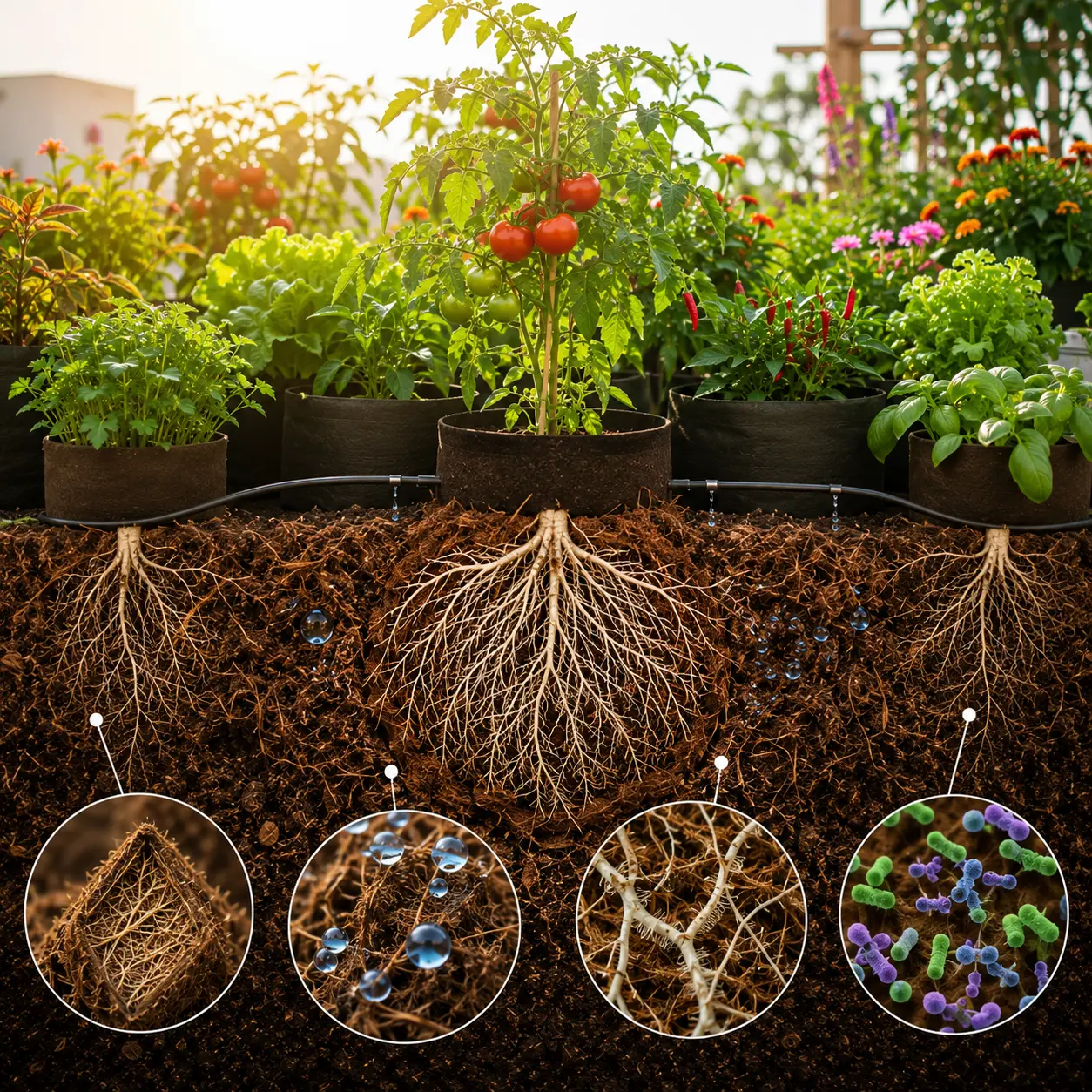
Coco Peat Growing Medium
Enhances moisture retention while maintaining excellent root-zone aeration.

Grow Bags for Plants
Improve drainage, root aeration, and vegetable production in limited spaces.

Plastic Pots for Plants
Ideal containers for seedlings, ornamentals, herbs, and balcony gardens.
India’s Seasons and This Plant
| Season (months) | What the plant is doing |
|---|---|
| Pre-monsoon (Mar–May) | Active growth begins; vines extend; new leaves unfurl rapidly |
| Monsoon (Jun–Sep) | Peak growth period; fastest leaf production; best time to take cuttings |
| Post-monsoon (Oct–Nov) | Growth continues but begins to slow; good planting window |
| Winter (Dec–Feb) | Slowest growth; needs less water; vines remain healthy but expand little |
“Flowering” Season in Detail
Money plant does not have a flowering season in any practical sense. Scientifically, the plant lacks functional gibberellin biosynthesis — the hormonal pathway that signals a plant to flower. Researchers have induced flowering in laboratory conditions by applying gibberellin hormones externally, but this is not practical for home growers and is of curiosity value only.
What the plant does have is a very visible growth season. New leaves emerge most vigorously between March and September, with the monsoon months (June–August) producing the fastest, lushest growth across most of India. In warm, humid climates like coastal Karnataka, Kerala, and West Bengal, new leaves can emerge nearly year-round with minimal slowdown.
In north India (Delhi, Punjab, UP), growth slows noticeably from November through February due to cooler temperatures. The plant will not die, but new leaf production drops significantly.
One thing to watch in the monsoon: in high-humidity conditions, the vines can grow so quickly they become tangled. Trimming every 3–4 weeks during this period keeps the plant tidy and encourages bushier growth.
Fruiting Season
Money plant does not fruit in cultivation. Fruit only follows flowers, and as noted above, this species does not flower under normal growing conditions. Skip any expectations of seeds or fruit.
Best Time to Plant
First choice: Monsoon onset (June–July). The combination of warmth, humidity, and consistent moisture creates perfect rooting conditions for cuttings. A cutting placed in moist soil or water in June will typically develop a strong root system within 2–3 weeks.
Second choice: Early winter (October–November). Growth is slower, but rooting still occurs reliably in the moderate temperatures of the Indian post-monsoon cool-down.
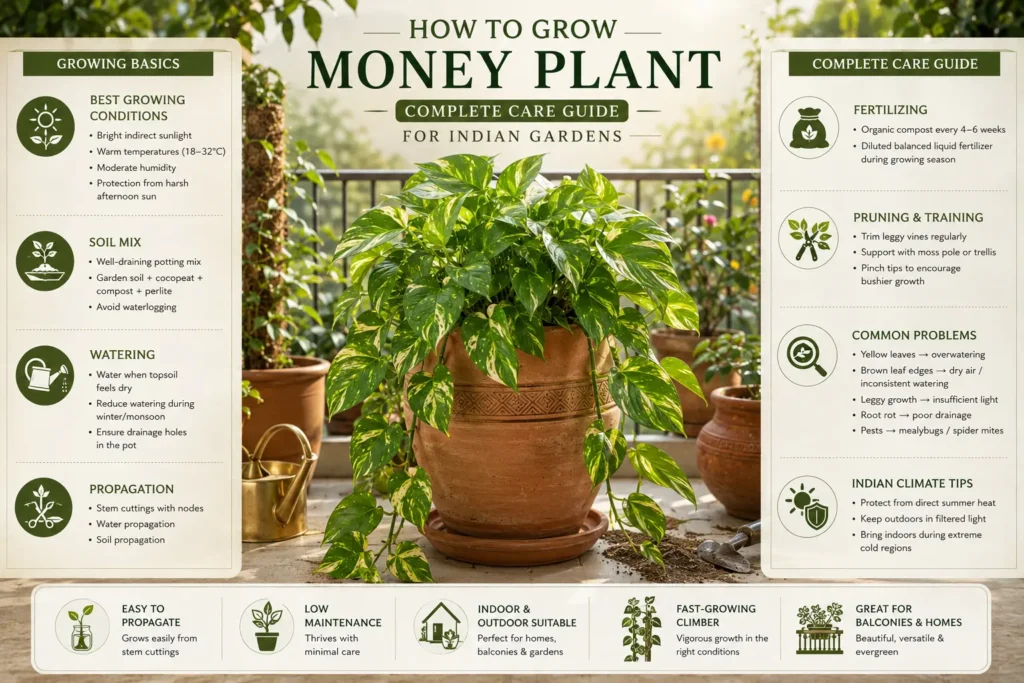
Avoid planting in peak summer (April–May) if possible — the heat and dry air can stress new cuttings before they have rooted, particularly in north and central India. If you must plant in summer, keep the cutting in water rather than soil until roots are well established.
Container vs. ground: Cuttings planted in containers can be started any time they are moved indoors to a stable environment. Ground planting outdoors in humid states like Kerala or Assam can be done year-round.
Month-by-Month Care Calendar
| Month | Season | Key Task |
|---|---|---|
| January | Winter | Reduce watering; no fertiliser needed; protect from cold drafts |
| February | Winter/Pre-monsoon | Fastest growth begins; best time for cuttings; reduce watering for outdoor plants. |
| March | Pre-monsoon | Growth picks up; resume monthly fertiliser; trim leggy vines |
| April | Pre-monsoon | Watch for spider mites in dry heat; mist leaves occasionally |
| May | Pre-monsoon | Keep away from harsh afternoon sun; water more regularly |
| June | Monsoon | Fastest growth begins; best time for cuttings; reduce watering for outdoor plants |
| July | Monsoon | Peak growth; trim actively; check for root rot in waterlogged pots |
| August | Monsoon | Continue trimming; wipe dust from leaves for better light absorption |
| September | Monsoon/Post-monsoon | Growth begins to slow; last chance for easy-rooting cuttings |
| October | Post-monsoon | Good planting window; fertilise lightly before winter slowdown |
| November | Post-monsoon/Winter | Growth slows; reduce watering and feeding frequency |
| December | Winter | Minimal care; water sparingly; no fertiliser until February |
What Can Go Wrong Seasonally?
Monsoon: Root rot from waterlogged pots. Outdoor and semi-outdoor pots fill with rainwater in the monsoon. If your pot does not have drainage holes, or if it sits in a saucer that collects water, root rot sets in quickly. Fix: elevate pots on bricks or pot feet, and ensure drainage holes are clear.
Summer: Leaf scorch and spider mites.s The combination of dry heat and strong light encourages spider mites, which appear as tiny dots on leaf undersides and leave fine webbing. This is commonly misdiagnosed as sunburn or nutrient deficiency. Look closely at the leaf underside with a magnifying glass. Fix: Spray with diluted neem oil solution every week for three weeks.
Winter: Yellowing from cold. In north Indian winters, placing a money plant near a cold window or in a room that drops below 12°C at night causes leaves to yellow and drop. This looks like overwatering, but it is a temperature problem. Move the plant to a warmer, more sheltered indoor position.