How to Grow Safed Musli: Complete Care Guide for Indian Gardens
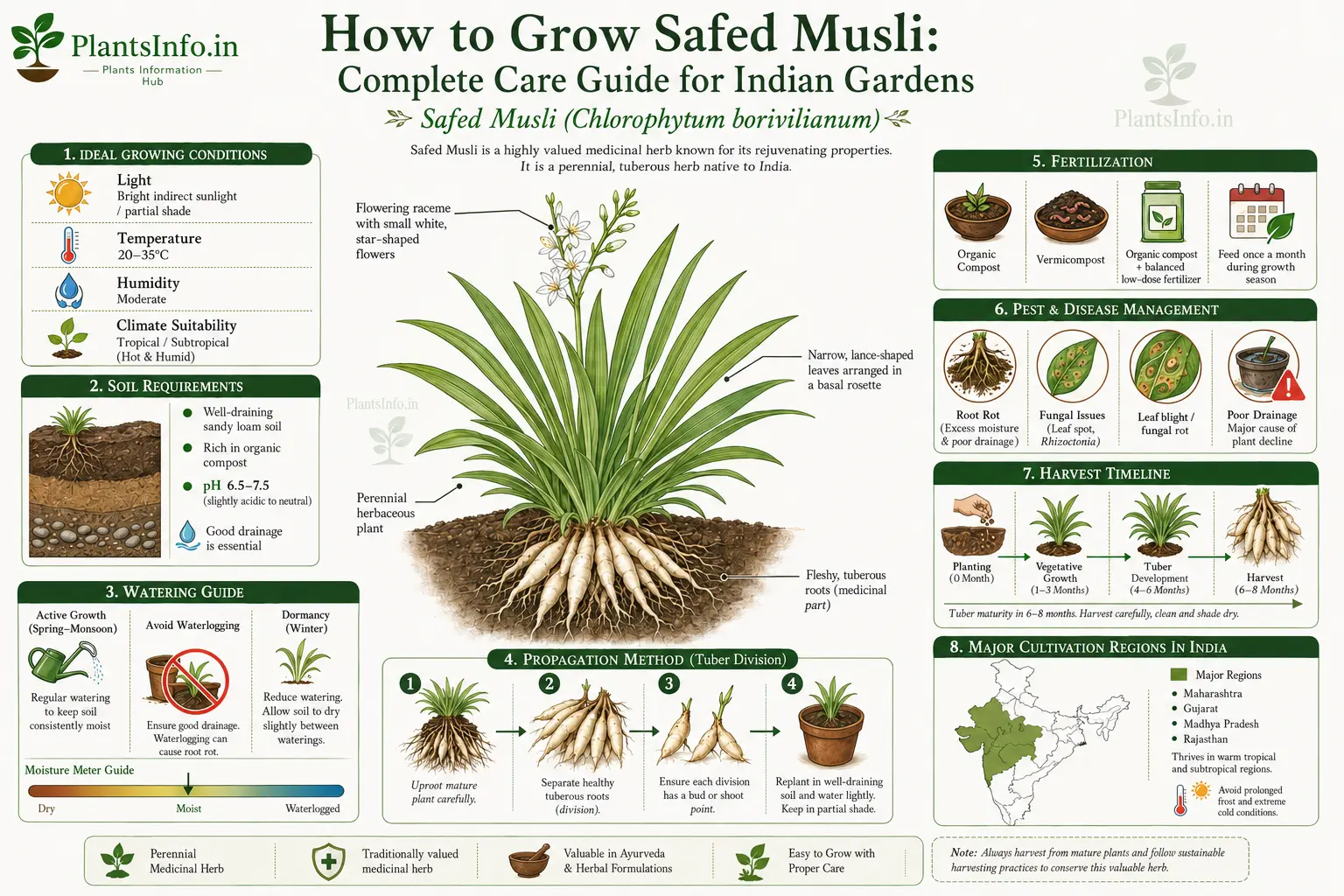
Quick Answer: Safed Musli is a seasonal tuberous herb grown from crown-bearing root tubers planted at monsoon onset. It completes its full growth cycle in approximately six to eight months — leafing out through the monsoon, flowering through summer, and going dormant in winter when tubers are harvested. It needs well-drained, organically rich soil and filtered to partial sun.
See also: Safed Musli plant profile, common problems, its flowering season, its benefits, and its varieties.
There is something counterintuitive about this plant that every first-time grower discovers: Safed Musli is not the vigorous, spreading herb you might expect for something called “white gold.” Above ground, it is a modest, grass-like plant with lanceolate leaves that could easily be mistaken for an ornamental Chlorophytum.
Recommended Products
Disclosure: As an Amazon Associate, PlantsInfo may earn from qualifying purchases.
🌱 Growing Essentials
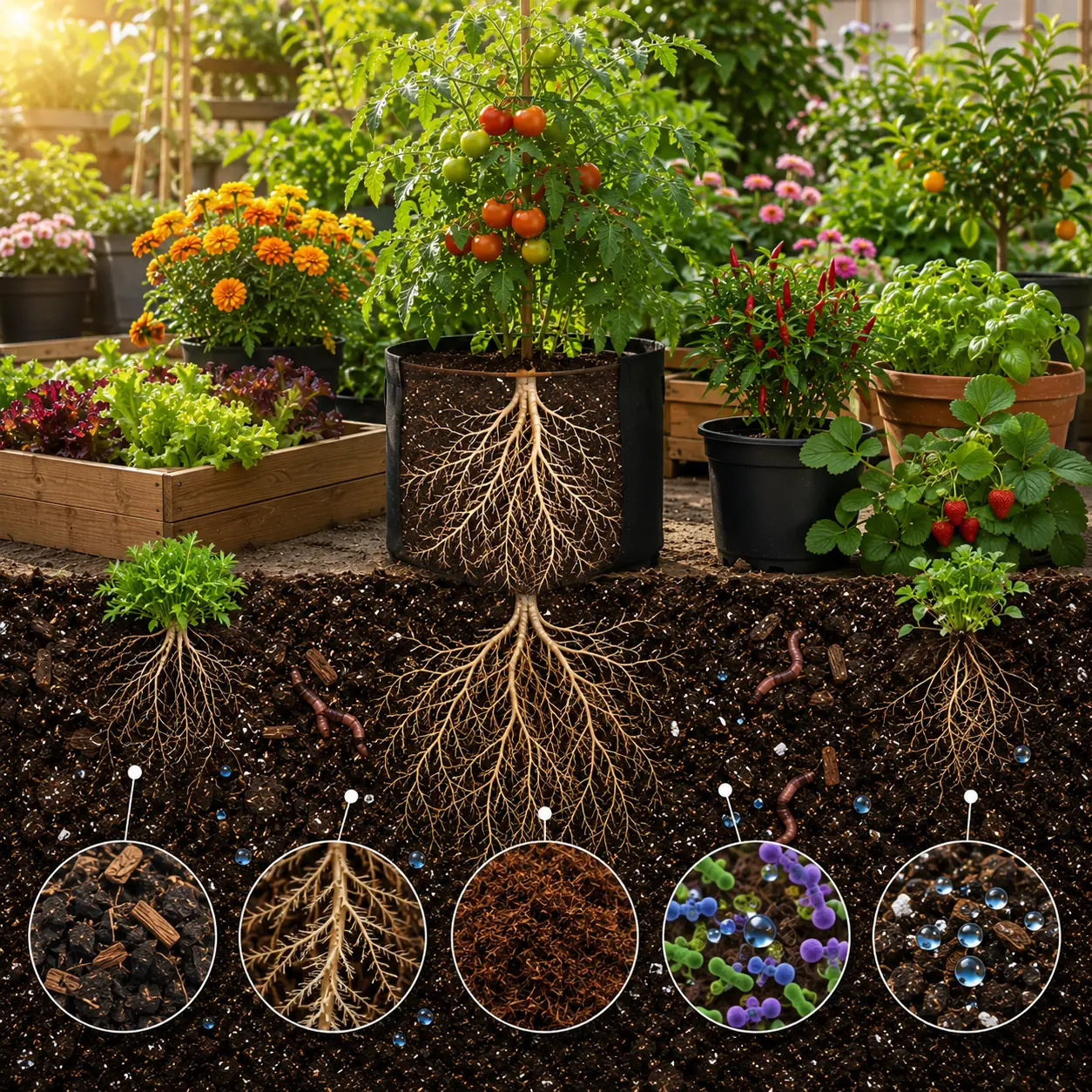
The following products can help with container gardening, potting, root development, soil management, and healthy plant growth.
Organic Potting Soil Mix
Provides nutrients, structure, and healthy growing conditions for container plants.
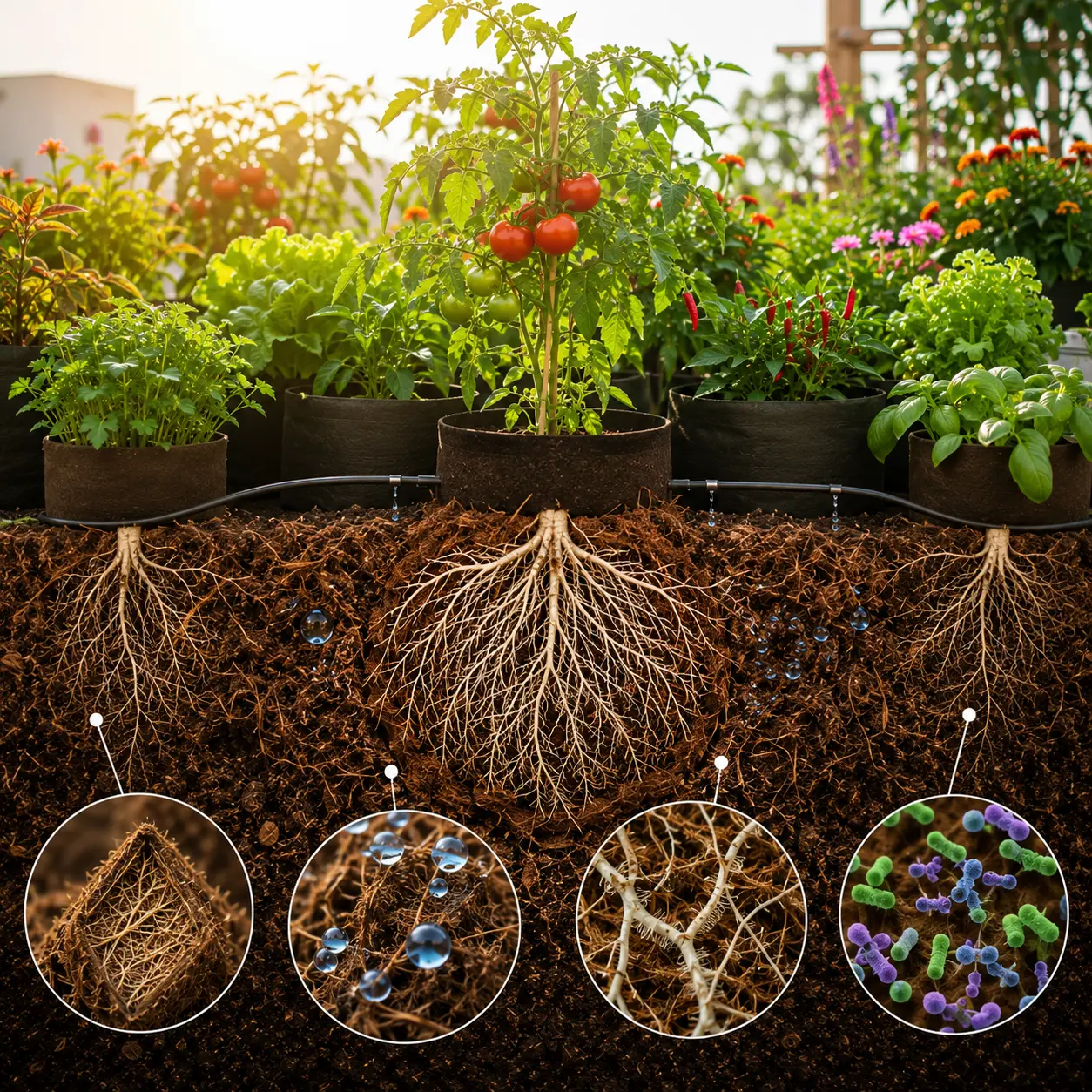
Coco Peat Growing Medium
Enhances moisture retention while maintaining excellent root-zone aeration.

Grow Bags for Plants
Improve drainage, root aeration, and vegetable production in limited spaces.

Plastic Pots for Plants
Ideal containers for seedlings, ornamentals, herbs, and balcony gardens.
All the value is underground, in the cluster of fleshy white tubers that swell invisibly through the monsoon season. The single biggest mistake beginners make is planting tubers too deep, or in compacted soil — both slow rooting and reduce the final tuber yield significantly.
Quick Facts
| Attribute | Detail |
|---|---|
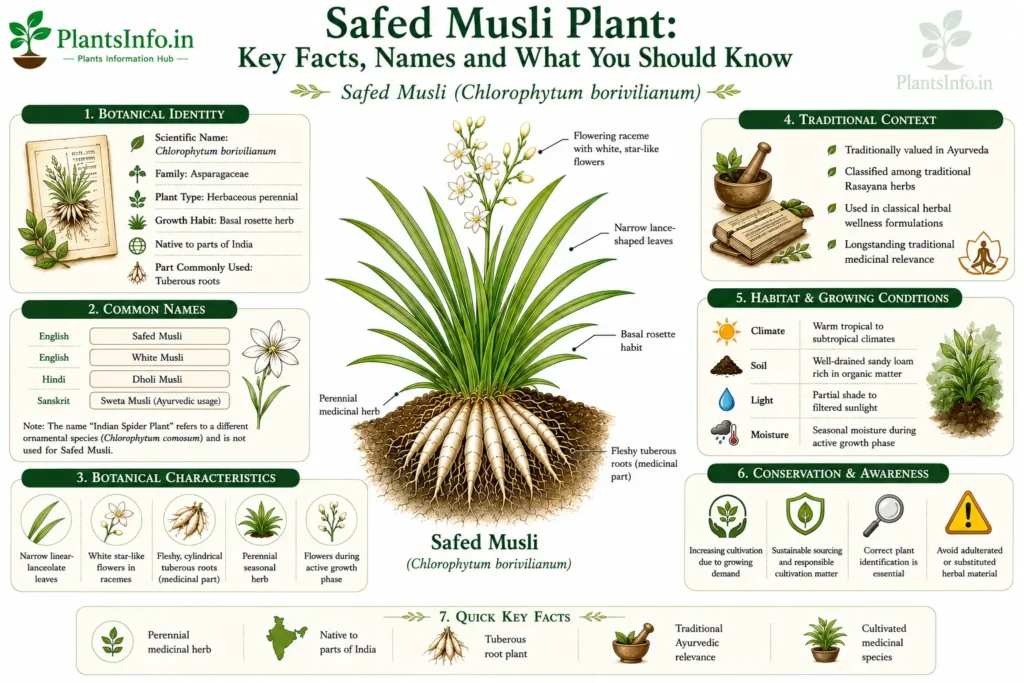
| Common names | Safed Musli, White Musli, Divya Aushadhi, Dholi Musli |
| Scientific name | Chlorophytum borivilianum Santapau & R.R. Fern. |
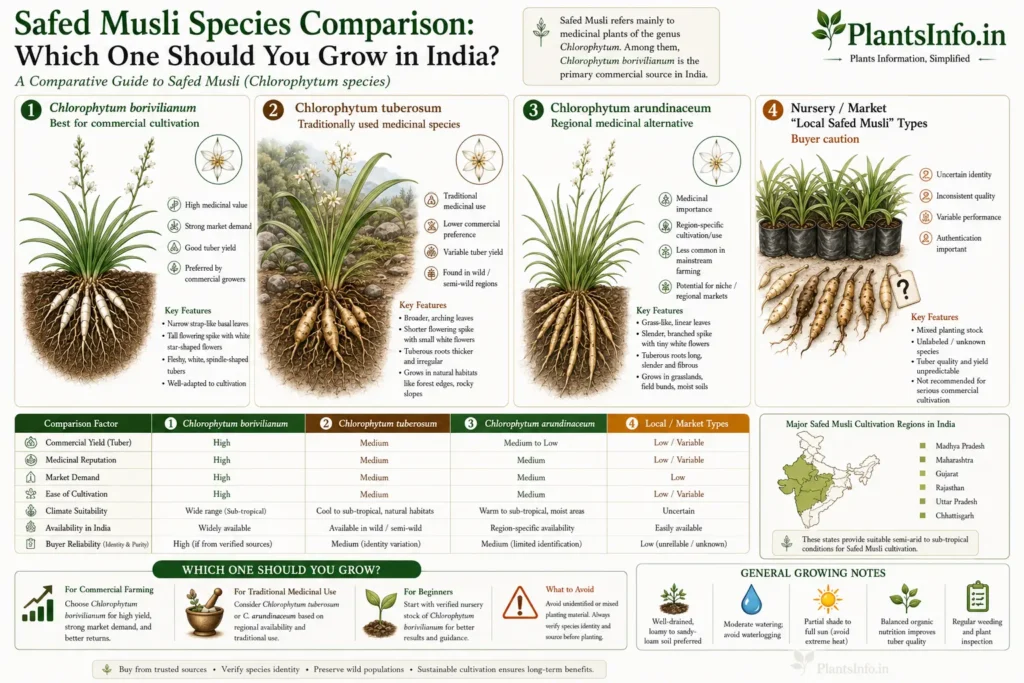
| Varieties | RC-2, RC-16, Jawahar Safed Musli 405, Rajvijay Safed Musli 414. |
| Plant type | Perennial tuberous herb (grown as annual crop) |
| Mature size | 30–45 cm above ground; tuber clusters 15–20 cm deep |
| Sunlight | Partial shade to filtered sun; 50–75% sunlight ideal |
| Water needs | Moderate; consistent moisture during growing season, dry during dormancy |
| Best season to plant | Monsoon onset (June–July) |
| Suitable states | MP, Gujarat, Rajasthan, Maharashtra, Chhattisgarh, UP, Karnataka, Assam |
Choosing the Right Spot
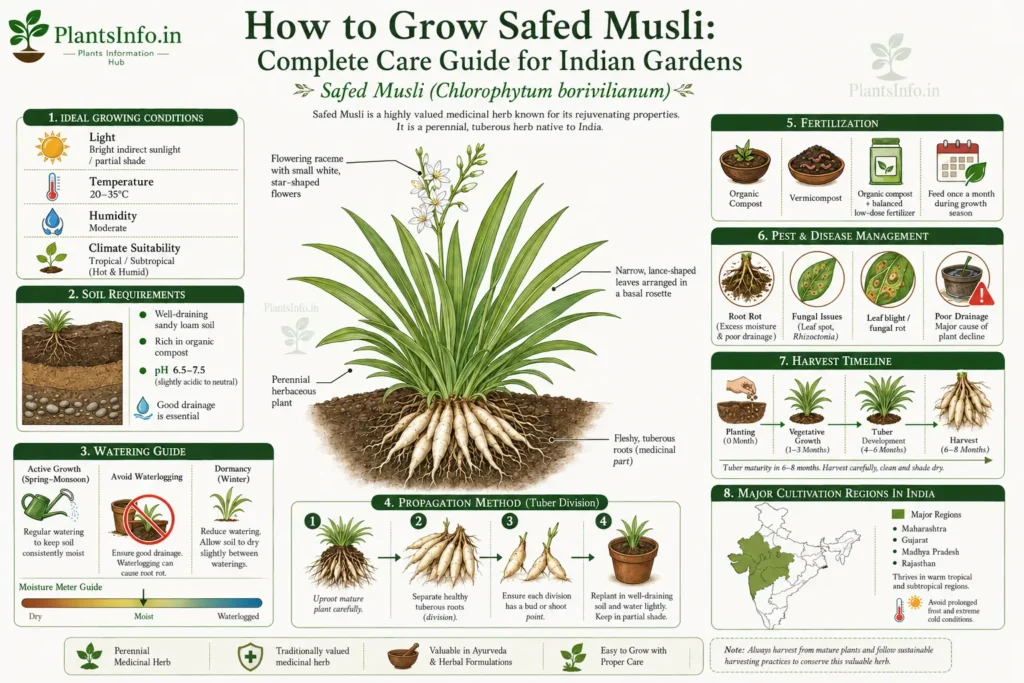
Safed Musli is a forest-floor plant in its natural habitat, growing in the dappled shade of deciduous forests across central India. In the home garden, this translates to a position that receives bright, filtered light — around 50–75% of full sunlight. Direct, unbroken afternoon sun in summer scorches the leaves and stresses the tuber development. Morning sun with afternoon shade, or the light beneath a canopy of trees with an open sky above, is ideal.
CIMAP research confirms that planting at approximately 75% of photosynthetically active radiation — roughly the light level under a light canopy or shade net — produces maximum dry root yield. A shade cloth of 25–30% density over a raised bed is an effective solution for open garden plots in North and Central India.
Container growing works well in large containers of 20–25 litres or more. The key requirement is depth — shallow containers restrict tuber development. A minimum depth of 25–30 cm is necessary for a full tuber cluster to form properly.
Soil and Potting Mix
Soil quality is the single most important factor in Safed Musli cultivation. The plant rewards investment in soil preparation more than any other input. Sandy loam or red soil rich in organic matter gives the best results across Indian conditions. Research at RAU Udaipur and CIMAP Lucknow both confirm that well-drained, organically enriched loam outperforms all other soil types for tuber yield and saponin content.
Soil pH between 6.5 and 7.5 is ideal. Hard, compacted clay soils and highly acidic soils must be avoided — they obstruct tuber expansion and cause the roots to fork or remain stunted.
For home garden preparation, work in a generous quantity of well-rotted farmyard manure or vermicompost to a depth of 25–30 cm before planting. Add coarse river sand to improve drainage if the base soil is heavy. One part garden soil, one part vermicompost, and one part coarse sand make a reliable container mix.
The most common soil mistake Indian home growers make is planting in the top 5 cm of unimproved garden soil and expecting the tubers to expand. The crop needs deep, loose, well-fed soil to develop its characteristic thick, white root clusters.
Planting — Season and Method
Safed Musli is planted at monsoon onset — the last week of June to mid-July is the prime window across most of central and north India. This timing aligns with warm, consistently moist soil, which is exactly what crown-bearing tubers need to root and sprout rapidly. In South India (Karnataka, Andhra Pradesh, Assam), planting can begin slightly earlier — mid-June — given earlier monsoon arrival.
Tubers with intact crowns are the planting material. Each planting unit should carry 3–4 attached tubers and a healthy crown bud. Plant in raised beds or ridges at a depth of 4–6 cm with the crown facing upward. Spacing of 15 cm × 15 cm is optimal for home bed cultivation, giving each plant adequate room for tuber cluster development without crowding.
Plant on raised beds or ridges wherever possible — this is not optional in areas with heavy monsoon rainfall. Flat-bed planting collects water at the crown zone and causes rot within days of heavy rain.
First watering: water lightly once at planting, then rely on monsoon rainfall. Supplementary irrigation is needed only if there is a gap of more than seven to ten days without rain during the establishment phase.
Watering
During the active monsoon growing season (July–September), Safed Musli needs consistent moisture — the soil should be moist to 10–15 cm depth at all times, but never waterlogged. Natural monsoon rainfall meets this requirement in most of central India. In drier years or in less rainfall zones, irrigate every five to seven days.
As the season moves into October–November and the plant begins to yellow and die back, reduce watering progressively. By December, when the above-ground parts have fully died back, stop all watering. The tubers are dormant and require dry conditions. Watering dormant tubers causes rot.
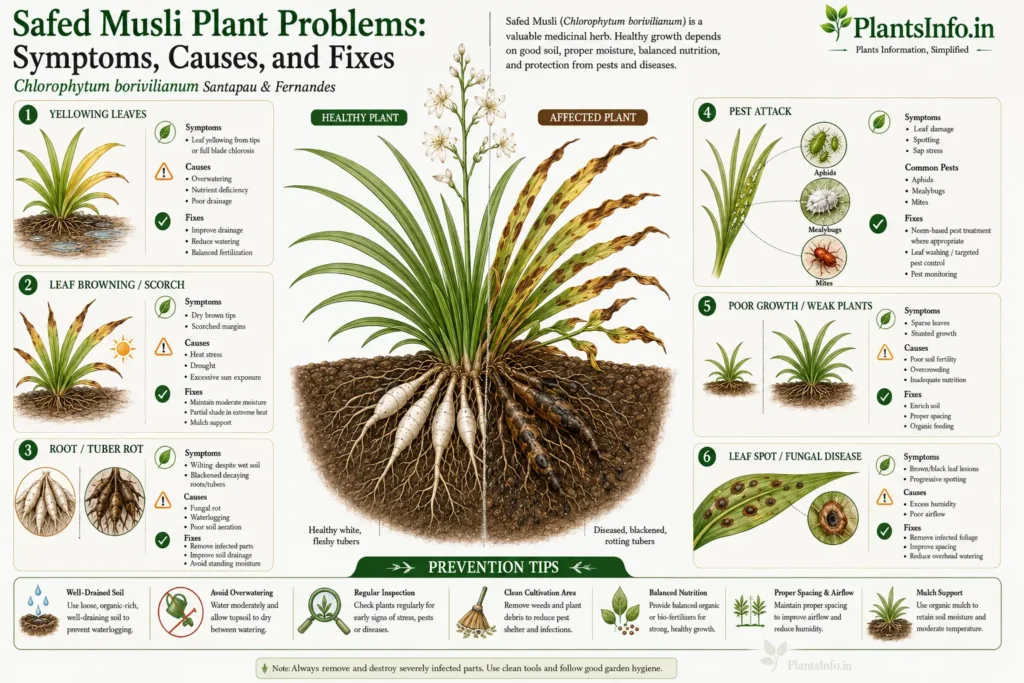
One specific overwatering sign during the growing season: the collar zone at soil level turns soft and dark brown while the lower leaves yellow and collapse — this is crown rot, not drought, and more water will accelerate the damage.
Fertiliser
Apply well-rotted farmyard manure or vermicompost at bed preparation, at a rate of 8–10 kg per square metre of bed area. This basal application is the most important nutritional input — Safed Musli responds more to good organic soil preparation than to top-dressings.
At 30 days after sprouting, apply a light dressing of neem cake (100–150 g per square metre) worked into the topsoil. Neem cake serves dual duty: slow-release nutrition and suppression of soil-borne pathogens, to which Safed Musli is susceptible.
Avoid high-nitrogen chemical fertilisers. Excessive nitrogen promotes lush above-ground leaf growth at the expense of tuber development — the exact opposite of what you want. If using chemical inputs, a modest phosphorus and potassium application (SSP or MOP) supports root and tuber development more usefully than urea.
Common Problems and Fixes
Three problems account for most Safed Musli losses in Indian home gardens:
Leaf blight — necrotic spots beginning at leaf tips, caused by Macrophomina phaseolina or Colletotrichum species; most serious during high-humidity monsoon months.
Tuber and collar rot — caused by waterlogged soil at the crown zone; the most common reason for complete crop failure.
Leaf-eating caterpillars — chewing damage on green leaves; most active during the monsoon season.
When Will You See Results?
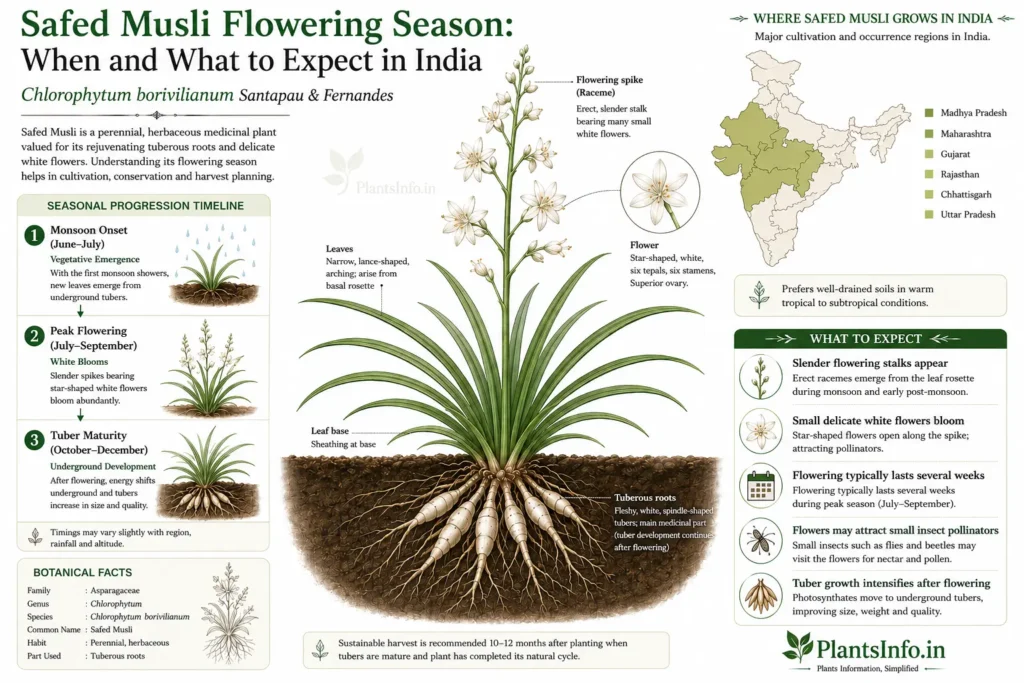
Above-ground sprouting begins approximately two to three weeks after tuber planting in warm monsoon soil. The plant is essentially invisible until then — new growers often worry that nothing is happening. Leaves reach their full height of 30–45 cm by August–September.
Flowers appear from July through December on sparse white panicles that can reach 120 cm in height. Tubers are ready for harvest approximately 90–120 days after planting, when the aerial parts have yellowed and died back completely — typically in November to December. Do not attempt early harvest; tubers continue to swell through October.
Year-one yields from home garden plantings are modest — typically a small cluster of 8–12 tubers per plant. Year-two replanting with the harvested crowns progressively improves yield as growers refine their soil preparation and spacing.
Propagation
Crown-bearing tubers are the standard propagation method. At harvest, separate the tuber cluster carefully, keeping the crown bud intact on each planting unit. These harvested crowns are the planting material for the next season’s crop.
Storage of planting material between harvest (November–December) and replanting (June–July) requires care. Store the harvested crowns with a small amount of attached soil in a cool, dry, shaded location. Do not store in airtight conditions — the crown bud is alive and needs minimal air circulation. Germination capacity degrades significantly if the crowns are stored in humid or wet conditions.
Seed propagation is possible but extremely slow — seedlings take two to three seasons to reach a harvestable root size. Crown propagation is always the practical choice for home gardeners.
Container Growing
Use containers with a minimum depth of 25–30 cm and a volume of at least 20–25 litres per plant. Standard round terracotta or cement containers of 30–35 cm diameter work well. Ensure a minimum of two large drainage holes.
Container plants need closer attention to moisture management than ground-planted crops — pots dry out faster and also overheat on exposed terraces in North India. Place containers in a position with morning sun and afternoon shade, and monitor soil moisture during July–October when the crop is actively developing.
At harvest, simply empty the pot, collect the tuber clusters, amend the potting mix with fresh vermicompost, and replant the following monsoon.
Harvesting
Harvest when the above-ground parts have completely yellowed and died back — this is the visual signal that tubers have reached their maximum development. In most of central India, this occurs in November to December.
Loosen the soil carefully from the sides of the bed or container before lifting the root cluster. The tubers are firm, white, and finger-shaped — typically 8–15 cm long and 1–2 cm in diameter in a well-grown plant. Handle carefully; damaged tubers are more susceptible to rot during storage.
Wash the tubers clean, peel the outer brown skin (optional — some preparations use unpeeled), and dry in shade for 7–10 days before storage or use. Properly dried Safed Musli tubers turn beige to pale yellow and have a shelf life of 12–18 months in a cool, dry container. Commercial drying is done at low temperatures to preserve saponin and alkaloid content.
Companion Plants
In forest-garden settings, Safed Musli grows naturally beneath deciduous canopy trees. In a home garden, planting it beneath the partial shade of an Amla or Neem tree replicates this natural habitat and produces healthy growth without supplementary shade netting.
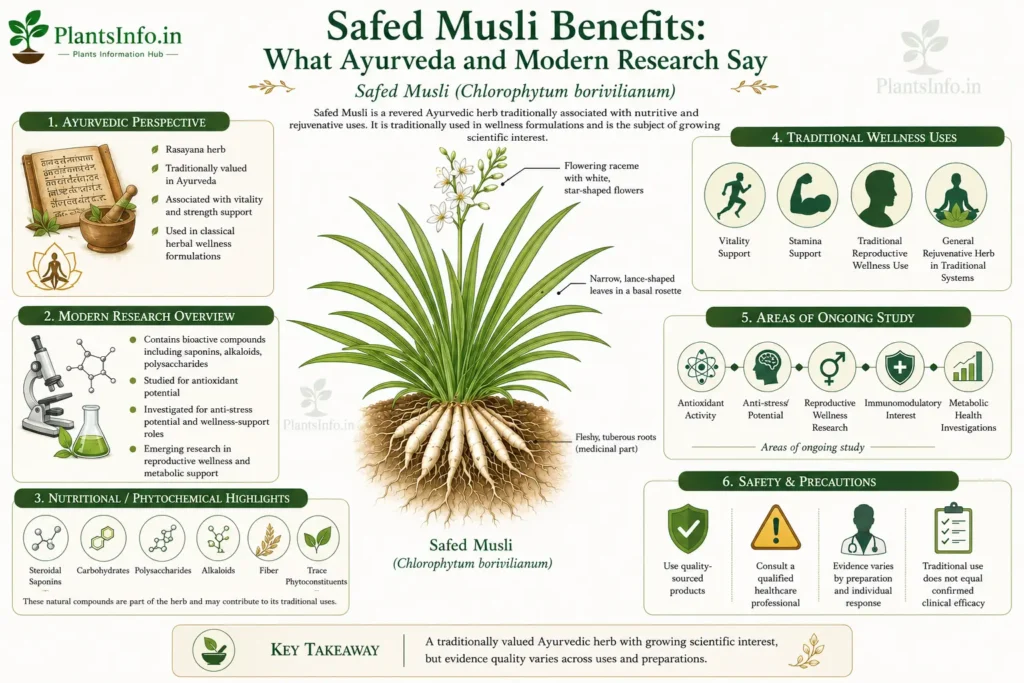
Ashwagandha planted nearby in a shared medicinal bed makes a thematically and practically compatible companion — both are vajikarana rasayana herbs with complementary growing seasons and non-overlapping root depths.
Avoid planting Safed Musli near crops requiring heavy irrigation — waterlogging risk from a neighbour’s irrigation schedule is a real problem for this moisture-sensitive tuber crop.
Key Takeaways
- Safed Musli is planted from crown-bearing tubers at monsoon onset and harvested approximately 90–120 days later when above-ground parts die back.
- Soil preparation is the single highest-impact investment — deep, loose, organically rich, well-drained soil directly determines tuber yield.
- Raised beds or ridges are not optional; flat-bed planting in monsoon conditions causes crown rot.
- Tubers are dormant from December to June and must be stored dry — watering dormant tubers causes rot.
- The plant looks modest above ground; all value is in the underground cluster that develops invisibly through the season.
Plant with patience — what Safed Musli withholds in visual drama, it delivers in the quiet accumulation of white tubers underground.