Jasmine Varieties Guide (Jasminum spp.): Major Species, Characteristics and Selection
Quick Answer
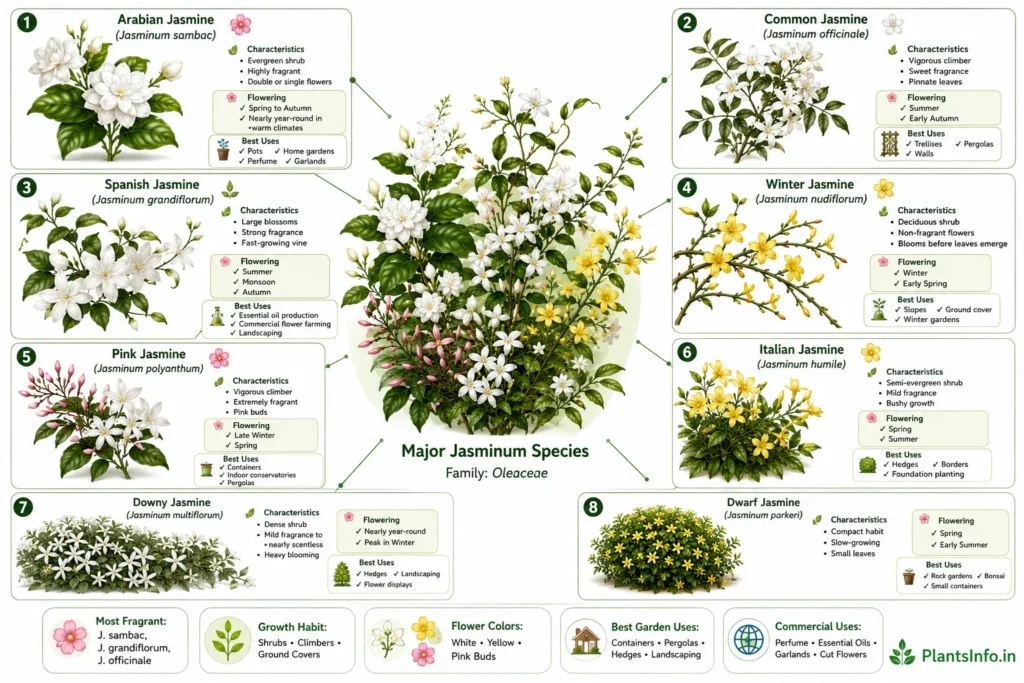
The genus Jasminum comprises more than 200 recognized species of flowering shrubs, climbers, and scandent plants belonging to the olive family (Oleaceae). While many species are cultivated ornamentally, only a relatively small number are widely grown for landscaping, commercial flower production, perfumery, or traditional cultural uses. Among the most important are Jasminum sambac (Arabian Jasmine), Jasminum grandiflorum (Spanish or Royal Jasmine), Jasminum officinale (Common or Poet’s Jasmine), Jasminum auriculatum (Juhi), and Jasminum multiflorum (Downy or Star Jasmine). Each species differs in growth habit, flower size, fragrance, flowering season, climatic adaptability, and horticultural use.
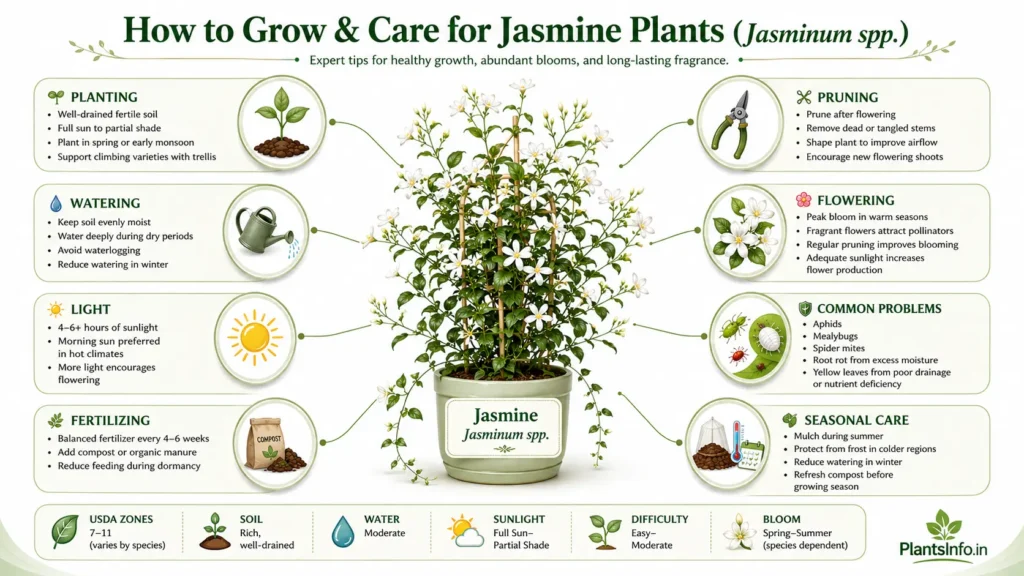
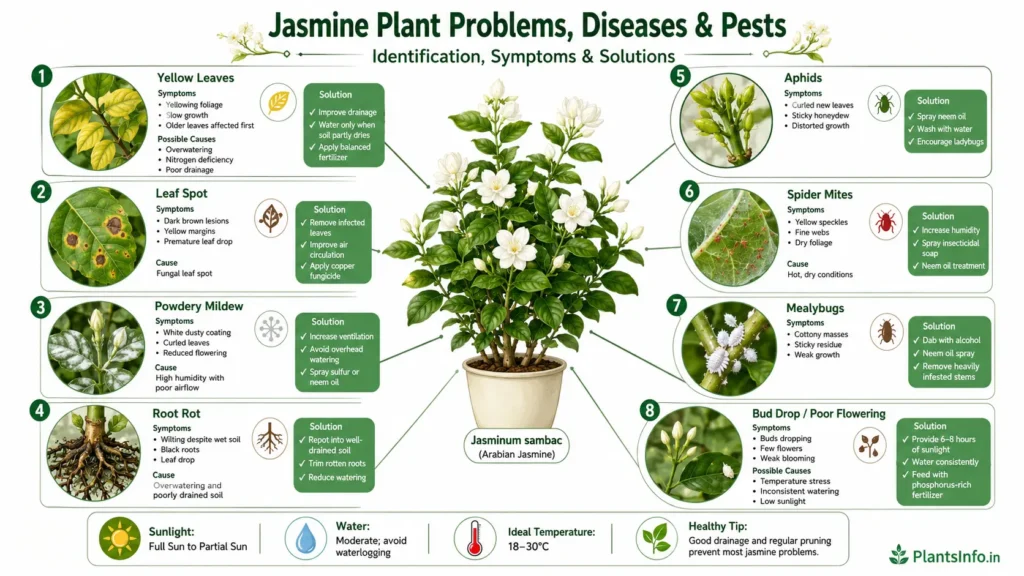
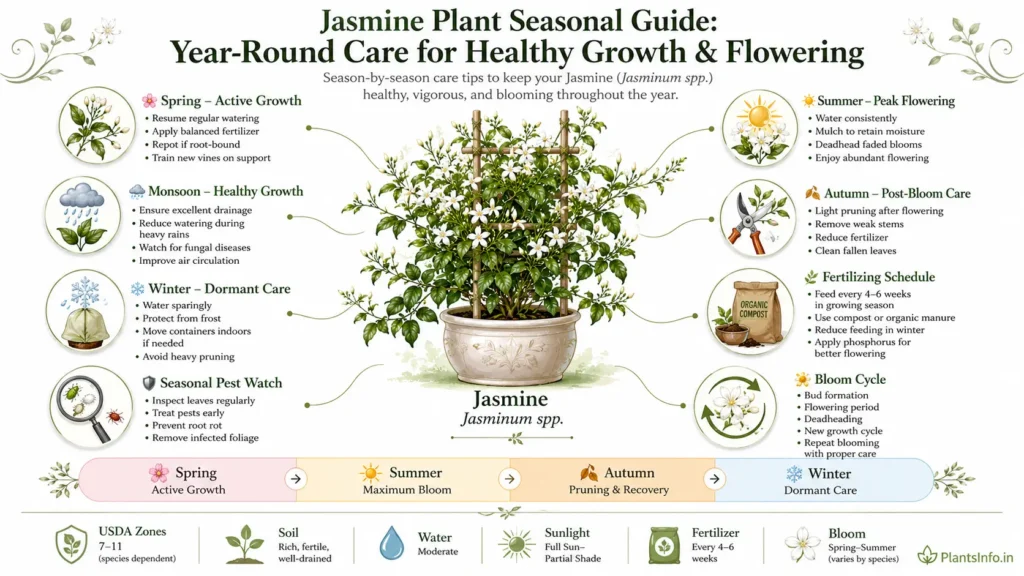
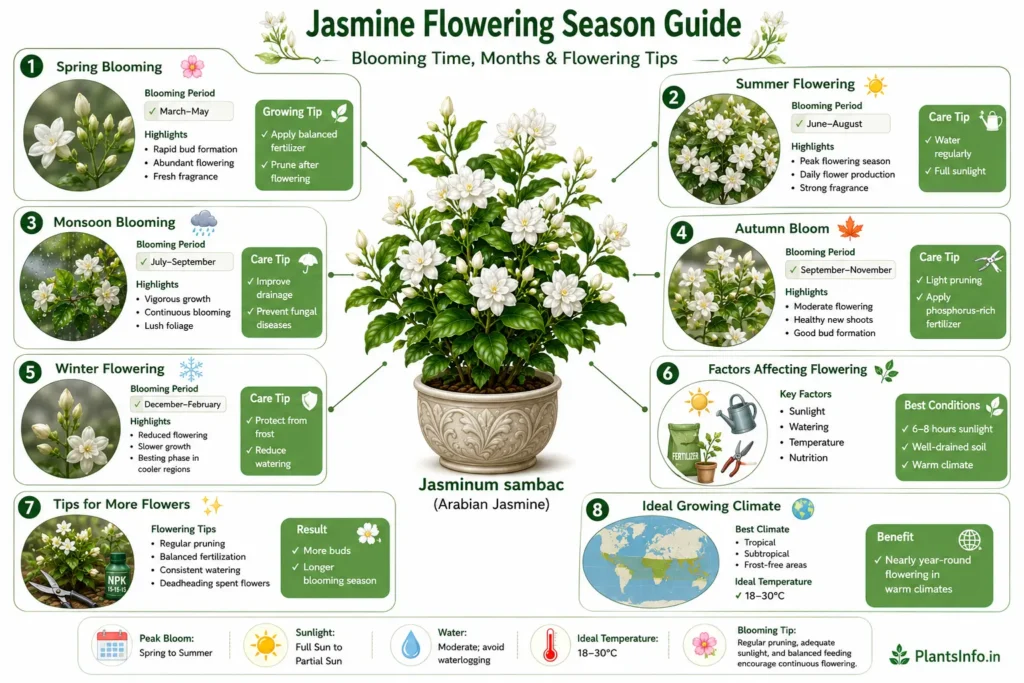
See also: Jasmine Plant plant profile, how to grow it, common problems, seasonal care, and its flowering season.
Introduction
Jasmine has captivated gardeners for centuries because of its fragrant flowers, graceful growth habits, and exceptional versatility. However, the name “jasmine” refers not to a single plant but to a diverse genus containing hundreds of species distributed across tropical, subtropical, and temperate regions of Asia, Africa, Europe, and Oceania.
Recommended Products
Disclosure: As an Amazon Associate, PlantsInfo may earn from qualifying purchases.
🌱 Growing Essentials
The following products can help with container gardening, potting, root development, soil management, and healthy plant growth.
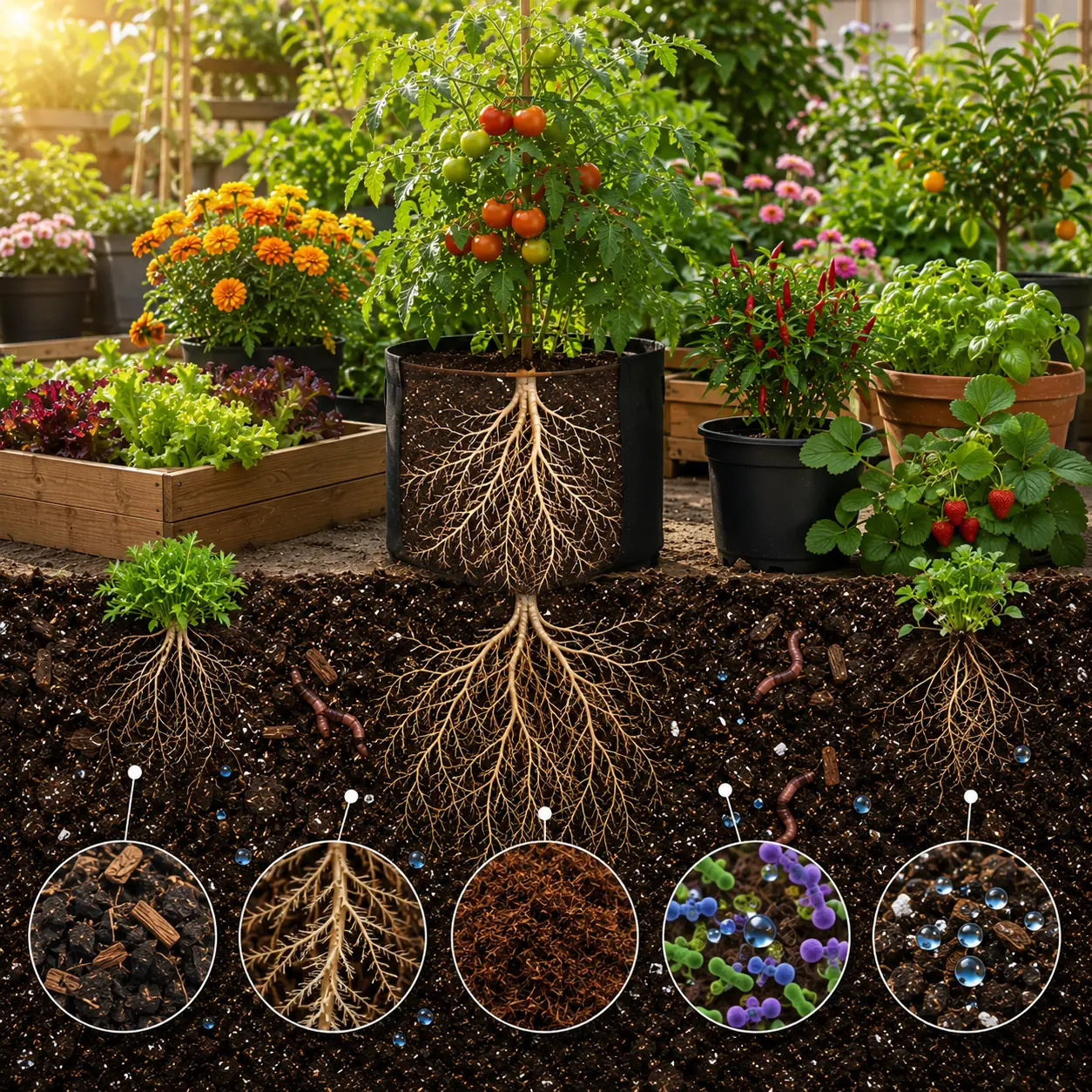
Organic Potting Soil Mix
Provides nutrients, structure, and healthy growing conditions for container plants.
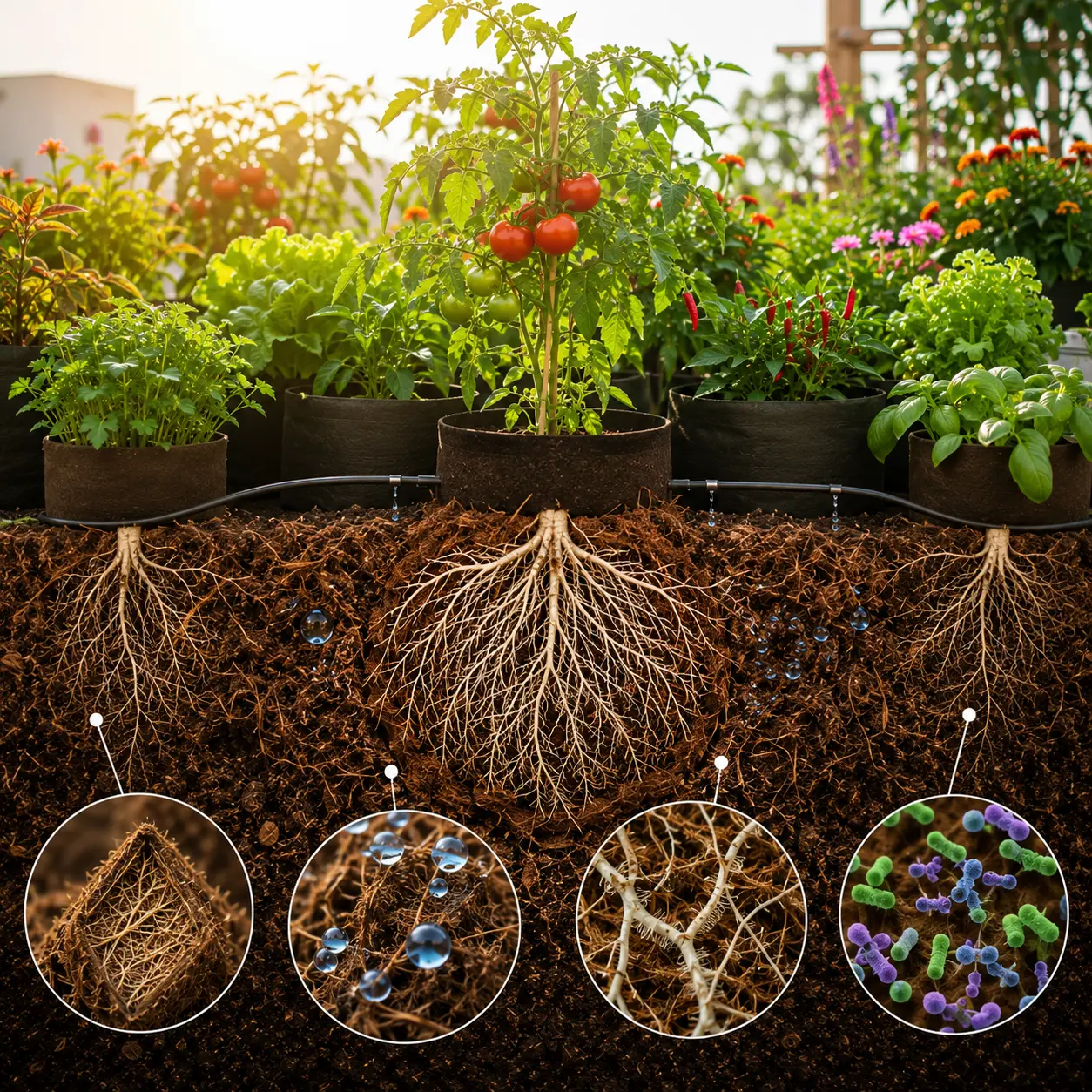
Coco Peat Growing Medium
Enhances moisture retention while maintaining excellent root-zone aeration.

Grow Bags for Plants
Improve drainage, root aeration, and vegetable production in limited spaces.

Plastic Pots for Plants
Ideal containers for seedlings, ornamentals, herbs, and balcony gardens.
Although many species share similar floral characteristics, they differ considerably in:
- Plant size.
- Growth habit.
- Leaf shape.
- Flower colour.
- Fragrance intensity.
- Flowering period.
- Cold tolerance.
- Commercial importance.
Understanding these differences allows gardeners, landscapers, and commercial growers to choose the most appropriate species for their climate, available space, and intended purpose.
This guide introduces the principal cultivated jasmine species that dominate ornamental horticulture and commercial production throughout India and many other parts of the world.
Understanding Jasmine Classification
Jasmine belongs to the family Oleaceae, which also includes olives (Olea), lilacs (Syringa), privets (Ligustrum), and ashes (Fraxinus).
Botanical Classification
| Taxonomic Rank | Classification |
|---|---|
| Kingdom | Plantae |
| Clade | Angiosperms |
| Clade | Eudicots |
| Order | Lamiales |
| Family | Oleaceae |
| Genus | Jasminum |
The genus currently includes more than 200 accepted species, although only a small proportion are widely cultivated commercially or ornamentally.
General Characteristics
Most Jasminum species share several botanical features:
- Opposite or occasionally alternate leaves.
- Woody stems.
- Tubular flowers with spreading lobes.
- Strong floral fragrance in many species.
- Berry-like fruits following successful pollination.
- Long-lived perennial growth.
Despite these similarities, individual species vary greatly in appearance and cultivation requirements.
Growth Habits
Different jasmine species may grow as:
- Evergreen shrubs.
- Semi-evergreen shrubs.
- Deciduous shrubs.
- Climbing vines.
- Scandent shrubs.
- Ground-covering plants.
This diversity explains why jasmine is used in everything from balcony containers to large landscape installations.
Flower Characteristics
Flowers differ significantly among species in:
- Size.
- Number of petals.
- Colour.
- Fragrance intensity.
- Blooming duration.
- Seasonal flowering pattern.
Some species flower almost continuously in tropical climates, while others produce one major flowering flush each year.
Major Jasmine Species
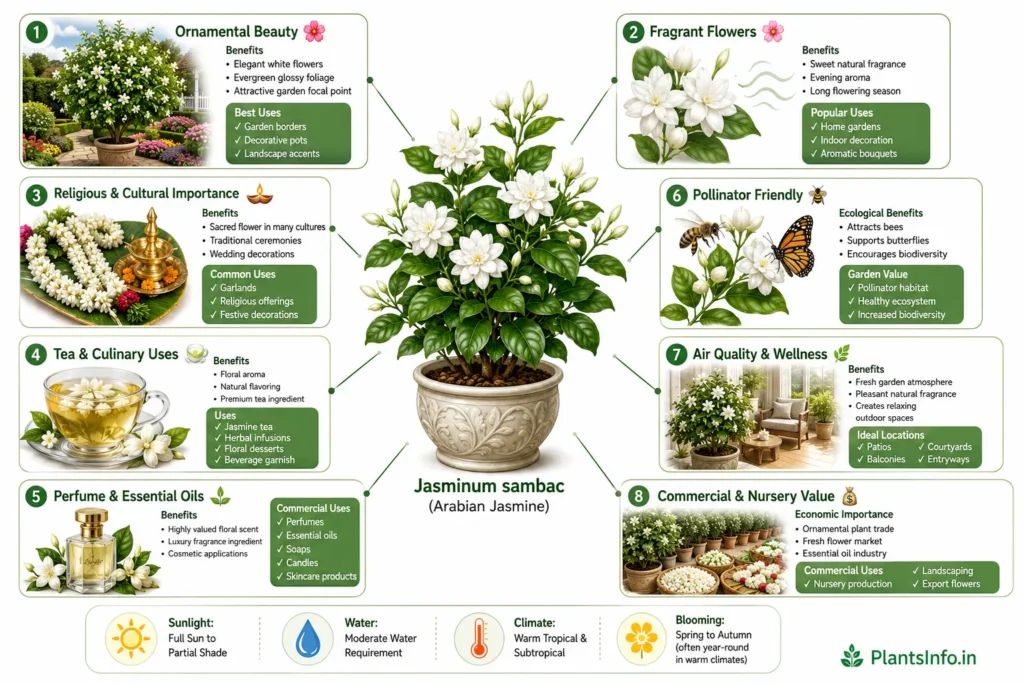
Jasminum sambac (Arabian Jasmine)
Overview
Jasminum sambac is among the most widely cultivated jasmine species in tropical regions and is especially important in India, Southeast Asia, and the Middle East. Despite its common name, Arabian Jasmine is believed to have originated in South or Southeast Asia before spreading widely through cultivation.
Key Characteristics
- Evergreen shrub or twining climber.
- Highly fragrant white flowers.
- Simple or double-flowered cultivars.
- Repeated flowering under warm conditions.
- Glossy dark-green foliage.
Ornamental Value
This species is prized for:
- Exceptional fragrance.
- Long flowering season.
- Container suitability.
- Decorative garden use.
- Floral garlands.
- Religious offerings.
Best Growing Conditions
- Warm tropical to subtropical climates.
- Full sun to partial shade.
- Well-drained fertile soil.
- Moderate irrigation.
Common Uses
- Home gardens.
- Courtyards.
- Temple gardens.
- Fragrance gardens.
- Commercial flower production.
- Perfume industry.
Jasminum grandiflorum (Spanish or Royal Jasmine)
Overview
Jasminum grandiflorum is one of the world’s most important commercial jasmine species because of its highly valued flowers and fragrance. It is extensively cultivated for perfume extraction and ornamental landscaping.
Key Characteristics
- Vigorous climbing shrub.
- Large white flowers.
- Strong sweet fragrance.
- Long flowering period.
- Attractive pinnate foliage.
Distinguishing Features
Compared with J. sambac, this species generally produces:
- Larger flowers.
- More elongated petals.
- Faster climbing growth.
- Extensive commercial cultivation for fragrance extraction.
Commercial Importance
This species is widely grown for:
- Perfumery.
- Essential oil production.
- Floral extraction.
- Cut flowers.
- Commercial horticulture.
Jasminum officinale (Common or Poet’s Jasmine)
Overview
Often referred to as Common Jasmine or Poet’s Jasmine, Jasminum officinale is native to parts of Asia and has become naturalized in many temperate regions.
Key Characteristics
- Deciduous to semi-evergreen climber.
- Clusters of white flowers.
- Pleasant sweet fragrance.
- Pinnate leaves.
- Vigorous growth.
Adaptability
Compared with many tropical jasmine species, J. officinale generally exhibits:
- Better tolerance of cooler climates.
- Reliable climbing performance.
- Attractive ornamental value.
- Extended flowering season in suitable environments.
Landscape Uses
Common applications include:
- Pergolas.
- Trellises.
- Arches.
- Boundary fences.
- Cottage gardens.
- Vertical landscaping.
Jasminum auriculatum (Juhi)
Overview
Jasminum auriculatum, commonly known as Juhi, is a highly fragrant Indian jasmine widely cultivated for loose flowers, garlands, and religious ceremonies.
Key Characteristics
- Evergreen shrub.
- Intensely fragrant white flowers.
- Moderate growth rate.
- Dense branching.
- Glossy foliage.
Horticultural Importance
Juhi is particularly valued because of:
- High-quality fragrance.
- Decorative flowers.
- Commercial flower production.
- Traditional cultural importance.
Common Uses
- Garland making.
- Religious offerings.
- Garden planting.
- Decorative floral work.
- Fragrance production.
Jasminum multiflorum (Downy or Star Jasmine)
Overview
Jasminum multiflorum differs noticeably from many fragrant jasmine species because its flowers possess only a faint fragrance or are nearly scentless. Instead, it is grown primarily for its abundant star-shaped blooms and ornamental appearance.
Key Characteristics
- Large evergreen shrub.
- Dense branching.
- Numerous white star-shaped flowers.
- Soft hairy stems and leaves.
- Long flowering season.
Ornamental Advantages
Gardeners appreciate this species for:
- Heavy flowering.
- Attractive foliage.
- Excellent hedging potential.
- Low-maintenance growth.
- Strong landscape presence.
Best Uses
- Informal hedges.
- Foundation plantings.
- Landscape borders.
- Specimen shrubs.
- Public gardens.
Although less fragrant than many other species, its profuse flowering makes it highly desirable for ornamental landscaping.
Comparison Between Different Jasmine Species
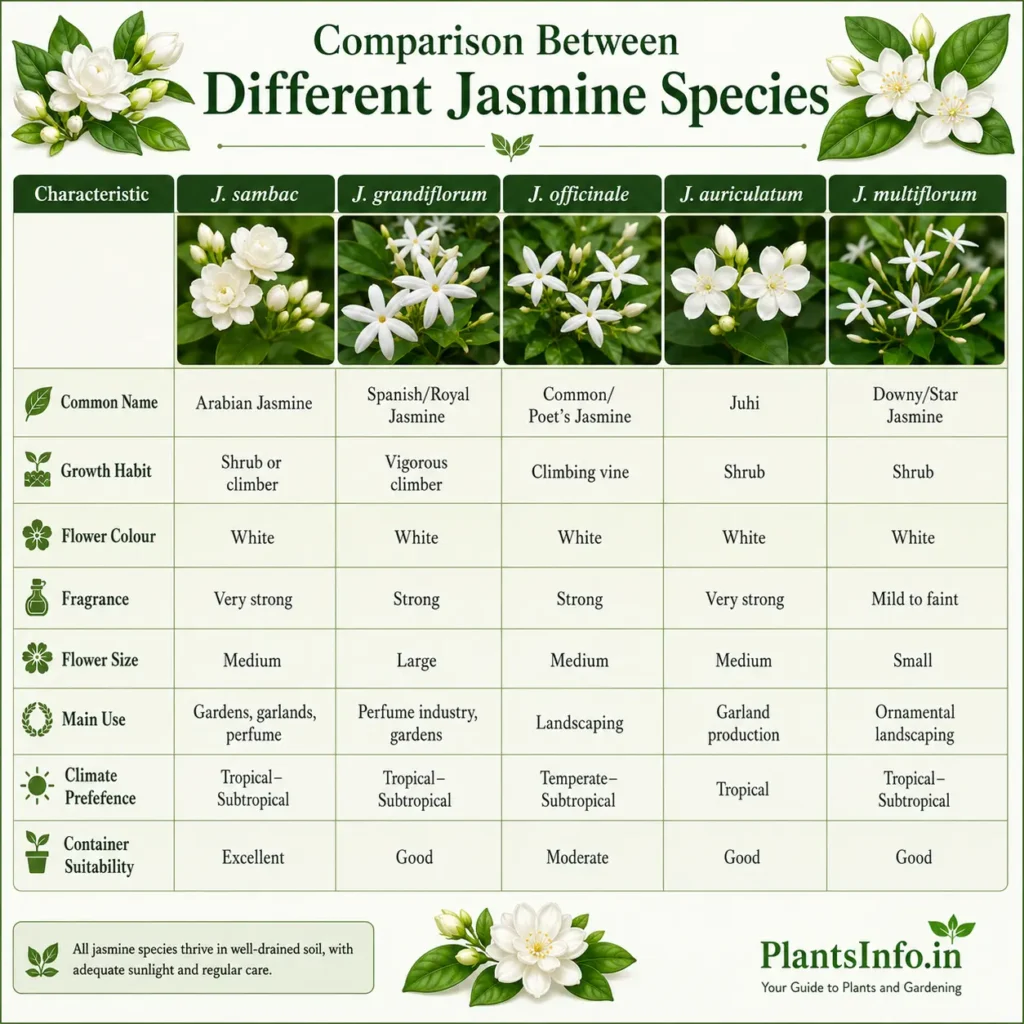
| Characteristic | J. sambac | J. grandiflorum | J. officinale | J. auriculatum | J. multiflorum |
|---|---|---|---|---|---|
| Common Name | Arabian Jasmine | Spanish/Royal Jasmine | Common/Poet’s Jasmine | Juhi | Downy/Star Jasmine |
| Growth Habit | Shrub or climber | Vigorous climber | Climbing vine | Shrub | Shrub |
| Flower Colour | White | White | White | White | White |
| Fragrance | Very strong | Strong | Strong | Very strong | Mild to faint |
| Flower Size | Medium | Large | Medium | Medium | Small |
| Main Use | Gardens, garlands, perfume | Perfume industry, gardens | Landscaping | Garland production | Ornamental landscaping |
| Climate Preference | Tropical–Subtropical | Tropical–Subtropical | Temperate–Subtropical | Tropical | Tropical–Subtropical |
| Container Suitability | Excellent | Good | Moderate | Good | Good |
Choosing the Right Species
Selecting the most suitable jasmine depends on your gardening goals.
- Choose Jasminum sambac for intense fragrance, container gardening, and traditional flower use.
- Select Jasminum grandiflorum if fragrance production and commercial value are priorities.
- Grow Jasminum officinale where cooler winters are common, and a vigorous climber is desired.
- Plant Jasminum auriculatum for highly fragrant flowers and cultural uses.
- Use Jasminum multiflorum when abundant ornamental flowering and hedge performance are more important than fragrance.
Understanding these differences helps gardeners select a species that matches local climate, available space, maintenance preferences, and intended landscape or commercial use.
Other Important Jasminum Species
While Jasminum sambac, J. grandiflorum, and J. officinale dominate ornamental horticulture and commercial flower production, many other species contribute significantly to landscape design, botanical collections, and regional gardening traditions. These species exhibit considerable diversity in flower color, growth habit, climate adaptability, and ornamental value, expanding the versatility of the Jasminum genus beyond its best-known representatives.
Jasminum humile (Italian or Yellow Jasmine)
Overview
Jasminum humile is an evergreen to semi-evergreen shrub valued for its cheerful yellow flowers and adaptability to subtropical and temperate climates. Unlike many white-flowered jasmine species, it provides bright seasonal color and serves as an attractive landscape shrub.
Key Characteristics
- Evergreen or semi-evergreen shrub.
- Bright yellow tubular flowers.
- Light, pleasant fragrance.
- Arching growth habit.
- Dark green foliage.
Ornamental Value
Its ornamental strengths include:
- Vibrant yellow blooms.
- Long flowering period.
- Attractive shrub form.
- Seasonal color contrast.
- Low-maintenance growth.
Best Landscape Uses
Suitable for:
- Mixed shrub borders.
- Foundation plantings.
- Informal hedges.
- Public landscapes.
- Cottage gardens.
Jasminum mesnyi (Primrose Jasmine)
Overview
Jasminum mesnyi, commonly known as Primrose Jasmine, is a vigorous scrambling shrub recognized for its large, bright yellow, semi-double flowers that appear in late winter and early spring.
Unlike many fragrant jasmine species, its flowers are only lightly scented or nearly scentless, making visual impact its primary ornamental feature.
Key Characteristics
- Vigorous arching shrub.
- Semi-double yellow flowers.
- Early-season flowering.
- Evergreen foliage in mild climates.
- Rapid growth.
Landscape Advantages
This species is particularly valued for:
- Bright spring color.
- Large ornamental flowers.
- Excellent wall coverage.
- Cascading growth habit.
- Adaptability to slopes and banks.
Best Uses
Ideal for:
- Retaining walls.
- Banks and embankments.
- Large landscapes.
- Informal hedges.
- Cascading garden displays.
Jasminum nudiflorum (Winter Jasmine)
Overview
Winter Jasmine is unusual within the genus because it produces bright yellow flowers on nearly leafless stems during late winter or very early spring, providing seasonal interest when many other ornamental plants remain dormant.
Key Characteristics
- Deciduous shrub.
- Bright yellow flowers.
- Leafless flowering stems.
- Arching branches.
- Moderate growth.
Distinguishing Features
Unlike fragrant tropical jasmines:
- Flowers appear before or with new leaves.
- Fragrance is minimal.
- Excellent cold tolerance.
- Outstanding winter ornamental value.
Best Uses
Common landscape applications include:
- Rock gardens.
- Slopes.
- Banks.
- Walls.
- Winter gardens.
- Informal borders.
Jasminum parkeri (Dwarf Jasmine)
Overview
Jasminum parkeri is a compact evergreen shrub native to the Himalayan region. It is valued primarily for its naturally dwarf habit, making it particularly suitable for small gardens and container cultivation.
Key Characteristics
- Compact shrub.
- Small yellow flowers.
- Dense branching.
- Slow to moderate growth.
- Fine-textured foliage.
Ornamental Advantages
Gardeners appreciate:
- Naturally compact size.
- Neat growth habit.
- Low maintenance.
- Container suitability.
- Rock garden compatibility.
Best Uses
Suitable for:
- Container gardens.
- Rock gardens.
- Courtyards.
- Small residential landscapes.
- Border edging.
Jasminum polyanthum (Pink Jasmine)
Overview
Jasminum polyanthum is one of the most popular ornamental climbing species grown worldwide. It is especially admired for its spectacular masses of pink flower buds that open into fragrant white flowers.
Key Characteristics
- Vigorous evergreen climber.
- Pink flower buds.
- White fragrant flowers.
- Rapid climbing growth.
- Dense flowering clusters.
Ornamental Value
Major advantages include:
- Spectacular floral display.
- Attractive contrasting buds and flowers.
- Strong fragrance.
- Excellent climbing ability.
- Reliable flowering.
Best Uses
Commonly grown for:
- Pergolas.
- Garden arches.
- Trellises.
- Balcony screens.
- Decorative fences.
- Conservatories in cooler climates.
Jasminum dichotomum (Gold Coast Jasmine)
Overview
Jasminum dichotomum is a tropical shrub or small climber known for its attractive white flowers followed by glossy black berries. It is grown primarily as an ornamental species in warm climates.
Key Characteristics
- Evergreen shrub or climber.
- White fragrant flowers.
- Decorative black fruits.
- Glossy foliage.
- Moderate growth.
Landscape Value
Its ornamental appeal includes:
- Attractive flowering.
- Decorative fruit display.
- Dense foliage.
- Wildlife interest.
- Garden versatility.
Best Uses
Recommended for:
- Tropical gardens.
- Wildlife-friendly landscapes.
- Mixed shrub borders.
- Ornamental hedges.
- Botanical collections.
Lesser-Known Jasminum Species
Beyond the commonly cultivated species, numerous lesser-known jasmines contribute to botanical diversity and specialized horticulture.
Examples include:
- Jasminum angustifolium
- Jasminum flexile
- Jasminum elongatum
- Jasminum brevilobum
- Jasminum nervosum
- Jasminum malabaricum
- Jasminum calophyllum
Many of these species are:
- Regionally distributed.
- Adapted to specific habitats.
- Important for conservation.
- Maintained in botanical gardens.
- Used in breeding and taxonomic research.
Although not widely available in commercial nurseries, they contribute significantly to the genetic diversity of the genus and may become increasingly important for future ornamental breeding and climate adaptation research.
Species Selection Guide
Selecting the appropriate jasmine species depends on local climate, available growing space, maintenance preferences, and intended use.
Best Species for Strong Fragrance
Choose:
- Jasminum sambac
- Jasminum grandiflorum
- Jasminum officinale
- Jasminum auriculatum
These species are widely recognized for their highly aromatic flowers.
Best Species for Commercial Flower Production
Commercial growers commonly prefer:
- Jasminum sambac
- Jasminum grandiflorum
- Jasminum auriculatum
These species are extensively cultivated for loose flowers, garlands, and fragrance extraction.
Best Species for Small Gardens
Where space is limited, suitable options include:
- Jasminum parkeri
- Jasminum sambac (compact cultivars)
- Jasminum multiflorum
These species perform well in containers, courtyards, and smaller residential landscapes.
Best Climbers
For vertical gardening, consider:
- Jasminum grandiflorum
- Jasminum officinale
- Jasminum polyanthum
These vigorous climbers are ideal for pergolas, trellises, arches, and fences.
Best Shrub Forms
Gardeners seeking freestanding shrubs may select:
- Jasminum humile
- Jasminum multiflorum
- Jasminum auriculatum
- Jasminum parkeri
These species naturally develop attractive shrub forms with relatively little structural training.
Best for Cooler Climates
Species with greater tolerance of cooler conditions include:
- Jasminum officinale
- Jasminum nudiflorum
- Jasminum humile
- Jasminum polyanthum
These are generally better suited to subtropical or temperate regions than many strictly tropical species.
Best for Tropical India
In warm tropical regions, particularly across much of peninsular India, the following species perform exceptionally well:
- Jasminum sambac
- Jasminum grandiflorum
- Jasminum auriculatum
- Jasminum multiflorum
These species thrive under warm temperatures and extended growing seasons, making them excellent choices for home gardens, commercial flower cultivation, and ornamental landscaping.
Choosing the Right Jasmine
Before selecting a species, consider the following questions:
- What is the local climate?
- Is fragrance a priority?
- Do you need a climber or a shrub?
- Will the plant be grown in the ground or a container?
- Is the primary goal landscaping, flower production, or fragrance?
Matching species characteristics to growing conditions and intended use greatly improves long-term performance and overall garden success.
Popular Cultivars (Where Applicable)
Within the major Jasminum species, numerous cultivars have been selected for improved flower form, fragrance, growth habit, flowering duration, or ornamental appeal. Cultivars are naturally occurring or horticulturally selected variants within a species and differ from botanical species in having distinctive inherited characteristics maintained through vegetative propagation.
While hundreds of local selections exist, only a relatively small number are widely recognized in commercial horticulture and home gardening.
Popular Jasminum sambac Cultivars
Because Jasminum sambac is one of the most extensively cultivated jasmine species, it possesses numerous well-known cultivars.
‘Maid of Orleans’
Characteristics
- Single white flowers.
- Strong fragrance.
- Nearly continuous flowering in warm climates.
- Excellent container performance.
- Easy maintenance.
Best For
- Home gardens.
- Balconies.
- Religious offerings.
- Fragrance gardens.
‘Belle of India’
Characteristics
- Semi-double to double flowers.
- Long, slender petals.
- Strong fragrance.
- Elegant floral appearance.
- Vigorous growth.
Best For
- Ornamental landscapes.
- Decorative flower production.
- Premium garden collections.
‘Grand Duke of Tuscany’
One of the most recognizable jasmine cultivars.
Characteristics
- Large double flowers.
- Rosette-like appearance.
- Intense fragrance.
- Slower growth.
- Long-lasting blooms.
Best For
- Specimen containers.
- Courtyards.
- Premium ornamental displays.
- Fragrance gardens.
Cultivars of Jasminum grandiflorum
Compared with J. sambac, J. grandiflorum has fewer internationally recognized ornamental cultivars because commercial production generally emphasizes flower yield and fragrance quality rather than distinct floral forms.
Selection programs commonly focus on:
- Higher flower production.
- Increased essential oil yield.
- Improved fragrance.
- Better branching.
- Adaptation to regional climates.
Many commercially cultivated forms are maintained as elite production clones rather than widely marketed ornamental cultivars.
Cultivars of Jasminum officinale
Several ornamental selections of J. officinale are available internationally.
Common characteristics include:
- Improved climbing habit.
- Enhanced fragrance.
- Increased flowering.
- Better cold tolerance.
- Attractive foliage.
Some cultivars also display variegated foliage, providing ornamental interest even outside the flowering season.
Regional Selections
Across India, growers have developed numerous regional strains selected for:
- Flower size.
- Bud production.
- Fragrance intensity.
- Extended flowering season.
- Adaptation to local climates.
- Commercial harvesting efficiency.
Many of these selections are maintained by local nurseries and commercial flower growers rather than being formally registered cultivars.
Best Jasmine Varieties for India
India’s diverse climatic zones allow cultivation of several jasmine species. Selecting the appropriate variety depends on regional temperature, rainfall, elevation, and intended use.
Best Overall Variety
Jasminum sambac
Recommended because of:
- Excellent fragrance.
- Long flowering season.
- Wide climatic adaptability.
- Strong cultural importance.
- Outstanding container performance.
- High ornamental value.
It remains one of the most dependable choices for home gardens throughout tropical and subtropical India.
Best Variety for Perfume Production
Jasminum grandiflorum
Preferred because of:
- High-quality floral fragrance.
- Commercial importance.
- Strong demand from the fragrance industry.
- Reliable flower production.
Best Variety for Garlands and Religious Use
Recommended species include:
- Jasminum sambac
- Jasminum auriculatum
These species produce highly fragrant flowers traditionally used for garlands, temple offerings, and ceremonial decorations.
Best Variety for Container Gardening
Excellent choices include:
- Jasminum sambac (‘Maid of Orleans’)
- Jasminum parkeri
- Compact forms of Jasminum multiflorum
These varieties remain manageable in pots while maintaining excellent ornamental value.
Best Variety for Pergolas and Trellises
Suitable climbers include:
- Jasminum grandiflorum
- Jasminum officinale
- Jasminum polyanthum
Their vigorous climbing habit allows rapid coverage of vertical structures.
Best Variety for Hedges
Recommended shrub species include:
- Jasminum multiflorum
- Jasminum humile
- Jasminum auriculatum
These develop dense branching suitable for informal hedges and landscape borders.
Best Variety for Cooler Regions
For subtropical and temperate climates:
- Jasminum officinale
- Jasminum nudiflorum
- Jasminum humile
These species generally tolerate lower winter temperatures better than strictly tropical jasmines.
Best Varieties by Purpose
| Gardening Goal | Recommended Variety |
|---|---|
| Strongest fragrance | Jasminum sambac |
| Premium perfume production | Jasminum grandiflorum |
| Garland making | Jasminum sambac, J. auriculatum |
| Balcony gardening | Jasminum sambac (‘Maid of Orleans’) |
| Small gardens | Jasminum parkeri |
| Vertical gardening | Jasminum grandiflorum, J. officinale |
| Informal hedges | Jasminum multiflorum |
| Cooler climates | Jasminum officinale |
| Heavy flowering display | Jasminum multiflorum |
| Commercial flower farming | Jasminum sambac, J. grandiflorum, J. auriculatum |
Variety Comparison Chart
| Characteristic | J. sambac | J. grandiflorum | J. officinale | J. auriculatum | J. multiflorum | J. polyanthum |
|---|---|---|---|---|---|---|
| Growth Habit | Shrub/Climber | Climber | Climber | Shrub | Shrub | Climber |
| Fragrance | Excellent | Excellent | Very Good | Excellent | Mild | Strong |
| Flower Size | Medium | Large | Medium | Medium | Small | Medium |
| Flower Abundance | Excellent | Very Good | Good | Very Good | Excellent | Excellent |
| Container Growing | Excellent | Good | Moderate | Good | Good | Moderate |
| Climbing Ability | Moderate | Excellent | Excellent | Low | Low | Excellent |
| Hedge Suitability | Moderate | Low | Low | Good | Excellent | Low |
| Commercial Value | Excellent | Excellent | Moderate | High | Moderate | Moderate |
| Best Climate | Tropical | Tropical–Subtropical | Subtropical–Temperate | Tropical | Tropical | Subtropical |
Frequently Asked Questions (FAQ)
Which jasmine species is best for beginners?
Jasminum sambac is often the best choice because it is adaptable, fragrant, relatively easy to maintain, and performs well in both gardens and containers.
Which jasmine has the strongest fragrance?
Among the most intensely fragrant cultivated species are:
- Jasminum sambac
- Jasminum auriculatum
- Jasminum grandiflorum
Fragrance intensity may also vary among cultivars and environmental conditions.
Which jasmine flowers for the longest period?
In warm tropical climates, Jasminum sambac frequently produces repeated flowering flushes over much of the year, making it one of the longest-blooming cultivated species.
Which jasmine is best for pots?
Compact cultivars of Jasminum sambac and naturally smaller species such as Jasminum parkeri are excellent choices for container cultivation.
Are all jasmine flowers fragrant?
No. While many species are highly aromatic, others—such as Jasminum multiflorum and Jasminum mesnyi—have only a faint fragrance or are grown primarily for their ornamental display rather than scent.
Can different jasmine species grow together?
Yes. Multiple species can be grown in the same landscape if they have similar requirements for sunlight, drainage, and climate. Combining species with different flowering periods and growth habits can also extend seasonal interest.
Conclusion
The remarkable diversity of the Jasminum genus allows gardeners to choose plants that suit almost every landscape style, climate, and horticultural objective. From the intensely fragrant Jasminum sambac and commercially important Jasminum grandiflorum to the heavy-flowering Jasminum multiflorum and winter-blooming Jasminum nudiflorum, each species offers distinct ornamental and practical advantages.
Selecting the right jasmine involves more than choosing the most attractive flowers. Climate, available space, growth habit, maintenance requirements, fragrance, flowering season, and intended use should all be considered before planting. Understanding these characteristics helps gardeners create healthier landscapes and achieve more reliable flowering over the long term.
Whether the goal is perfume production, cultural flower use, vertical gardening, container displays, wildlife-friendly landscapes, or simply enjoying beautifully scented blooms, the rich diversity of Jasminum ensures there is a suitable variety for nearly every garden and growing condition.