Neem Tree Varieties: Which One Should You Grow in India?
Neem Tree Varieties: Which One Should You Grow in India?
Quick Answer: Most Indians grow one neem — the common desi neem (Azadirachta indica) — without ever knowing that improved selections, a closely related species, and distinct ecotypes exist. For most home gardeners, the choice is simple: a grafted improved selection fruits faster and yields more seed. For large plots or agroforestry, the choice between species matters considerably.
See also: Neem Plant plant profile, how to grow it, common problems, its flowering season, and its benefits.
Walk into any Indian nursery and ask for neem — you will almost certainly receive an ungrafted seedling of Azadirachta indica with no variety name attached. This is adequate for shade and garden use. But for gardeners who want early fruiting, higher azadirachtin content in the seed, or a faster-growing tree for timber or green manure, the variety and species decision matters more than most sellers acknowledge.
Recommended Products
Disclosure: As an Amazon Associate, PlantsInfo may earn from qualifying purchases.
🌱 Growing Essentials
The following products can help with container gardening, potting, root development, soil management, and healthy plant growth.
Organic Potting Soil Mix
Provides nutrients, structure, and healthy growing conditions for container plants.
Coco Peat Growing Medium
Enhances moisture retention while maintaining excellent root-zone aeration.

Grow Bags for Plants
Improve drainage, root aeration, and vegetable production in limited spaces.

Plastic Pots for Plants
Ideal containers for seedlings, ornamentals, herbs, and balcony gardens.
Quick Variety Selector
| Type / Selection | Type | Plant Size | Best For | Suited To |
|---|---|---|---|---|
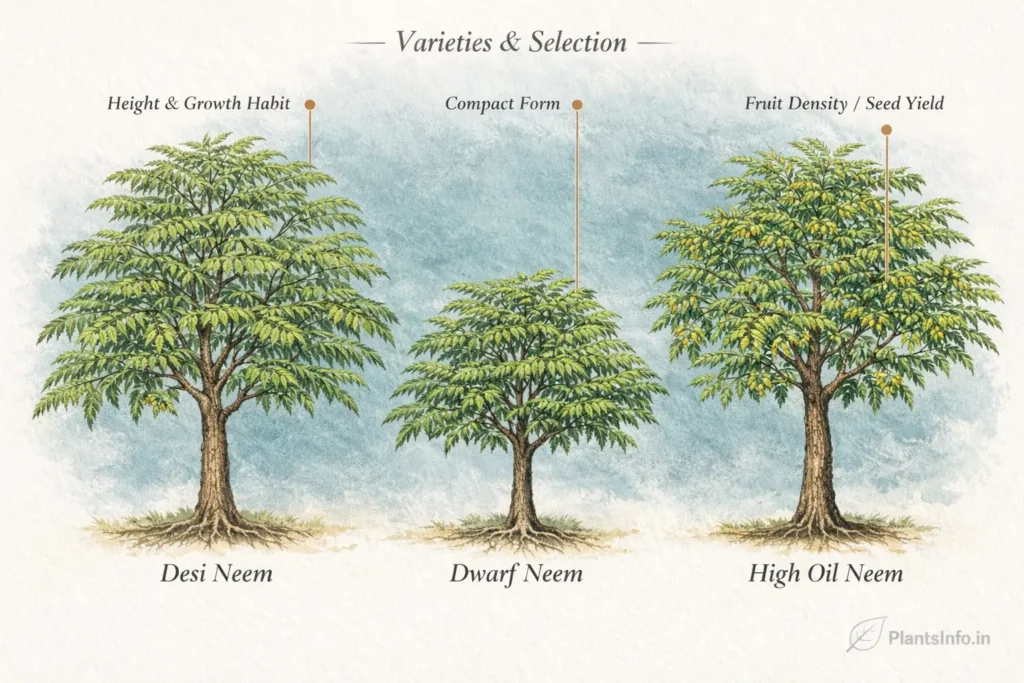
| Desi Neem (seedling) | Open-pollinated seedling | Large | Shade, general garden use, traditional | Pan-India |
| PKV Neem (improved selection) | Improved grafted | Medium-large | Higher seed yield, azadirachtin content | Vidarbha, Central India |
| Melia dubia (Malabar neem) | Separate species | Very large | Fast timber, green manure, agroforestry | South India, Western Ghats |
| Azadirachta indica var. siamensis | Botanical variety | Medium | Drier climates, ornamental | Rajasthan, Gujarat, arid zones |
| CAZRI selections | Improved | Medium-large | Arid zone planting, drought tolerance | Rajasthan, Gujarat, Haryana |
Varieties in Detail
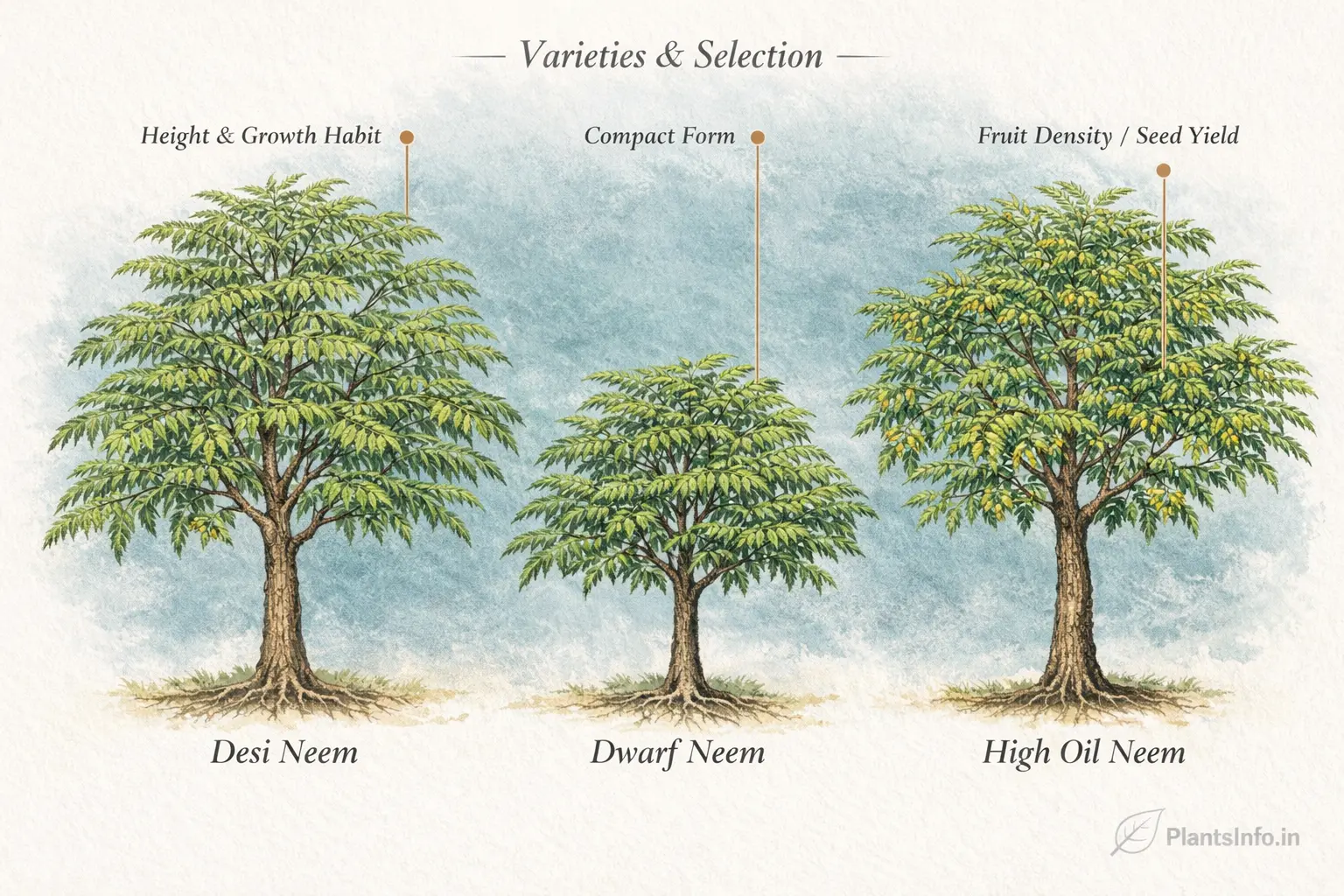
Desi Neem (Ungrafted Seedling)
The common neem seedling available at virtually every Indian nursery is an ungrafted open-pollinated plant — genetically variable, slow to first seed (5–7 years from seed), and highly adapted to local conditions over generations.
Its advantage is precisely this local adaptation: a seedling grown in Rajasthan from seed collected in Rajasthan will be better suited to arid conditions than any nursery import. Its weakness is variability — fruit yield, azadirachtin content, and growth rate differ significantly between individual trees. For pure shade planting or where fruiting is not a priority, the desi seedling is perfectly sufficient.
PKV Neem (Panjabrao Krishi Vidyapeeth Selection)
PKV Neem is an improved clonal selection developed at Panjabrao Krishi Vidyapeeth in Akola, Maharashtra. Grafted trees begin fruiting in 2–3 years and produce higher seed yields with more consistent azadirachtin content than unselected seedlings. It was developed primarily for the semi-arid Vidarbha conditions and performs well across Central and North India. For gardeners who want neem for seed harvest — whether for home-made pesticide preparations or for oil extraction — PKV Neem is the most practical improved selection currently available in Indian nurseries.
Melia dubia (Malabar Neem / Malai Vembu)
Melia dubia is a separate species entirely, not a neem variety, but is widely sold as “neem” or “fast neem” in South Indian nurseries — a persistent and consequential mislabelling. It grows dramatically faster than Azadirachta indica — 6–8 metres in the first two years under good conditions — and produces valuable, lightweight timber.
It does not contain azadirachtin and has none of the medicinal or pesticidal properties of true neem. For agroforestry, farm boundary planting, and timber, Melia dubia is an excellent choice. For anyone who wants neem’s medicinal or pesticidal properties, it is the wrong tree entirely. Always verify the scientific name before buying anything sold as “fast neem.”
Azadirachta indica var. siamensis
This botanical variety of neem — sometimes listed as a distinct species in older literature — is adapted to drier, semi-arid conditions and is found naturally in parts of Rajasthan, Gujarat, and the drier Deccan zones. It is smaller-statured than the common neem, with slightly narrower leaflets, and is more tolerant of extreme heat and low rainfall.
In arid garden conditions where common neem seedlings struggle to establish, this variety is more reliable. It is not widely available in nurseries but can be sourced through state forest department nurseries in Rajasthan and Gujarat.
CAZRI Selections (Central Arid Zone Research Institute)
CAZRI in Jodhpur has developed and released neem selections specifically for arid and semi-arid conditions — primarily for farm forestry and wasteland reclamation rather than home gardens. These selections prioritise drought tolerance, survival rate in low-rainfall zones, and seed yield under water stress.
For gardeners in Rajasthan, Gujarat, or the drier parts of Haryana and Punjab who have struggled with neem establishment, CAZRI-sourced material through state forest departments offers meaningfully better results than general nursery seedlings.
Head-to-Head Comparisons
Desi Seedling vs PKV Neem (Grafted)
For shade, street planting, or a large garden where fruiting timeline is irrelevant, the desi seedling wins on cost, availability, and local adaptation. For anyone who specifically wants seed yield, faster fruiting, or consistent azadirachtin content for pesticidal use, PKV Neem or any grafted improved selection is the clear choice — it begins fruiting 2–4 years earlier and produces more reliably.
The price difference between a seedling and a grafted plant is modest; for home gardeners who want the tree to do something useful beyond shade, paying for the grafted plant is worthwhile.
Azadirachta indica vs Melia dubia
This comparison only matters because the two are so often confused or deliberately mislabelled. Azadirachta indica is the true neem — slower growing, medicinally active, and the tree that every traditional and Ayurvedic reference to neem describes. Melia dubia is a fast timber tree with no azadirachtin. If you are buying neem for shade only and growth speed is important, Melia dubia is not a bad tree — but know what you are buying. If you are buying neem for any medicinal, pesticidal, or cultural purpose, insist on Azadirachta indica and verify the label.
How to Choose for Your Space
Container or terrace garden: Neem is not suited to long-term container growing. The taproot and eventual canopy spread make container culture a temporary measure at best. Young saplings can be grown in large containers for 2–3 years before ground planting becomes necessary.
Small ground plot (under 100 sq ft): A single neem tree will eventually dominate a small plot — mature spread reaches 8–10 metres. For small gardens, plant at a boundary where the canopy will extend outward rather than over the garden. Choose a grafted improved selection to maximise benefit from the limited planting spot.
Larger garden or farm boundary: Full flexibility. Desi neem for shade and wildlife value. PKV Neem or a CAZRI selection for seed yield and pesticidal use. Melia dubia for agroforestry, green manure, or fast boundary planting where true neem properties are not required.
Medicinal or pesticidal use: Always choose Azadirachta indica — grafted improved selection preferred for consistent azadirachtin content. Verify the species name at purchase.
Regional Suitability
North India (UP, MP, Bihar, Rajasthan): Common neem thrives across the Indo-Gangetic plain and the drier Deccan transition zones. For Rajasthan and Gujarat, CAZRI selections or the siamensis variety offer better arid-zone establishment. PKV Neem performs well across Central and North India.
South India (Tamil Nadu, Karnataka, Andhra Pradesh): Common neem grows well across the Deccan plateau and semi-arid peninsular zones. Melia dubia is most popular in the Western Ghats foothills and humid coastal areas of Karnataka and Kerala, where it grows fastest.
Maharashtra: PKV Neem is the recommended improved selection — it was bred specifically for Vidarbha conditions and is most reliably available in Maharashtra nurseries.
Northeast India: Common neem grows in the warmer, lower-altitude parts of Assam and adjacent states but is not a characteristic tree of the wetter, cooler Northeast. It is not recommended for high-altitude or high-rainfall zones above 1,000 metres.
Desi vs Improved — What Nobody Tells You
Improved neem selections are not hybrids — they are clonal selections from superior individual trees, propagated by grafting. This means they can, in principle, be vegetatively propagated by a skilled gardener. The real advantage of improved selections is narrower than most nurseries suggest: earlier fruiting and more consistent seed yield. For everything else — shade, air quality, wildlife value, cultural significance — a well-grown desi seedling from locally collected seed is equal to or better than any improved selection. The gardener who collects seed from the best-performing neem tree in their neighbourhood and grows their own seedling is working with locally adapted genetics that no nursery catalogue can match.
Watch Out for Mislabelling
Two mislabelling problems are common and consequential. First, Melia dubia sold as neem — address this by always checking the scientific name and noting that Melia dubia has compound leaves with larger, asymmetric leaflets compared to the evenly pinnate, smaller leaflets of true neem.
Second, ungrafted seedlings sold as named improved varieties like PKV Neem — verify by checking for a visible graft union 10–30 cm above the soil line. A seedling has no graft union and a single, continuous taproot-dominant stem. For verified true neem material, state forest department nurseries, KVK outlets, and CAZRI-linked sources in arid regions are the most reliable options.
Where to Source These Varieties in India
PKV Neem grafted plants are most reliably available through Panjabrao Krishi Vidyapeeth’s associated nurseries in Maharashtra and through state horticulture department outlets in Maharashtra and MP. CAZRI selections are available through state forest department nurseries in Rajasthan and Gujarat.
For common neem seedlings across India, any KVK outlet or state nursery is a reliable source — the key is to ask for locally grown seed material wherever possible, as local ecotypes outperform nursery imports in most established growing conditions.
For the overwhelming majority of Indian home gardeners, the right answer is a grafted Azadirachta indica — improved selection if available, common desi seedling if not — planted in full sun with good drainage. Everything else is context-specific from there.