Plant Guides

Guduchi Benefits: What Ayurveda and Modern Research Say

Guduchi benefits infographic comparing traditional Ayurvedic uses of Tinospora cordifolia with modern scientific research on antioxidant, immune, anti-inflammatory, and metabolic health applications.

Guduchi (Tinospora cordifolia) is one of Ayurveda’s most respected rasayana herbs — a traditional rejuvenative valued for supporting general wellness, immune function, and recovery during periods of weakness or recurrent illness. In classical Ayurvedic practice, it is described as a…

How to Grow Guduchi (Giloy) at Home

How to grow Guduchi (Giloy) at home infographic showing Tinospora cordifolia propagation from stem cutting, potting soil mix, planting, trellis support, sunlight, watering, pruning, and harvesting medicinal stems.

Quick Answer: Guduchi is an easy-to-grow perennial vine that thrives across most of India with very little attention. Plant a stem cutting in a pot or in the ground, give it something to climb, and it will establish itself quickly…

Brahmi Varieties: Which One Should You Grow in India?

Botanical comparison infographic showing Brahmi (Bacopa monnieri) vs Gotu Kola (Centella asiatica), comparing leaf shape, flowers, growing conditions, medicinal tradition, and gardening suitability in India

Quick Answer: Almost all brahmi grown in Indian homes, farms, and Ayurvedic gardens is a single species — Bacopa monnieri — with no formal variety distinction in common cultivation. But meaningful differences exist between regional ecotypes, and a small number…

Brahmi Plant Problems: Symptoms, Causes, and Fixes

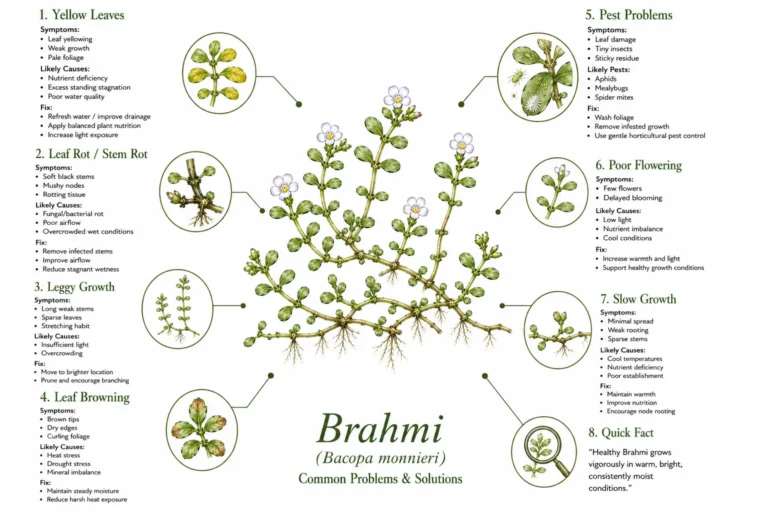
Botanical infographic showing common Brahmi plant (Bacopa monnieri) problems including yellow leaves, stem rot, pests, poor flowering, slow growth, symptoms, causes, and fixes

Quick Answer: Brahmi is a resilient plant with a short list of genuine problems. Most issues — yellowing, wilting, stem rot — trace back to either insufficient water or, less commonly, completely stagnant, anaerobic soil. Pest pressure is low. When…

Brahmi Flowering Season: When and What to Expect in India

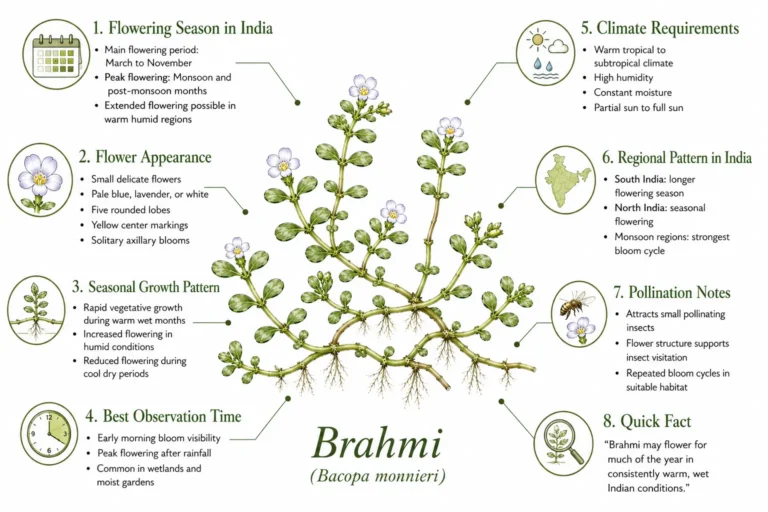
Brahmi flowering season in India infographic showing Bacopa monnieri bloom period, flower appearance, growing conditions, and regional flowering patterns

Quick Answer: Brahmi flowers intermittently through much of the year in South India and coastal regions, with the most consistent bloom occurring from July through October — the monsoon and post-monsoon period when warmth and moisture are both abundant. In…

Brahmi Plant: Key Facts, Names, and What You Should Know

Botanical infographic of Brahmi plant (Bacopa monnieri) showing identification features, uses, and growing conditions

Quick Answer: Brahmi (Bacopa monnieri) is a small, creeping, semi-aquatic herb native to the Indian subcontinent, found growing wild at the margins of ponds, rivers, and paddy fields across the country. It is one of Ayurveda’s most important cognitive herbs,…

Brahmi Benefits: What Ayurveda and Modern Research Say

Botanical illustration of Brahmi (Bacopa monnieri) showing medicinal leaf anatomy, bacoside compounds, and Ayurvedic herbal benefits

Quick Answer: Brahmi is Ayurveda’s most celebrated herb for cognitive function — memory, learning, and mental clarity. Modern research has investigated these traditional claims more rigorously than almost any other Indian medicinal herb, with findings that broadly support use for…

Arrowroot Varieties: Which One Should You Grow in India?

Botanical infographic comparing Arrowroot varieties for India, including edible arrowroot (Maranta arundinacea), ornamental Maranta, canna-based substitutes, rhizome traits, and growing suitability.

Quick Answer: Arrowroot has no formally named commercial cultivars widely available in Indian nurseries or through agricultural supply channels. What you will encounter is unimproved landrace material and regional ecotypes — with the most important distinction being whether you are…