
Pumpkin Varieties: Which One Should You Grow in India?
Pumpkin Varieties: Which One Should You Grow in India?
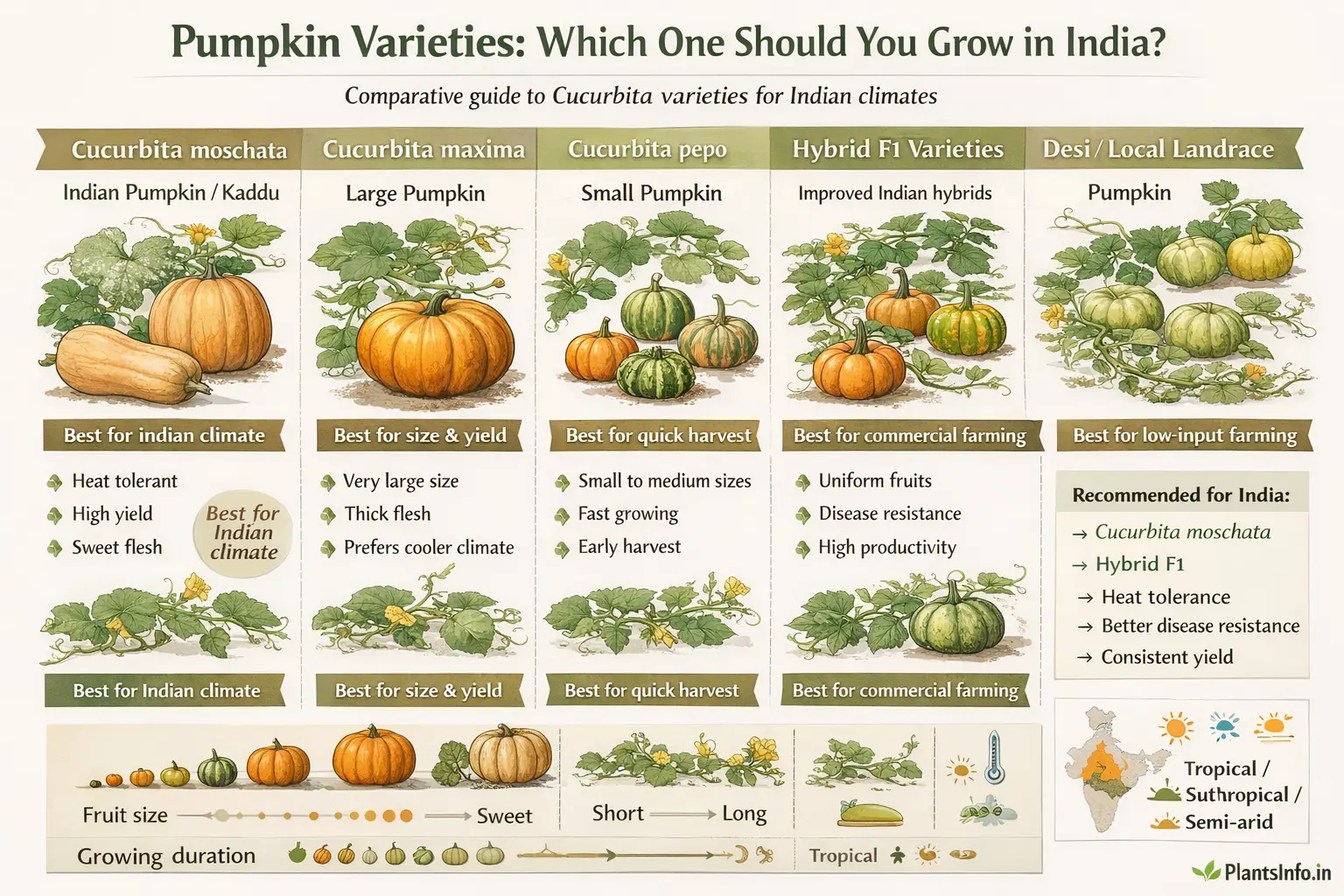
Stand at the vegetable section of any large Indian wholesale market, and you will find at least four or five distinct pumpkin types stacked in separate piles — red, orange, green, pale cream, small and round, large and flat — each with a different regional name and a different best use.
See also: Pumpkin Plant plant profile, how to grow it, common problems, its flowering season, and its benefits.
The single most important factor separating pumpkin varieties for an Indian home gardener is fruit type and vine size: growing a vigorous commercial variety with 4-metre vines in a 10-square-foot terrace is the most common pumpkin mistake in urban India. This spoke helps you choose what actually fits your space and season.
Recommended Products
Disclosure: As an Amazon Associate, PlantsInfo may earn from qualifying purchases.
🌱 Growing Essentials
The following products can help with container gardening, potting, root development, soil management, and healthy plant growth.
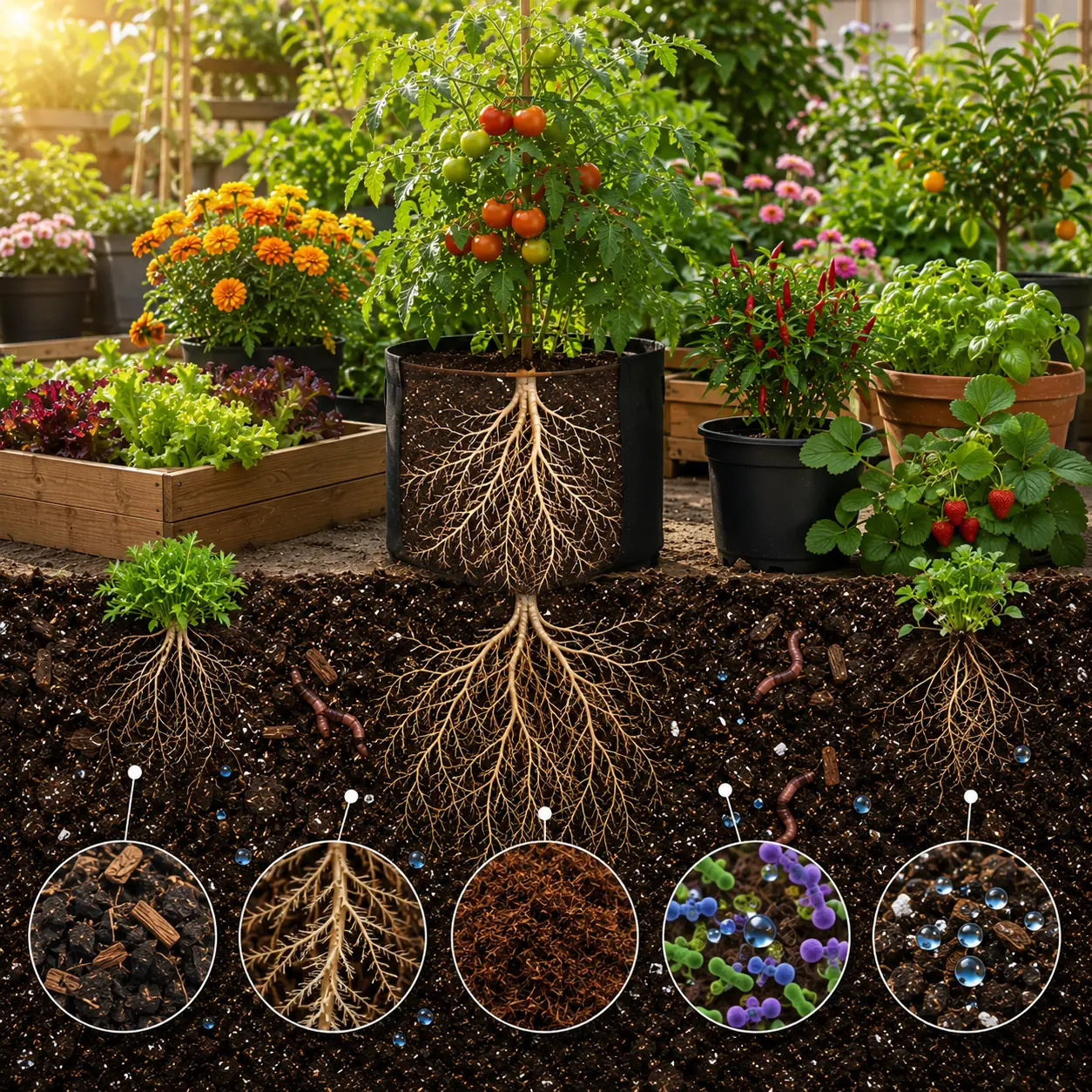
Organic Potting Soil Mix
Provides nutrients, structure, and healthy growing conditions for container plants.
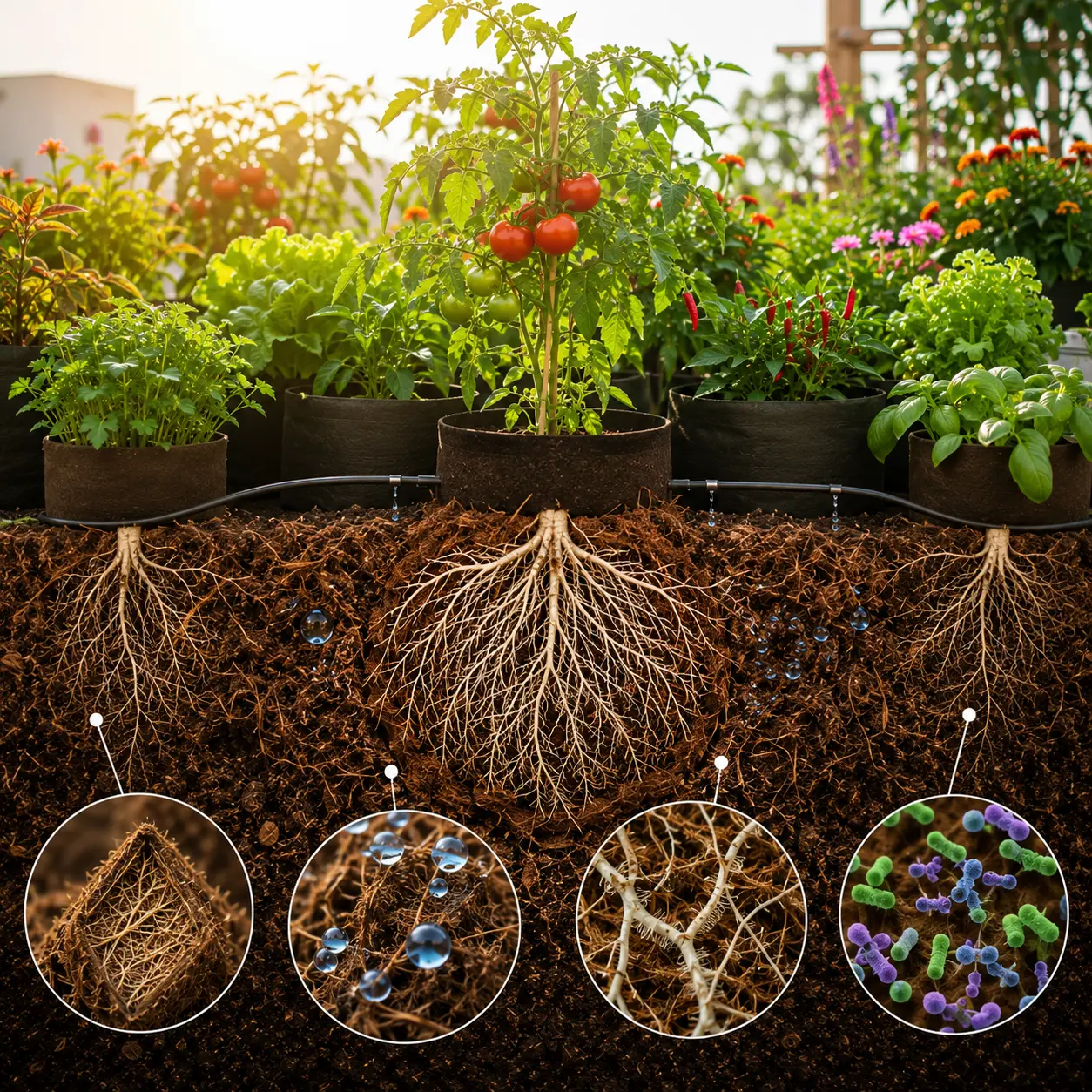
Coco Peat Growing Medium
Enhances moisture retention while maintaining excellent root-zone aeration.

Grow Bags for Plants
Improve drainage, root aeration, and vegetable production in limited spaces.

Plastic Pots for Plants
Ideal containers for seedlings, ornamentals, herbs, and balcony gardens.
Quick Variety Selector
| Variety | Type | Plant Size | Best For | Suited To |
|---|---|---|---|---|
| Pusa Viswas | Open-pollinated (improved) | Medium–Large | Home use, good yield, pan-India | North and Central India, UP, Bihar |
| Pusa Hybrid-1 | Hybrid | Large | Home gardens, South India | Pan-India, most states |
| Arka Suryamukhi | Open-pollinated (improved) | Medium | Karnataka, Tamil Nadu, and Andhra Pradesh | Karnataka, Tamil Nadu, Andhra Pradesh |
| CO-1 / CO-2 | Open-pollinated (improved) | Medium | South Indian cooking, home use | Tamil Nadu, Kerala |
| Kashi Harit | Open-pollinated (improved) | Medium | Home use, northern India | UP, Bihar, Jharkhand |
| Desi Red / Local Red (unimproved) | Desi (open-pollinated) | Large | Traditional cooking, seed saving | Eastern India, Bengal, Odisha |
| Butternut / Vilaiti Kaddu | Open-pollinated / hybrid | Compact–Medium | Containers, terraces, mild flavour | Peninsular India, hill stations |
| Punjab Samrat | Open-pollinated (improved) | Large | High yield, storage | Punjab, Haryana, Northwest India |
Varieties in Detail
Pusa Viswas
Developed by IARI (Indian Agricultural Research Institute), New Delhi, Pusa Viswas is one of the most widely recommended open-pollinated pumpkin varieties for home gardens in North and Central India. The fruit is medium to large, with a flat-round shape, greenish-grey skin that transitions to creamy orange at maturity, and dense, sweet orange flesh.
It matures in approximately 90 to 100 days from sowing. Its notable strength is adaptability — it performs reliably across a broad range of growing conditions from the Gangetic plains through Central India. Its notable weakness is vine size: plants are vigorous and need space to run. Not ideal for containers or small terraces. Being open-pollinated, seeds can be saved from good-quality fruit for the following season.
Pusa Hybrid-1
The hybrid counterpart to Pusa Viswas was developed for higher yield and greater uniformity. Fruit size and skin colour are more consistent across the plant than in open-pollinated types. Vine vigour is high — expect plants to run 4 to 5 metres under good conditions.
Pusa Hybrid-1 is the variety most commonly found in Indian commercial vegetable farming and in nurseries that cater to serious kitchen gardeners wanting maximum production from a single plant. Its notable strength is yield and disease tolerance. Its notable weakness is that seeds cannot be saved — hybrid offspring do not breed true — so fresh seed must be purchased each season.
Arka Suryamukhi
Developed by IIHR (Indian Institute of Horticultural Research), Bengaluru, specifically for South Indian growing conditions. The fruit is medium-sized with a flattened shape, pale green skin, and good shelf life.
Arka Suryamukhi is valued in Karnataka, Tamil Nadu, and Andhra Pradesh home gardens for its compact-to-medium vine habit, which makes it more manageable in smaller plots than the larger North Indian varieties.
Its notable strength is adaptability to the wet-dry cycles of peninsular India and suitability for the traditional South Indian preparation of kaddu kootu and sambar-style dishes. Its notable weakness is lower name recognition in nurseries outside its home region — availability can be inconsistent in North Indian markets.
CO-1 / CO-2 (Tamil Nadu Agricultural University Varieties)
Released by TNAU, these varieties are tailored to the growing conditions of Tamil Nadu and Kerala. CO-2 has largely superseded CO-1 in commercial growing, but both remain available. Fruit is medium-sized, round to oval, with pale green to cream skin.
These varieties perform well in the coastal humidity of South India and have good tolerance to the wet spells that challenge many other varieties in Kerala and coastal Tamil Nadu. Seed is widely available through TNAU seed centres and KVK outlets in South India.
Their notable weakness for home gardeners outside South India is limited availability and less published home-garden trial data compared to IARI varieties.
Kashi Harit
Released by IIVR (Indian Institute of Vegetable Research), Varanasi, Kashi Harit is a pale-green-fruited open-pollinated variety developed for the eastern and central Gangetic plains. The fruit has a distinctive appearance — smooth, pale green skin — and is particularly valued for culinary use in UP, Bihar, and Jharkhand, where the light-skinned fruit is preferred in local markets.
It matures relatively early (around 80 to 90 days) compared to some other improved varieties. Its notable strength is early maturity and local market acceptance in its home region. Its notable weakness is moderate yield compared to hybrid types.
Desi Red / Local Red
This is not a named variety but a collective term for the traditional large red-orange pumpkins found across West Bengal, Odisha, and parts of the Northeast. These are unimproved, open-pollinated landraces — genetic material maintained by farmers over generations without formal breeding.
The fruit is large (often 5 to 10 kg), with deep orange-red flesh and a rich, sweet flavour that many cooks consider superior to improved varieties for traditional preparations like kumro bata or the festive lauki halwa equivalents of eastern Indian cooking.
Their notable strength is flavour depth and complete seed-saving ability. Their notable weakness is vine vigour (plants are very large), variable fruit quality across individual plants, and lower yield per plant compared to improved types. Not suitable for small gardens or containers.
Butternut Squash / Vilaiti Kaddu
Botanically, Cucurbita moschata (the same species as most Indian pumpkins), the butternut-type varieties have a distinctly different fruit shape — beige-skinned, pear-shaped, with a long neck — and a milder, nuttier flavour than traditional Indian varieties.
Both open-pollinated and hybrid butternut types are now available in Indian nurseries, particularly in cities and hill station nurseries where temperate-leaning vegetables have a market. The compact to medium vine habit of many butternut varieties makes them the best choice for large containers and terrace gardens.
Their notable strength for urban gardeners is a manageable size, and the growing consumer interest in butternut for soups and roasting. Their notable weakness is unfamiliarity as a cooking ingredient in many traditional Indian households.
Punjab Samrat
Developed for the Northwestern plains and suitable for both kharif and late-season planting. Punjab Samrat produces large, flat, round fruit with greenish-grey skin and pale orange flesh.
It is selected for high yield and good keeping quality — the fruit stores well after harvest, which matters in commercial growing. For home gardens, the main advantage is productivity per plant in the climate of Punjab and Haryana. Its notable weakness is large vine size and limited availability outside its home region.
Head-to-Head Comparison
Pusa Viswas vs. Pusa Hybrid-1
For a home gardener who is not primarily focused on maximum yield, Pusa Viswas is the more practical choice. It produces reliable, good-quality fruit, the seed can be saved from season to season without loss of variety characters, and it is available from IARI seed centres and most reputable nurseries across India.
Pusa Hybrid-1 wins on yield and fruit uniformity, but those advantages matter more on a commercial plot than in a home garden, where three or four fruits per plant is often sufficient.
The hybrid’s requirement for freshly purchased seed every season adds a recurring cost and a dependency on a reliable supply that the open-pollinated variety avoids.
Desi Red (local landrace) vs. any improved variety
For flavour in traditional eastern Indian cooking, the desi red landrace produces a genuinely superior result — the flesh is denser, sweeter, and has a depth of flavour that most improved varieties lack.
For a home gardener in West Bengal, Odisha, or Assam with space for a large running vine and a preference for traditional preparations, growing the local variety from saved seed is entirely defensible.
For everyone else — particularly urban gardeners with limited space or gardeners in regions where the desi red landrace is not locally adapted — an improved variety will produce better practical results.
How to Choose for Your Space
Container or terrace garden: Butternut-type varieties are the best fit. Choose a compact hybrid or open-pollinated butternut, use a minimum 30-litre container, and train the vine vertically on a trellis. If a traditional Indian pumpkin is preferred, Arka Suryamukhi or Kashi Harit can be managed in large ground-level containers with aggressive vine training — but be prepared to limit the plant to one or two main vines. No traditional large-fruited Indian variety is a natural container plant.
Small ground plot (under 100 sq ft): Choose Kashi Harit or Arka Suryamukhi based on your region, and train the vine vertically on a strong trellis or over a fence. Limit to one plant per 30 to 40 sq ft of ground. Remove all but two or three main vines from the start to keep the plant manageable and improve fruit quality.
Larger garden or backyard: Any of the improved open-pollinated varieties — Pusa Viswas, Arka Suryamukhi, Punjab Samrat — will thrive with room to run. For maximum yield from a single plant, Pusa Hybrid-1 is the honest recommendation. For flavour-first growing in eastern India, a good desi red landrace sourced from a local seed-saving network is worth the reduced consistency.
Commercial or large kitchen garden: Pusa Hybrid-1 or Punjab Samrat for North India. IIHR and TNAU releases for South India. Hybrid types consistently outperform open-pollinated varieties on yield and uniformity at scale.
Regional Suitability
North India (UP, Bihar, Madhya Pradesh, Rajasthan plains): Pusa Viswas and Pusa Hybrid-1 are the benchmark varieties. Kashi Harit is particularly strong in the eastern Gangetic plains. Monsoon season (kharif) planting is the primary window.
Northwest India (Punjab, Haryana): Punjab Samrat performs reliably in this zone. Pusa varieties are also well-suited. Both kharif and late-season (planted in September for a November–December harvest) windows are productive.
Eastern India (West Bengal, Odisha, Jharkhand, Bihar): The desi red landrace and Kashi Harit are well-adapted here. Pusa varieties also perform reliably. This is the region with the richest traditional pumpkin culture in India — local landraces are worth preserving and growing.
South India (Karnataka, Tamil Nadu, Andhra Pradesh, Kerala): Arka Suryamukhi and CO-2 are the recommended varieties. Butternut types grow well in the hill districts of Tamil Nadu, Kerala, and Karnataka. Avoid purely Northern varieties in the hot, humid coastal south — they tend to underperform relative to locally bred material.
Northeast India (Assam, Meghalaya, Manipur): Local pumpkin varieties adapted to the high-rainfall, high-humidity conditions of the Northeast perform better than imported improved varieties. Pusa varieties can be grown, but local adaptations are preferable where available. KVK outlets in these states are the most reliable source.
Hill stations and high-altitude zones (above 1,000 m): Butternut squash and temperate-adapted pumpkin varieties perform well. Traditional Indian large-fruited varieties are slower to develop at altitude but can produce well in sheltered, south-facing positions. Avoid planting before the last frost date — pumpkin is cold-sensitive and will not germinate or establish below 15°C.
Desi vs. Hybrid — What Nobody Tells You
Hybrid pumpkin varieties in India deliver significantly higher yield and more uniform fruit — that part of the seed packet claim is accurate. What is rarely stated clearly is the extent of the trade-off on flavour and culinary texture. Several serious home cooks who grow both types consistently prefer the flesh of open-pollinated desi varieties for halwa, subzi, and traditional preparations — the flesh is denser, sweeter, and drier, which suits these cooking methods better.
What hybrid varieties genuinely win on, beyond yield, is disease tolerance. Hybrid pumpkins sold by established Indian seed companies typically carry partial resistance to powdery mildew and some virus strains — a meaningful advantage in the disease pressure of an Indian monsoon garden.
The practical recommendation: if yield and disease resistance are your priority, grow a hybrid. If you are growing pumpkin primarily for flavour and traditional cooking, and you have the space and patience for an open-pollinated variety, choose a well-sourced desi or improved open-pollinated type and save seed from your best fruit each season. You will gradually select for the characters that suit your specific growing conditions — something no hybrid can do for you.
Watch Out for Mislabelling
Mislabelling is a genuine problem with pumpkin seed in India, particularly with varieties sold loose by weight at local seed shops rather than in sealed, branded packets. The most common issue is varieties sold under the generic name “kaddu” or “pumpkin” with no variety specification — you are buying unknown genetic material and accepting the variability that comes with it.
A second common issue is that butternut squash seedlings are sold as “pumpkin” in nurseries that stock both. The seedling appearance is similar in the early stages. Verify by leaf shape — butternut leaves have a more distinctly lobed, slightly silvery-mottled appearance compared to the more uniformly green leaves of most Indian pumpkin varieties.
For variety-specific seed, source from IARI seed sales outlets, IIHR and TNAU seed centres, ICAR-affiliated nurseries, or KVK outlets in your state. Seeds from these sources carry variety labels with reasonable accuracy. Avoid purchasing pumpkin seeds from roadside vendors or unbranded bulk sources if variety performance matters to you.
The right pumpkin for most Indian home gardeners is a regionally appropriate improved open-pollinated variety — Pusa Viswas in the North, Arka Suryamukhi in the South, a local TNAU release in Tamil Nadu — grown from certified seed, trained on a trellis, and limited to two strong vines per plant. Get that combination right, and the variety question largely takes care of itself.


