Star Fruit Flowering Season in India: Flowering and Fruiting Calendar

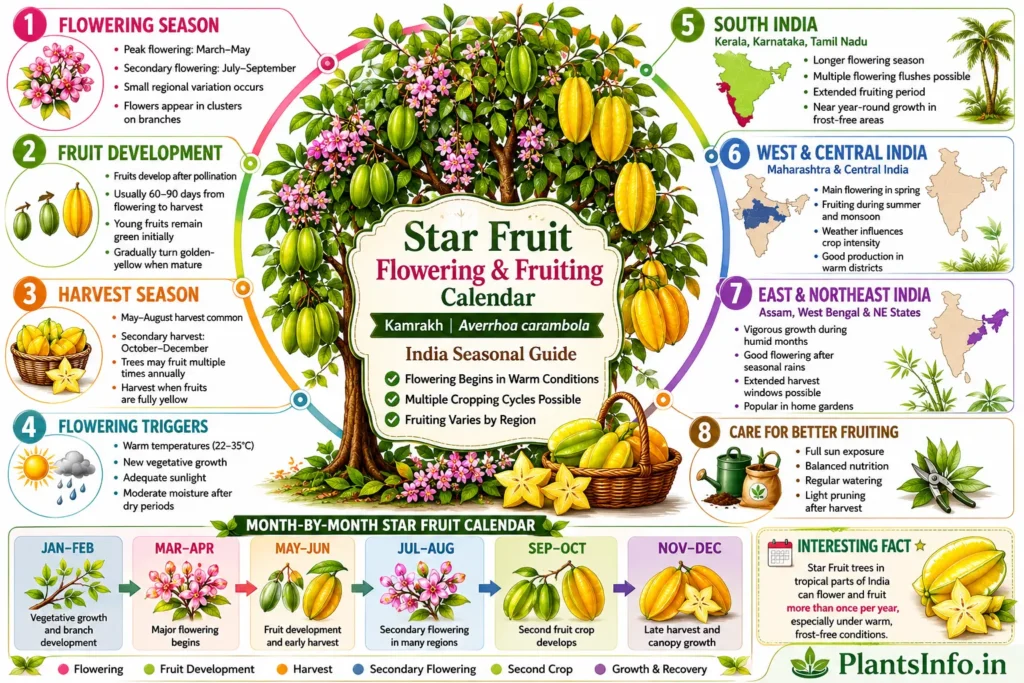
Quick Answer:Star fruit flowers multiple times a year in tropical India — typically two to three major flowering flushes, with the strongest flowering commonly occurring from late winter into spring (February–April in much of India) and a secondary flush often occurring during or after the monsoon period. Fruit typically ripens 60–75 days after flowering, although development may range from about 45–90 days depending on cultivar, temperature, and rainfall. Exact timing shifts by a month or two depending on how far south or north the tree is growing.
See also: Star Fruit plant profile, how to grow it, common problems, its benefits, and its varieties.
At a Glance

| Activity | Typical Timing |
|---|---|
| Main flowering flush | February–April |
| Secondary flowering flush | August–September |
| First harvest | May–June |
| Second harvest | October–November |
| Best planting time | March–April |
| Alternate planting time | October |
Unlike most Indian fruit trees that offer one annual window and then go quiet, kamrakh keeps producing in overlapping cycles. A tree in full health in Kerala or Andhra Pradesh can carry flowers, unripe fruit, and ripe fruit on the same branch simultaneously — which is both botanically unusual and practically convenient for the home gardener who wants fresh fruit across several months rather than a single overwhelming harvest.
Recommended Products
Disclosure: As an Amazon Associate, PlantsInfo may earn from qualifying purchases.
🌱 Growing Essentials
The following products can help with container gardening, potting, root development, soil management, and healthy plant growth.
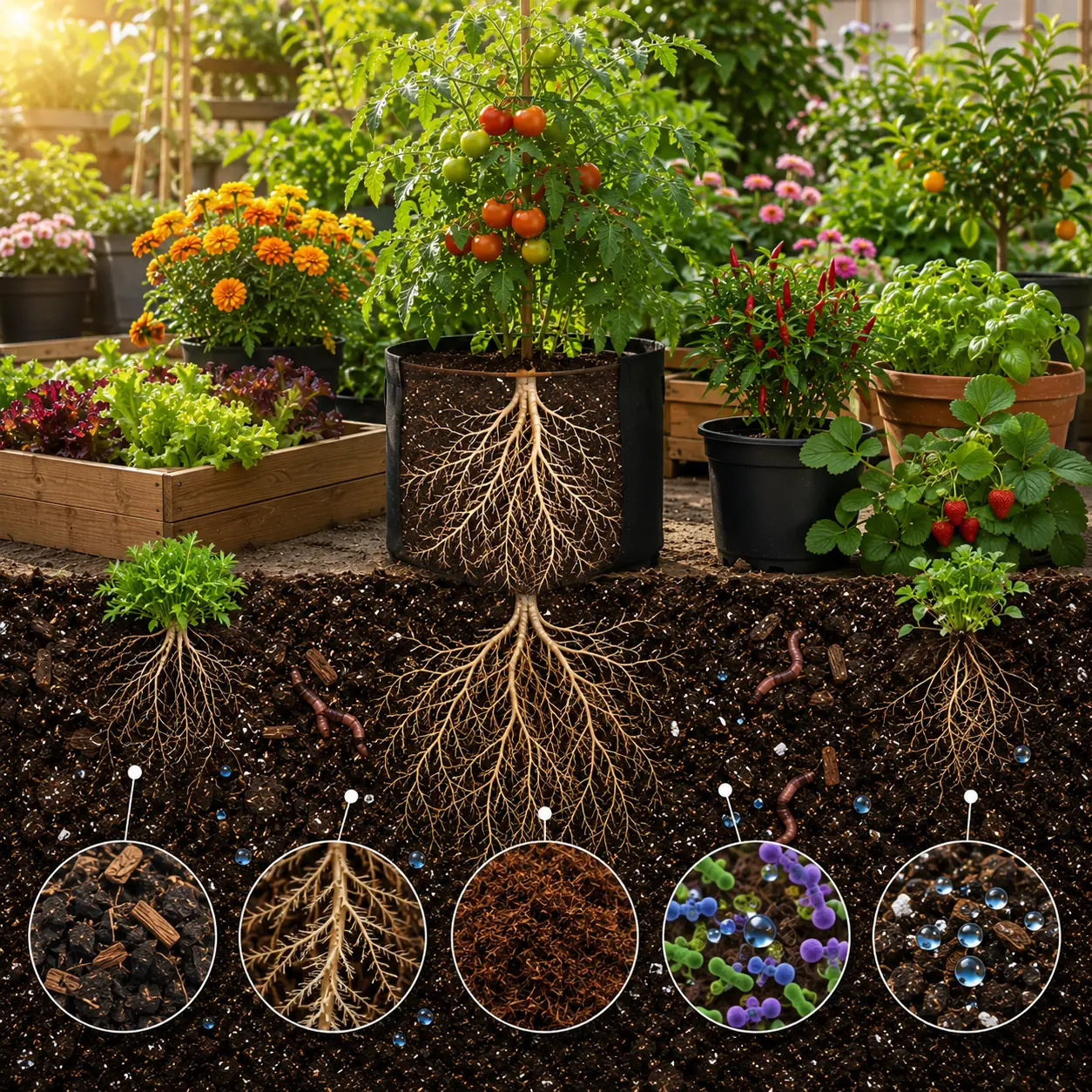
Organic Potting Soil Mix
Provides nutrients, structure, and healthy growing conditions for container plants.
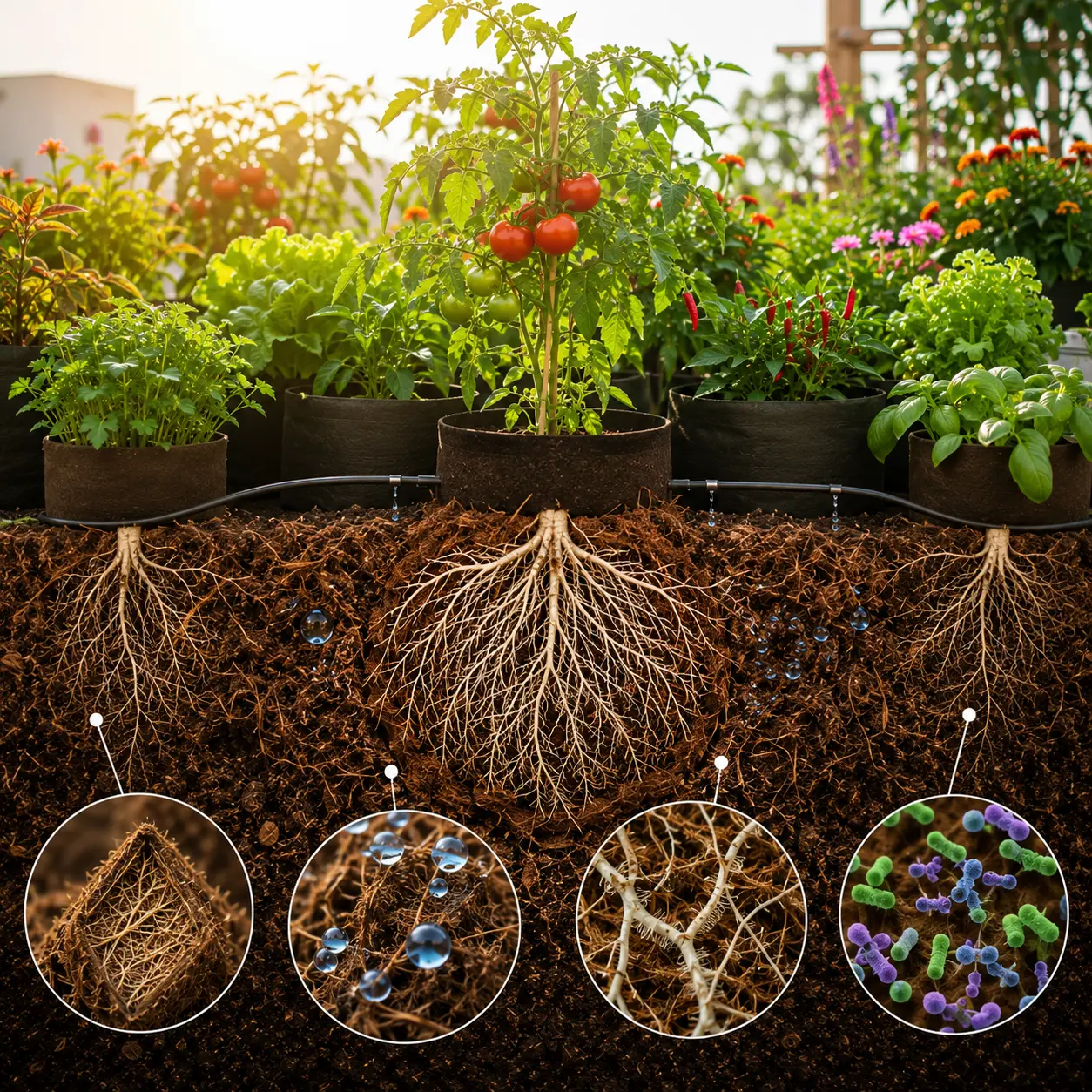
Coco Peat Growing Medium
Enhances moisture retention while maintaining excellent root-zone aeration.

Grow Bags for Plants
Improve drainage, root aeration, and vegetable production in limited spaces.

Plastic Pots for Plants
Ideal containers for seedlings, ornamentals, herbs, and balcony gardens.
India’s Seasons and This Plant
| Season (months) | What the plant is doing |
|---|---|
| Pre-monsoon (Mar–May) | Main flowering flush; fruit set begins; rapid vegetative growth |
| Monsoon (Jun–Sep) | First flush fruit developing and ripening; second flowering flush (Aug–Sep) in South India |
| Post-monsoon (Oct–Nov) | Second flush fruit ripening; tree consolidating; minor vegetative growth |
| Winter (Dec–Feb) | Reduced activity in North India; pre-flowering bud development begins in South; coldest weeks slow the tree |
Flowering Season in Detail
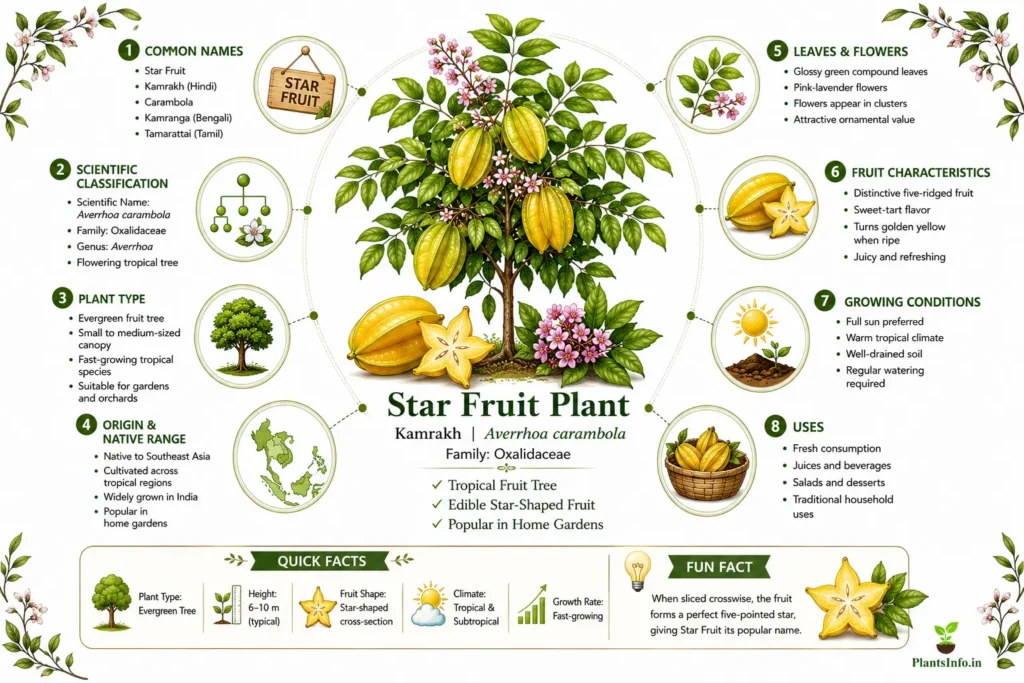
The primary flowering flush in most of India begins in February and peaks through March and April. Buds appear as tiny clusters directly on the woody branches and occasionally on the main trunk — the cauliflorous flowering habit means flowers do not always appear where a gardener expects them, at shoot tips, but emerge from older wood. This can alarm first-time growers who do not recognise the clusters as flower buds until the lavender-pink petals open.
Individual flowers are short-lived, but clusters open progressively over several days. Peak bloom commonly occurs during March in many parts of South India, and a week or two later in Maharashtra and Bengal.
The trigger for the primary flowering flush is a combination of slightly cooler temperatures (the mild Indian winter) followed by warming and lengthening days in February. In South India, where temperatures never drop sharply, this temperature differential is subtle, and the tree relies more on subtle seasonal changes in temperature and growing conditions. In North India and Bengal, the more pronounced winter-to-spring transition makes the March flush more predictable and often more prolific.
The second flowering flush, which occurs in August–September, is driven by post-monsoon conditions — receding humidity, stable temperatures, and the shift out of the most intensive rainfall period. This flush is typically lighter than the March one but reliable in tropical regions. Trees in Kerala and Tamil Nadu often produce a minor third flush in November–December.
Regional variation is significant: Trees in the Northeast often flower somewhat later than those in peninsular South India, although timing varies considerably with local climate and annual weather patterns.
Fruiting Season
Fruit sets approximately 7–10 days after successful pollination. Many cultivated star fruit trees can set fruit without a second tree, although pollinator activity and cross-pollination may improve fruit set in some cultivars.
Development from fruit set to harvest takes approximately 60–75 days under warm conditions. The first flush fruit that sets in March typically ripens in May–June, just as the monsoon begins. The second flush fruit (August–September flowering) ripens in October–November, the most comfortable harvest window in most of India.
Ripening is clearly signalled: unripe fruit is firmly green; as it matures, the ridges yellow first, then the flat faces between ridges, until the whole fruit is a deep golden yellow with a slightly waxy skin. Ripe fruit at this stage has a mild, sweet-tart fragrance detectable from close range.
If fruit is left on the tree beyond full ripeness, it softens rapidly, develops brown patches at the ridges, and drops within days. The harvest window is short — typically five to seven days per fruit cluster from optimal ripeness to over-ripeness. Regular checking every two to three days during the peak ripening period prevents loss.
Best Time to Plant
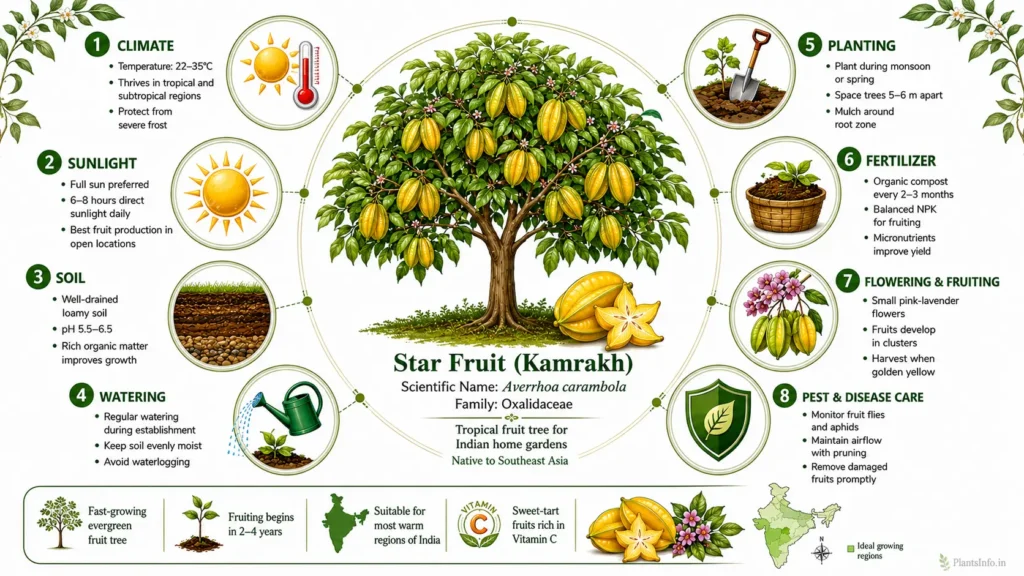
The ideal planting window in most of India is March–April, in the weeks just before the monsoon season begins. A sapling planted at this time establishes through the warm pre-monsoon weeks and then receives consistent moisture from June onward without the gardener needing to irrigate daily.
This timing works because root establishment coincides with warming temperatures and the arrival of reliable seasonal moisture, which encourage rapid root spread, and the incoming monsoon provides consistent moisture without waterlogging if drainage is adequate.
The second-best planting window is October — after the main monsoon subsides and the soil is still warm enough to encourage root growth before winter slows the tree. In North India, October planting gives young trees a few weeks to settle before temperatures drop; in South India and Kerala, October planting is nearly as good as March.
Avoid planting in peak summer (May–June in most states) unless irrigation is guaranteed, and avoid planting during the height of the monsoon (July–August) when soil saturation risks root damage before the tree is established.
Container planting has more flexibility — a pot can be moved to shelter if conditions deteriorate — but the same seasonal preference applies.
Month-by-Month Calendar
| Month | Season | What to Do |
|---|---|---|
| January | Winter | Tree is slowing; bud development beginning in South India; monitor for cold stress in North India |
| February | Late winter / early spring | Flower buds becoming visible on branches; do not prune now |
| March | Pre-monsoon | Primary flowering flush — peak bloom; pollination activity high; first fruit set visible |
| April | Pre-monsoon | Fruit developing from March flush; vegetative growth resuming; ideal planting month |
| May | Pre-monsoon / summer | First flush fruit approaching ripeness; check daily in final two weeks; summer stress possible in North India |
| June | Monsoon onset | First flush fruit ripening and harvesting; monsoon arrives — check drainage immediately |
| July | Monsoon | Fruit from first flush completing; tree in vegetative growth; monitor root zone drainage |
| August | Monsoon | Second flowering flush begins in South India and Konkan coast; watch for bud clusters on branches |
| September | Monsoon / post-monsoon | Second flush pollination and early fruit set; monsoon receding in most states |
| October | Post-monsoon | Second flush fruit developing; ideal second planting window; mild conditions suit establishment |
| November | Post-monsoon | Second flush fruit ripening in most regions; harvest peak for post-monsoon crop |
| December | Early winter | Minor third flush possible in Kerala and Tamil Nadu; tree slowing in North India |
What Can Go Wrong Seasonally?
Flower drop without fruit set in the March flush is the most commonly misread seasonal problem. When nearly all flowers fall without setting fruit, the usual cause is extreme heat during the brief pollination window — temperatures above 38°C for several consecutive days during March–April can disrupt pollination in North India and the Deccan. This is not a disease; no treatment is needed. The second flush typically sets fruit more reliably.
Fruit splitting before harvest in October–November occurs when heavy unseasonal rain or irregular irrigation follows a dry spell just as fruit is approaching ripeness. The sudden influx of moisture causes rapid flesh expansion faster than the skin can accommodate. Maintain consistent soil moisture during the final three to four weeks before expected harvest to reduce risk.
Premature fruit drop during the monsoon — small developing fruit falling from June–July clusters — is most often caused by waterlogged roots rather than pest damage. This is a drainage issue, not a fruiting issue; the tree is shedding load under stress. The fix is drainage, not any spray or supplement.
Post-Harvest and Post-Bloom Care
After the first flush harvest in May–June, remove any dried flower stalks and check for branch tips that bore fruit but have not produced new growth — these can be lightly tip-pruned to encourage a new vegetative flush before the August flowering. Do not cut into old wood at this stage.
After the second flush harvest in November, this is the correct window for any structural pruning — removing crossing branches, thinning the canopy interior, and shaping the tree for the following season. Pruning at this stage gives the tree the full winter period to callus over cuts before the February bud development begins.
Star fruit’s multi-flush flowering habit means the season is never truly over — just shifting from one phase to the next.
Conclusion
Star fruit is one of the few fruit trees in India that can flower and fruit in multiple cycles throughout the year rather than in a single concentrated season. In most regions, the strongest flowering occurs from February to April, followed by a secondary flowering flush during or after the monsoon period.
Fruit typically ripens 60–75 days after flowering, creating harvest windows in late spring and again during autumn. While exact timing varies with climate, temperature, rainfall, and location, understanding these seasonal patterns makes it easier to plan planting, pruning, irrigation, and harvest activities. Regular observation of your tree’s flowering and fruiting cycles will provide the most accurate guide for local conditions.