How to Grow Star Fruit (Kamrakh): Complete Care Guide for Indian Gardens

Quick Answer: Star fruit is a moderate-difficulty fruit tree that thrives across tropical and subtropical India. It grows well in ground or large containers, begins fruiting in 2–3 years from a grafted sapling, and rewards gardeners who get the drainage right from the start.
See also: Star Fruit plant profile, common problems, its flowering season, its benefits, and its varieties.
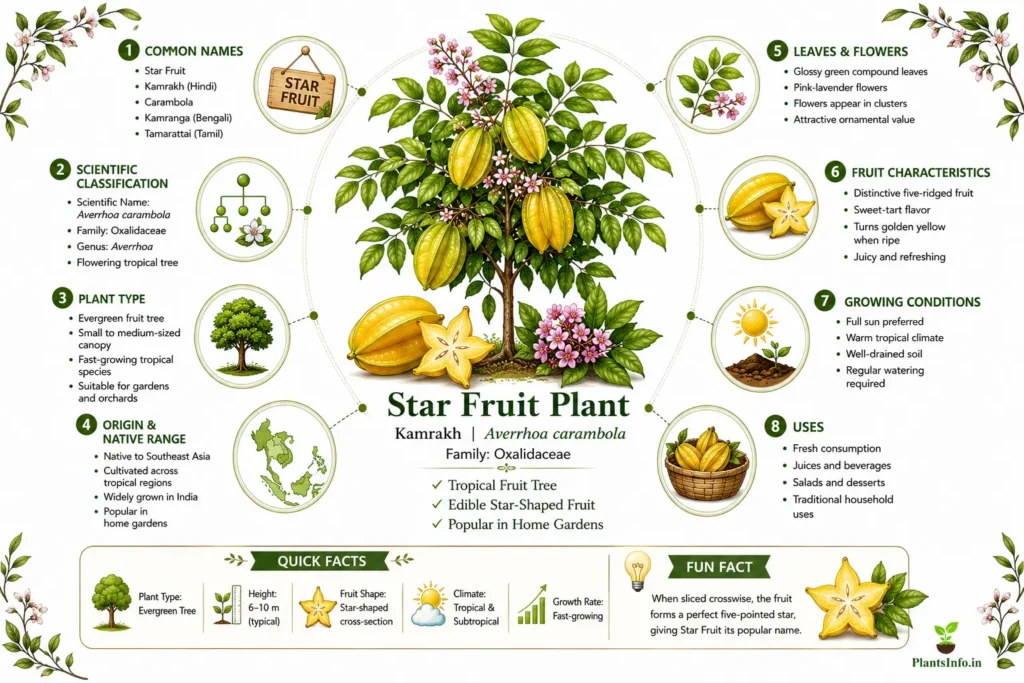
Star fruit (Averrhoa carambola) is a tropical fruit tree valued for its distinctive star-shaped fruit and ornamental appearance. Most people plant a star fruit tree for its looks and stay for the harvest. The five-ribbed cross-section that gives it its name makes it one of the most distinctive fruits in any Indian garden — and the tree itself, with its arching branches and clusters of small pink flowers, is no ornamental slouch either.
Recommended Products
Disclosure: As an Amazon Associate, PlantsInfo may earn from qualifying purchases.
🌱 Growing Essentials
The following products can help with container gardening, potting, root development, soil management, and healthy plant growth.
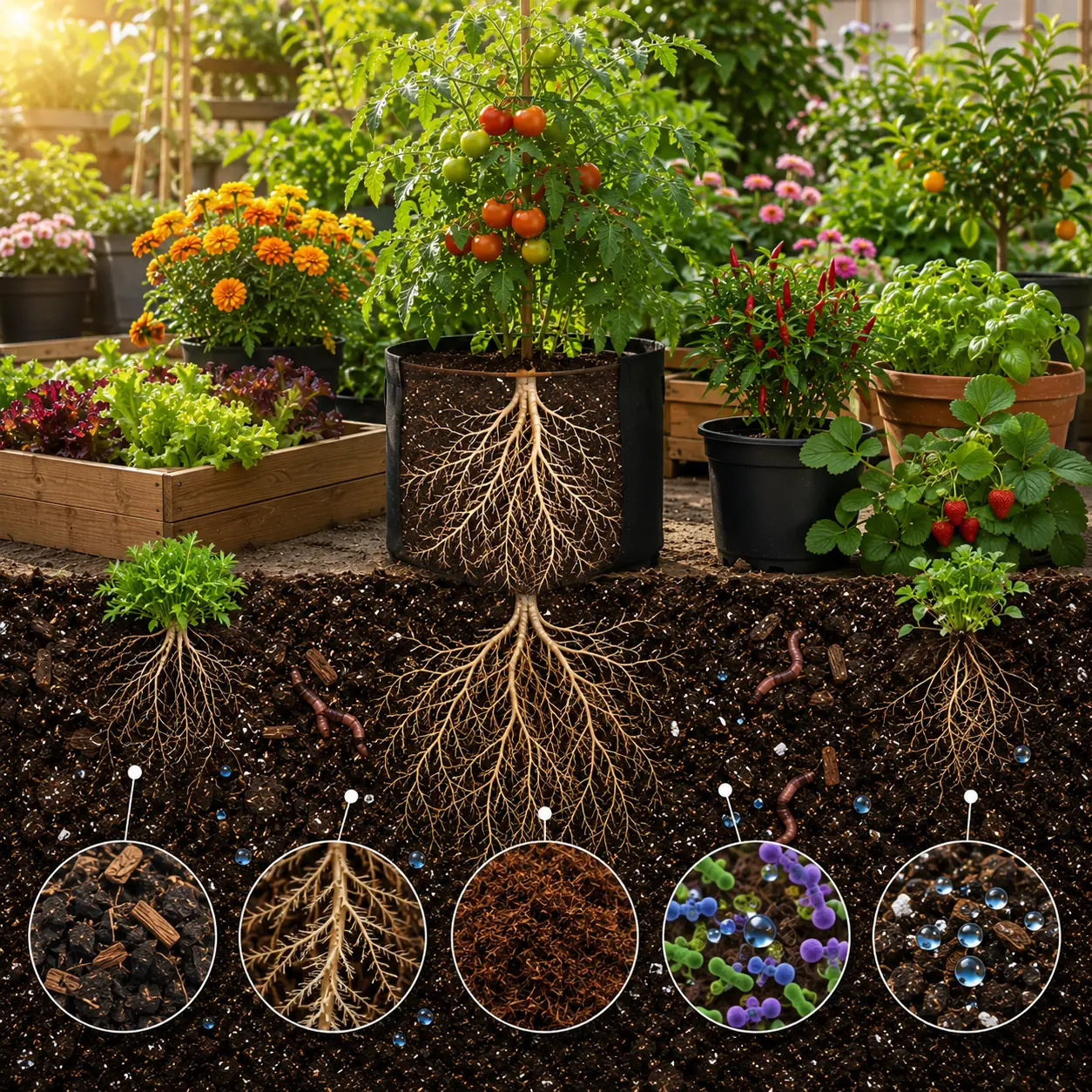
Organic Potting Soil Mix
Provides nutrients, structure, and healthy growing conditions for container plants.
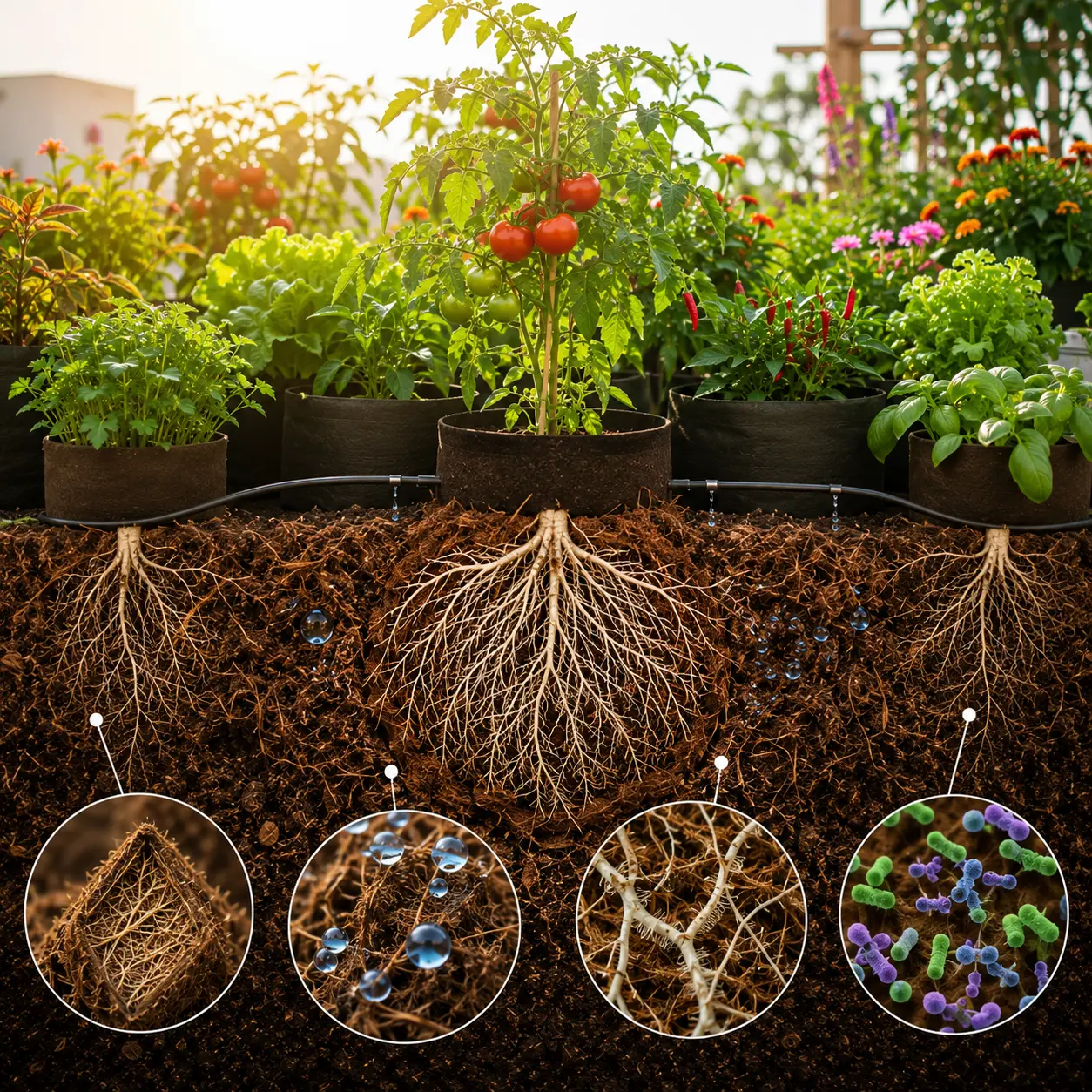
Coco Peat Growing Medium
Enhances moisture retention while maintaining excellent root-zone aeration.

Grow Bags for Plants
Improve drainage, root aeration, and vegetable production in limited spaces.

Plastic Pots for Plants
Ideal containers for seedlings, ornamentals, herbs, and balcony gardens.
The single mistake that finishes off more star fruit trees in India than anything else is not heat or drought — it is a waterlogged root zone during the monsoon. Get the drainage sorted before the first plant goes in, and the rest is manageable.
Difficulty: Moderate

Quick Facts
| Attribute | Detail |
|---|---|
| Common names | Star fruit, kamrakh, carambola, kamaranga |
| Scientific name | Averrhoa carambola L. |
| Varieties | B-17 (sweet), Arkin, Fwang Tung. |
| Plant type | Tropical/subtropical evergreen fruit tree |
| Mature size | Typically 3–6 m under home garden management; up to 10–12 m if left unpruned. |
| Sunlight | Full sun — minimum 6 hours of direct sun daily |
| Water needs | Moderate; well-drained conditions essential |
| Best season to plant | Pre-monsoon (March–April) or early post-monsoon (October) |
| Suitable states | Kerala, Tamil Nadu, Andhra Pradesh, Telangana, Karnataka, Maharashtra, West Bengal, Assam, Odisha, Goa |
Choosing the Right Spot
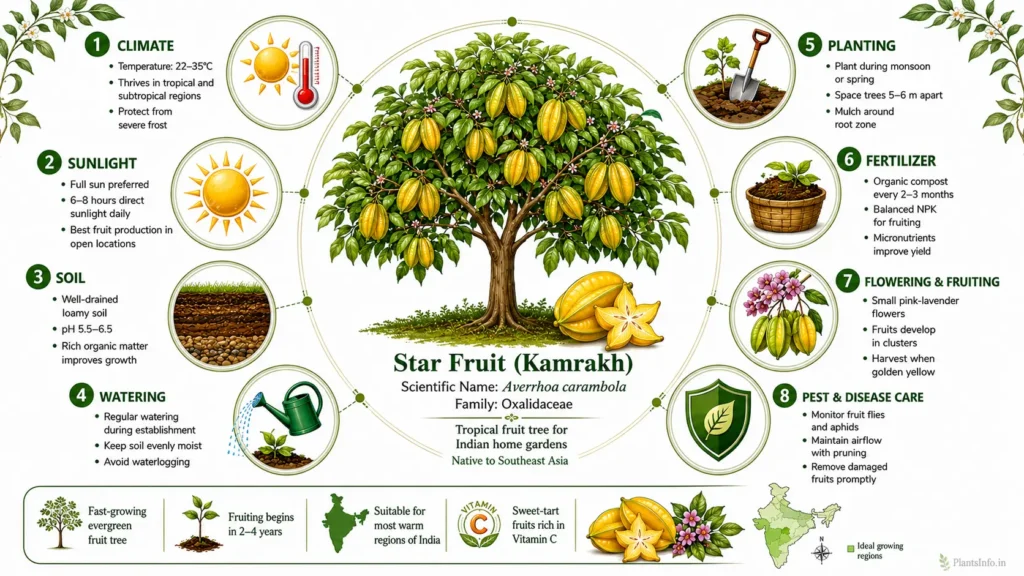
Star fruit needs a minimum of six hours of direct sunlight daily — morning sun with some afternoon shade is acceptable in regions with extreme summer heat, such as the Deccan plateau and Rajasthan borders, but full sun is preferred everywhere else. In coastal states like Kerala and Goa, the tree thrives in open exposure with no sheltering needed.
Leave at least 5–6 metres between trees and between a tree and any wall or structure; the canopy spreads wide, and airflow around the branches reduces fungal pressure significantly. In North India, planting against a south-facing wall provides warmth that can make the difference between a productive tree and a merely decorative one.
For containers, a minimum 24-inch (60 cm) diameter pot works for the first three to four years. Ground planting produces a larger, more productive tree in the long run — containers slow growth but make the plant manageable for terraces.
Soil and Potting Mix
Star fruit prefers loamy, well-draining soil with a pH in the range of 5.5–7.0, with optimum growth around 6.0–6.5. It tolerates slightly acidic conditions well, which suits the naturally acidic soils of the Northeast, the Western Ghats foothills, and parts of West Bengal. In heavy black cotton soil (common across Maharashtra and parts of Andhra Pradesh), drainage must be improved before planting.
To improve standard garden soil, mix in one part coarse sand or perlite and one part well-matured compost or vermicompost per two parts soil. Raise the planting mound by 20–30 cm in areas prone to waterlogging — this single step prevents the most common cause of early tree death in the monsoon belt.
The most common soil mistake is planting directly into undrained clay without amendment. Star fruit does not recover easily from prolonged root saturation; the damage shows weeks after the event, by which point recovery is difficult.
Planting — Season and Method
The best time to plant star fruit in India is just before the monsoon — March through April — so the tree can establish with natural rainfall rather than relying on daily irrigation. A second good window opens in October, after the main monsoon subsides and the soil is still warm.
Grafted saplings are far more practical than seeds for home gardeners. Grafted plants begin flowering in 2–3 years; seed-grown trees can take 5–7 years and often produce inferior fruit. Most state nurseries and KVK (Krishi Vigyan Kendra) outlets stock grafted B-17 or Fwang Tung saplings at reasonable prices.
Dig a planting pit of approximately 60 cm × 60 cm × 60 cm. Fill the base with a mix of topsoil, compost, and a handful of neem cake before placing the sapling. Water thoroughly immediately after planting, then hold back for two to three days to allow the roots to begin anchoring.
Watering
For the first four to six weeks after planting, water every two to three days — enough to keep the root zone moist but never waterlogged. The tree is establishing its root system during this period and cannot tolerate either drought or standing water.
A mature tree in the ground needs watering every five to seven days in summer (April–June) and can rely largely on rainfall during the monsoon. Reduce irrigation significantly from June onward whenever there is regular rainfall of 50 mm or more per week.
One specific overwatering sign to watch: if the youngest leaves at branch tips begin to curl inward and turn pale yellow — not brown at the edges — before any of the older foliage is affected, the roots are sitting in excess moisture. This is distinct from iron deficiency yellowing, which starts on older inner leaves.
During the monsoon, check that the soil around the root zone drains freely within two hours of heavy rain. If it pools for longer, create a small drainage channel away from the tree.
Fertiliser
Star fruit is a moderate feeder and responds well to both organic and balanced inorganic fertilisers. For a young tree in its first two years, apply vermicompost (2–3 kg per application) three times a year — once before the monsoon (May), once at the end of monsoon (October), and once in winter (January). Add a handful of neem cake with each application to suppress soil pathogens.
For fruiting trees, supplement with a balanced NPK fertiliser such as 10-10-10 at roughly 200–300 g per application twice a year — in March and September. Potassium is particularly important for fruit development and sweetness; a potassium-rich organic source like wood ash or banana peel compost worked into the topsoil in the pre-flowering period (typically February–March) is a useful addition.
Mustard cake dissolved in water and applied monthly during the growing season is an effective organic nitrogen source that is widely available across Indian markets.
Common Problems and Fixes
The three most common problems star fruit faces in Indian gardens are:
Fruit drop before ripening — typically caused by irregular watering or a sudden switch between dry and wet conditions; the plant responds to stress by aborting developing fruit.
Sooty mould on leaves — a secondary fungal problem that follows mealy bug or aphid infestation; the insects produce honeydew that the mould colonises.
Leaf curl and dieback at branch tips — usually a sign of either waterlogging stress or thrips damage, which can look deceptively similar on first inspection.
For full diagnosis and treatment, see the Star Fruit Problems Guide.
When Will You See Results?
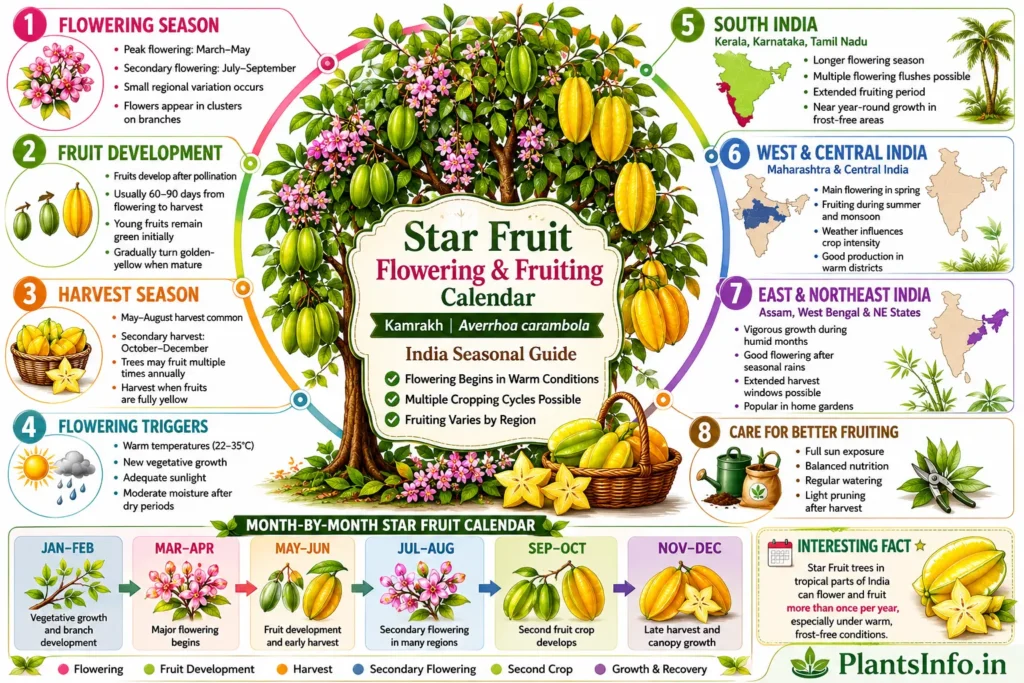
A grafted sapling planted in March will typically produce its first flowers in the second or third monsoon season. First fruiting is often light — a handful of fruit clusters — and this is normal. The tree is still building its root and canopy structure.
By years three to four, a well-maintained tree in the ground should produce 20–40 kg of fruit per season in optimal conditions. Container trees produce less but begin fruiting at a similar age.
The patience note worth making: Star fruit flowers several times a year in tropical India, but not every flowering flush develops fruit. This is normal and does not indicate a problem.
Propagation
The most practical propagation methods for home gardeners are grafting (cleft or tongue grafting) and air layering. Grafting onto a rootstock of Averrhoa bilimbi (bilimbi) is common in Kerala and produces vigorous, productive trees. Air layering takes approximately 45–60 days to produce a rooted cutting and can be done at the end of the monsoon when wood is firm but not yet dormant.
Seeds germinate readily but produce genetically variable plants that often revert to more sour types. Unless you are intentionally selecting for a new variety, seed propagation is not recommended for home gardens.
Cuttings alone have a low success rate without rooting hormone and a warm, humid propagation chamber — grafting or air layering are significantly more reliable for this species.
Pruning and Training
Prune star fruit in late winter (January–February) before the pre-monsoon growth flush begins. Light shaping is sufficient for most home garden trees — remove crossing branches, any dead wood, and any growth that is heading back into the centre of the canopy.
Do not prune heavily after October; new growth triggered by a late-season cut is vulnerable to the cold nights that affect North India and high-altitude growing zones. In Kerala and Tamil Nadu, where winters are mild, pruning can extend through February.
For container trees, tip-pruning — pinching growing tips after each flush — keeps the canopy compact and encourages branching. Avoid removing more than one-third of the canopy in any single pruning session.
Harvesting
Star fruit in India is ready to harvest when the ridges of the fruit turn fully yellow and the skin develops a slight waxy sheen. Fruit harvested while still mostly green will ripen off the tree but with noticeably lower sweetness. The best test is to press gently at the widest point — ripe fruit gives slightly without feeling soft.
Harvest by cutting the stem with scissors or a sharp knife rather than pulling, which can damage the fruit cluster and the small branch it grows on. Star fruit clusters repeatedly on the same spurs, so protecting those branch points preserves future harvests.
At room temperature, ripe star fruit keeps for three to five days. Refrigerated, it holds for up to two weeks without significant quality loss. For longer storage, slice and freeze; the frozen slices are excellent in drinks and cooking even if the fresh texture is lost.
Seasonal Protection
In North India, young trees (under three years) are vulnerable to temperatures below 5°C. Wrap the trunk with hessian or old cloth from December through February and reduce watering during cold spells. Established trees survive mild frost but may drop leaves temporarily; they typically recover as temperatures rise in March.
Summer stress in May–June shows as leaf scorch on exposed outer foliage, particularly in the Deccan and Central Indian plains. Mulching the root zone with dry leaves, straw, or sugarcane bagasse to a depth of 5–7 cm significantly reduces soil temperature and moisture loss during peak heat.
FAQ
Can star fruit grow in pots?
Yes. A grafted star fruit tree can grow and fruit in a 24–30-inch container with regular pruning.
How long does star fruit take to bear fruit?
Grafted trees usually fruit within 2–3 years. Seed-grown trees may take 5–7 years.
Can star fruit grow in North India?
Yes, but young trees need protection from winter temperatures below 5°C.
How often should I water star fruit?
Water when the top few centimetres of soil begin to dry. Avoid waterlogging at all times.
Key Takeaways
- Start with a grafted sapling, not seeds — it cuts the wait for first fruit from 5–7 years down to 2–3 years.
- Drainage is non-negotiable: a raised planting mound and amended soil prevent the most common cause of tree failure during the Indian monsoon.
- Plant in March–April or October for the best establishment; avoid planting in peak summer or the heart of the monsoon.
- Feed three times a year with vermicompost and supplement with potassium before flowering for sweeter fruit.
- Light annual pruning in January–February keeps the tree shaped and productive without disrupting the flowering cycle.
Star fruit rewards patience and good drainage — give it those two things, and it will produce for decades. Growing success with star fruit depends less on fertiliser and more on proper site preparation. Most failures occur due to poor drainage during the monsoon rather than lack of nutrients.