Guggul Varieties: Which One Should You Grow in India?
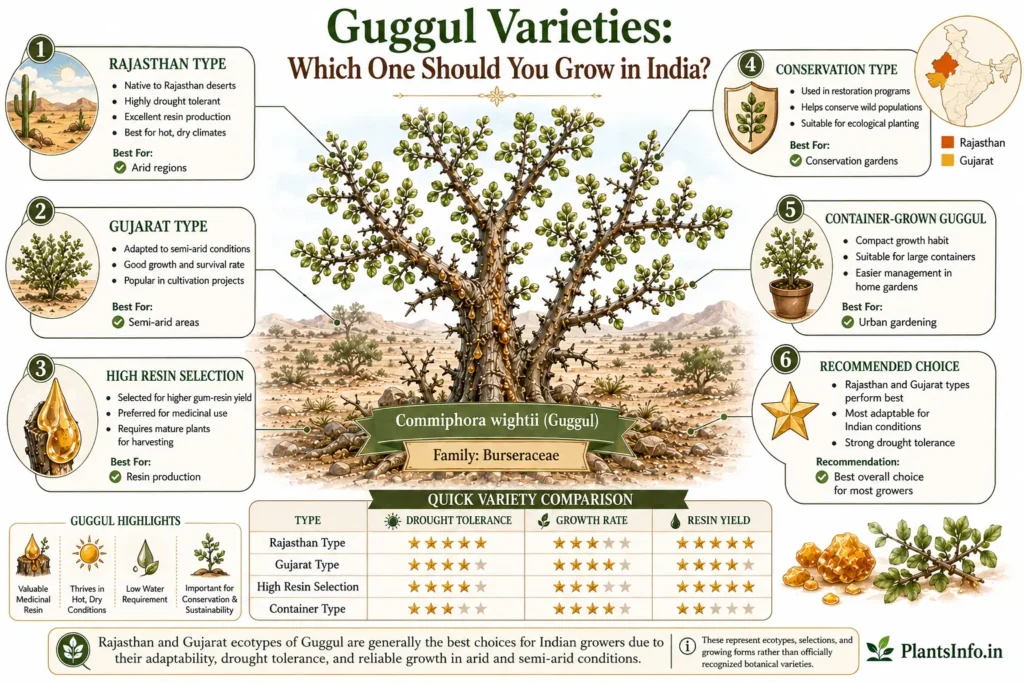
Quick Answer: No commercially released horticultural varieties of guggul exist in India. The meaningful distinctions are between regional ecotypes — primarily Rajasthan and Gujarat provenances — and the five classical resin grades described in Ayurvedic texts. For home gardeners, the most important choice is not variety but source: provenance-matched, nursery-propagated material from KVK or NMPB-registered suppliers is significantly more reliable than unnamed nursery stock.
See also: Guggul Plant plant profile, how to grow it, common problems, its flowering season, and its benefits.
Walk into most nurseries in India and ask for a guggul plant. If they stock it at all — and many do not — you will receive an unnamed sapling with no information about where it was propagated from or which provenance it represents. Unlike mango or papaya, where variety names are routinely used in commerce, guggul is sold almost entirely as a species rather than as a named selection. This spoke exists to give you the framework to make a better choice than the nursery label will.
Recommended Products
Disclosure: As an Amazon Associate, PlantsInfo may earn from qualifying purchases.
🌱 Growing Essentials
The following products can help with container gardening, potting, root development, soil management, and healthy plant growth.
Organic Potting Soil Mix
Provides nutrients, structure, and healthy growing conditions for container plants.
Coco Peat Growing Medium
Enhances moisture retention while maintaining excellent root-zone aeration.

Grow Bags for Plants
Improve drainage, root aeration, and vegetable production in limited spaces.

Plastic Pots for Plants
Ideal containers for seedlings, ornamentals, herbs, and balcony gardens.
Quick Varieties Selection
| Type / Provenance | Type | Plant Size | Best For | Suited To |
|---|---|---|---|---|
| Rajasthan ecotype (Aravalli provenance) | Landrace / regional ecotype | Medium (2–3 m) | Resin yield, conservation planting, arid gardens | Rajasthan, Haryana, dry Madhya Pradesh |
| Gujarat ecotype (Kutch / Kathiawar provenance) | Landrace / regional ecotype | Small–medium (1.5–2.5 m) | Early flowering, mild-winter zones, containers | Gujarat, dry Maharashtra |
| NMPB / KVK selected material | Improved landrace selection | Medium | Conservation cultivation, verified resin quality | Rajasthan, Gujarat, Madhya Pradesh |
| Mahishaksha (classical grade) | Resin quality classification | — | Highest Ayurvedic potency; resin from mature wild or old cultivated trees | Traditional Ayurvedic use |
| Tissue culture propagated | Clonal / research-stage | Medium | Uniform resin yield (research and conservation farms) | Rajasthan, Gujarat (limited availability) |
Varieties in Detail
Rajasthan Ecotype (Aravalli Provenance)
The Rajasthan ecotype — material originating from the Aravalli hill districts of Udaipur, Rajsamand, Chittorgarh, and Ajmer — represents the most widely documented and most studied guggul provenance in India. Plants from this provenance are adapted to the specific combination of rocky, calcareous soils, pronounced winter cold (minimum temperatures of 3–8°C), and a brief but occasionally intense monsoon that characterises the Aravalli range. They tend toward medium size at maturity (2–3 metres in cultivation), with a branching, multi-stemmed form.
Resin yield studies conducted at research stations in Rajasthan indicate that Aravalli-provenance material produces measurable resin earlier in its development compared to plants of unknown provenance, though this advantage is variable across individual plants. The key strength of Rajasthan ecotype material is climate adaptation: in cultivation within Rajasthan and Haryana, it establishes more reliably than material moved from Gujarat, which has a milder winter baseline. The notable weakness is cold sensitivity at the seedling stage — young Rajasthan ecotype plants in their first winter require protection below 3°C.
For propagation, stem cuttings from Aravalli-provenance mother plants taken by state forest department nurseries and KVK outlets in Rajasthan are the most accessible and reliable source. Material from NMPB conservation programmes in Rajasthan is generally from verified Aravalli provenance.
Gujarat Ecotype (Kutch / Kathiawar Provenance)
The Gujarat ecotype originates from the Kutch district and the Kathiawar peninsula — historically the second major wild population of guggul in India, now significantly depleted. Plants from this provenance experience milder winters than the Rajasthan ecotype (minimum temperatures rarely below 8–10°C in Kutch) and a different rainfall pattern: lower total rainfall but more erratic distribution. They tend to be slightly smaller at maturity, flower two to three weeks earlier in the season, and have a somewhat more compact natural form.
The Gujarat ecotype’s key strength is its performance in the milder dry-climate zones of Gujarat and coastal dry Maharashtra — conditions that the Rajasthan ecotype, adapted to colder winters, does not always match efficiently. For container growing on terraces in Ahmedabad, Surat, or Mumbai’s drier northern suburbs, Gujarat provenance material is the better starting point.
Resin quality from Gujarat ecotype material is documented as variable — the depletion of wild populations means that much of what is sold as Gujarat-origin guggul in local nurseries is of uncertain provenance. Sourcing from NMPB programmes in Gujarat or from the Forest Department nurseries in Kutch gives more reliable material.
NMPB and KVK Selected Material
The National Medicinal Plants Board, through its conservation cultivation programmes and KVK outlets across Rajasthan and Gujarat, has propagated guggul from documented mother trees with verified provenance and, in some cases, assessed resin yield. This material does not have formal variety names but represents the closest thing to improved planting material available to Indian home gardeners and farmers.
The key strength of NMPB and KVK material is traceability — the provenance is documented, the propagation method (usually stem cuttings or air layers from known mother plants) is verified, and the plants are grown without tissue culture shortcuts that may produce establishment challenges. For anyone undertaking conservation planting or agroforestry with guggul, sourcing from these channels is strongly preferred over general nursery purchases.
Availability is the main constraint: NMPB programme material is more readily available in Rajasthan and Gujarat than in other states, and supply is seasonal. Contact the nearest KVK well in advance of the intended planting window.
Tissue Culture Propagated Material
Tissue culture propagation of guggul has been developed at several agricultural research institutions — including CIMAP (Central Institute of Medicinal and Aromatic Plants, Lucknow) and various state agricultural universities — as a conservation and upscaling tool. Tissue culture material produces clonally uniform plants from selected mother trees with assessed resin yields, which is valuable for research farms and large-scale conservation plantings.
For home gardeners, tissue culture guggul is not yet commercially available through accessible retail channels. Establishment rates from tissue culture plantlets can be variable, and the acclimatisation requirements demand more careful nursery management than conventionally propagated saplings. Monitor NMPB and state agricultural university programmes for availability if this material becomes accessible — the yield consistency it offers will be meaningful for anyone growing guggul specifically for resin harvest.
The Five Classical Resin Grades
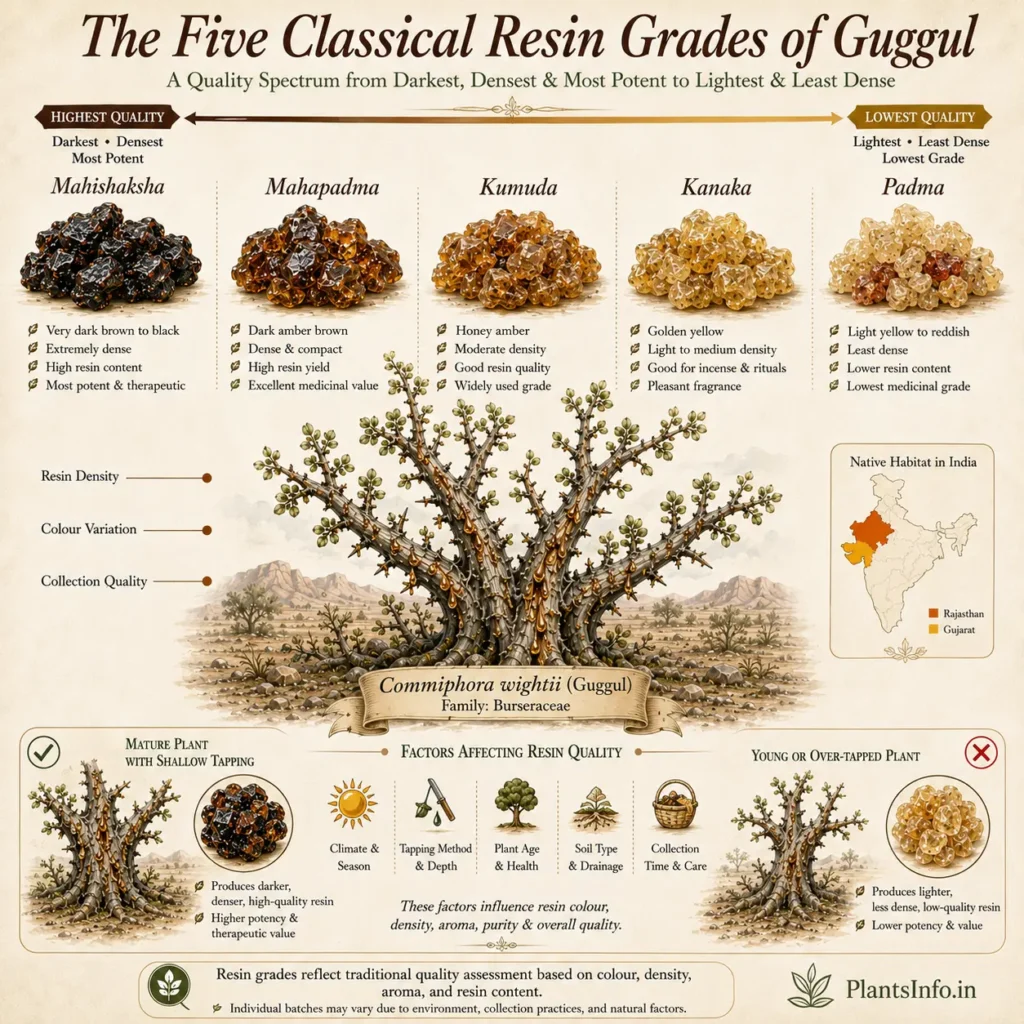
Classical Ayurvedic texts — particularly the Sushruta Samhita and Bhavaprakasha — describe five grades of guggul resin differentiated by colour, texture, fragrance, and origin rather than by plant variety. These are not plant varieties in the horticultural sense but quality classifications of the harvested resin.
- Mahishaksha — dark brown to black, dense, heavy resin from mature plants; considered the highest grade and most potent therapeutically.
- Mahapadma — light brown, translucent; the second grade.
- Kumuda — white to pale yellow, softer texture; third grade.
- Kanaka — golden yellow, fragrant, the grade most associated with ritual and incense use.
- Padma — reddish, least dense; the fifth and lowest grade for therapeutic purposes.
In practice, the resin grade produced by any given plant depends on the plant’s age, the tapping method, and the season of collection — not on a distinct plant variety. Older, mature plants tapped by a shallow incision in the dry season produce denser, darker resin that approximates the Mahishaksha grade. Young or over-tapped plants produce lighter, less potent material.
Head-to-Head Comparison
Rajasthan Ecotype vs. Gujarat Ecotype
For most home gardeners in India’s dry zones, this is the only comparison that matters. Both are landraces of the same species, and the differences are matters of adaptation rather than dramatic botanical distinction — but those differences are meaningful in practice.
The Rajasthan ecotype is the better choice for gardeners in Rajasthan, Haryana, dry parts of Madhya Pradesh, and western Uttar Pradesh. Its adaptation to colder winters and the specific soil chemistry of the Aravalli range make it the more reliable performer in these zones. Resin yield data, though limited to research station observations, favour Aravalli material in Rajasthan conditions.
The Gujarat ecotype is the better choice for gardeners in Gujarat, dry coastal Maharashtra, and any zone where winters are mild and the soil is more saline or calcareous in the Kutch-Kathiawar pattern. Its earlier flowering and more compact form also suit container culture better than the more vigorous Rajasthan ecotype.
Neither ecotype is appropriate for planting outside the arid and semi-arid belt. In any zone receiving more than 1,000 mm of annual rainfall, climate unsuitability will override provenance advantages. The recommendation for high-rainfall zone gardeners is the same regardless of ecotype: container growing with monsoon shelter, not ground planting.
Named Nursery Stock vs. NMPB / KVK Material
This comparison matters for anyone purchasing guggul saplings in India today. The difference is not botanical — both are Commiphora wightii — but it is significant in terms of what you are actually getting.
Named nursery stock (plants labelled simply “guggul” or “carambola” at general nurseries) is typically seed-grown from unknown provenance, variable in quality, and unverified for resin yield potential. Seed-grown guggul has a poor germination record and high variability between plants; some individuals from the same seed batch produce meaningful resin at maturity, others do not. The price is lower, and availability is higher.
NMPB and KVK material is cutting- or layer-propagated from documented mother plants, provenance-matched to the growing region, and more reliably productive at maturity. The price is comparable or slightly higher, availability is more limited, and lead time for sourcing is longer. For anyone planting guggul with a genuine intention to harvest resin or contribute meaningfully to conservation, NMPB and KVK material is the clearly superior choice.
How to Choose for Your Space
Container or terrace garden in a dry-climate city (Jaipur, Jodhpur, Ahmedabad, Bhuj): Gujarat ecotype or NMPB-sourced material in a minimum 18-inch deep container with pure gritty drainage mix. Move under shelter during the monsoon. This is a viable long-term strategy for resin production at a modest scale.
Small ground plot in an arid or semi-arid zone: Rajasthan ecotype (in Rajasthan and Haryana) or Gujarat ecotype (in Gujarat and dry Maharashtra) planted with drainage improvement in October. A single plant is adequate for conservation and aesthetic purposes; two plants improve fruit set. Space 4–5 metres apart.
Larger agroforestry or farm boundary planting: NMPB- or KVK-sourced material only — the additional cost and sourcing effort are justified at scale where resin yield matters. Plant in rows along farm boundaries or rocky hillsides at 4–6 metre spacing. Consult the nearest KVK for state-specific recommendations on spacing and provenance.
High-rainfall zone (outside the arid belt): Do not attempt ground planting. Container growing with monsoon shelter is the only viable option, and success is not guaranteed. If the goal is conservation planting specifically, consult a state agricultural university programme about appropriate species for your zone — guggul may not be the right choice.
Regional Suitability
Rajasthan: Best-suited region in India. All ecotypes perform; Aravalli provenance material is the strongest choice. KVK outlets in Udaipur, Jodhpur, Ajmer, and Kota regularly stock propagated material.
Gujarat: Second-best region. Gujarat ecotype preferred; NMPB Kutch conservation programme material is the gold standard for sourcing. Performance in the wetter eastern Gujarat districts (Vadodara, Surat) is less reliable than in Kutch and Saurashtra.
Madhya Pradesh (dry regions — Mandsaur, Ratlam, Neemuch): Rajasthan ecotype performs adequately in the drier western districts. The wetter central and eastern MP districts (Jabalpur, Rewa) are not suitable.
Haryana (Aravalli belt — Mahendragarh, Bhiwani, Rewari): Rajasthan ecotype is appropriate and has been used in documented in-situ conservation programmes in these districts. Winter cold tolerance is important; Aravalli provenance material handles Haryana winters reliably.
Maharashtra: Restricted to the drier Vidarbha region and the rain shadow areas of the Deccan. Konkan coast and western Maharashtra are not suitable.
All other states: Not recommended for ground cultivation. Container growing with a monsoon shelter is theoretically possible but not practically productive for most gardeners.
Watch Out for Mislabelling
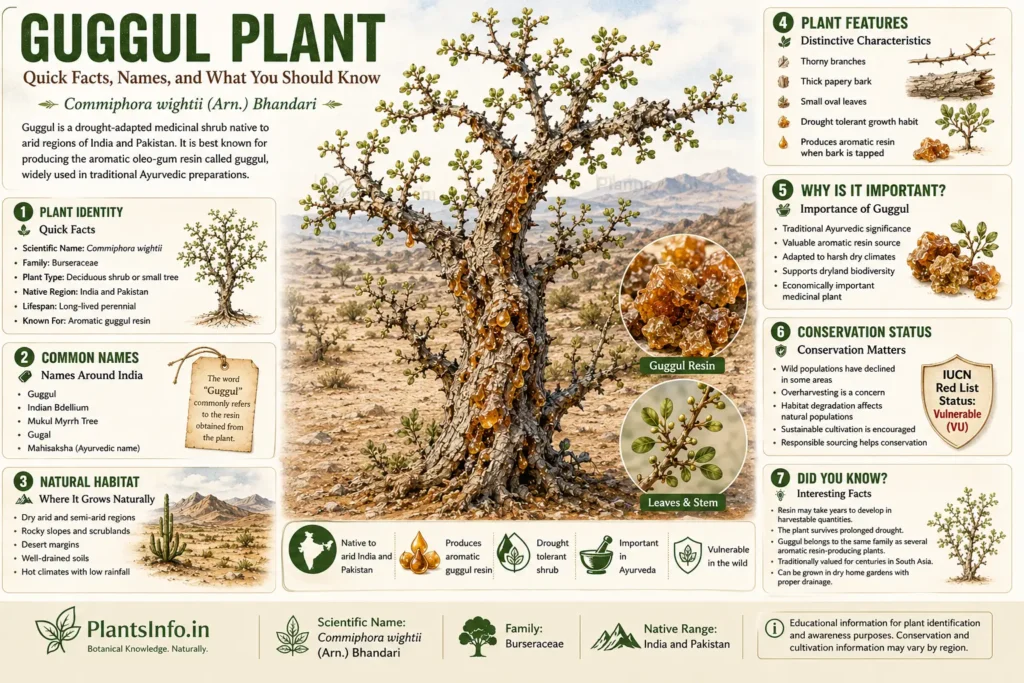
Guggul mislabelling in Indian nurseries is a significant problem with a specific character: unlike fruit tree mislabelling (where a sour variety is sold under a sweet variety’s name), guggul mislabelling often involves selling a different Commiphora species entirely, or selling Boswellia serrata (shallaki) as guggul. Both Boswellia and Commiphora are thorny shrubs with resinous bark and similar growth habits in the nursery stage, and both are sold in the Ayurvedic plant trade — but they are distinct species with different active compounds and different therapeutic profiles.
The single most reliable visual check: Commiphora wightii has thin, papery bark that peels in flaky sheets and reveals a green-grey underlayer, and produces a golden to amber resin when the bark is nicked. Boswellia serrata has rougher, harder bark that peels in larger, more papery layers, produces a white to pale milky resin, and has a distinctly different leaf form (larger, more clearly pinnate leaflets). At the nursery stage, request to see a small nick made in the bark by the seller — the resin colour and consistency are the clearest verification.
For sourcing reliably verified Commiphora wightii specifically, KVK outlets in Rajasthan and Gujarat, state forest department nurseries, and NMPB-registered medicinal plant nurseries are the appropriate channels. General roadside nurseries in states outside the natural range should be treated with significant caution.
The choice between guggul ecotypes is modest compared to the choice of whether to plant at all — and in its native dry zones, every plant matters.