Guggul Flowering Season: When and What to Expect in India
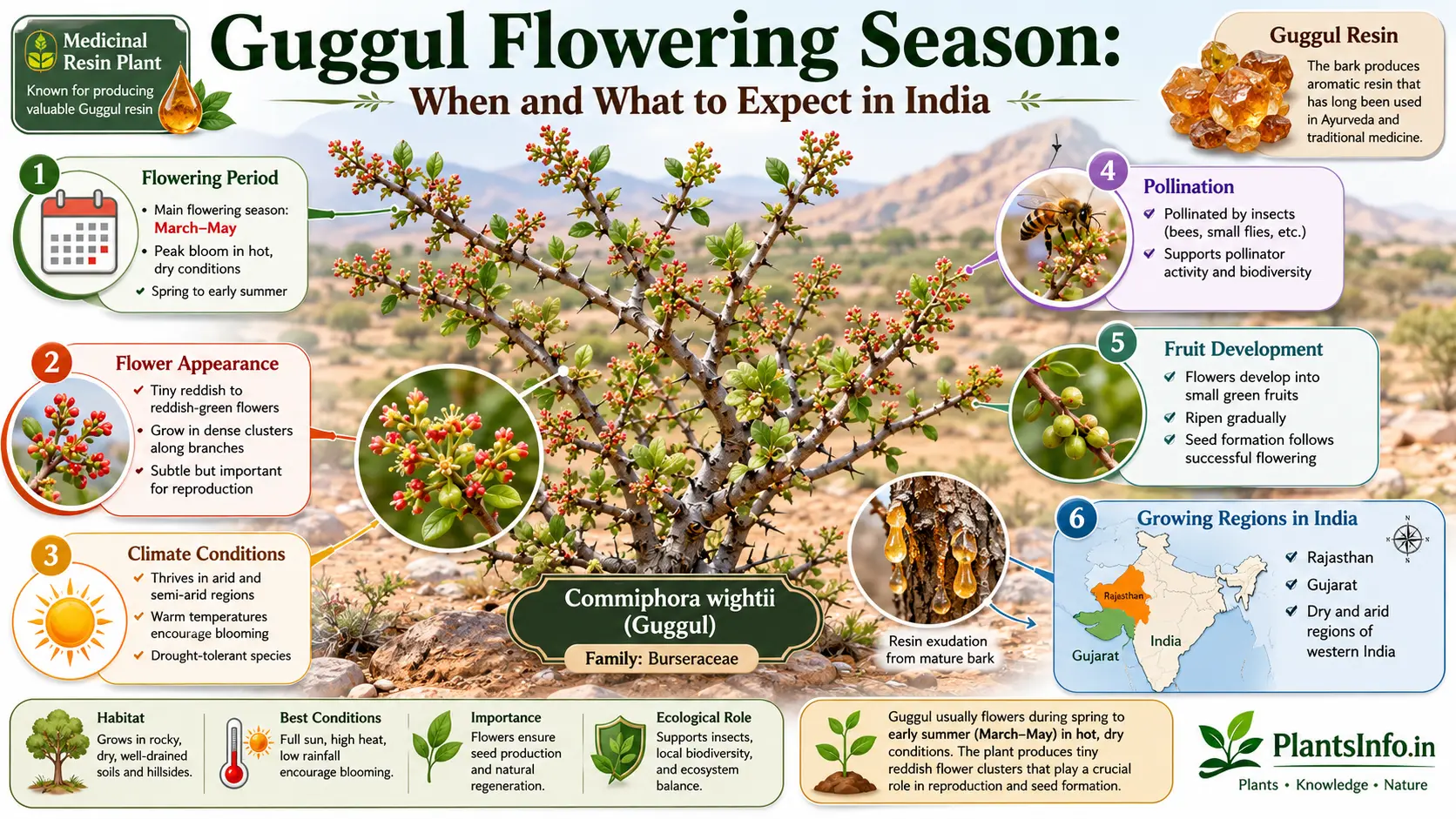
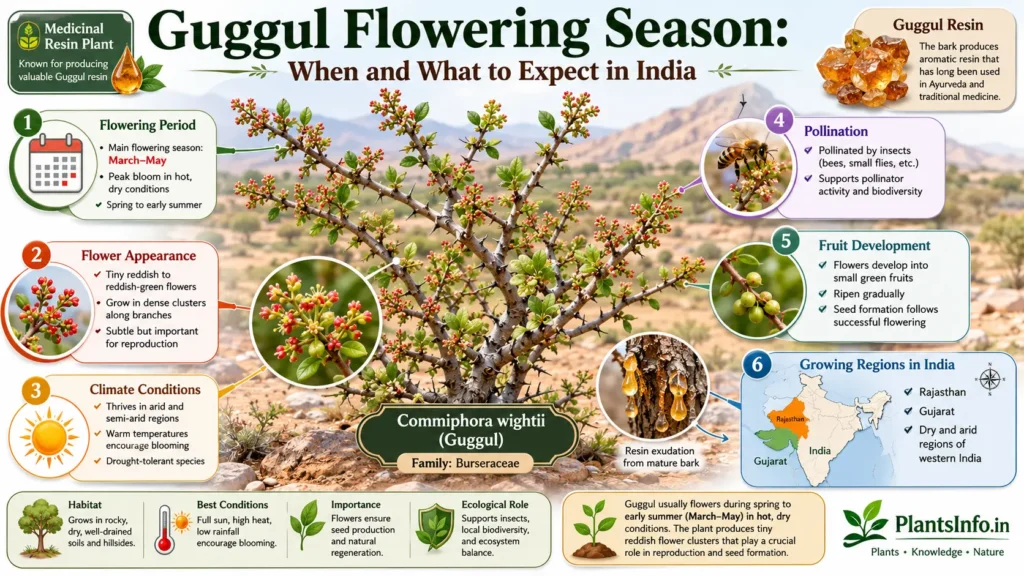
Quick Answer:Guggul flowers once a year, typically between January and March, producing small red-pink flowers on bare, leafless branches before the new leaf flush begins. Fruiting follows in March–April. In its native range across Rajasthan and Gujarat, both flowering and fruiting are tightly tied to the transition from dry winter to pre-monsoon heat.
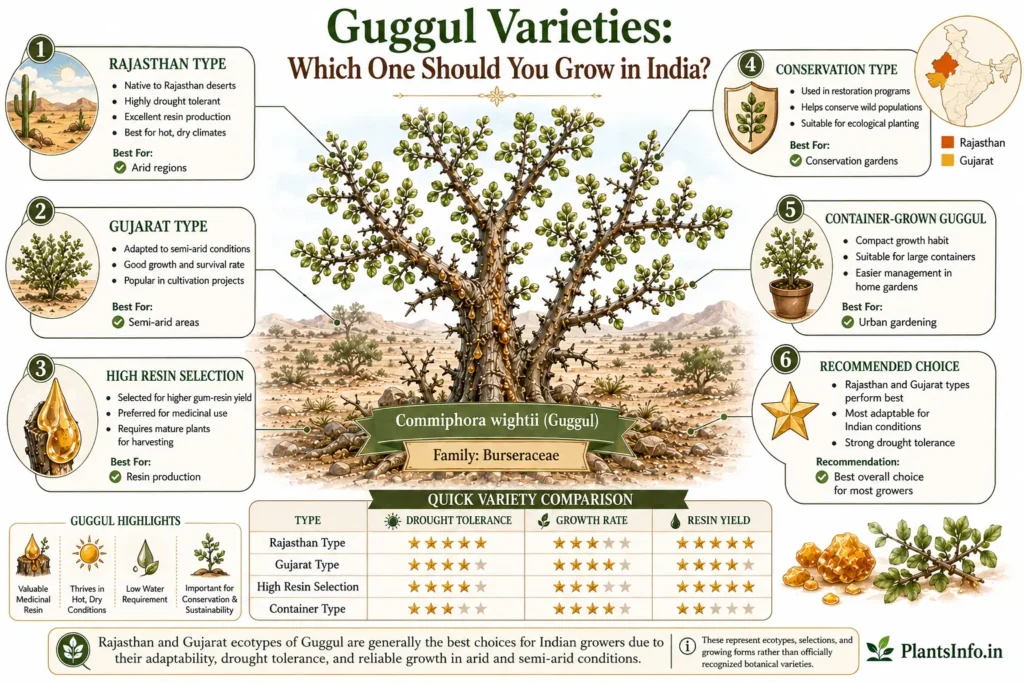
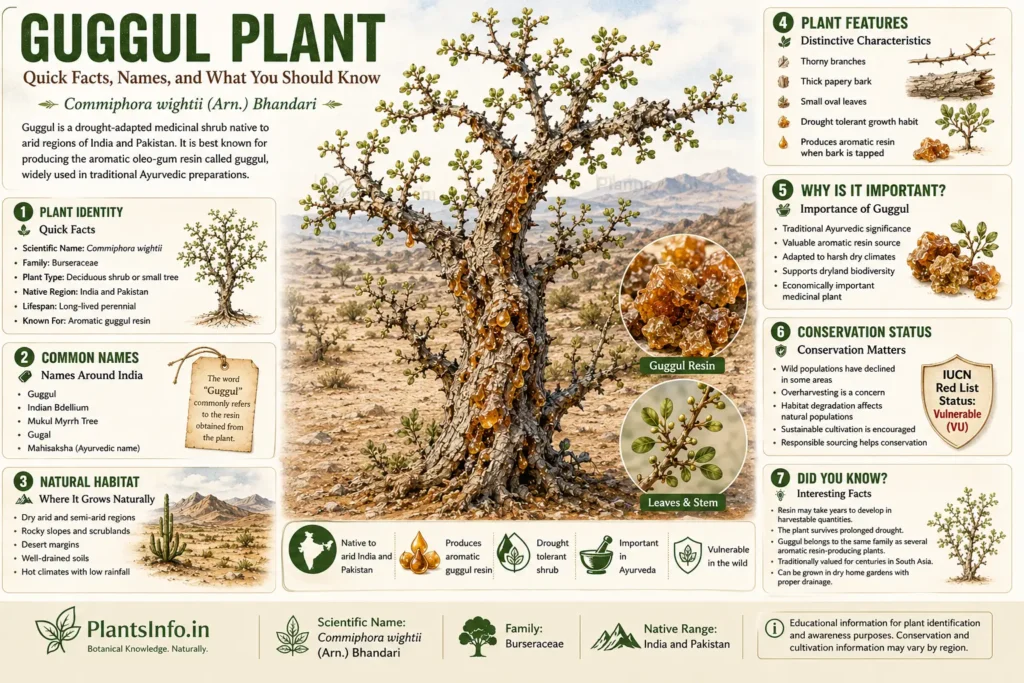
See also: Guggul Plant plant profile, how to grow it, common problems, its benefits, and its varieties.
A guggul tree in January looks like it has given up entirely — bare branches, shed leaves, no visible sign of life. Then, without warning, clusters of small red-pink flowers appear directly on the grey-brown bark, bright against the winter scrubland. It is one of the more startling seasonal transformations in Indian dry-forest botany, and it happens on a schedule so consistent that traditional harvesters in Rajasthan use it as a phenological calendar marker for the changing of the dry season.
Recommended Products
Disclosure: As an Amazon Associate, PlantsInfo may earn from qualifying purchases.
🌱 Growing Essentials
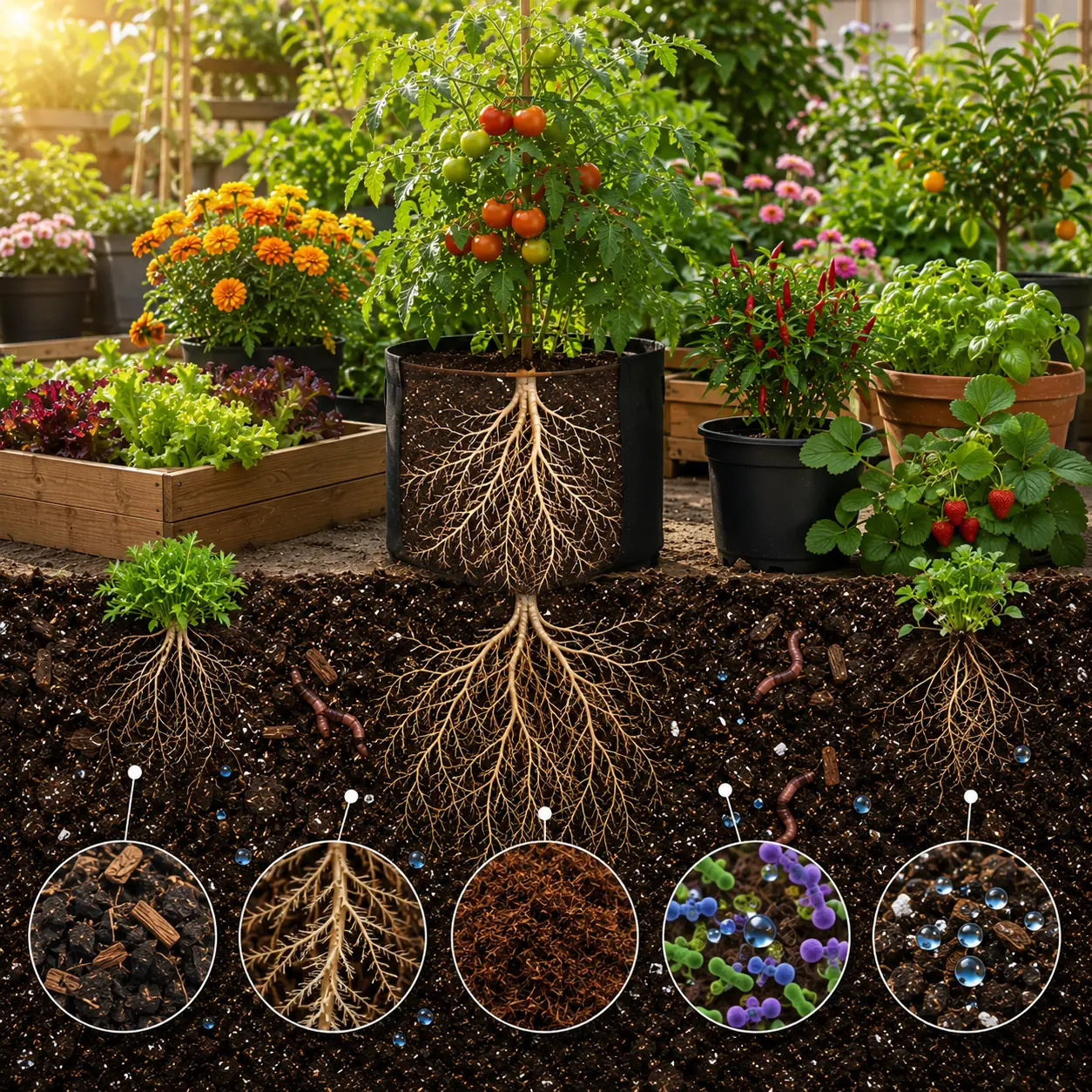
The following products can help with container gardening, potting, root development, soil management, and healthy plant growth.
Organic Potting Soil Mix
Provides nutrients, structure, and healthy growing conditions for container plants.
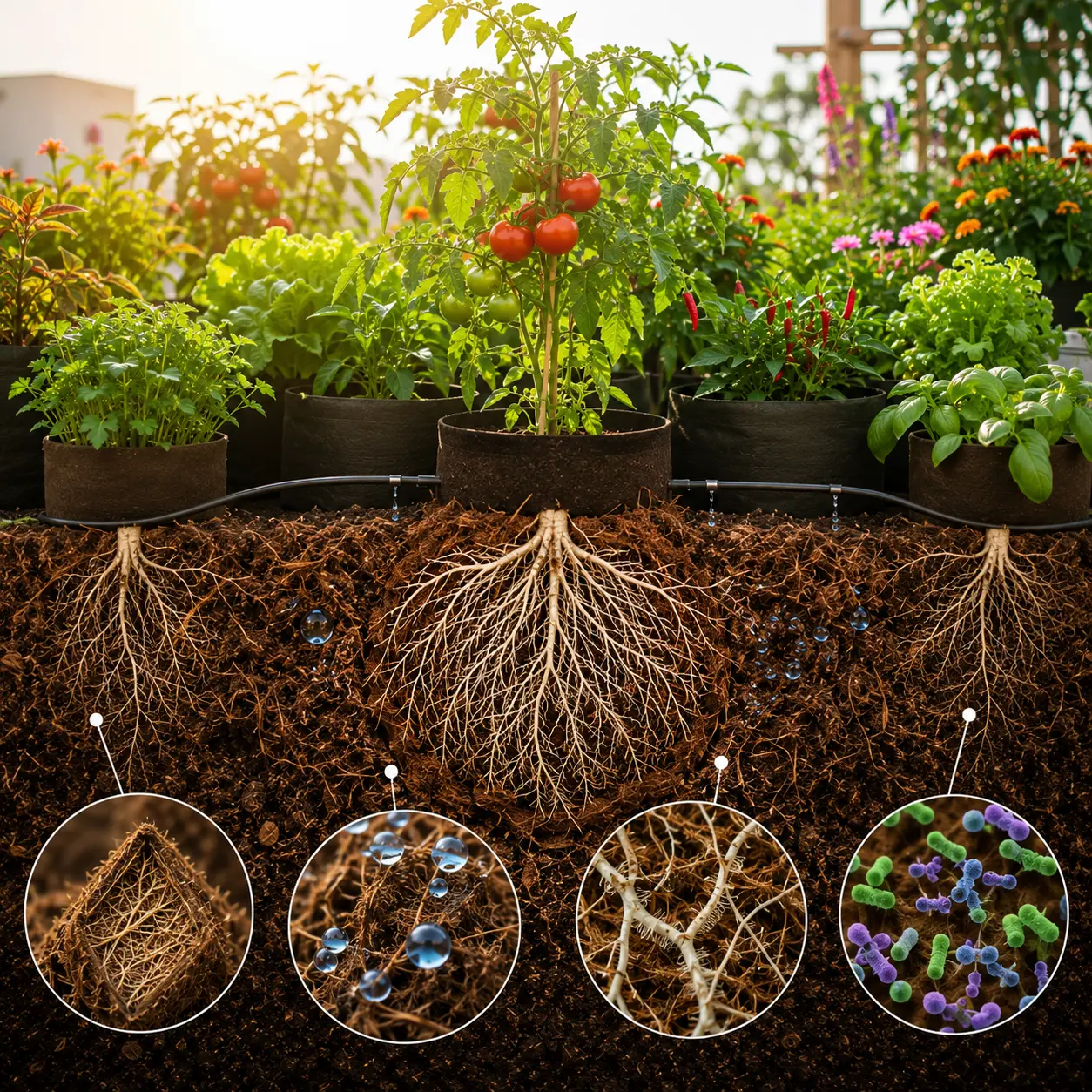
Coco Peat Growing Medium
Enhances moisture retention while maintaining excellent root-zone aeration.

Grow Bags for Plants
Improve drainage, root aeration, and vegetable production in limited spaces.

Plastic Pots for Plants
Ideal containers for seedlings, ornamentals, herbs, and balcony gardens.
India’s Seasons and This Plant
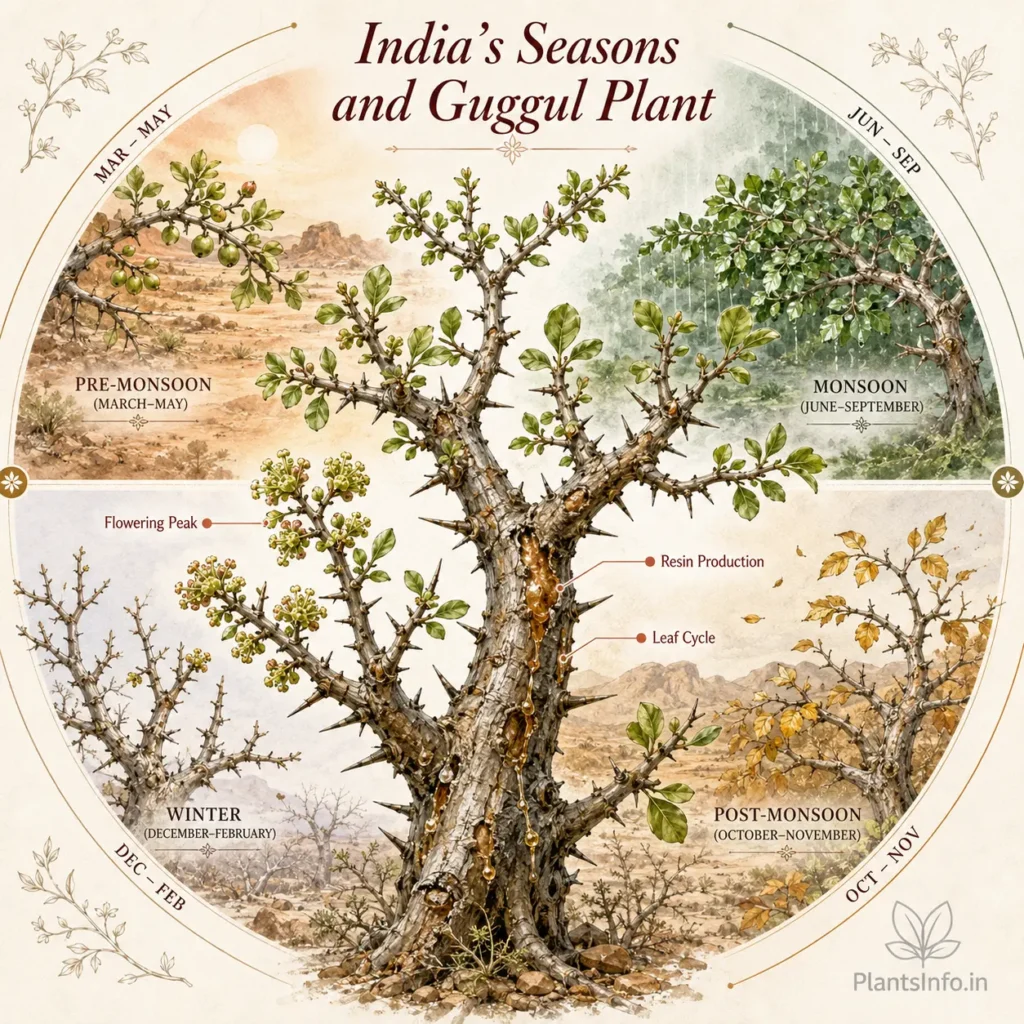
| Season (months) | What the plant is doing |
|---|---|
| Pre-monsoon (Mar–May) | Flowering ends; fruit developing and ripening; new leaf flush emerging; active shoot growth |
| Monsoon (Jun–Sep) | Fully leafed; vegetative growth phase; resin production active in bark; no flowering |
| Post-monsoon (Oct–Nov) | Growth slowing; leaves beginning to yellow and drop in northern range |
| Winter (Dec–Feb) | Deciduous rest; leaves shed by December–January; flower buds forming on bare branches; flowering peaks January–February |
Flowering Season in Detail
Guggul is one of the relatively rare Indian plants that flowers on bare, leafless wood — a pattern called hysteranthous flowering, where the flowers appear before the leaves of the same season. In most of its native range, leaves drop progressively from November through December, and the first flower buds become visible on the naked branches by late December or early January.
Peak flowering falls in January and February across Rajasthan and Gujarat, coinciding with the coldest and driest weeks of the year. The flowers are small — barely 5–8 mm across — with four red to pink-red petals, and appear in dense axillary clusters along the bare branches. They are not individually showy, but the clusters on leafless grey wood create a visually distinctive effect that makes guggul identifiable at a distance in dry scrubland.
Individual flowers last three to five days. The full flowering episode per plant extends over three to four weeks, as different branches and clusters open in sequence rather than simultaneously. This staggered opening is ecologically significant — it extends the period during which pollinators can access nectar and increases the probability of cross-pollination between the gynodioecious flowers of different plants.
Guggul is gynodioecious — some individual plants bear bisexual and male flowers, while others bear only female flowers with non-functional stamens. This means that fruit production on any given plant depends partly on the proximity of compatible flowering plants. In cultivation, planting two or more individuals within 20–30 metres of each other improves fruit set. In the wild, dispersed populations with large spacing between individuals are one reason natural regeneration is poor.
The primary trigger for flowering is the combination of cool, dry winter conditions followed by the onset of warming in January. In Rajasthan, minimum temperatures in December–January (dropping to 3–8°C in the Aravalli belt) appear to fulfil a chilling requirement that initiates the floral programme. In Gujarat’s Kutch region, where winters are milder, flowering tends to begin two to three weeks earlier — late December — and the season is shorter.
Regional variation in flowering timing is modest but consistent: Haryana (northernmost natural range) flowers two to three weeks later than Gujarat (southernmost natural range), with Rajasthan falling in between. This gradient mirrors the latitude-linked temperature difference across the species’ native distribution.
Fruiting Season
Fruit development begins immediately after successful pollination, with small green fruit visible by late February in Gujarat and by March in Rajasthan. The fruit — small, oval to round, approximately 1–1.5 cm in diameter — ripens relatively quickly, turning red and slightly fleshy by March–April.
The ripening window is short: ripe fruit persists on the tree for approximately two to three weeks before falling or being consumed by birds. In the natural range, fruiting coincides with the end of the dry season and the beginning of the pre-monsoon heat buildup — conditions that accelerate ripening but also reduce the time available for seed dispersal.
Seed germination in the wild is poor. Seeds have a physical dormancy mechanism — a hard seed coat — that requires scarification (mechanical abrasion or hot water treatment) before germination can occur. Poor natural regeneration from seed is one of the documented reasons wild populations recover so slowly after disturbance or harvesting pressure.
Cultivated plants in home gardens should have fruit collected for propagation attempts when they turn fully red and slightly soft. Allow the pulp to ferment and separate before cleaning and treating seeds for sowing. For vegetative propagation methods, see the Guggul Growing Guide.
Best Time to Plant
The two best planting windows align with guggul’s seasonal rhythms in its native range. The post-monsoon window — October through November — is generally preferred. The monsoon has recharged soil moisture, temperatures are moderate, and the plant has two to three months of warm-soil conditions to begin root establishment before the winter rest slows growth.
The early monsoon window — July — is the second-best option and works particularly well in Rajasthan and Gujarat, where the monsoon is brief (June–August) and moderate in intensity. A sapling planted in July establishes through the monsoon period with natural rainfall and enters its first winter with an established root system.
Avoid planting in December–February when the plant is in its natural rest period and soil temperatures are at their lowest — establishment is slow, and the risk of transplant shock is higher. Avoid planting in peak summer (April–June) without reliable irrigation, as newly planted saplings cannot yet draw on deep soil moisture the way established plants can.
Container planting has more flexibility but follows the same seasonal preference — October or July for optimal results.
Month-by-Month Calendar
| Month | Season | What to Do |
|---|---|---|
| January | Winter | Peak flowering on bare branches — observe and record; do not disturb; no intervention needed |
| February | Winter / pre-monsoon transition | Flowering continuing; early fruit set visible by late February in Gujarat; do not prune |
| March | Pre-monsoon | Fruit developing; new leaf flush beginning; monitor for flowering completion |
| April | Pre-monsoon | Fruit ripening and dropping; leaves fully emerged; collect ripe fruit for seed propagation if desired |
| May | Pre-monsoon / summer | Tree fully leafed; active growth phase begins; check soil moisture in container plants; mulch ground-planted trees |
| June | Monsoon onset | Monsoon arrives in Rajasthan and Gujarat; check drainage around root zone; suspend irrigation |
| July | Monsoon | Active vegetative growth; ideal planting window for new saplings; monitor for pest activity |
| August | Monsoon | Continued growth; resin production highest in bark during active growing season; no harvesting action |
| September | Monsoon / post-monsoon | Monsoon receding; growth continues; begin reducing irrigation for container plants |
| October | Post-monsoon | Ideal planting window for new saplings; growth slowing; leaves beginning to yellow in northern range |
| November | Post-monsoon | Leaf drop beginning in Rajasthan and Haryana; dormancy approaching; no pruning yet |
| December | Early winter | Leaves shed; bare branches; flower buds forming internally; tree entering peak rest — no intervention |
What Can Go Wrong Seasonally?
- No flowers in a young cultivated plant are the most common disappointment for home gardeners and are almost always a maturity issue, not a problem. Guggul does not flower consistently until it has been established for three to four years in cultivation. A plant that is growing well but not yet flowering is performing normally — patience is the only intervention required.
- Fruit drop without seed development — small immature fruit falling in March before they ripen — is typically a pollination failure caused by the absence of a compatible plant nearby. Guggul’s gynodioecious flowering system means a solitary plant may produce flowers but little fruit if it bears only female flowers with no male or bisexual plants in the range. Plant at least two individuals to improve fruit set.
- Premature leaf flush before flowering completes can occur in unusually warm winters — when December and January temperatures stay above 15°C, the chilling requirement that holds the leaf flush back may be partially unsatisfied. The plant begins leafing out before flowering is complete, and the resulting leaf canopy competes with the flower clusters for resources. This is weather-driven and not correctable; the following year’s flowering is typically normal if winter temperatures return to the usual range.
Dormancy and Off-Season Care
Guggul’s winter deciduous rest — roughly November through February in the northern part of its range, shorter and less pronounced in Gujarat — is a genuine dormancy, not a sign of distress. A bare, leafless guggul in December is behaving exactly as it should.
The distinction between dormancy and distress: a dormant plant has clean, bare branches with no discolouration, firm bark, and small flower buds visibly forming at the branch nodes by January. A distressed plant shows shrivelled bark, soft or sunken stems at the base, and no bud formation. The latter requires inspection of the root zone; the former requires nothing but patience.
Do not water heavily during the dormant period. Do not fertilise. Do not prune until the dormancy is fully complete — January tip-pruning is acceptable for shaping, but heavier structural pruning risks cutting into wood that is about to bear flowers. The safest pruning window is after the fruit has set and the new leaf flush is fully established — late April through May.
When the red flowers open on bare branches in January, guggul is signalling that the dry season is turning — a calendar the Aravalli hills have kept for millennia.
Conclusion
Guggul follows a highly predictable annual cycle in its native dry regions of India. Flowering typically occurs from January to March on bare branches during the winter dormant period, followed by fruit development in March and April and active vegetative growth during the warmer months. Regional climate differences can shift flowering by a few weeks, but the overall pattern remains remarkably consistent across the species’ natural range.
Understanding this seasonal rhythm helps growers distinguish normal dormancy from plant stress, choose the best planting periods, and anticipate flowering and fruiting each year. For cultivated plants, patience is often essential, as mature, well-established individuals are far more likely to flower and produce fruit than young saplings.