Guggul Plant: Quick Facts, Names, and What You Should Know
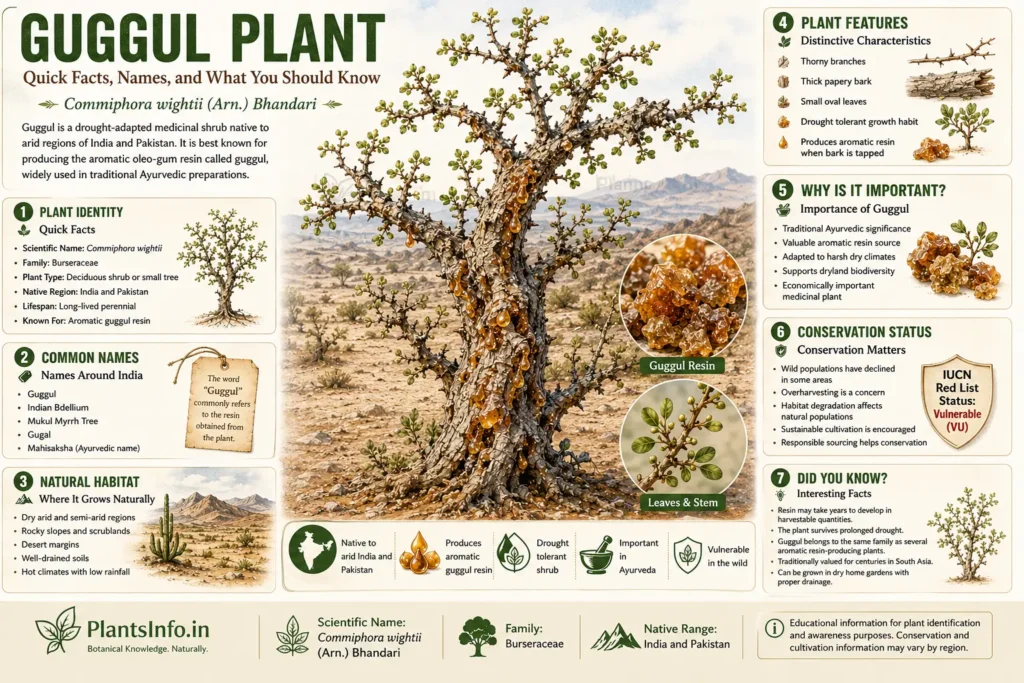
Quick Answer: Guggul (Commiphora wightii) is a small, thorny, deciduous shrub native to the arid and semi-arid zones of Rajasthan and Gujarat. It is the source of the golden resin used in Ayurvedic medicine for nearly 3,000 years and is now Critically Endangered in the wild due to overexploitation and habitat destruction.
See also: Guggul Plant plant profile, how to grow it, common problems, its flowering season, and its benefits.
Somewhere between a medicine chest and a disappearing act: that is the position guggul occupies in Indian natural history right now. The resin it produces has been in continuous use since the Vedic period — burned in rituals, prescribed in classical texts, and manufactured into dozens of formulations still sold in every Ayurvedic pharmacy in the country. The plant behind all of it is a modest, thorny shrub that most Indians would walk past without recognition. That invisibility, combined with relentless demand, has pushed it to the edge of extinction in its native range.
Recommended Products
Disclosure: As an Amazon Associate, PlantsInfo may earn from qualifying purchases.
🌱 Growing Essentials
The following products can help with container gardening, potting, root development, soil management, and healthy plant growth.
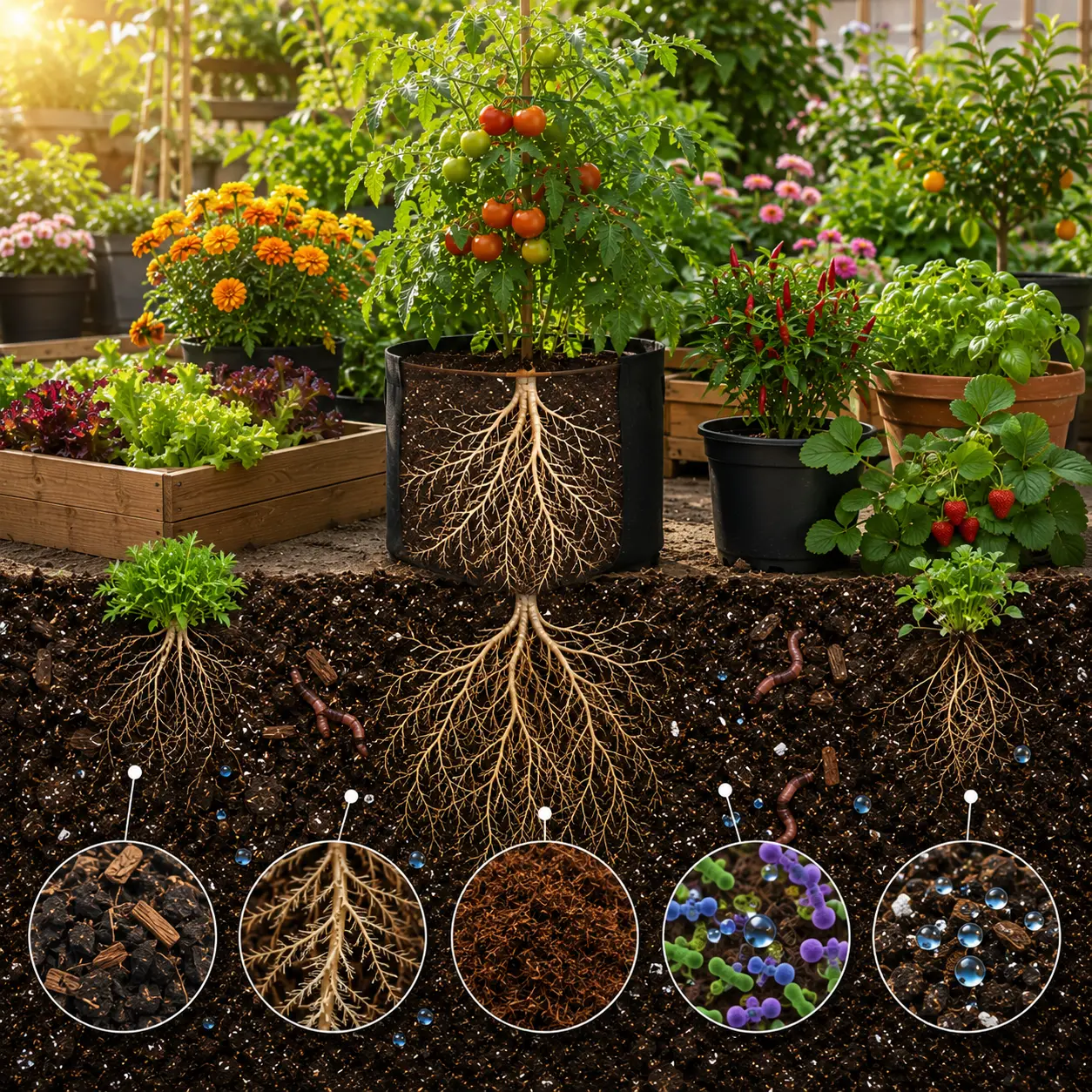
Organic Potting Soil Mix
Provides nutrients, structure, and healthy growing conditions for container plants.
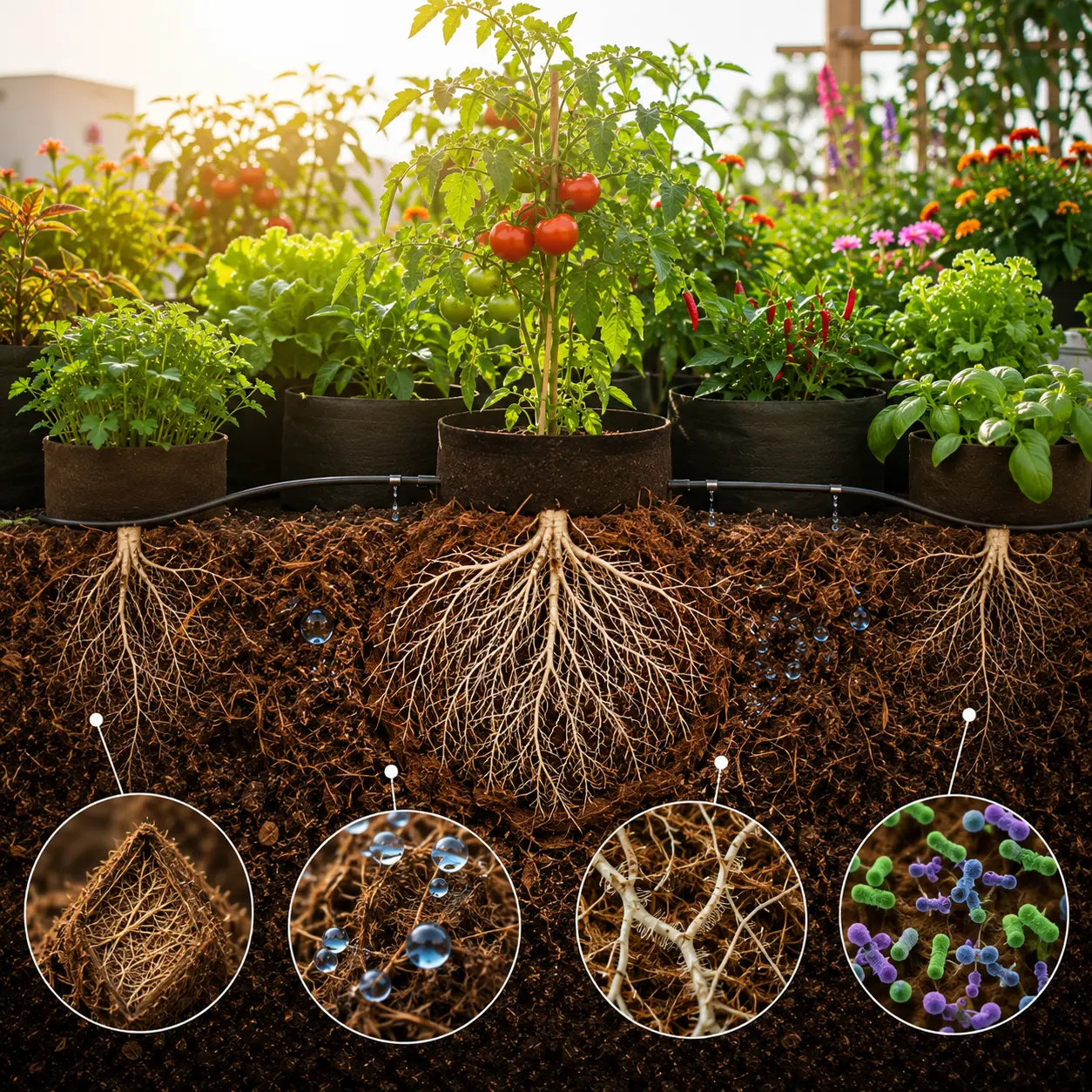
Coco Peat Growing Medium
Enhances moisture retention while maintaining excellent root-zone aeration.

Grow Bags for Plants
Improve drainage, root aeration, and vegetable production in limited spaces.

Plastic Pots for Plants
Ideal containers for seedlings, ornamentals, herbs, and balcony gardens.

Names in Different Languages
| Language | Name |
|---|---|
| English | Guggul, Indian bdellium, Mukul myrrh tree, Indian myrrh |
| Hindi | Guggul, gugal, gugul |
| Bengali | Guggul, mukul |
| Tamil | Mahiśākṣa, gukkulu |
| Telugu | Guggipannu, guggulu |
| Marathi | Guggul, gugul |
| Kannada | Guggulu, kanti guggulu |
| Malayalam | Guggulu, gulgulu |
| Gujarati | Gugal, guggal |
| Punjabi | Gugal |
| Sanskrit | Guggulu, pura, purahvaya, devadhupa |
| Scientific name | Commiphora wightii (Arn.) Bhandari |
| Family | Burseraceae |
Most searched name: “Guggul” dominates Hindi, English, and pan-Indian searches. “Gugal” is the dominant spelling in Gujarat. In Ayurvedic commerce, “guggulu” (the Sanskrit form) is standard in product labelling.
Name note: The Sanskrit name Pura — meaning “that which fills” or “that which wards off disease” — reflects the resin’s role as both a ritual purifier and a medicine. Devadhupa translates as “divine incense,” referring to its use in yajna and temple rituals. The English name “Indian bdellium” connects guggul to the ancient trade name bdellium, found in Greek, Latin, and Hebrew sources describing the same aromatic resin from the Indian subcontinent.
What Does It Look Like?
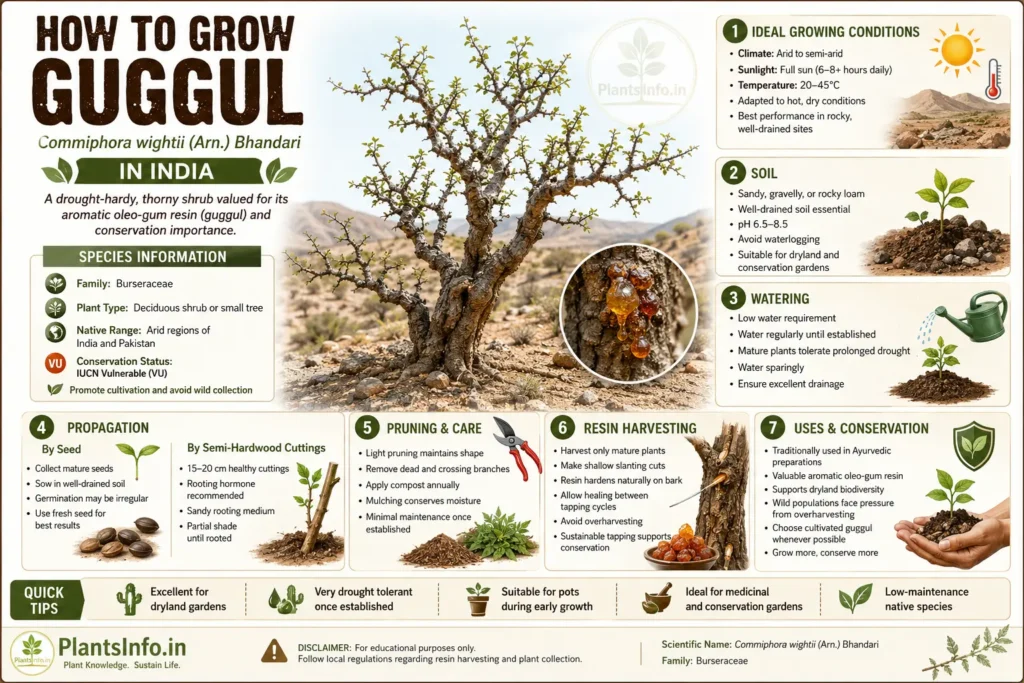
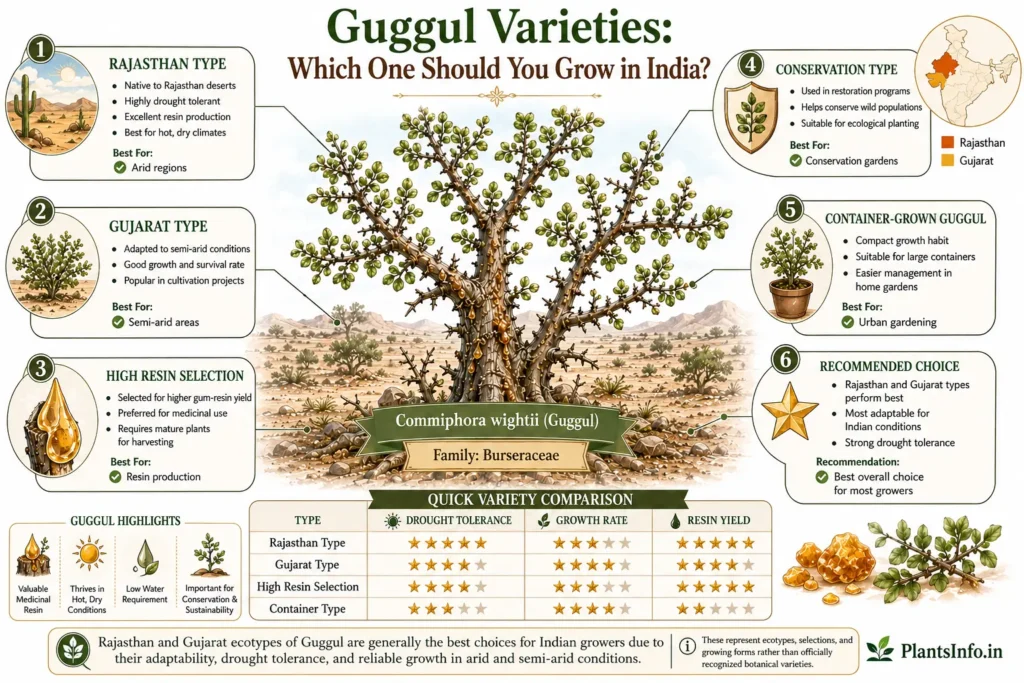
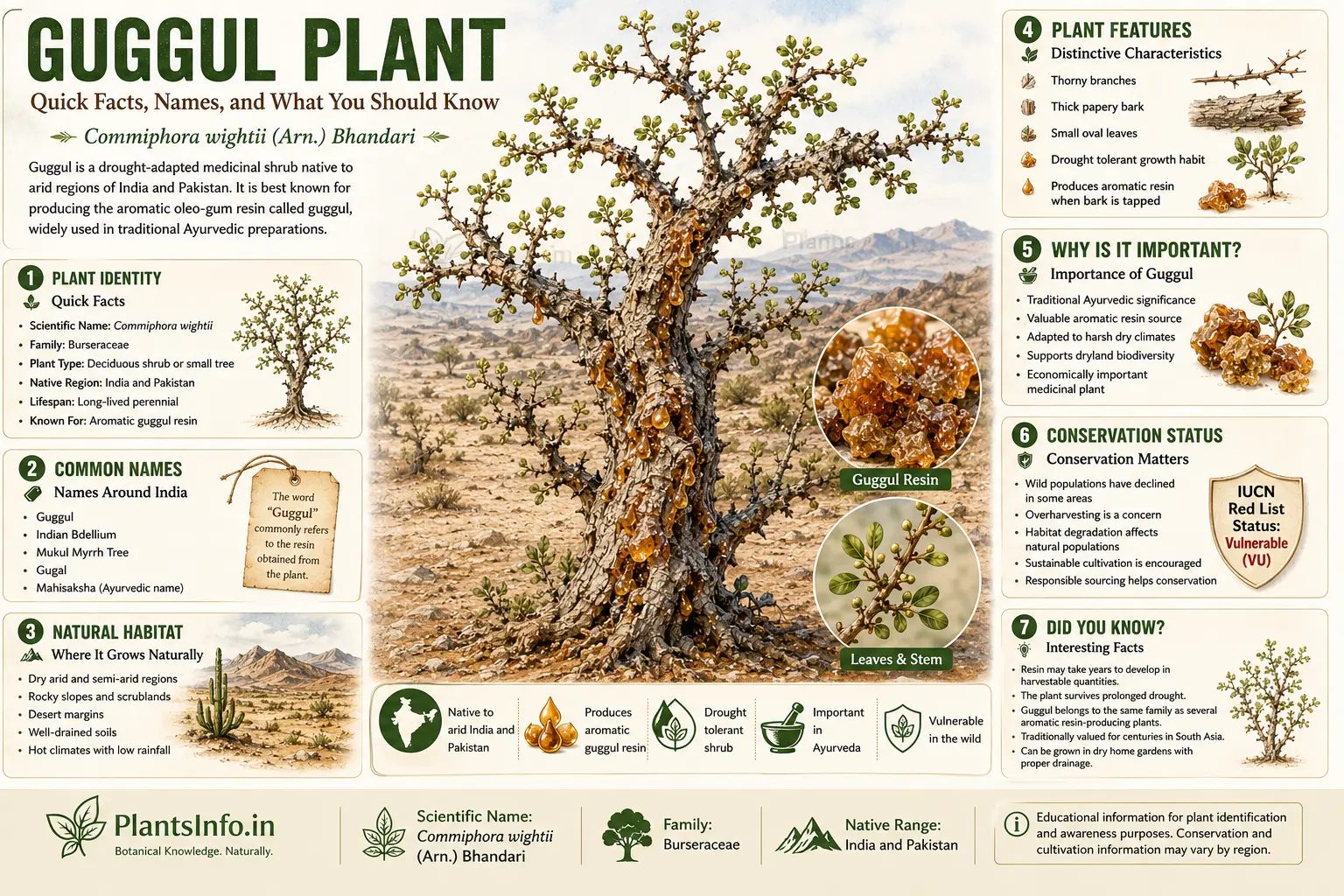
Guggul is a shrub or small tree reaching a maximum height of 3.5–4 metres at maturity, though most plants in the wild grow to 1.5–2.5 metres given the harsh conditions of their native rocky hillsides. Growth is distinctly slow — the plant takes 8–10 years to reach 3–3.5 metres under normal conditions. The overall form is gnarled and spreading rather than upright, with multiple stems branching close to the ground.
The bark is the plant’s most distinctive visual feature: thin, papery, and peeling in flaky sheets to reveal a greenish-grey underlayer — similar in character to an arjuna or paper birch but drier and more brittle. When the bark or a branch is cut or wounded, a golden-yellow to orange resin oozes slowly from the wound and solidifies on contact with air.
Branches are thorny, ending in sharp spine-like tips that make the plant formidably defensive. Leaves are simple or trifoliate — sometimes a single leaf, sometimes three leaflets together on the same branch — ovate in shape, 1–5 cm long, with irregularly toothed margins. They are bright green, slightly sticky to touch from resin content in the leaf surface, and drop during the dry season (November–February in the natural range), giving the plant a bare, skeletal appearance in winter.
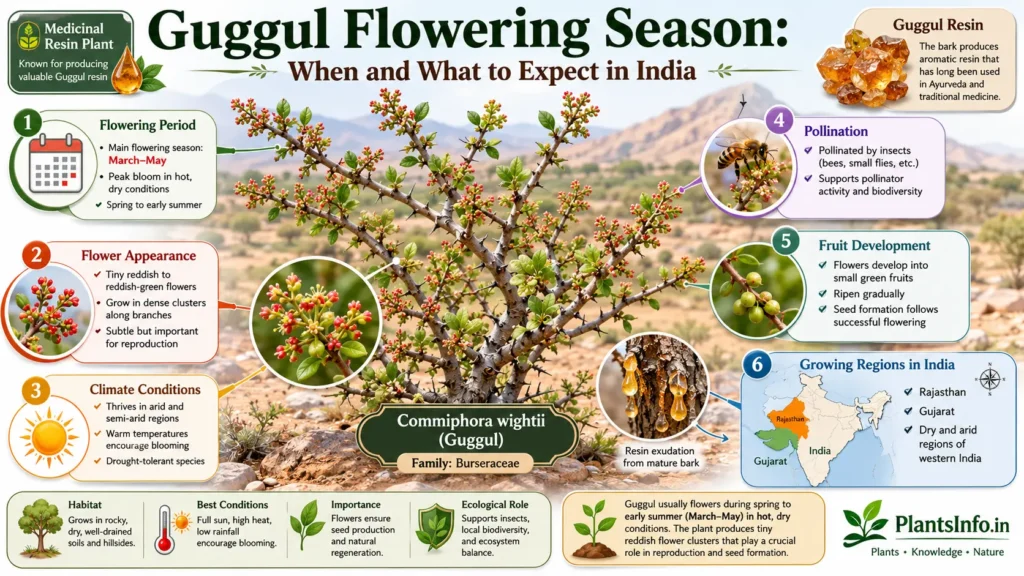
Flowers are small, red to pink-red, with four petals, appearing in dense clusters on the bare branches before the leaves flush in late winter to early spring. The visual effect — bright red-pink flowers on bare, thorny grey branches — is striking and unmistakable in the field. Fruits are small, round to oval, red when ripe, about the size of a large pea, and somewhat fleshy. They contain a single seed.
Where Does It Grow in India?
Guggul is native to India — specifically to the arid and semi-arid zones of Rajasthan and Gujarat, with natural populations also documented in parts of Madhya Pradesh, Maharashtra’s Vidarbha region, and the Aravalli ranges extending into Haryana. It grows in rocky, stony, shallow-soil habitats — hillsides, dry riverbeds, and scrubland — at altitudes from near sea level up to approximately 1,200 metres.
Within Rajasthan, natural populations are concentrated in the Aravalli hill districts — Udaipur, Rajsamand, Chittorgarh, Bhilwara, Ajmer, Pali — and in the dry districts bordering the Thar Desert. In Gujarat, the Kutch district and the Kathiawar peninsula historically had the most significant populations, though these are now severely depleted.
The plant prefers an arid to semi-arid climate with annual rainfall in the range of 200–500 mm, hot summers (up to 45–48°C in the Thar belt), and dry winters. It tolerates calcium-rich, alkaline soils that most plants cannot use, and rocky terrain that provides sharp drainage. These extreme adaptations are precisely what make it difficult to cultivate outside its natural range.
Urban distribution is minimal — guggul is rarely found in city gardens outside Rajasthan and Gujarat, though conservation awareness campaigns by the NMPB (National Medicinal Plants Board) and state forest departments have begun to change this in Jodhpur, Ajmer, and Ahmedabad.
What Is It Used For?
Guggul’s uses span medicine, ritual, and ecology in ways that are difficult to separate cleanly.
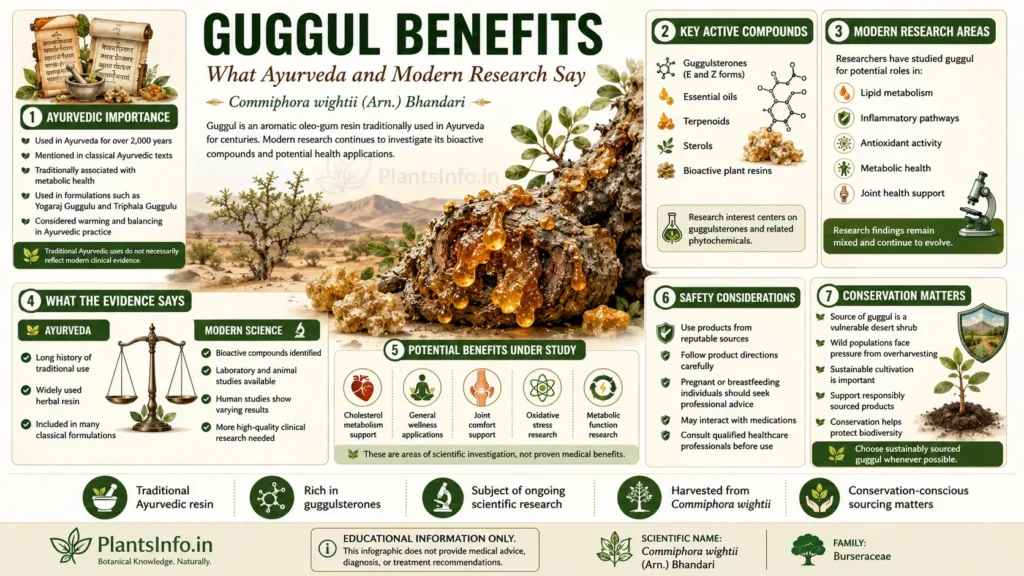
Ayurvedic medicine: The resin is the primary ingredient or Yogavahi carrier in dozens of classical formulations — Yograj Guggul, Kanchnar Guggul, Triphala Guggul, Mahayogaraj Guggul — used for joint disorders, lipid conditions, thyroid support, and metabolic diseases. For full medicinal detail, see the Guggul Benefits Guide.
Religious and ritual use: Raw resin burned as dhoop (incense) is a continuous practice in Hindu temple ritual and household puja across Rajasthan, Gujarat, and North India. The fragrant smoke is associated with purification and the invocation of divine presence in Vedic yajna traditions.
Modern pharmaceutical: Standardised guggul extract (gugulipid) was approved as a hypolipidemic drug in India in 1986 and is manufactured by several Indian pharmaceutical companies. International interest in guggulsterone as an anti-inflammatory and anti-cancer compound has generated substantial laboratory research.
Perfumery: Guggul resin has a warm, balsamic, myrrh-like fragrance that is used in traditional Indian attars and in natural perfumery.
Ecological: In its native scrubland habitat, guggul provides cover and browse for dryland wildlife and fruit for birds. See the Guggul Benefits Guide for full ecological detail.
In Mythology and Ancient Texts
Guggul is one of the most thoroughly documented medicinal plants in classical Indian literature. The earliest references appear in the Atharvaveda, one of the four foundational Vedic texts, where a substance identified by scholars as bdellium — the ancient name for guggul resin — is mentioned in healing hymns and ritual purification contexts. This places guggul’s documented use at approximately 1700–1500 BCE.
The Charaka Samhita, the foundational text of Ayurvedic internal medicine, lists guggul in the Sangya Sthapana Mahakashaya — a group of drugs for restoring consciousness and vitality — and names it among the most important substances for promoting longevity and balancing the three doshas. Charaka also records its use for urinary disorders, intestinal worms, and as a Rasayana (rejuvenative).
The Sushruta Samhita, the classical surgical text, gives guggul its most extensive classical treatment. Sushruta classifies it as one of the foremost substances for Vata disorders and medas (fat tissue) imbalances, describes its use in treating internal tumours, oedema, obesity, liver dysfunction, leukoderma, and sinus conditions, and establishes its role as a Yogavahi — a potentiating carrier that enhances the action of companion medicines. Sushruta also records five varieties of guggul resin distinguished by colour, origin, and therapeutic potency, with Mahishaksha (dark, dense resin) ranked highest.
The Raj Nighantu, a medieval Ayurvedic lexicon, includes guggul in the Chandanadi Varga and provides a descriptive Sanskrit verse confirming its bitter-warm character, its action on Kapha and Vata disorders, and its status as a Rasayana. The text also records the names Pura and Devadhupa, linking the medicinal and ritual identities of the resin.
In cross-cultural terms, the same resin appears in ancient Greek and Roman sources as bdellium and in Hebrew scripture as one of the fragrant substances in the Garden of Eden (Genesis 2:12). This positions guggul among the ancient aromatic trades that connected India to the Mediterranean world — the same trade routes that carried pepper, cardamom, and sandalwood westward carried guggul resin as a precious commodity.
Regionally, guggul has no distinct mythological narrative of the kind attached to the peepal or neem. Its significance is pharmacological and ritual rather than narrative — it is a substance with sacred properties, not a plant with a god’s story.
Is It Easy to Grow?
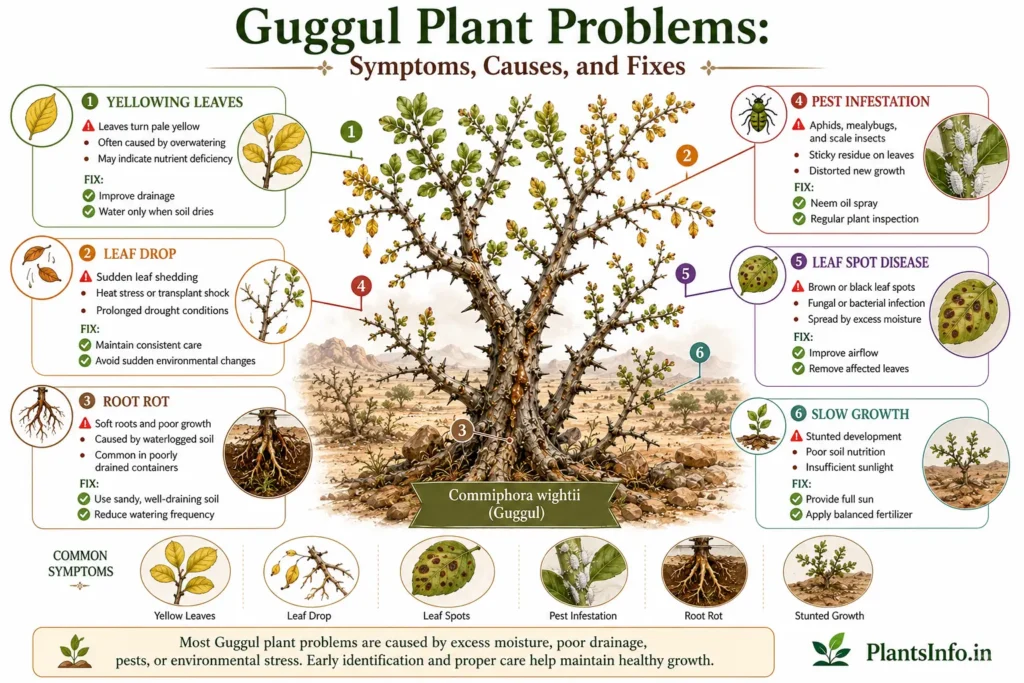
In Rajasthan, Gujarat, and the drier parts of Madhya Pradesh and Haryana, guggul is genuinely easy to grow — it requires poor soil, minimal water, and full sun, and rewards neglect over attention. Outside this arid and semi-arid belt, growing guggul is significantly more challenging: the combination of monsoon humidity, heavy rainfall, and fertile garden soils creates conditions the plant is simply not adapted to. For full growing details, see the Guggul Growing Guide.
⚠ Special Flags
Critically Endangered — IUCN Red List: Commiphora wightii is listed as Critically Endangered by the IUCN due to overexploitation for resin and widespread habitat destruction across its native range. Wild collection of plants, seeds, or resin from natural populations is harmful and may be subject to legal restriction under state forest and wildlife protection regulations. Always source from nurseries, KVK outlets, or NMPB-registered suppliers.
Significant contraindications: Guggul resin must not be used internally during pregnancy or by persons with thyroid conditions, kidney or liver disease, or those on anticoagulant medications, without direct medical supervision. See the Guggul Benefits Guide for the full contraindication profile.
Commonly confused with: Commiphora mukul is an older synonym for C. wightii — the same species, different name. Both names appear in published literature, product labels, and nursery stock. Boswellia serrata (shallaki) produces a related but distinct resin (frankincense) and is sometimes conflated with guggul in retail contexts; the two resins have different chemical profiles and different classical indications.
Frequently Asked Questions
Is guggul the same as myrrh?
They are related but not identical. Both belong to the family Burseraceae and produce aromatic resins used in medicine and incense, but guggul (Commiphora wightii) is a distinct species from true myrrh (Commiphora myrrha). Their active compounds and classical medicinal indications differ.
Can guggul be grown in Kerala or West Bengal?
It can be planted but is unlikely to thrive long-term. Guggul is native to arid conditions and does not tolerate the sustained humidity and heavy monsoon rainfall of Kerala, coastal Karnataka, or Bengal. Rajasthan, Gujarat, and dry parts of Madhya Pradesh and Haryana are the appropriate growing regions.
Is the thorny guggul plant safe around children?
The branch tips are genuine thorns and can cause injury. In gardens where children are present, plant guggul in a boundary position or raised bed away from play areas. The resin and leaves are not toxic on contact, but should not be consumed without preparation and guidance.
Why is guggul endangered?
Guggul (Commiphora wightii) is classified as Critically Endangered because wild populations have declined dramatically due to excessive resin harvesting, habitat degradation, and poor natural regeneration. In many areas, plants were repeatedly tapped using unsustainable methods that damaged or killed mature shrubs before they could reproduce. Combined with grazing pressure and the loss of dryland habitats across western India, these factors have caused severe population declines throughout much of the species’ native range.
How long does a guggul plant live?
Guggul is a long-lived shrub that can survive for several decades under suitable conditions. Although exact lifespans vary depending on climate, soil conditions, and harvesting pressure, healthy plants may remain productive for 30 years or more. Growth is slow, and resin production generally begins only after the plant reaches maturity at around 8–10 years of age.
What is the difference between guggul and frankincense?
Guggul and frankincense are related but distinct aromatic resins. Guggul comes from Commiphora wightii, while Indian frankincense is obtained from Boswellia serrata. Both belong to the family Burseraceae and have long histories of medicinal and ceremonial use, but they differ in chemical composition, fragrance, and traditional applications. Guggul is especially associated with Ayurvedic formulations, whereas frankincense is more commonly known for its resin acids, aromatic qualities, and use in traditional medicine and incense.
Can guggul be grown in pots?
Yes. Guggul can be grown successfully in large containers, especially during its first several years. Choose a deep pot with excellent drainage and use a sandy, free-draining soil mix similar to those used for cacti and succulents. Container cultivation is particularly useful in urban gardens and on rooftops, but long-term growth is generally better when the plant is eventually established in the ground, where its deep root system can develop fully.
Conclusion
Guggul (Commiphora wightii) is far more than a source of Ayurvedic resin. It is a uniquely adapted desert shrub with deep cultural, medicinal, and ecological significance in India. As wild populations continue to decline, understanding the plant itself—its identity, habitat, and conservation needs—becomes increasingly important. Whether encountered in a dryland landscape, a medicinal garden, or an Ayurvedic formulation, guggul remains one of India’s most historically important native plants.
⚠ Medical Disclaimer
This article discusses traditional Ayurvedic uses and published scientific research. It is intended for educational purposes only and should not be considered medical advice. Always consult a qualified healthcare professional before using any herbal product.