Ashwagandha Plant: Key Facts, Names, and Interesting Info
Names in Different Languages
| Language | Name |
|---|---|
| English | Ashwagandha, Indian ginseng, winter cherry |
| Hindi | अश्वगंधा |
| Bengali | অশ্বগন্ধা |
| Tamil | அமுக்கரா |
| Telugu | పెన్నేరు |
| Marathi | अश्वगंधा |
| Kannada | ಅಶ್ವಗಂಧಾ |
| Malayalam | അമുക്കുരം |
| Gujarati | અશ્વગંધા |
| Punjabi | ਅਸ਼ਵਗੰਧਾ |
| Scientific name | Withania somnifera (L.) Dunal |
| Family | Solanaceae |
Ashwagandha is the most widely recognised common name for this species in India.
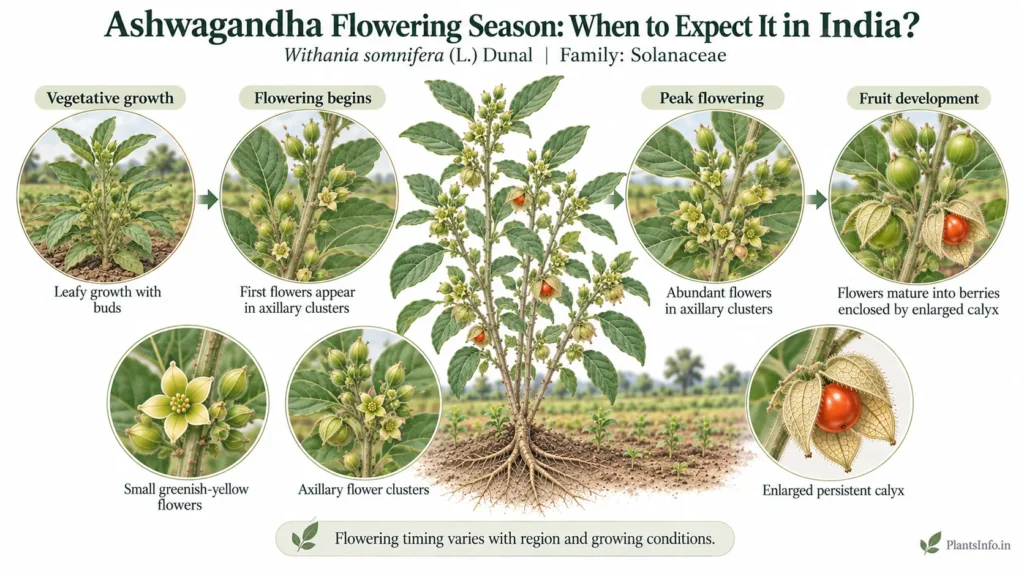
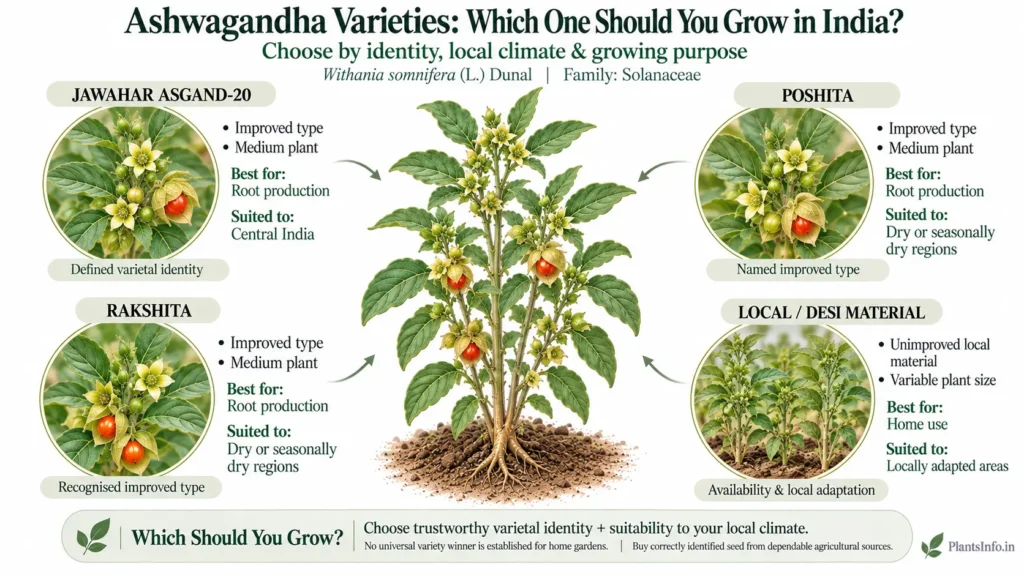
See also: Ashwagandha plant profile, how to grow it, common problems, seasonal care, and its flowering season.
Quick Facts
| Feature | Typical characteristic |
|---|---|
| Growth form | Subshrub or shrub, often woody-based |
| Leaves | Broad, oval to oblong, green and softly hairy |
| Flowers | Small, greenish-yellow, borne in leaf axils |
| Fruit | Small, round, red berry enclosed by an enlarged papery calyx |
| Distinguishing feature | Enlarged papery calyx surrounding the berry |
What Does It Look Like?
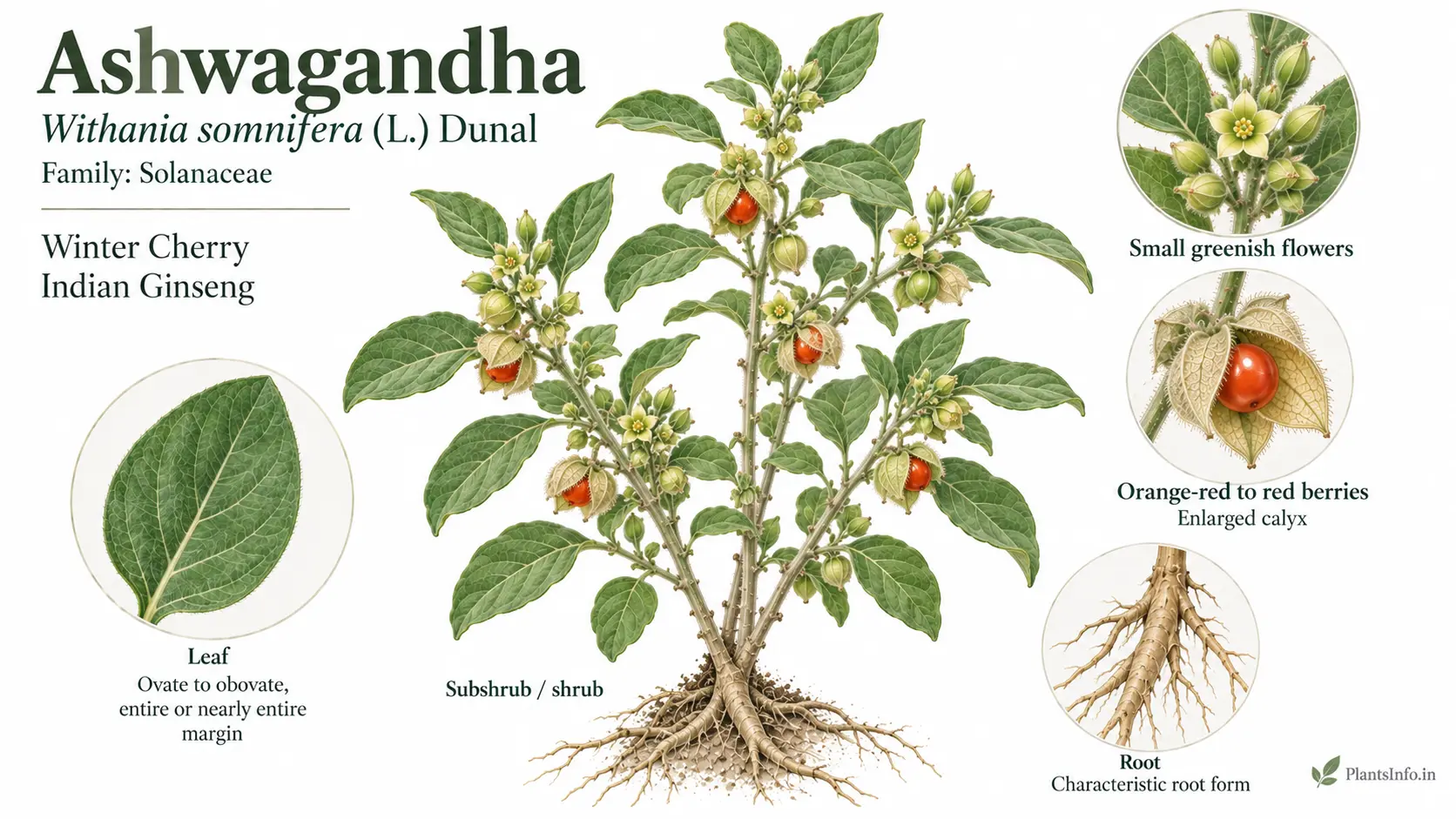
Withania somnifera is a branching subshrub or shrub that can reach roughly 0.3–2 m, with size varying according to its environment. Older stems can become woody toward the base, while younger growth is often covered with fine hairs.
Recommended Products
Disclosure: As an Amazon Associate, PlantsInfo may earn from qualifying purchases.
🌱 Growing Essentials
The following products can help with container gardening, potting, root development, soil management, and healthy plant growth.

Organic Potting Soil Mix
Provides nutrients, structure, and healthy growing conditions for container plants.

Coco Peat Growing Medium
Enhances moisture retention while maintaining excellent root-zone aeration.

Grow Bags for Plants
Improve drainage, root aeration, and vegetable production in limited spaces.

Plastic Pots for Plants
Ideal containers for seedlings, ornamentals, herbs, and balcony gardens.
The leaves are simple, broadly oval to oblong and may have a soft, grey-green appearance. Small greenish-yellow flowers occur in the leaf axils rather than forming large, conspicuous clusters.
The fruit is a small, round, shiny red berry. For identification, the enlarged papery calyx surrounding the developing berry is the clearest visual feature to look for.
Where Does It Grow in India?
Ashwagandha has a broad native distribution extending from southern Europe and Africa through Asia to China and Myanmar, with India included within its recognised native range.
Within India, it occurs in warm, relatively dry environments and is also cultivated. Rajasthan, Madhya Pradesh, Gujarat, Maharashtra and Karnataka are important regions associated with its cultivation, although the species is not restricted to these states.
It occurs in cultivated and disturbed habitats as well as more natural settings. Its distribution is associated mainly with subtropical conditions, while altitude varies across its geographic range.
What Is It Used For?
- Ayurvedic medicine: The root is a recognised material in traditional Ayurvedic preparations.
- Traditional preparations: Dried root is processed into forms such as powder and incorporated into traditional formulations.
- Modern research: Extracts and naturally occurring constituents such as withanolides have been investigated in health-related research.
- Home cultivation: The species is grown by gardeners interested in traditional Indian medicinal plants.
- Botanical education: Its characteristic fruiting structure makes it useful for learning plant identification within the Solanaceae.
Is It Easy to Grow?
Ashwagandha is moderate in difficulty for a home gardener. Its warm-climate preference makes it suitable for many parts of India, but performance can be less predictable where conditions remain persistently wet or cool.
Frequently Asked Questions
Is Ashwagandha related to tomato and brinjal?
Yes. Withania somnifera belongs to the Solanaceae, the same family as tomato, brinjal, chilli, and potato.
Why is Ashwagandha called Indian ginseng?
“Indian ginseng” is a common English name for Ashwagandha, but it does not mean the plant is a species of true ginseng.
Is Ashwagandha native to India?
Yes. India falls within the recognised native range of Withania somnifera, rather than the species being regarded as a recent introduction to the country.
Conclusion
Ashwagandha is a warm-region Indian species with a broad native range, recognised traditional importance and a distinctive botanical identity within the nightshade family.