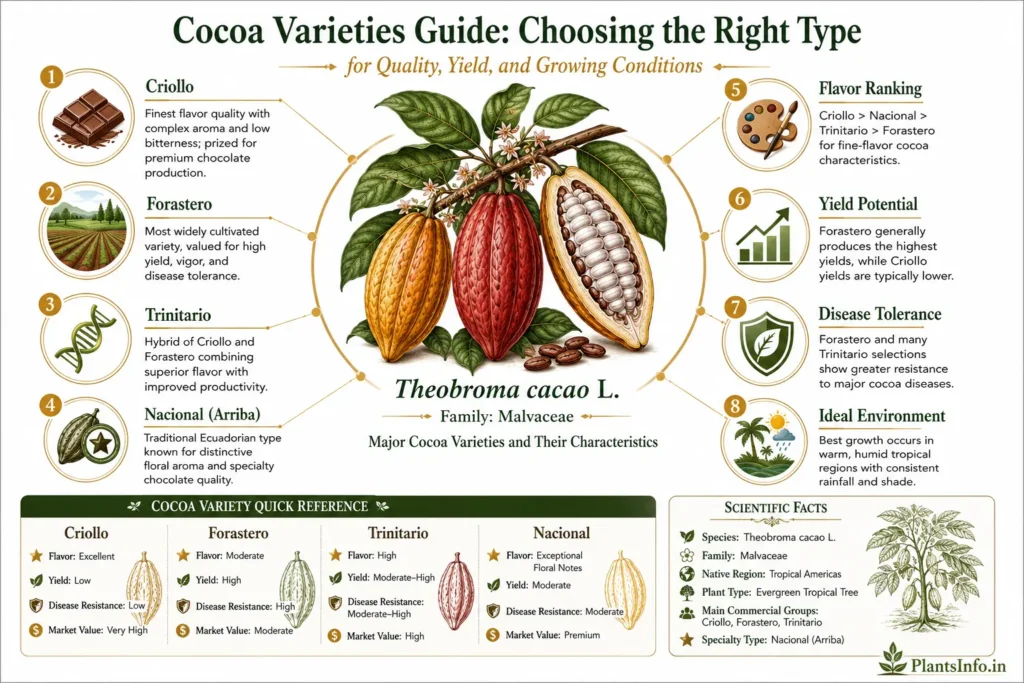
Cocoa Seasonal Guide: Flowering, Fruiting, Harvest & Planting Times
Quick Answer
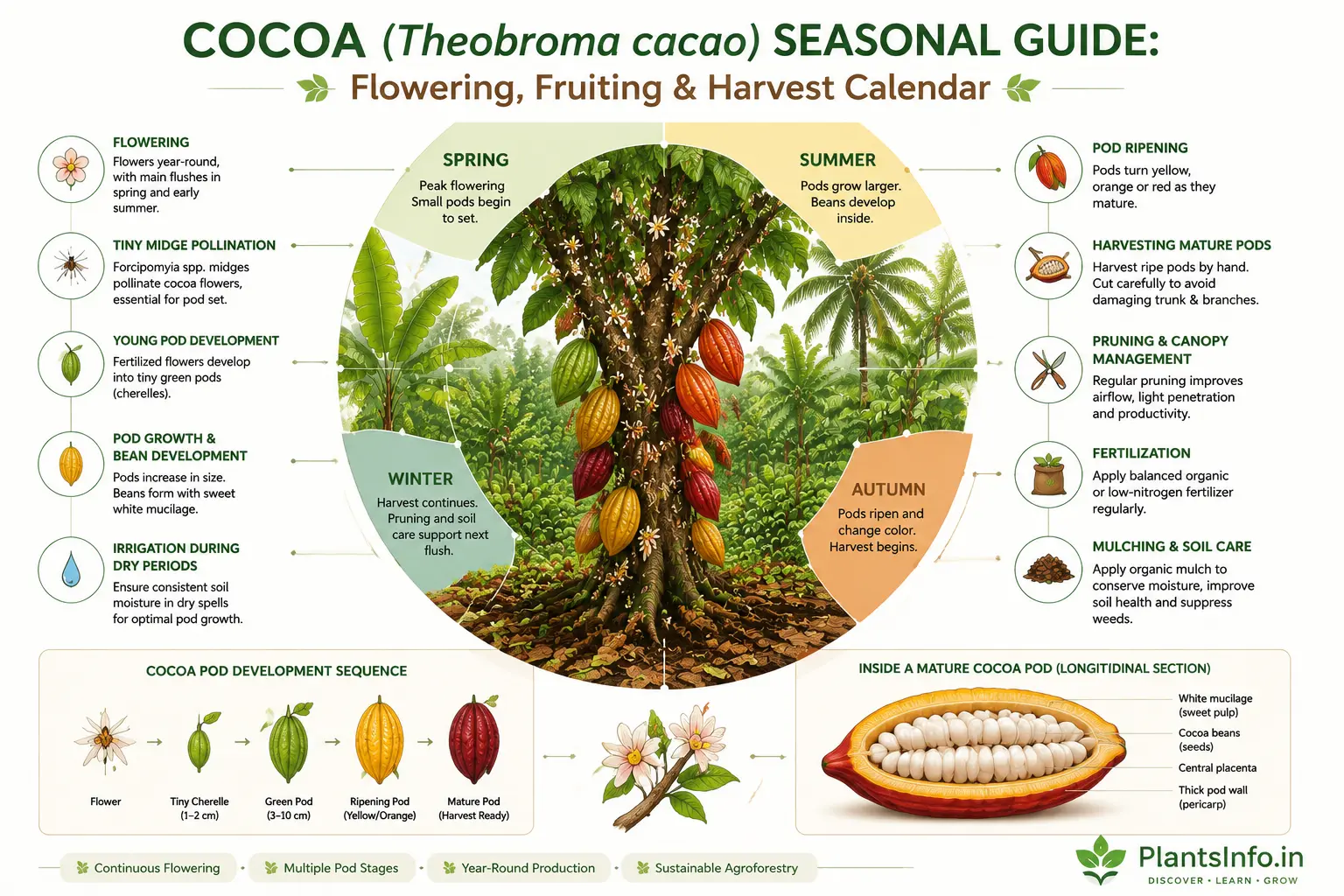
Cocoa (Theobroma cacao L.) does not follow a single, sharply defined annual growing season like many temperate fruit trees. In warm, humid tropical climates, the tree can produce multiple flowering flushes throughout the year, with flowering and pod development influenced primarily by rainfall patterns, soil moisture, temperature, and tree health rather than calendar dates. Consequently, harvesting may also occur several times annually, although one or two periods often account for the largest share of production.
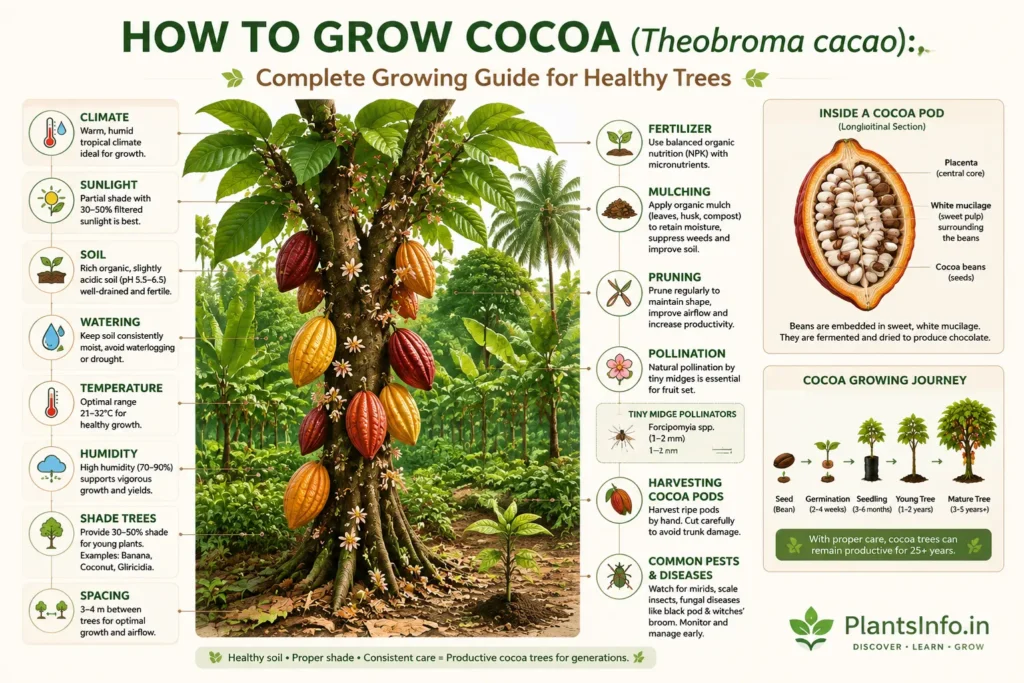
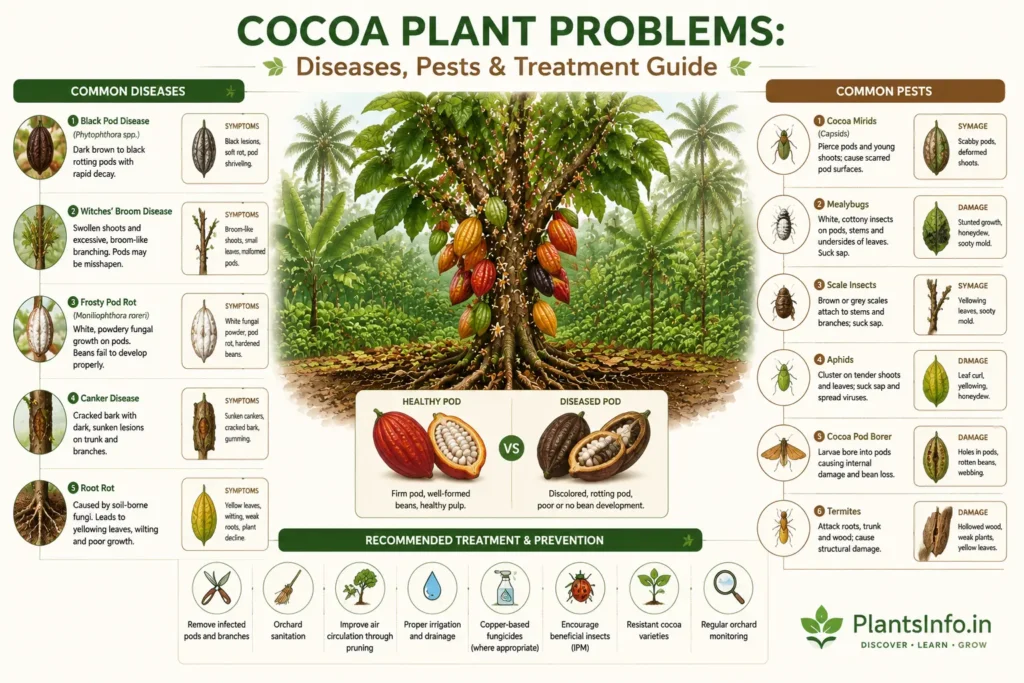
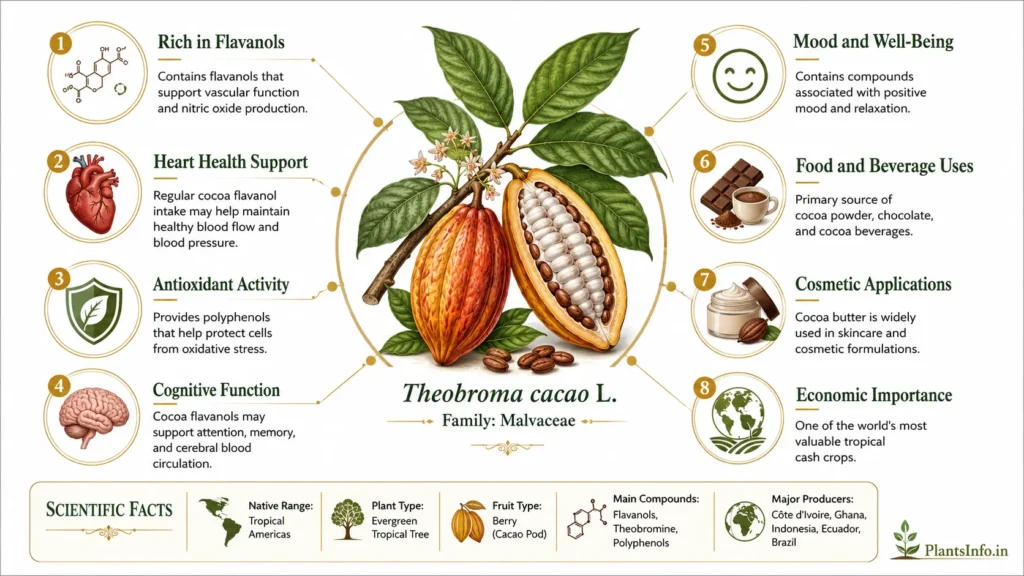
See also: Cocoa plant plant profile, how to grow it, common problems, its benefits, and its varieties.
In India, seasonal behaviour varies between regions. Cocoa-growing areas along the Western Ghats and other humid tropical regions generally experience continuous vegetative growth with flowering peaks commonly associated with the onset or conclusion of rainy periods. Local weather conditions, irrigation availability, and plantation management can shift flowering and harvesting by several weeks, so growers should use regional observations alongside general seasonal guidance.
Recommended Products
Disclosure: As an Amazon Associate, PlantsInfo may earn from qualifying purchases.
🌱 Growing Essentials
The following products can help with container gardening, potting, root development, soil management, and healthy plant growth.
Organic Potting Soil Mix
Provides nutrients, structure, and healthy growing conditions for container plants.
Coco Peat Growing Medium
Enhances moisture retention while maintaining excellent root-zone aeration.

Grow Bags for Plants
Improve drainage, root aeration, and vegetable production in limited spaces.

Plastic Pots for Plants
Ideal containers for seedlings, ornamentals, herbs, and balcony gardens.
Introduction
Understanding cocoa’s seasonal cycle helps growers anticipate key biological events, schedule orchard operations, and manage expectations throughout the year. Unlike deciduous fruit trees that undergo pronounced dormancy, cocoa remains evergreen and physiologically active whenever environmental conditions remain favourable.
Because cocoa evolved beneath the canopy of tropical rainforests, relatively stable temperatures allow continuous growth. Seasonal changes therefore depend less on temperature extremes and more on fluctuations in rainfall, humidity, soil moisture, and light availability. Extended dry periods may temporarily reduce vegetative growth or flowering, while the return of adequate moisture frequently stimulates new leaf flushes and floral development.
For Indian growers, recognizing these seasonal responses is particularly important because monsoon timing differs between regions. The southwest monsoon, northeast monsoon, local irrigation practices, and plantation microclimates all influence annual flowering, pod development, and harvest timing.
Quick Seasonal Summary
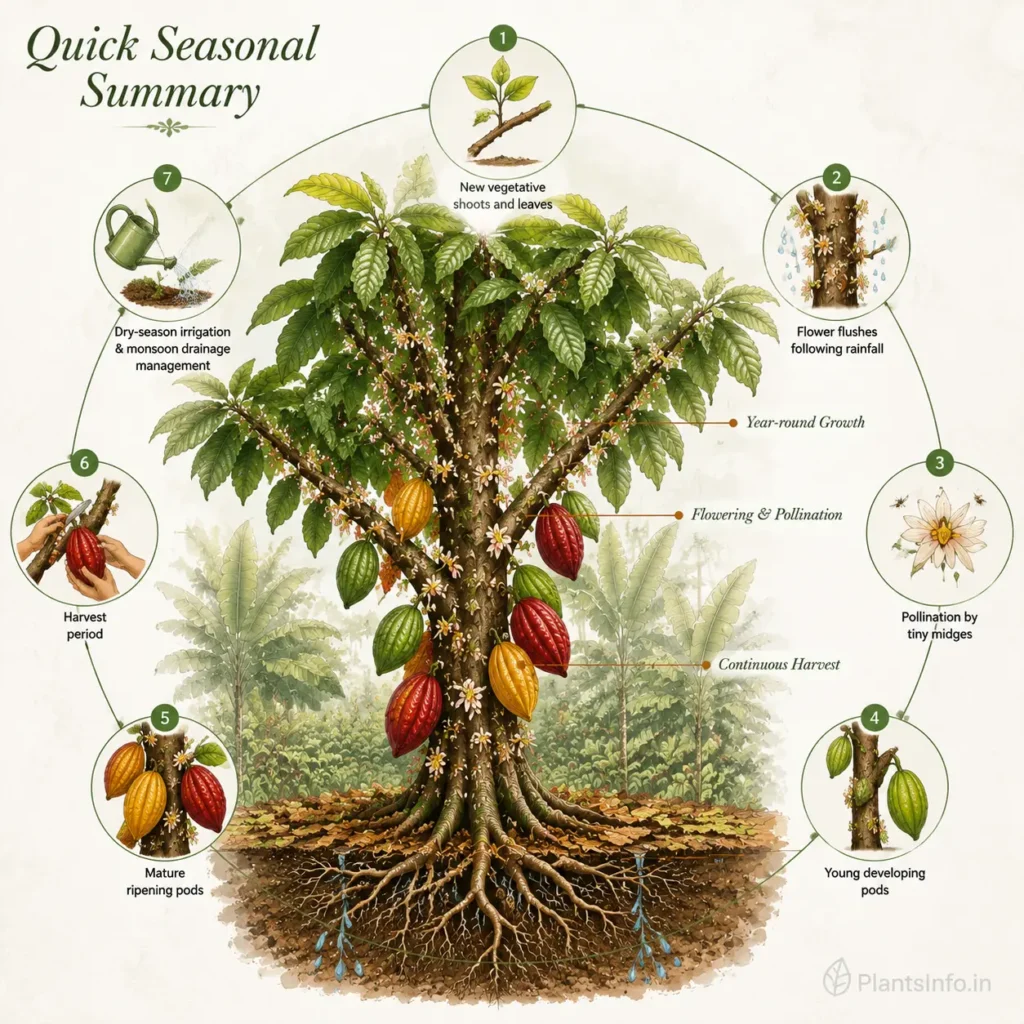
Seasonal Importance Assessment
| Seasonal Event | Importance | Typical Pattern |
|---|---|---|
| Vegetative Growth | High | Occurs throughout the year under favourable conditions |
| Flowering | Critical | Multiple flushes, often associated with rainfall patterns |
| Pollination | Critical | Coincides with flowering periods and favourable humidity |
| Fruit Development | High | Continuous where flowering is continuous |
| Harvesting | High | Several harvests annually, with regional peak seasons |
| Dry Season Management | High | Essential to maintain flowering and pod development |
| Monsoon Drainage | Critical | Prevents prolonged root stress during heavy rainfall |
Key Seasonal Limiting Factor
The principal factor influencing cocoa’s seasonal performance is the distribution of moisture throughout the year.
Unlike crops that depend primarily on seasonal temperature changes, cocoa responds strongly to:
- Consistent soil moisture.
- High atmospheric humidity.
- Moderate shade.
- Absence of prolonged drought.
- Effective drainage during heavy rainfall.
Where these conditions remain relatively stable, cocoa may continue growing, flowering, and fruiting for much of the year. Conversely, prolonged moisture stress or waterlogging can disrupt flowering cycles and reduce future yields.
Seasonal Behaviour at a Glance
| Growth Stage | Typical Seasonal Pattern |
|---|---|
| New Leaf Flush | Several times annually following favourable moisture conditions |
| Flower Bud Initiation | Repeated during suitable growing conditions |
| Flowering | Multiple flushes each year |
| Pod Development | Continuous following successful pollination |
| Pod Maturation | Approximately 5–6 months after successful pollination, depending on climate and growing conditions |
| Harvest | Multiple harvest periods each year |
What Makes Cocoa Different?
Many fruit crops have clearly defined flowering and harvest seasons driven by winter dormancy and spring growth. Cocoa behaves differently because:
- It remains evergreen.
- It lacks true winter dormancy.
- Flowers are produced directly on the trunk and older branches (cauliflory).
- Flowering may occur repeatedly throughout the year.
- Different stages of development—flowers, immature pods, and mature pods—may be present simultaneously on the same tree.
This overlapping growth pattern means orchard management requires continuous observation rather than relying solely on fixed calendar dates.
Flowering Season
Flowering marks the beginning of cocoa’s reproductive cycle and largely determines the potential size of future harvests. Healthy mature trees produce numerous small flowers directly from the trunk and older branches, a characteristic known as cauliflory.
When Does Cocoa Flower?
Under tropical Indian conditions, cocoa is capable of flowering during much of the year. Rather than one distinct flowering season, most trees experience several flowering flushes, with intensity varying according to rainfall, soil moisture, canopy condition, and overall tree vigour.
Many cocoa-growing regions observe stronger flowering following periods of renewed moisture after relatively drier conditions, although timing varies considerably between locations.
For this reason, flowering calendars should always be interpreted as general seasonal trends rather than fixed annual dates.
Environmental Factors Influencing Flowering
Flower production is influenced by several interacting environmental conditions.
| Factor | Influence on Flowering |
|---|---|
| Soil Moisture | Consistent moisture supports continued floral development |
| Rainfall | Often stimulates new flowering flushes |
| Temperature | Warm tropical temperatures favour continuous reproductive activity |
| Humidity | Supports flower development and pollinator activity |
| Light | Balanced shade encourages healthy vegetative and reproductive growth |
| Tree Health | Well-maintained trees generally produce stronger flowering flushes |
No single environmental factor determines flowering. Instead, successful flowering reflects the combined effect of favourable growing conditions over time.
Flower Production
A mature cocoa tree can produce thousands of flowers annually, but only a very small proportion develop into mature pods. This is a normal characteristic of the species rather than an indication of poor management.
Natural flower loss results from several biological factors, including limited pollination success and the tree’s ability to regulate the number of developing fruits it can support.
Consequently, growers should avoid assuming that heavy flowering will automatically result in proportionally heavy harvests.
Regional Variation in India
Seasonal flowering patterns differ across India’s cocoa-growing regions.
Kerala and Coastal Karnataka
Relatively stable temperatures and dependable humidity often support repeated flowering throughout the year, with noticeable peaks commonly associated with rainfall transitions.
Tamil Nadu
In irrigated plantation systems, flowering may remain comparatively continuous, although intensity often reflects seasonal rainfall and irrigation management.
Andhra Pradesh and Telangana
Where dry seasons are more pronounced, flowering may become more seasonal unless irrigation maintains adequate soil moisture.
Northeast India
High humidity generally favours flowering, but exceptionally heavy rainfall may occasionally reduce pollinator activity during certain periods.
Practical Observation
Experienced growers often observe that uniform soil moisture throughout the year contributes more to consistent flowering than occasional heavy irrigation after severe drought. Trees exposed to repeated cycles of moisture stress frequently exhibit irregular flowering patterns, even when temperatures remain favourable.
Seasonal Expectation
Flowering is a recurring biological process rather than a single annual event. It is therefore common to find fresh flowers, developing pods, and mature pods on the same cocoa tree simultaneously, especially in humid tropical regions with relatively stable growing conditions.
Fruiting Season
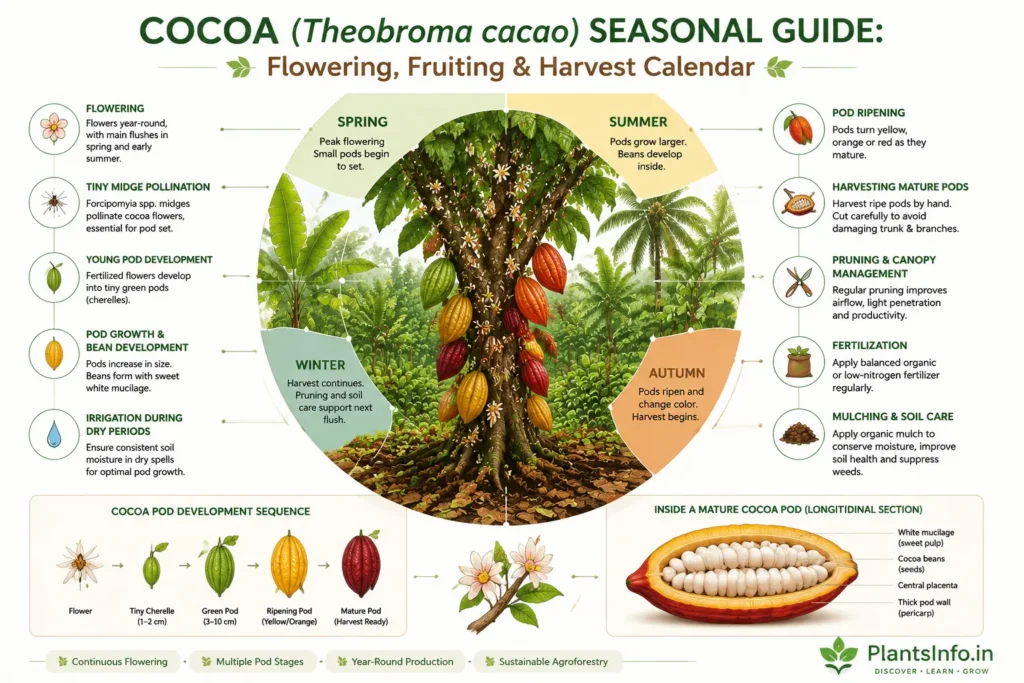
Following successful pollination and fertilization, cocoa flowers develop into pods that mature gradually over several months. Unlike many fruit trees that produce a single synchronized crop, cocoa often carries flowers, immature pods, and mature pods simultaneously because flowering occurs in multiple flushes throughout the year.
This overlapping reproductive cycle allows harvests to be distributed across several months rather than concentrated within one short season.
Fruit Development
Under favourable tropical conditions, cocoa pods generally require approximately 5–6 months to reach physiological maturity after successful pollination. The exact duration varies according to:
- Temperature
- Rainfall distribution
- Soil moisture
- Tree health
- Pod load
- Local growing conditions
Higher temperatures within the species’ optimum range often accelerate development slightly, while prolonged moisture stress may slow pod growth.
Stages of Pod Development
| Stage | Typical Characteristics |
|---|---|
| Fruit Set | Successful fertilization produces small developing pods (cherelles). |
| Early Pod Growth | Rapid enlargement and active seed development begin. |
| Mid Development | Pods continue increasing in size while beans accumulate storage reserves. |
| Maturation | Pod colour changes according to genotype, and beans reach harvest maturity. |
Although trees may produce thousands of flowers annually, only a small proportion develop into mature pods. This natural reduction reflects the tree’s ability to balance reproductive demand with available resources.
Seasonal Variation in Fruiting
In humid regions where rainfall remains relatively well distributed, pod development often continues throughout the year. However, the abundance of developing pods generally reflects earlier flowering peaks.
Consequently, periods of heavy flowering are usually followed several months later by correspondingly larger harvests.
Regional Fruiting Patterns in India
| Region | General Fruiting Pattern |
|---|---|
| Kerala | Extended fruiting with multiple pod flushes |
| Coastal Karnataka | Nearly continuous pod production under favourable conditions |
| Tamil Nadu | More uniform in irrigated plantations |
| Andhra Pradesh & Telangana | Fruiting may become more seasonal where irrigation is limited |
| Northeast India | Good fruit development, although prolonged heavy rainfall may influence seasonal distribution |
Because local weather differs considerably between districts, regional observation remains more valuable than relying solely on generalized calendars.
Pollination & Fruit Set
Successful pollination is one of the most important determinants of cocoa yield because only pollinated flowers can develop into pods.
Pollination Biology
Cocoa flowers are primarily pollinated by tiny midges (family Ceratopogonidae) and a range of other small insects adapted to humid tropical environments. Wind contributes little to pollination because cocoa pollen is relatively heavy and flowers are structurally adapted for insect-mediated transfer.
Pollination activity is therefore closely linked to environmental conditions that favour these small insect populations.
When Does Pollination Occur?
Pollination occurs during each flowering flush rather than during one fixed annual season.
Its success depends upon:
- Active flowering.
- Suitable humidity.
- Moderate temperatures.
- Healthy pollinator populations.
- Favourable microclimatic conditions.
Continuous flowering means opportunities for pollination also occur repeatedly throughout the year.
Factors Influencing Fruit Set
| Factor | Influence |
|---|---|
| Flower abundance | Determines potential pod production |
| Pollinator activity | Essential for successful fertilization |
| Humidity | Supports pollinator survival and flower longevity |
| Moisture availability | Maintains healthy flower development |
| Tree vigour | Healthy trees generally retain more developing pods |
| Environmental stress | Drought or prolonged stress may reduce fruit set |
Even under excellent growing conditions, only a small percentage of flowers mature into harvestable pods. This is a normal biological characteristic rather than evidence of inadequate management.
Cherelle Wilt
One distinctive feature of cocoa is the natural loss of some young developing pods, commonly referred to as cherelle wilt.
This physiological process allows the tree to regulate crop load according to available resources. Moderate levels are considered normal and should not automatically be interpreted as a disease problem.
Practical Observation
Maintaining a humid plantation environment with adequate organic matter often supports healthier pollinator habitats than highly exposed orchards. Growers frequently observe more consistent pod set where shade, moisture, and microclimatic stability are maintained throughout the year.
Best Planting Time
Although cocoa can technically be planted whenever adequate irrigation is available, establishment is generally most successful when planting coincides with naturally favourable weather.
India
| Region | Recommended Planting Period | Why It Is Suitable |
|---|---|---|
| Kerala | June–August | Southwest monsoon provides reliable soil moisture |
| Coastal Karnataka | June–August | Warm temperatures and dependable rainfall |
| Tamil Nadu | Depends on local rainfall or irrigation availability | Establishment benefits from adequate soil moisture |
| Andhra Pradesh | Early rainy season | Reduces irrigation requirements |
| Telangana | Beginning of rainy season or under assured irrigation | Improves early establishment |
| Northeast India | Early rainy season | Encourages rapid root development |
Why Monsoon Planting Works Well
Young cocoa plants establish more successfully when:
- Soil moisture remains consistently available.
- Air humidity is relatively high.
- Temperatures remain warm.
- Water stress is minimized during root development.
Planting at the beginning of the rainy season also allows roots to develop before the onset of the following dry period.
When to Delay Planting
Postpone planting if:
- Heavy flooding is expected.
- Soils remain waterlogged.
- Irrigation cannot be provided during prolonged dry weather.
- Unusually cool conditions occur in marginal growing areas.
The objective is to maximise early root establishment rather than simply following a calendar date.
Harvest Timing
Harvest timing depends on when flowering and fruit set occurred several months earlier. Because flowering is distributed across multiple flushes, cocoa harvests are likewise spread throughout the year.
Harvest Pattern
Most Indian cocoa-growing regions experience:
- Several harvesting rounds annually.
- One or two major harvest periods.
- Additional smaller harvests between peak seasons.
The precise timing varies with local climate, rainfall distribution, and plantation management.
Recognising Mature Pods
Harvest maturity is determined by pod development rather than calendar age alone.
General indicators include:
- Characteristic colour change appropriate to the genotype.
- Full pod size.
- Mature bean development.
- Ease of harvesting without forcing immature pods.
Pods should not be harvested prematurely because immature beans ferment poorly and produce lower-quality cocoa.
Harvest Frequency
Commercial plantations commonly harvest at regular intervals during active production periods to:
- Collect pods at optimum maturity.
- Minimise losses from overripe pods.
- Maintain bean quality.
- Improve processing efficiency.
Frequent harvesting also reduces the likelihood of mature pods remaining unnecessarily on the tree.
Annual Calendar
The following calendar represents a general seasonal pattern for humid tropical cocoa-growing regions of India. Local rainfall, irrigation, altitude, and regional climate may shift activities by several weeks.
| Month | Typical Seasonal Activity |
|---|---|
| January | Harvesting, pod maturation, vegetative growth in irrigated plantations |
| February | Harvesting continues; flowering may occur where moisture remains adequate |
| March | New vegetative flushes; flowering influenced by irrigation or early pre-monsoon showers |
| April | Flowering and fruit set increase in many regions following pre-monsoon rainfall |
| May | Active vegetative growth; continued flowering in humid regions |
| June | Southwest monsoon begins in many cocoa-growing areas; excellent period for planting and vigorous vegetative growth |
| July | Strong vegetative growth; flowering continues under favourable conditions |
| August | Continued flowering, fruit set, and establishment of newly planted trees |
| September | Developing pods enlarge; sustained canopy growth |
| October | Pod maturation increases; flowering continues in many plantations |
| November | Major harvesting begins in numerous regions; flowering may continue |
| December | Peak harvesting in many production areas; simultaneous flowering and pod development on healthy trees |
Regional Notes
Kerala and Coastal Karnataka
Seasonal transitions are relatively moderate because rainfall and humidity remain favourable for much of the year. Multiple flowering and harvesting cycles commonly overlap.
Tamil Nadu
Areas influenced by the northeast monsoon may experience seasonal patterns that differ from those of the western coast. Irrigation can further modify annual activity.
Andhra Pradesh and Telangana
The timing and intensity of flowering, fruit set, and harvesting depend more strongly on rainfall distribution and irrigation availability than in higher-rainfall coastal regions.
Northeast India
High rainfall generally supports vigorous growth, but local weather conditions may influence pollination and harvesting logistics during exceptionally wet periods.
Seasonal Interpretation
The annual calendar should be viewed as a practical planning guide rather than a rigid schedule. Cocoa remains biologically responsive to environmental conditions, and well-managed plantations may display flowers, young pods, mature pods, and vegetative flushes simultaneously during much of the year.
Seasonal Risks
Although cocoa remains physiologically active throughout the year in tropical climates, seasonal changes can significantly influence flowering, fruit development, and overall plantation performance. Most seasonal risks arise from fluctuations in moisture availability rather than large temperature changes.
Understanding these recurring challenges allows growers to anticipate potential problems before they affect productivity.
Dry Season
The dry season is often the most limiting period for cocoa production, particularly where irrigation is unavailable or unreliable.
Potential Effects
- Reduced vegetative growth.
- Fewer flowering flushes.
- Increased shedding of young developing pods.
- Temporary leaf wilting during prolonged drought.
- Slower pod development.
Young plantations are especially vulnerable because developing root systems have limited access to deeper soil moisture.
Seasonal Priorities
- Maintain adequate irrigation where possible.
- Preserve soil moisture with organic mulches.
- Avoid severe pruning during extended drought.
- Monitor newly planted trees more frequently than established plantations.
Southwest Monsoon
The southwest monsoon generally creates favourable growing conditions across many Indian cocoa-producing regions by supplying abundant moisture and supporting vigorous vegetative growth.
However, excessive rainfall can also create management challenges.
Potential Effects
- Temporary waterlogging on poorly drained sites.
- Reduced oxygen availability around roots.
- Delayed orchard operations.
- Increased difficulty accessing plantations for maintenance and harvesting.
Seasonal Priorities
- Maintain efficient field drainage.
- Keep drainage channels clear before heavy rainfall begins.
- Inspect young plantations after prolonged rain.
- Replace displaced mulch where necessary.
Proper drainage remains the most effective safeguard against prolonged monsoon-related stress.
Northeast Monsoon
In parts of Tamil Nadu and adjoining regions, the northeast monsoon contributes substantially to annual rainfall and influences local flowering and harvesting patterns.
Growers should adjust seasonal management according to local rainfall rather than relying solely on national calendars.
Periods of High Temperature
Although cocoa is a tropical species, prolonged exposure to hot, dry conditions can reduce physiological efficiency when humidity declines.
Possible Consequences
- Increased evapotranspiration.
- Temporary reduction in flowering.
- Moisture stress.
- Slower canopy growth.
Maintaining shade and adequate soil moisture helps moderate these seasonal stresses.
Unusually Cool Weather
Temperatures below the species’ preferred range reduce growth and may slow flowering and pod development.
In marginal growing regions, cold winds and occasional winter chills pose greater risks to young plants than to established trees.
Because cocoa lacks frost tolerance, freezing temperatures may cause severe injury or complete plant loss.
Seasonal Risk Summary
| Seasonal Condition | Risk Level | Primary Concern |
|---|---|---|
| Prolonged drought | High | Moisture stress and reduced flowering |
| Heavy monsoon rainfall | Moderate–High | Waterlogging and poor drainage |
| High temperatures with low humidity | Moderate | Increased water demand |
| Temporary cool periods | Moderate | Slower growth |
| Frost | Critical | Severe plant damage or death |
The severity of these risks depends largely on site selection and environmental management rather than seasonal weather alone.
Seasonal Opportunities
Each season also presents opportunities to improve long-term plantation performance.
Beginning of the Rainy Season
This is generally the most favourable period for:
- Establishing new plantations.
- Planting replacement trees.
- Applying organic matter.
- Encouraging rapid root development.
Natural rainfall reduces transplant stress while promoting vigorous early growth.
Active Growing Season
Periods of continuous vegetative growth provide favourable conditions for:
- Canopy assessment.
- Nutrient uptake.
- Observation of flowering intensity.
- Monitoring overall tree vigour.
Healthy canopy development during these periods supports future reproductive growth.
Harvest Periods
Regular harvesting offers opportunities to:
- Assess annual productivity.
- Monitor pod maturity.
- Identify uneven flowering patterns.
- Evaluate overall plantation performance.
Consistent harvesting also helps maintain bean quality by preventing mature pods from remaining on trees longer than necessary.
End of the Rainy Season
Following periods of active growth, growers can evaluate:
- Tree establishment.
- Shade balance.
- Drainage performance.
- Soil moisture conservation practices.
Lessons learned during one rainy season often guide improvements before the following year.
Practical Observation
Experienced cocoa growers often focus less on individual seasons than on maintaining environmental stability throughout the year. Plantations that avoid severe fluctuations in soil moisture and canopy conditions generally produce more regular flowering and harvesting cycles than those exposed to repeated environmental stress.
Frequently Asked Questions
Does cocoa have a single flowering season?
No.
In favourable tropical climates, cocoa produces multiple flowering flushes throughout the year. The timing and intensity of flowering depend primarily on rainfall patterns, soil moisture, humidity, and tree health rather than a single annual season.
Can cocoa produce flowers and pods at the same time?
Yes.
Healthy cocoa trees commonly bear flowers, immature pods, and mature pods simultaneously because flowering occurs repeatedly throughout the year.
This overlapping reproductive cycle is one of the defining characteristics of the species.
When are the main harvest seasons in India?
Harvesting generally occurs several times each year, although one or two periods often account for most production.
The exact timing varies among regions according to local flowering patterns, rainfall distribution, and management practices.
Why does flowering vary between plantations?
Flowering depends on numerous interacting factors, including:
- rainfall,
- irrigation,
- humidity,
- soil moisture,
- tree health,
- shade management,
- and local climate.
Consequently, neighbouring plantations may display noticeably different flowering patterns even within the same district.
How long does pod development take?
Under favourable tropical conditions, cocoa pods generally require about 5–6 months to mature after successful pollination.
Environmental conditions may shorten or extend this period slightly.
Does heavy flowering guarantee a heavy harvest?
No.
Although mature trees may produce thousands of flowers annually, only a small proportion develop into harvestable pods.
Natural flower and young pod loss are normal aspects of cocoa biology.
Does the monsoon improve cocoa production?
Reliable rainfall generally supports vegetative growth, flowering, and pod development.
However, excessively wet conditions can become harmful where drainage is poor.
The benefits of monsoon rainfall therefore depend largely on maintaining well-drained soils.
Is irrigation necessary during the dry season?
In areas experiencing prolonged dry periods, supplemental irrigation often helps maintain consistent flowering and pod development.
Where rainfall remains evenly distributed throughout the year, irrigation requirements are considerably lower.
Can seasonal weather shift harvest dates?
Yes.
Differences in rainfall timing, irrigation, altitude, and local climate frequently shift flowering and harvesting by several weeks.
Growers should use regional observations together with general seasonal guidance rather than relying solely on calendar dates.
Why are flowers and pods present throughout the year?
Unlike temperate fruit trees, cocoa does not undergo a pronounced winter dormancy.
Warm temperatures allow continuous physiological activity, enabling repeated flowering and overlapping fruit development whenever environmental conditions remain favourable.
Is there a “best” season for cocoa growth?
The period immediately following the onset of reliable rainfall generally supports the most vigorous vegetative growth and establishment of young plants.
Nevertheless, healthy cocoa trees continue growing during much of the year if moisture, shade, and temperature remain favourable.
Does every region in India follow the same seasonal calendar?
No.
Regional rainfall patterns differ considerably between the Western Ghats, eastern coastal regions, the Northeast, and irrigated inland plantations.
Local climatic conditions should always take precedence over generalized seasonal calendars.
Conclusion
Cocoa (Theobroma cacao L.) follows a seasonal pattern unlike that of most fruit trees. Rather than entering a pronounced dormant period, it remains evergreen and capable of producing new leaves, flowers, and pods throughout much of the year under suitable tropical conditions.
Its annual cycle is governed primarily by rainfall distribution, soil moisture, humidity, and overall environmental stability rather than by large seasonal changes in temperature. Consequently, flowering, pollination, pod development, and harvesting often overlap, allowing multiple production cycles within a single year.
For Indian growers, understanding local monsoon patterns is essential for interpreting seasonal behaviour. While general annual trends provide useful guidance, successful plantation management depends on observing regional rainfall, maintaining adequate drainage during wet periods, conserving soil moisture during dry seasons, and responding to local climatic conditions.
Ultimately, the most productive cocoa plantations are those that minimise seasonal stress. By maintaining stable growing conditions throughout the year, growers encourage more regular flowering, improved fruit set, consistent pod development, and dependable harvests over the long term.