
Hibiscus: Key Facts, Common Names & Distribution in India
Quick Answer
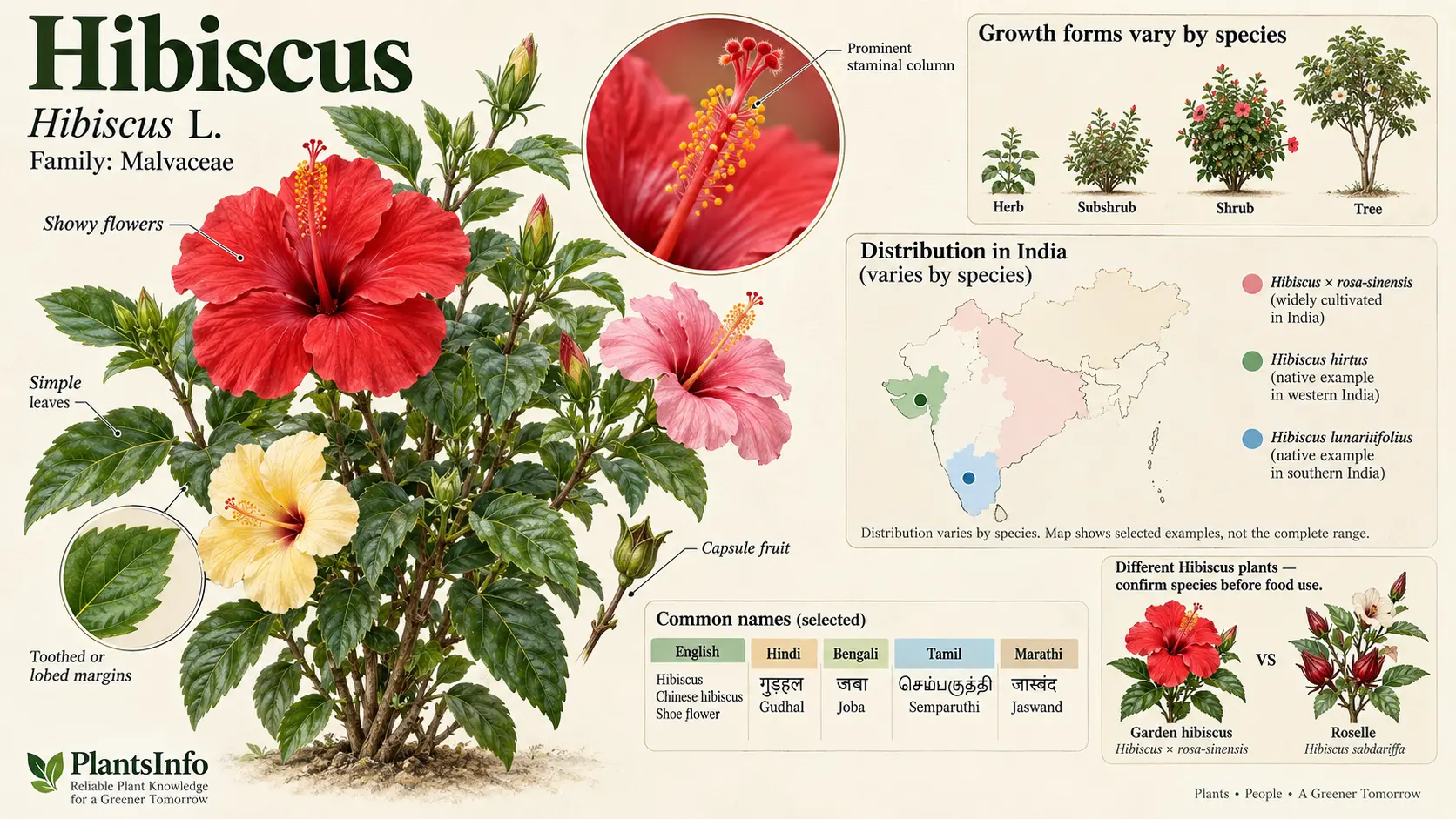
Hibiscus L. is a genus in the mallow family, containing herbs, subshrubs, shrubs, and trees across tropical and subtropical regions. In India, “Hibiscus” commonly refers to several species, while the familiar garden hibiscus is usually Hibiscus × rosa-sinensis or a related cultivated form.
See also: Hibiscus Plant plant profile, how to grow it, common problems, seasonal care, and its flowering season.
Quick Facts
| Feature | Typical characteristic |
|---|---|
| Growth form | Herbs, subshrubs, shrubs, or trees, depending on species |
| Leaves | Simple, usually stalked, with margins ranging from nearly entire to toothed or lobed |
| Flowers | Usually showy, commonly with five petals and a prominent staminal column |
| Fruit | Usually a capsule containing multiple seeds |
| Distinguishing feature | The conspicuous staminal column surrounding the style is a useful visual clue |
| Scientific name | Hibiscus L. |
| Family | Malvaceae |
Hibiscus is a diverse genus rather than one uniform garden plant. The genus includes many species with different forms and distributions, so characteristics of the familiar garden hibiscus should not automatically be applied to every Hibiscus species.
Recommended Products
Disclosure: As an Amazon Associate, PlantsInfo may earn from qualifying purchases.
🌱 Growing Essentials
The following products can help with container gardening, potting, root development, soil management, and healthy plant growth.

Organic Potting Soil Mix
Provides nutrients, structure, and healthy growing conditions for container plants.

Coco Peat Growing Medium
Enhances moisture retention while maintaining excellent root-zone aeration.

Grow Bags for Plants
Improve drainage, root aeration, and vegetable production in limited spaces.

Plastic Pots for Plants
Ideal containers for seedlings, ornamentals, herbs, and balcony gardens.
Names in Different Languages
| Language | Common name |
|---|---|
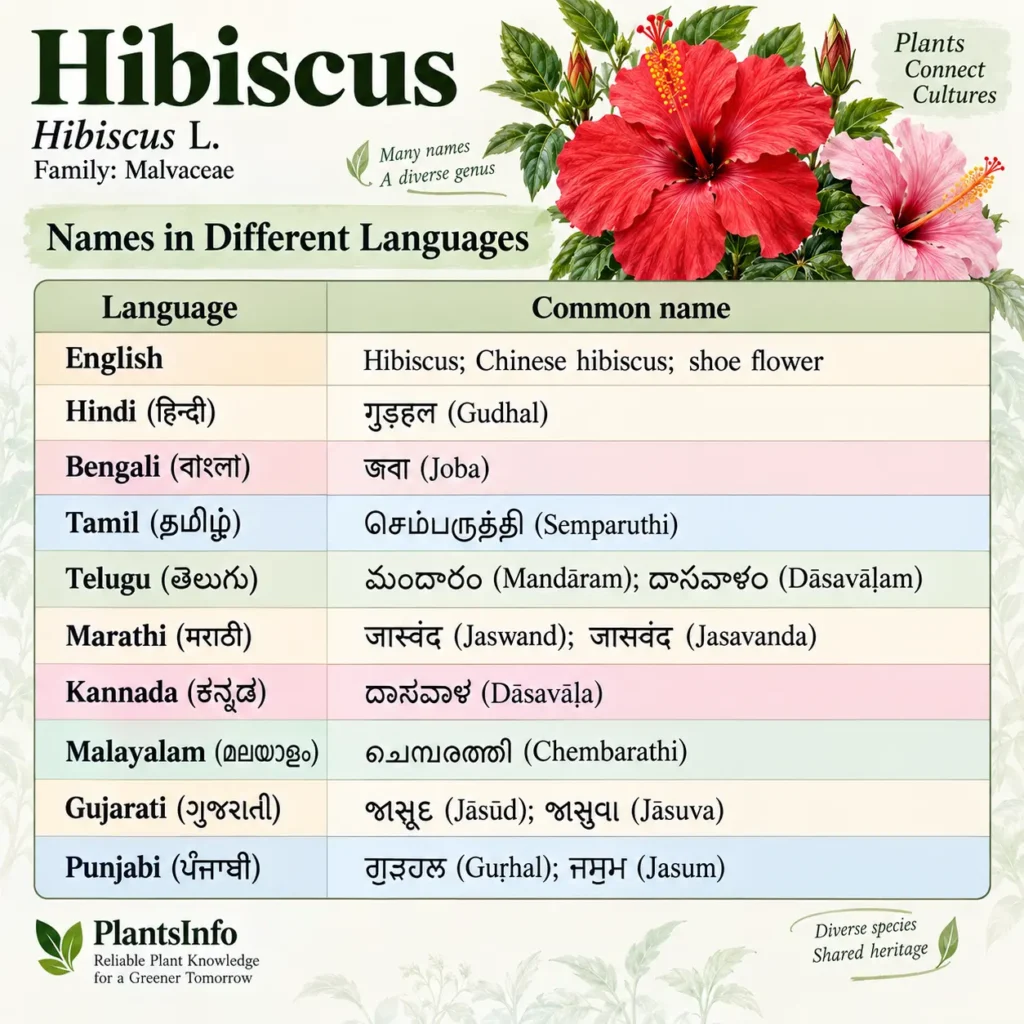
| English | Hibiscus; Chinese hibiscus; shoe flower |
| Hindi (हिन्दी) | गुड़हल (Gudhal); गुड़हल/गुड़हल? |
| Bengali (বাংলা) | জবা (Joba) |
| Tamil (தமிழ்) | செம்பருத்தி (Semparuthi) |
| Telugu (తెలుగు) | మందారం (Mandāram); దాసవాళం (Dāsavāḷam) |
| Marathi (मराठी) | जास्वंद (Jaswand); जासवंद (Jasavanda) |
| Kannada (ಕನ್ನಡ) | ದಾಸವಾಳ (Dāsavāḷa) |
| Malayalam (മലയാളം) | ചെമ്പരത്തി (Chembarathi) |
| Gujarati (ગુજરાતી) | જાસૂદ (Jāsūd); જાસુવા (Jāsuva) |
| Punjabi (ਪੰਜਾਬੀ) | ਗੁੜਹਲ (Guṛhal); ਜਸੁਮ (Jasum) |
These vernacular names are commonly associated with Hibiscus rosa-sinensis in Indian botanical records rather than necessarily applying to every species in the genus.
Regional naming varies, so a common name alone may not establish the exact species being discussed.
What Does It Look Like?
The genus is too diverse for one mature height or leaf shape to represent every Hibiscus species. Plants may occur as herbs, subshrubs, shrubs, or trees.
Leaves are generally simple and may be toothed, nearly entire, or distinctly lobed. Flower colours can include red, pink, white, and yellow, with some flowers showing a contrasting darker centre.
One of the most useful visual clues is the prominent staminal column, formed by numerous anthers arranged along a tube surrounding the style.
The familiar cultivated Hibiscus × rosa-sinensis is an evergreen shrub with simple, alternate leaves and large flowers commonly found in pinkish to red forms.
Where Does It Grow in India?
India contains native Hibiscus species as well as cultivated and introduced species and hybrids. The distribution therefore depends on which species is being identified.
The familiar garden hibiscus, Hibiscus × rosa-sinensis, is widely cultivated in India and is recorded in botanical sources from regions including Kerala, Tamil Nadu, Maharashtra, Delhi, Uttar Pradesh, and Punjab.
Other Hibiscus species have more restricted distributions. For example, Hibiscus hirtus is recorded as native to western India, while Hibiscus lunariifolius is recorded as native to southern India and Sri Lanka.
Therefore, there is no single state-level range that accurately describes the entire genus in India.
What Is It Used For?
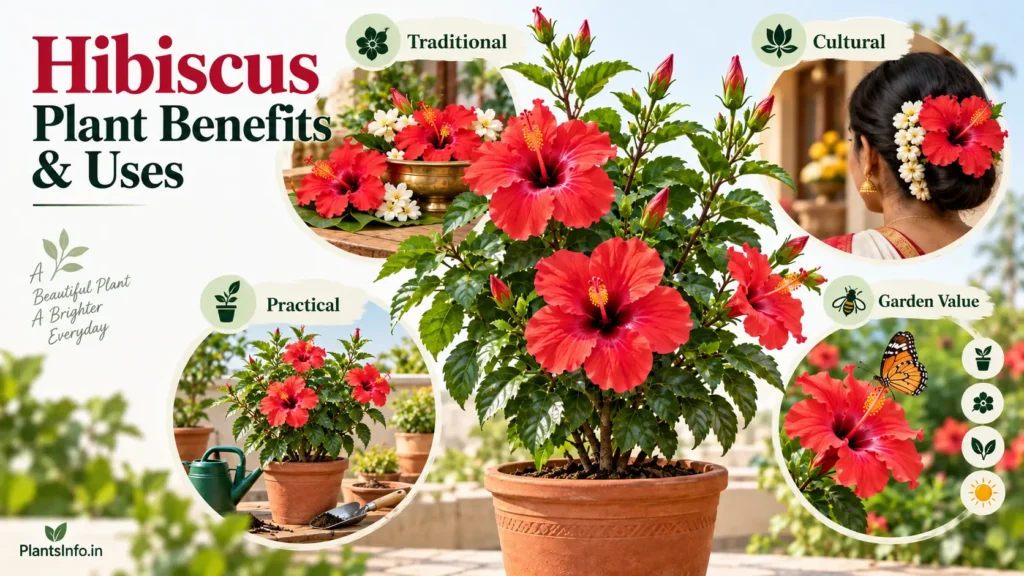
- Ornamental: Cultivated hibiscus, particularly H. × rosa-sinensis, is widely grown for its showy flowers.
- Religious and cultural: Hibiscus flowers, especially red forms, are used in Indian worship traditions.
- Traditional use: Different Hibiscus species have documented traditional uses, but a use recorded for one species should not automatically be attributed to another.
- Food: Certain species, notably roselle (Hibiscus sabdariffa), are used as food or beverage plants. This does not establish that every ornamental Hibiscus is suitable for consumption.
- Educational: The conspicuous floral structures make cultivated Hibiscus useful for observing basic flower morphology.
Is It Easy to Grow?
The familiar cultivated garden hibiscus is widely grown as an ornamental shrub in India. However, growing characteristics and environmental suitability vary among Hibiscus species and cultivated forms.
For that reason, “Hibiscus” should not be treated as a single plant with identical requirements across the genus.
Commonly Confused With Another Species
Ornamental Hibiscus vs. Roselle
Hibiscus × rosa-sinensis and Hibiscus sabdariffa are different plants despite sharing the Hibiscus name.
Roselle is associated with edible calyces and beverages, whereas the familiar garden hibiscus is primarily cultivated as an ornamental. Confirm the plant’s identity before treating a Hibiscus plant as a food source.
Frequently Asked Questions
Is Hibiscus a tree or a shrub?
The genus includes herbs, subshrubs, shrubs, and trees. The common garden hibiscus encountered in India is generally a shrub.
Is Hibiscus native to India?
Some Hibiscus species are native to India, while others are cultivated or introduced. Hibiscus hirtus, for example, is recorded as native to western India.
Does “Hibiscus” always mean Hibiscus rosa-sinensis?
No. Hibiscus is the genus name, while Hibiscus × rosa-sinensis is one familiar cultivated hibiscus. The two terms should not be treated as synonyms.
Conclusion
For accurate identification, start with Hibiscus as a genus name and determine the species before applying a regional name, use, or other species-specific claim.
🌿 About Hibiscus Plant (Hibiscus L.)
🌿 View Complete Hibiscus Plant (Hibiscus L.) Plant Profile →🌱 Growing Guide
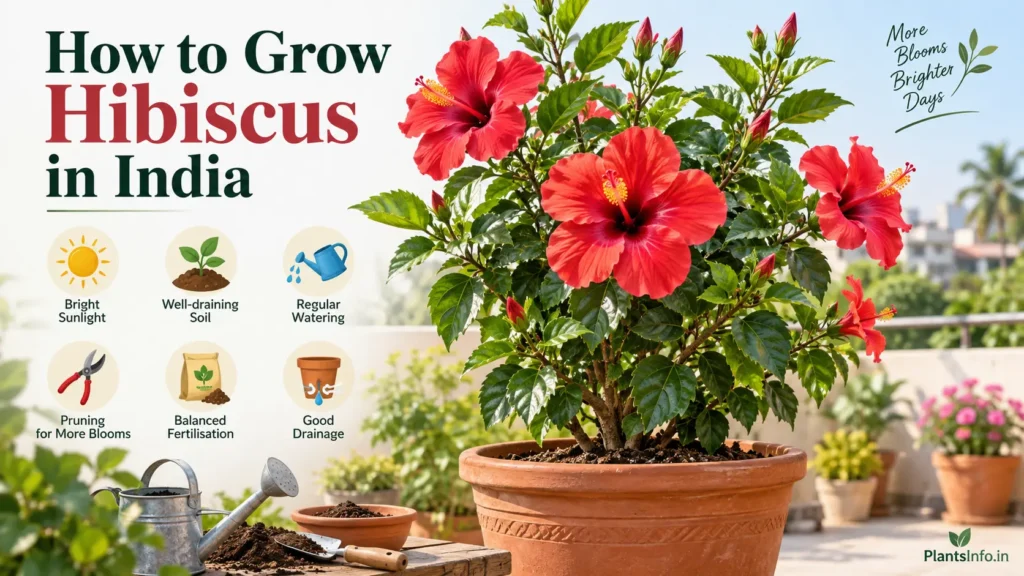
Practical guidance on planting, growing conditions, and routine plant care.
⚠️ Problems & Diseases
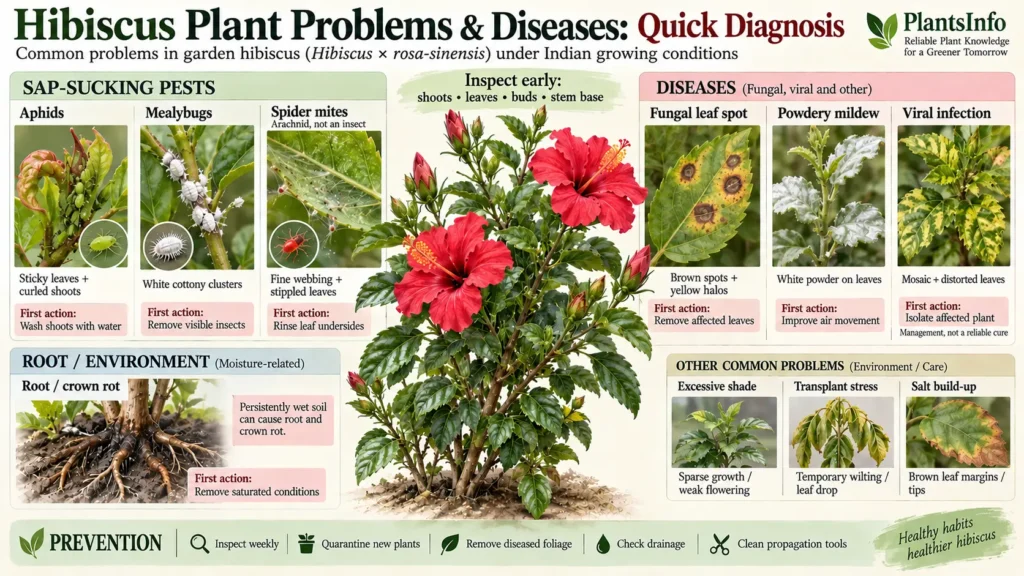
Information on common plant problems, diseases, and their identification.
🍂 Seasonal Care
Season-specific guidance for maintaining plant health and growth.

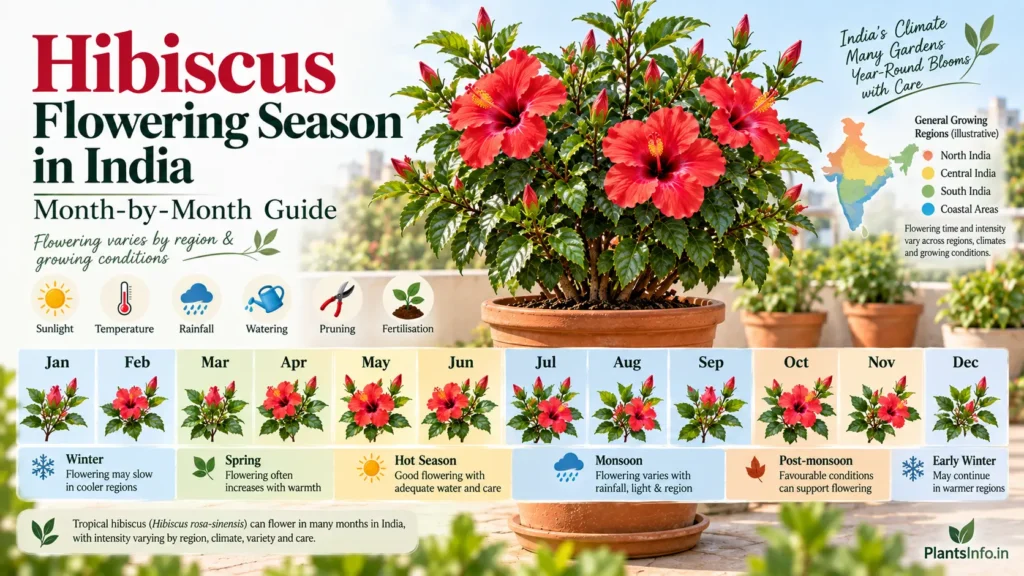
🌸 Flowering Season
Information about flowering periods, seasonal patterns, and bloom development.
🍃 Benefits
An overview of documented uses, benefits, and relevant plant characteristics.
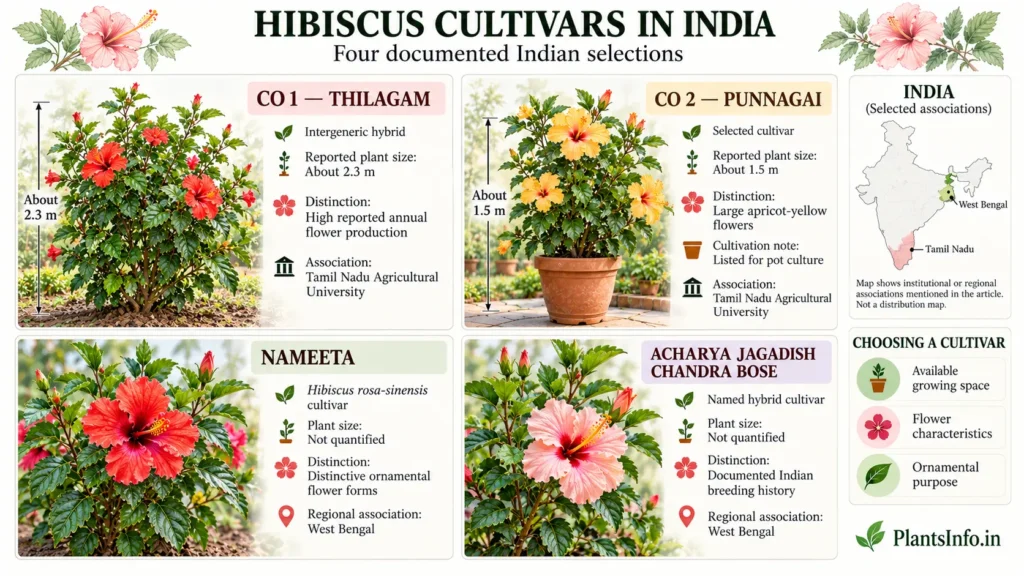
🧬 Varieties
Explore recognised varieties, cultivars, and related forms of this plant.
📊 Quick Facts
A concise reference to important botanical and cultivation facts.
