Shatavari Varieties: Which One Should You Grow in India?

Shatavari Varieties: Which One Should You Grow in India?
Quick Answer: Most Indian home gardeners grow the standard wild-type Shatavari because it is the most available — but improved varieties developed by Indian agricultural research institutes offer meaningfully better root yield and disease resistance. Knowing which type you are buying matters more for Shatavari than for most medicinal plants.
See also: Shatavari plant profile, how to grow it, common problems, its flowering season, and its benefits.
Walk into most herbal plant nurseries in Maharashtra or Karnataka, and you will find a pot labelled simply “Shatavari” with no further detail. That plant is almost certainly the wild-type — viable and medicinal, but not necessarily the best choice for a terrace garden or a home grower looking for a reasonable root harvest within two to three years. This spoke fixes the information gap between what nurseries sell and what research stations have developed.
Recommended Products
Disclosure: As an Amazon Associate, PlantsInfo may earn from qualifying purchases.
🌱 Growing Essentials
The following products can help with container gardening, potting, root development, soil management, and healthy plant growth.
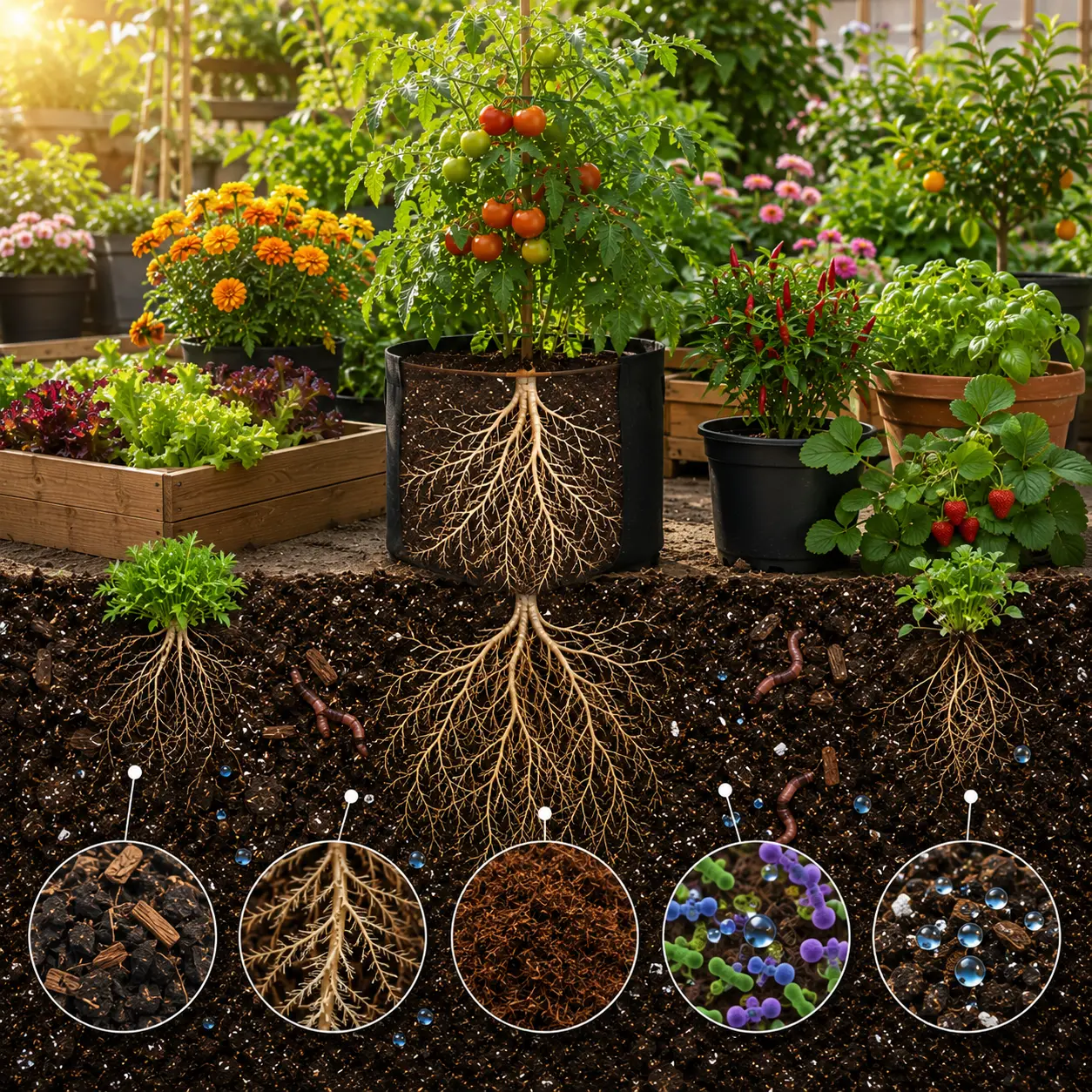
Organic Potting Soil Mix
Provides nutrients, structure, and healthy growing conditions for container plants.
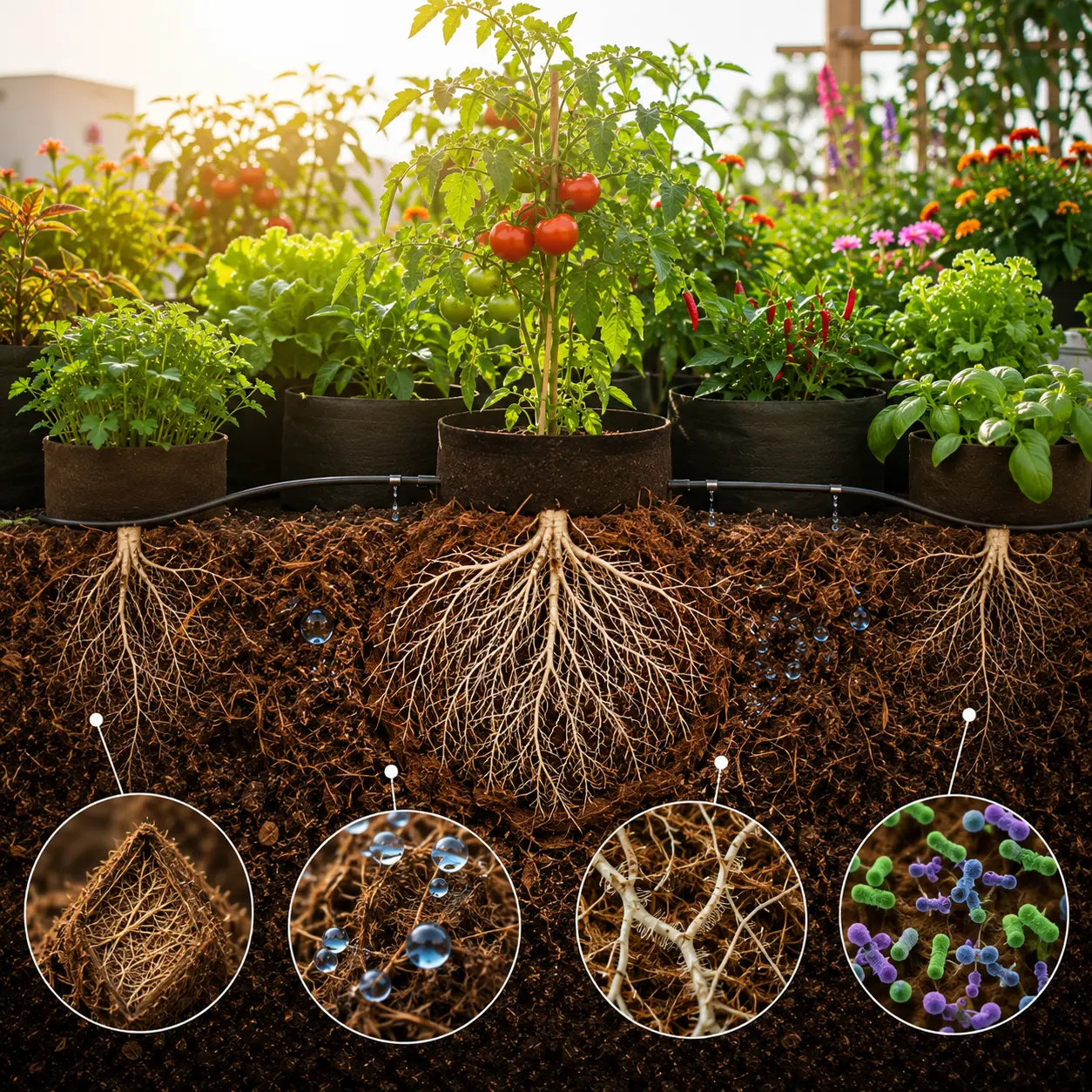
Coco Peat Growing Medium
Enhances moisture retention while maintaining excellent root-zone aeration.

Grow Bags for Plants
Improve drainage, root aeration, and vegetable production in limited spaces.

Plastic Pots for Plants
Ideal containers for seedlings, ornamentals, herbs, and balcony gardens.
Quick Variety Selector
| Variety | Type | Plant Size | Best For | Suited To |
|---|---|---|---|---|
| Wild type (local ecotype) | Open-pollinated / wild | Large | Traditional home use, low input | Regional/wild |
| CIMAP-1 (Shatavari-1) | Improved / open-pollinated | Medium | Higher root yield, home or small farm | UP, MP, Rajasthan, Maharashtra |
| Rajasthan local ecotype | Regional/wild | Large | Drought conditions, minimal inputs | Rajasthan, MP, Gujarat |
| Karnataka ecotype | Regional / wild | Medium–Large | Humid and semi-humid climates | Karnataka, AP, Tamil Nadu |
| JNKVV selection | Improved / open-pollinated | Medium | Root yield, disease resistance | MP, Maharashtra |
Varieties in Detail
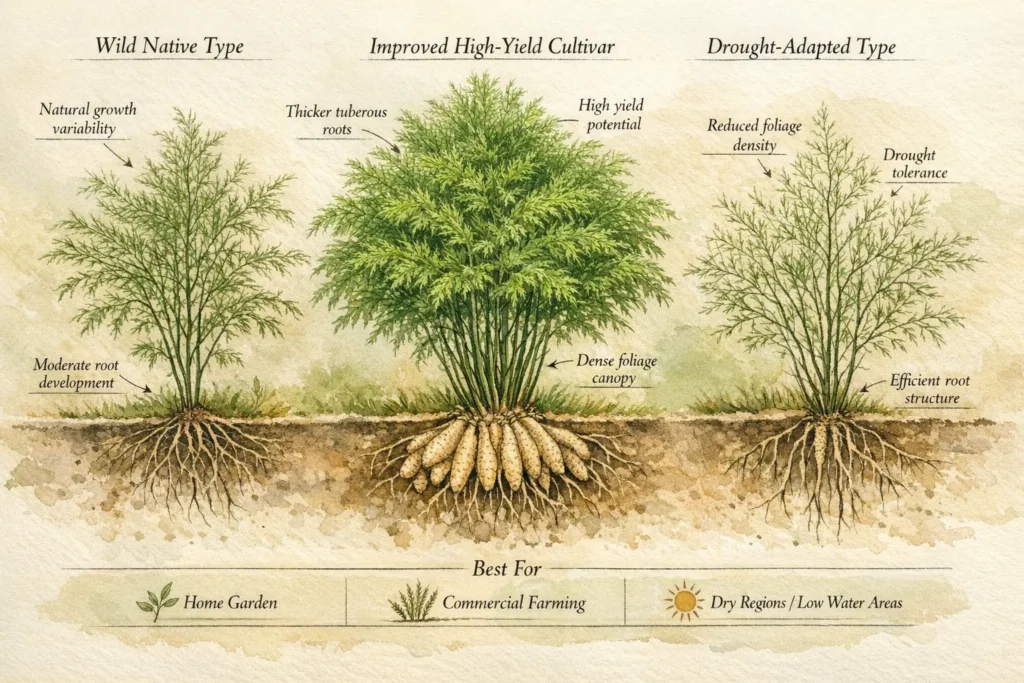
Wild type (local ecotype): This is the plant that grows spontaneously across Indian scrubland and the one most commonly propagated through informal nursery networks. It has not been selectively bred for root yield — it has been optimised by natural selection for survival, which means strong drought tolerance, good disease resistance, and adaptability across a wide range of conditions. Root yield per plant is lower than that of improved varieties, but the plant is genuinely low-maintenance and widely available. Seed saving works normally with wild-type material — there is no restriction on propagation.
CIMAP-1 (Shatavari-1): Developed by the Central Institute of Medicinal and Aromatic Plants (CIMAP), Lucknow, this is the most studied improved variety in India. It was selected from wild germplasm collections for significantly higher root yield — research plots have recorded root yields 30–50% above wild-type averages under comparable growing conditions. The plant is medium-sized compared to wild types, which makes it more suitable for container growing and smaller ground plots. It is an open-pollinated variety; seed can be saved and replanted. Availability is limited to state agriculture department outlets, KVK nurseries, and a small number of certified Ayurvedic farming suppliers — it is not typically found in general plant nurseries.
Rajasthan local ecotype: This refers to the wild-type populations naturalised in Rajasthan’s semi-arid belt, which have developed stronger drought tolerance than the broad wild type. Plants from this population are particularly suited to low-rainfall growing conditions and require minimal irrigation once established. Root quality is considered high in Ayurvedic processing circles for its concentrated root tissue, attributable to slow growth in dry conditions. Not formally bred — collected and propagated from specific regional populations.
Karnataka ecotype: Wild-type material collected from the Western Ghats and Deccan plateau regions. Better suited to humid and semi-humid conditions than the Rajasthan ecotype. Faster aerial growth, slightly lower drought tolerance. Performs well in Karnataka, Andhra Pradesh, and Tamil Nadu conditions.
JNKVV selection: Developed at Jawaharlal Nehru Krishi Vishwa Vidyalaya in Madhya Pradesh, this selection is bred for moderate climate conditions with emphasis on disease resistance alongside yield improvement. Less widely documented than CIMAP-1 but gaining recognition among MP-based Ayurvedic farmers. Suited to the central Indian plateau climate.
Head-to-Head Comparison
Wild type vs. CIMAP-1: For a home gardener primarily interested in a low-maintenance ornamental climber with medicinal value, the wild type is perfectly adequate and far easier to source. For a gardener specifically growing for root harvest — whether for personal use or small-scale supply — CIMAP-1’s yield advantage is significant enough to justify the extra effort of sourcing it from a KVK or agricultural research outlet. CIMAP-1 wins for yield and container suitability; wild type wins for availability and adaptability.
Rajasthan ecotype vs. Karnataka ecotype: The deciding factor is climate. If you are in a low-rainfall, hot, semi-arid zone (interior Rajasthan, western MP, Marathwada), the Rajasthan ecotype handles conditions that would stress the Karnataka ecotype. In humid conditions — coastal Karnataka, Andhra Pradesh, the Konkan — the Karnataka ecotype grows faster and more reliably. Neither is “better” in absolute terms; regional fit is the determining criterion.
How to Choose for Your Space
Container or terrace garden: CIMAP-1 is the best choice for containers — its medium plant size is more manageable, and its root yield advantage is meaningful when root zone space is limited. Use a container of at least 45–50 cm depth. If CIMAP-1 is unavailable, wild type from a reputable herbal nursery is a reliable alternative.
Small ground plot (under 100 sq ft): CIMAP-1 or JNKVV selection for maximum root yield from limited space. Alternatively, the Karnataka ecotype performs well in small plots in humid southern regions with minimal input.
Larger garden or backyard: Wild type or Rajasthan ecotype, depending on your climate zone. These larger-growing varieties develop extensive root networks that benefit from the space and produce substantial root clusters over three years.
Home use vs. supply: Home growers should not over-optimise variety selection — any healthy Shatavari plant produces medicinal roots. The improved varieties matter most when a regular, substantial harvest is the goal.
Regional Suitability
North India (UP, Bihar, Rajasthan, MP): CIMAP-1 and the Rajasthan ecotype both perform well. CIMAP-1 is the recommended choice where it can be sourced; Rajasthan ecotype for drier, lower-input growing in the northwest.
South India (Karnataka, AP, Tamil Nadu, Kerala): Karnataka ecotype and wild type perform reliably. CIMAP-1 can also be grown successfully if drainage is good.
Coastal regions (Konkan, Malabar, Coromandel): Karnataka ecotype or wild type. High humidity requires particular attention to drainage regardless of variety.
Deccan plateau (Maharashtra, Telangana): Wild type and JNKVV selection both suit the climate. JNKVV selection is particularly appropriate for MP and eastern Maharashtra.
Hill stations above 1,200 m: Shatavari is not recommended above this altitude — no variety performs reliably in sustained low temperatures.
Desi vs. Hybrid — What Nobody Tells You
All currently available Shatavari varieties in India are open-pollinated, not hybrid. This is significant: seed saving works with all of them, and there is no mandatory re-purchasing of certified seed each season, as there is with F1 hybrid varieties.
The practical implication: if you source CIMAP-1 once, you can propagate from it indefinitely through root division or saved seed, without losing the yield characteristics. This is a meaningful long-term advantage that is rarely explained in nursery transactions.
The trade-off of improved varieties versus wild ecotypes is not yield versus flavour (as it is in many vegetable crops) but yield versus adaptability. Improved varieties may underperform in conditions significantly different from the research station conditions where they were selected. Wild types carry more genetic diversity and tend to adapt more readily to local soil and climate variation.
⚠ Watch Out for Mislabelling
Shatavari mislabelling in Indian nurseries is common in two directions: related Asparagus species (particularly Asparagus racemosus look-alikes and Asparagus officinalis material occasionally sold under the Shatavari name) are sometimes stocked interchangeably, and improved variety names are often applied to generic wild-type material.
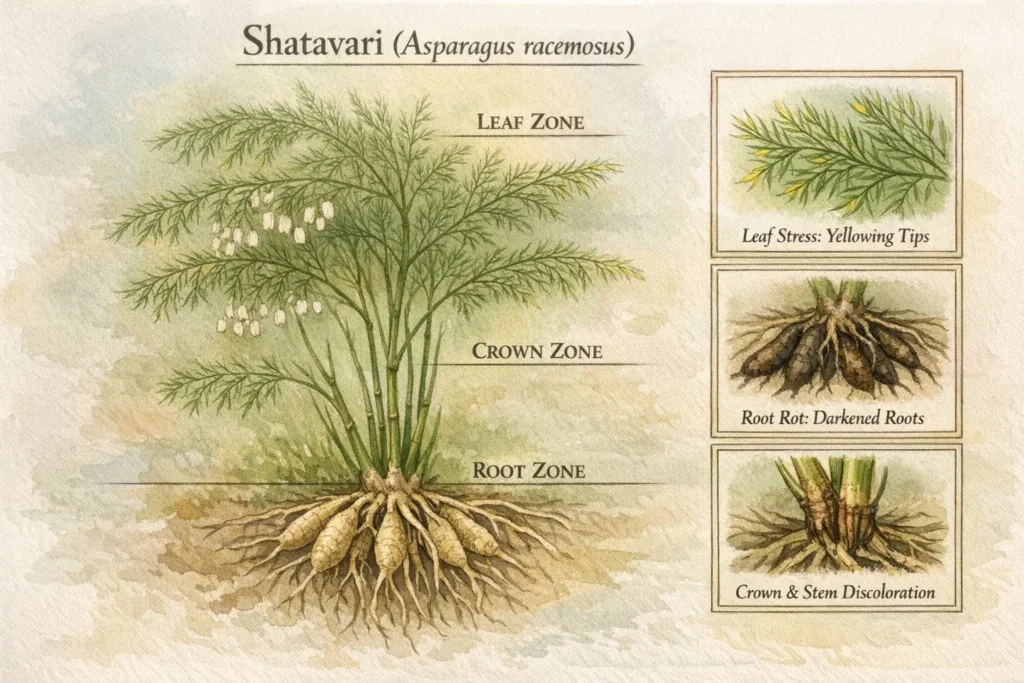
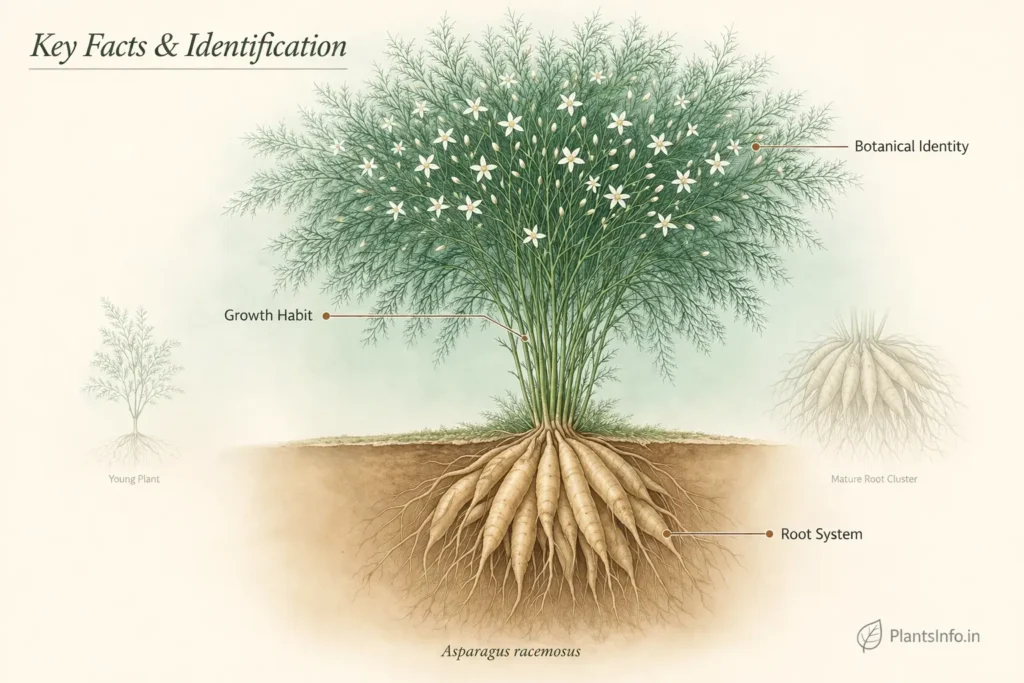
The most reliable visual check: the stem of Asparagus racemosus carries small, distinctly recurved (backward-curving) spines, and the cladodes grow in clusters of 2–6. Asparagus officinalis (culinary asparagus) has larger, softer cladodes and is grown for shoots, not roots. If a plant sold as Shatavari lacks the fine recurved spines, verify before purchase.
For improved varieties, source from KVK (Krishi Vigyan Kendra) outlets, state horticulture department nurseries, and CIMAP-certified suppliers rather than general plant nurseries. Ask specifically for the variety name — a nursery selling genuine CIMAP-1 will be able to confirm the source. If the seller cannot name the source, assume wild type regardless of the label.
Conclusion
For most Indian home gardeners, the decision is simple: source CIMAP-1 if root yield is the goal and access to a KVK or agricultural nursery is possible; use wild type if availability is the constraint — both will produce a healthy, medicinal plant that rewards three years of patience.