Complete Ashwagandha (Withania somnifera) Guides
Growing Guide
Problems & Diseases
Seasonal Care
Flowering Season
Introduction
Withania somnifera (L.) Dunal is a perennial shrub in the family Solanaceae, widely distributed across the drier regions of the Indian subcontinent, the Mediterranean basin, the Middle East, and parts of East Africa. It belongs to one of the more botanically distinctive genera of the nightshade family, characterised by papery calyx-enclosed berries, a densely tomentose habit, and an exceptionally well-documented withanolide steroidal lactone chemistry. The species occupies arid to semi-arid scrublands, degraded rocky slopes, roadsides, and village margins across a wide latitudinal range from northern Africa to the Indian subcontinent.
Classification
- Plant Type
- Shrub
- Lifecycle
- Perennial
- Leaf Habit
- Deciduous
- Native Region
- Indian Subcontinent, Middle East, North Africa
- Plant Family
- Solanaceae
Withania somnifera is among the most extensively studied plant species in Solanaceae outside the major food crop genera, generating sustained research attention across phytochemistry, agronomy, and ecology. The genus Withania contains approximately 23 accepted species distributed across the Mediterranean, Macaronesia, Africa, and Asia, with W. somnifera representing the most broadly distributed and commercially significant member. Its ability to colonise disturbed, overgrazed, and nutrient-poor habitats has contributed to its broad natural and semi-naturalised distribution.
The species is known under a large number of vernacular names across its range, including ashwagandha in Sanskrit and Hindi, Indian winter cherry in English, and withania or coagulant in some agricultural contexts. It has been cultivated in India on a commercial scale for several decades, with Madhya Pradesh, Rajasthan, Haryana, and Gujarat accounting for the majority of commercial production.
Taxonomic Synonyms
| Field | Information |
|---|---|
| Accepted Scientific Name | Withania somnifera (L.) Dunal |
| Known Synonyms | Physalis somnifera L.; Withania kansuensis Kuang & A.M.Lu; Withania microphysalis Suesseng.; Withania obtusifolia Speg. |
| Taxonomic Authority Source | Kew Plants of the World Online (POWO) |
Quick Plant Information
| Field | Information |
|---|---|
| Common Name(s) | Ashwagandha; Indian winter cherry; Indian ginseng; Withania; Poison gooseberry |
| Scientific Name | Withania somnifera (L.) Dunal |
| Family | Solanaceae |
| Plant Type | Perennial shrub |
| Lifespan | Perennial; typically 3–5 productive years in cultivation; longer in undisturbed wild populations |
| Growth Habit & Form | Erect, much-branched shrub; 30–150 cm tall; densely stellate-tomentose throughout |
| Native Range | Indian subcontinent; Mediterranean basin (Spain to Turkey and North Africa); Middle East; Horn of Africa and East Africa |
| Climate Adaptation & Habitat Type | Arid to semi-arid; tropical and subtropical dry scrublands; Mediterranean shrublands; disturbed rocky slopes, roadsides, and degraded grasslands |
| Leaf Type | Berry (enclosed within a persistent, inflated, papery calyx) |
| Flower Color(s) | Pale greenish-yellow to yellow |
| Fruit Type | Berry (enclosed within persistent, inflated, papery calyx) |
| Evergreen or Deciduous | Evergreen; may shed leaves under extreme drought |
Botanical Description
Stem
Withania somnifera produces erect, much-branched woody stems arising from a stout, fleshy taproot. The stems are terete, densely covered with a persistent grey-white stellate tomentum of branched hairs, and become woody and bark-covered at the base in mature specimens. Young shoots are green, flexible, and soft-tomentose, hardening progressively with age. The overall habit is that of a compact to spreading shrub, typically reaching 30–100 cm in height under dry field conditions and occasionally exceeding 150 cm in sheltered or wetter situations.
Leaves
Leaves are simple, alternate, and petiolate, with a broadly ovate to elliptic blade 5–12 cm long and 2–7 cm wide. Both surfaces are densely covered with stellate (star-shaped branched) hairs that give the plant its characteristic greyish-green tomentose appearance. The leaf margins are entire to shallowly sinuate; the apex is acute to obtuse; the base is cuneate to rounded and often somewhat unequal at the petiole insertion. Leaves of the same node or shoot may differ considerably in size, a characteristic of the genus.
Flowers
Flowers are small, approximately 6–10 mm long, and produced in compact axillary cymose clusters of 3–12 flowers on short peduncles. The corolla is tubular-campanulate, pale greenish-yellow, with 5 reflexed or spreading lobes, and covered externally with stellate pubescence. The calyx is 5-lobed, densely tomentose, and persistent, enlarging greatly after anthesis to form the papery bladder-like structure enclosing the mature fruit. Five stamens are inserted near the corolla base with short filaments and introrse anthers. The style is slender with a capitate stigma.
Fruit
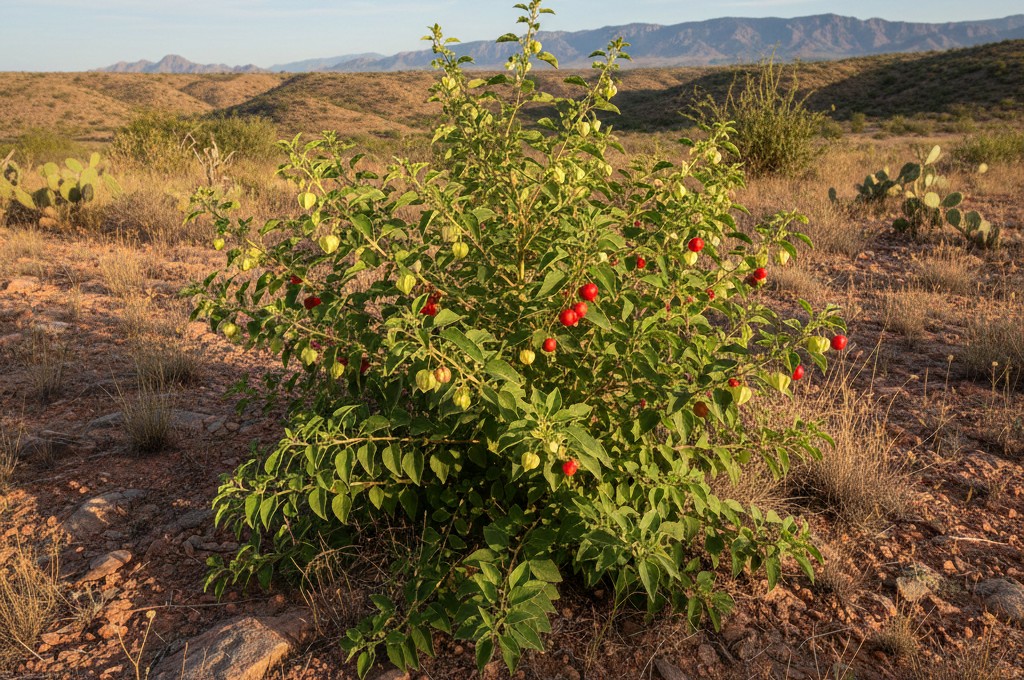
The fruit is a globose berry, 5–8 mm in diameter, red to orange-red at maturity, and entirely enclosed within the greatly enlarged, papery, inflated, bladder-like calyx that turns straw-yellow to buff as it matures. The fruit surface is smooth and glossy. Each berry contains numerous small, reniform, flattened seeds embedded in a juicy pulp. The enclosed berry arrangement within the papery calyx physically resembles the fruit of Physalis species and contributes to the common name “winter cherry.”
Roots
The root system consists of a thick, fleshy, tuberous taproot that may extend 30–60 cm into the soil profile, with a characteristic whitish interior and a yellowish-brown outer surface bearing a faint horse-like odour (from which the Sanskrit name ashwagandha — “horse smell” — is partly derived). The taproot branches into subsidiary fleshy roots in mature plants. The root is the primary commercially harvested organ and may reach 1–2 cm in diameter at the crown in well-grown one- to two-year-old cultivation specimens.
Growth Architecture & Life Strategy
Withania somnifera is classified as a chamaephyte in the Raunkiaer system, maintaining its perennating buds on woody stems 0–25 cm above the ground surface throughout the year. This life form classification reflects the persistent woody base of the shrub, which survives seasonal drought and mild cold events while the softer upper shoots may experience partial die-back and subsequent resprouting. The growth form is thus intermediate between a true shrub and a subshrub depending on site conditions, with the woody basal frame persisting across multiple growing seasons.
Under favourable conditions, Withania somnifera adopts a moderately fast growth rate in its first year, producing the bulk of root biomass in the period from establishment to approximately 180 days after sowing. In arid dryland conditions, growth is strongly seasonal, with peak vegetative activity coinciding with the post-monsoon wet period and effective cessation of above-ground growth during peak dry season. The root continues to accumulate storage compounds through late autumn and winter, with maximum withanolide concentrations in the root typically occurring in plants harvested at 150–180 days after sowing in Indian commercial cultivation.
The branching architecture is indeterminate and spreading, with axillary buds at most nodes capable of producing lateral shoots throughout the growing season. The dense stellate tomentum across all above-ground surfaces reduces water loss by reflecting solar radiation and trapping a boundary layer of humid air at the leaf surface, a structural adaptation consistent with the species’ predominance in arid and semi-arid habitats. The entire shoot and leaf system is functionally deciduous in only the most severe drought conditions, with most above-ground biomass maintained through extended dry periods.
Common Types / Varieties
Several named cultivars and selections of Withania somnifera have been developed through breeding programmes at Indian agricultural research institutions, primarily for improved root yield and withanolide content.
‘Poshita’ is a high-yielding variety developed by the Rajasthan Agricultural Research Institute (RARI), Durgapura, selected for superior root fresh weight and adaptability to the semi-arid conditions of Rajasthan and Madhya Pradesh. It is among the most widely planted named varieties in Indian commercial ashwagandha cultivation and is characterised by uniform plant height and relatively early maturity.
‘Pratap’ is another RARI-developed variety, selected for improved withanolide concentration in the root as well as overall biomass. It performs well in dryland conditions with minimal irrigation and is recommended for cultivation on sandy loam soils in the arid zones of western India.
‘JA-134’ is a selection developed under the All India Coordinated Research Project on Medicinal and Aromatic Plants, evaluated at multiple locations across India for stability of root yield and secondary metabolite content. It is distinguished from ‘Poshita’ by a somewhat taller plant stature and higher seed set per plant.
Native Range & Distribution
| Country / Territory | Range Status | Notes |
|---|---|---|
| India | Native | Widespread across dryland and semi-arid zones; most abundant in Rajasthan, Madhya Pradesh, Uttar Pradesh, Gujarat, Haryana, and the Deccan plateau; also present in lower Himalayan foothills |
| Pakistan | Native | Distributed in Punjab, Sindh, and Balochistan provinces; common on degraded rocky slopes and roadsides |
| Afghanistan | Native | Dry rocky slopes and disturbed land throughout the lowland and foothill zones |
| Iran | Native | Widely distributed in arid and semi-arid regions |
| Iraq | Native | Tigris-Euphrates lowlands; disturbed steppe and roadsides |
| Turkey | Native | Scattered in Anatolian dry shrublands and disturbed areas |
| Greece | Native | Rocky slopes and dry scrublands of mainland and islands |
| Italy | Native | Southern Italy and Sicily; dry rocky coastal habitats |
| Spain | Native | Southern and eastern Spain; dry stony habitats and scrublands |
| Portugal | Native | Southern mainland and Algarve; dry degraded habitats |
| Morocco | Native | Dry slopes, roadsides, and degraded scrub throughout |
| Algeria | Native | Northern semi-arid and arid zones |
| Tunisia | Native | Dry rocky and sandy habitats in northern and central zones |
| Libya | Native | Semi-arid north; coastal hinterland |
| Egypt | Native | Dry desert margins, Nile valley fringes, and coastal strips |
| Yemen | Native | Dry montane slopes and semi-arid lowlands |
| Oman | Native | Rocky wadis and semi-arid hillsides |
| Somalia | Native | Dry bushland and degraded scrub |
| Ethiopia | Native | Dry Afromontane and Rift Valley scrubland margins |
| Kenya | Native | Northern dry scrublands and disturbed rocky habitats |
| South Africa | Naturalised | Introduced; naturalised in disturbed dry habitats in Western Cape and KwaZulu-Natal |
| Australia | Naturalised | Naturalised in dry disturbed habitats in Western Australia and South Australia following escape from cultivation |
| United States | Cultivated | Grown commercially in dryland agricultural systems in Arizona and California; limited naturalisation reported |
Distribution records derived from GBIF occurrence datasets and regional botanical surveys. Distribution maps for this species can be generated from GBIF occurrence data at gbif.org.
Habitat & Ecology
Withania somnifera occupies a broad spectrum of arid to semi-arid habitats including dry deciduous scrublands, rocky hillsides, stony wastelands, roadsides, overgrazed pastures, and village margins. It is characteristic of disturbed and degraded habitats throughout its range and is frequently described as a ruderal and subspontaneous species that colonises ground where competitive perennial vegetation has been removed by grazing, clearing, or erosion. In its Indian range, it is most commonly encountered on sandy loam to loamy soils in areas receiving 500–750 mm of annual rainfall, though it persists on as little as 250 mm where groundwater or seasonal floodwater supplements soil moisture.
The species tolerates full sun exposure, shallow soils with low organic matter content, and moderate salinity, characteristics that collectively exclude most other woody perennials and allow W. somnifera to occupy open niches in degraded landscapes. In Mediterranean contexts, the species is most frequent in phrygana-type shrublands, rocky garrigue margins, and coastal dry scrub on calcareous substrates. In East Africa, it is associated with semi-arid Acacia-Commiphora bushland and the margins of dry montane zones.
Altitudinal range extends from sea level to approximately 1,500 m in the Indian subcontinent and to about 2,200 m in the more continental parts of its African and Middle Eastern range, where the species can exploit cooler high-altitude dryland habitats. It does not tolerate sustained waterlogging or soils with impeded drainage, and is absent from heavier clay substrates that remain wet through the post-monsoon period.
Ecological Role
Withania somnifera functions primarily as a pioneer and ruderal subshrub in disturbed dryland habitats, establishing on bare and degraded soils where it stabilises surface layers through root binding and contributes modest quantities of slowly decomposing leaf litter enriched with withanolide compounds and stellate hair fragments. Its dense tomentum and bitter alkaloid chemistry reduce palatability to most generalist mammalian herbivores, though goats are documented to browse the shoots selectively under forage scarcity, spreading seeds in their dung and contributing to dispersal along pastoral movement routes.
The papery calyx-enclosed berries are consumed by birds including bulbuls (Pycnonotidae) and mynas (Acridotheres spp.) in the Indian subcontinent, with seeds deposited intact in faeces at distances of up to several hundred metres from parent plants. This bird-mediated dispersal is the primary mechanism by which W. somnifera colonises disturbed patches within and adjacent to its existing populations. The flowers are visited by small bees (Apidae) and flies (Syrphidae) that access nectar from the open tubular corolla, and the species contributes a modest pollen and nectar resource during its extended flowering period in otherwise resource-poor dryland habitats.
Root decomposition releases withanolide compounds into the soil matrix, where their effects on soil microbial communities and neighbouring plant germination have been the subject of documented allelopathic investigation, though the ecological significance of these interactions under field conditions remains incompletely characterised.
Recommended Products
Disclosure: As an Amazon Associate, PlantsInfo may earn from qualifying purchases.
🌱 Plant Care Essentials
The following tools can help with pruning, plant health, soil management, and fruit garden maintenance.

Neem Oil for Plant Care
Natural plant protection against aphids, whiteflies, mites, and other common garden pests.

Fungicide for Root Care
Helps suppress soil-borne fungal diseases and supports healthier root systems.

Spray Bottle for Plants
Ideal for applying foliar sprays, neem oil solutions, and liquid plant treatments.

Rubber Hand Gloves
Protects hands during pruning, planting, soil preparation, and garden maintenance.
Functional Traits
| Trait | Value |
|---|---|
| Growth Form | Erect perennial shrub; woody at base; 30–150 cm tall |
| Leaf Type | Simple; ovate-elliptic; alternate; densely stellate-tomentose |
| Photosynthetic Pathway | C3 |
| Seed Type | Orthodox |
| Rooting Depth | Taproot to 30–60 cm in sandy soils; shallower on rocky substrates |
| Wood Density | Not documented in available literature |
Phenological Calendar
| Event | Tropical & Subtropical Regions | Regional Qualifiers & Seasonal Deviations |
|---|---|---|
| Leaf Flush | Year-round in humid zones; new flush at monsoon onset | June–July new growth flush in northern India following pre-monsoon rains |
| Primary Flowering Onset | August–October (monsoon to post-monsoon period) | September–October peak in Rajasthan; June–August in wetter southern zones |
| Peak Flowering | October–December | November–December in Indo-Gangetic plains; October–November in Deccan |
| Secondary Flowering | January–February in warm dry years | Absent or suppressed in arid sites with cold winters |
| Fruit Development | 4–6 weeks post-pollination; October–January | November–January main fruiting period across most of Indian range |
| Fruit Maturity | December–March; calyx papery and straw-coloured at maturity | January–February in northern India; November–January in southern and western zones |
| Seed Dispersal | Concurrent with fruit maturity; gravity and bird-mediated | December–March across most of native range |
| Dormancy or Rest Period | Partial above-ground die-back during peak summer dry season (April–June) | Complete dormancy rare; mostly vegetative reduction; roots persist |
Flowering in Withania somnifera is associated with declining photoperiod and post-monsoon temperature reduction in the Indian subcontinent, with maximum flower and fruit production occurring during the cool dry season from October through February; plants grown under continuously warm, aseasonal tropical conditions show irregular year-round flowering without a pronounced peak.
Reproductive Biology
Withania somnifera flowers from approximately the third to fourth month after sowing in annual cultivation cycles, or continuously through the cool season in established perennial plants. Individual flowers are short-lived, typically lasting one to two days, but the protracted flowering period over several months ensures that a single mature shrub produces hundreds to several thousand fruits per season. The flowers are predominantly outcrossing, facilitated by protandry in many populations, though the extent of self-compatibility varies among accessions and has been noted as inconsistent across cultivation trials.
Fruit set is generally high under field conditions in the presence of adequate pollinators, with each enclosed berry containing 10–35 seeds depending on plant vigour and growing conditions. The papery enlarged calyx surrounding the fruit serves as a dispersal structure, being light enough to be carried short distances by wind and structurally intact enough to pass through the digestive tracts of bird dispersers. Commercial seed crops are typically harvested from second-year plants, which exhibit higher seed weight and germination uniformity than first-year plants in Indian trials.
Pollination Ecology
| Field | Information |
|---|---|
| Pollination Mechanism | Insect |
| Primary Pollinator Groups | Small bees (Apidae); hoverflies (Syrphidae); halictid bees (Halictidae) |
| Pollination Syndrome | Entomophily |
| Floral Reward | Nectar and pollen |
Seed Biology & Germination Ecology
| Field | Information |
|---|---|
| Seed Type | Orthodox |
| Seed Viability Period | 1–2 years under ambient storage; up to 3 years under cool dry conditions (below 15 °C / 59 °F) |
| Dormancy Type | None documented |
| Dormancy Breaking Mechanism | None documented; seeds germinate readily without pretreatment |
| Germination Temperature Range | 20–35 °C (68–95 °F); optimal around 25–30 °C (77–86 °F) |
| Light Requirement for Germination | Non-photoblastic; germination occurs in both light and dark conditions |
| Seed Bank Classification | Transient; seeds do not persist beyond one growing season under field conditions |
| Dispersal Unit | Whole enclosed berry-within-calyx structure; individual seeds released following calyx degradation |
Withania somnifera seeds germinate readily within 5–14 days of sowing under warm moist conditions without any pretreatment; the primary determinant of germination success in field plantings is soil temperature, with cool winter soils below 18 °C (64 °F) substantially reducing germination rates and extending the emergence period.
Vegetative Regeneration & Clonal Biology
| Field | Information |
|---|---|
| Vegetative Regeneration Capacity | Moderate |
| Primary Regeneration Mechanism | Basal bud sprouting from woody crown following shoot removal or disturbance |
| Tissue Types Capable of Regeneration | Woody stem base; root crown; lateral root tissue in juvenile plants |
| Apomixis Status | Not documented in available literature |
| Bulbil or Propagule Production | Absent |
| Layering Capacity | Not documented in available literature |
| Root Sprouting from Fragments | Documented from root crown fragments; absent from mid-root sections |
| Clonal Spread Rate | Negligible; regeneration confined to existing root crown position |
| Coppicing Response | Documented; multiple new shoots produced from the woody base within 4–6 weeks of shoot removal |
| Ecological or Invasive Significance of Clonal Biology | Coppicing capacity allows persistence in grazed habitats where above-ground shoots are repeatedly browsed; does not contribute to clonal spread or invasive colonisation |
The coppicing response of Withania somnifera is ecologically significant in heavily grazed habitats, where repeated browse pressure on shoots does not eliminate established plants because the woody crown and root system persist and regenerate new aerial growth; this persistence strategy distinguishes it from co-occurring annual forbs under high grazing pressure.
Soil Ecology & Rhizosphere Interactions
| Field | Information |
|---|---|
| Mycorrhizal Association Type | AM (arbuscular mycorrhizal) |
| Documented Fungal Partners | Glomus fasciculatum; Rhizophagus irregularis; Funneliformis mosseae (reported from Indian dryland field studies) |
| Nitrogen Fixation | Absent |
| Allelopathic Properties | Documented; aqueous root and leaf extracts associated with inhibition of germination and radicle growth in tested species |
| Documented Allelopathic Targets | Raphanus sativus; Vigna radiata; Triticum aestivum in controlled bioassay studies |
| Rhizosphere pH Modification | Not documented in available literature |
| Root Exudate Compounds | Withanolides; withaferin A; sitoindosides detected in rhizosphere soil adjacent to cultivated plants in Indian studies |
| Soil Microbiome Influence | AM fungal inoculation studies document enhanced root biomass and withanolide accumulation; broader microbiome compositional effects under field conditions not fully characterised |
Biochemical Profile
| Compound Class | Compounds Documented | Primary Location in Plant | Ecological Function |
|---|---|---|---|
| Steroidal lactones (withanolides) | Withaferin A, withanolide D, withanolide A, withacoagin, withanoside IV, withanoside V | Root; leaves | Herbivore deterrence; antimicrobial defence in plant tissues |
| Alkaloids | Somniferine, somnine, withanine, anaferine, tropine, pseudotropine, isopelletierine | Root; leaves; seeds | Herbivore deterrence; defensive secondary metabolites |
| Flavonoids | Kaempferol-3-glucoside; quercetin; luteolin | Leaves; flowers | UV photoprotection; pollinator attraction |
| Saponins | Sitoindoside VII, sitoindoside VIII | Root | Defensive secondary metabolites |
| Tannins | Hydrolysable tannins | Leaves; stem bark | Herbivore deterrence; resistance to fungal colonisation |
| Fatty acids | Palmitic acid, stearic acid, oleic acid, linoleic acid | Seeds | Seed energy reserve |
| Phytosterols | β-sitosterol, stigmasterol | Root; leaves | Membrane component |
Research Coverage
| Field | Information |
|---|---|
| Research Coverage Level | High |
| Primary Research Fields | Phytochemistry (withanolide chemistry); commercial agronomy; plant ecology; secondary metabolite biosynthesis |
| Earliest Published Study | Nees von Esenbeck, C.G.D., 1824 (early taxonomic description); sustained modern phytochemical research from 1960s (Siddiqui, Atal and collaborators) |
| Most Active Research Regions | India; Japan; United States; Germany; Israel |
| Key Knowledge Gaps | Full genome-scale biosynthetic pathway characterisation for withanolide production; long-term population ecology and demography in wild Mediterranean populations; ecotype variation in withanolide profiles across the native range |
Phytochemical Organ Distribution
| Plant Organ | Compound Class | Compounds Documented | Source |
|---|---|---|---|
| Root | Steroidal lactones; alkaloids; saponins; phytosterols | Withaferin A; withanolide A; withanolide D; withacoagin; sitoindoside VII; sitoindoside VIII; β-sitosterol; somniferine; withanine | Harborne, J.B. & Baxter, H., 1993 |
| Stem bark | Tannins; alkaloids | Hydrolysable tannins; withanine | Harborne, J.B. & Baxter, H., 1993 |
| Leaves | Steroidal lactones; flavonoids; alkaloids; tannins | Withaferin A; withanolide D; kaempferol-3-glucoside; quercetin; luteolin; somniferine | Harborne, J.B. & Baxter, H., 1993 |
| Flowers | Flavonoids | Kaempferol-3-glucoside; quercetin | Harborne, J.B. & Baxter, H., 1993 |
| Fruit | Steroidal lactones | Withaferin A (pericarp and calyx tissue); withanolide derivatives | Harborne, J.B. & Baxter, H., 1993 |
| Seeds | Fatty acids; phytosterols; withanolides | Palmitic acid; oleic acid; linoleic acid; β-sitosterol; minor withanolide fraction | Harborne, J.B. & Baxter, H., 1993 |
The root is the organ with the most complete phytochemical documentation for Withania somnifera, particularly with respect to the withanolide steroidal lactone fraction, which has been quantified across numerous Indian commercial cultivation accessions and wild-collected specimens, with withaferin A and withanolide D serving as the primary marker compounds in quality-standardisation literature.
Climate Adaptation & Stress Tolerance
Withania somnifera is adapted to arid and semi-arid climates with mean annual temperatures of 20–38 °C (68–100 °F) and annual rainfall of 250–750 mm, tolerating prolonged dry periods through a combination of deep taprooting, stomatal regulation, and the reflective function of its dense stellate tomentum. It is classified as drought-tolerant and persists through dry seasons of six to eight months in its Indian and African ranges without irrigation once established. The species does not tolerate prolonged waterlogging, and its natural distribution excludes soils with seasonally high water tables or impeded drainage.
Tolerance of mild winter cold is documented across its Mediterranean and northern Indian range, where night-time temperatures occasionally fall to 2–4 °C (36–39 °F) without significant plant loss. Severe frost below −2 °C (28 °F) causes shoot die-back and can kill established plants, limiting the species’ cultivable range to USDA Hardiness Zones 8 and above. Heat tolerance is high, with field trials in Rajasthan documenting normal growth and reproduction at maximum daytime temperatures of 44–45 °C (111–113 °F) during the pre-monsoon period.
Climate Vulnerability & Range Dynamics
| Field | Information |
|---|---|
| IUCN Climate Vulnerability Assessment | Not Evaluated |
| Primary Climate Sensitivity Factors | Increased frost frequency at high-altitude range margins; shifts in monsoon onset timing affecting germination and establishment; increasing aridity in East African range |
| Projected Range Shift Direction | Not documented in available literature |
| Projected Range Shift Magnitude | Not documented in available literature |
| Key Threatening Processes | Over-harvesting of wild root populations in India and Pakistan reducing reproductive adult density; habitat degradation in Mediterranean scrubland reducing wild population connectivity |
| Resilience Factors | Broad edaphic tolerance; drought resistance; ruderal colonisation capacity; extensive commercial cultivation maintaining ex-situ population |
| Published Modelling Studies | No study identified |
| Confidence Level | Low |
Cytogenetics
| Field | Information |
|---|---|
| Chromosome Number (2n) | 48 |
| Ploidy Level | Tetraploid (based on base chromosome number x = 12) |
| Genome Size (1C value) | Not documented in available literature |
| Karyotype Notes | Karyotype of 24 chromosome pairs; tetraploid condition inferred from chromosome count relative to the base number of the genus; no published karyomorphological analysis resolving arm ratios or satellite positions identified |
| Source | Darlington, C.D. & Wylie, A.P., 1955 |
Cultivation Requirements
| Field | Information |
|---|---|
| Light Requirements | Full sun; minimum 6 hours direct sunlight daily; growth and root yield reduced under shade |
| Watering | Low once established; drought-tolerant; requires moderate watering during germination and early establishment (first 4–6 weeks); excessive irrigation associated with root rot |
| Soil Type | Sandy loam to loam; well-drained; low organic matter tolerated; does not perform well in heavy clay |
| Soil pH | 7.5–8.0 optimal; tolerates 6.5–8.5 |
| Humidity | Low; tolerates high humidity during active growth but susceptible to fungal root diseases under persistently humid soil conditions |
| Temperature Range | 20–38 °C (68–100 °F) optimal; tolerates brief exposure to 45 °C (113 °F); frost below −2 °C (28 °F) causes shoot die-back |
| USDA Hardiness Zone | 8–11 |
| Fertilization | Moderate; responds to phosphorus supplementation on low-phosphorus sandy soils; high nitrogen associated with excess shoot growth at the expense of root withanolide accumulation |
| Container Suitability | Suitable in deep containers (minimum 40 cm depth) to accommodate taproot development; root deformation and yield reduction occur in shallow containers |
Propagation Methods
Withania somnifera is propagated almost exclusively from seed in both commercial and smallholder cultivation systems, with seeds sown directly into prepared seedbeds at a depth of 1–2 cm or raised in nursery trays before transplanting at 4–6 weeks; direct sowing is preferred in commercial dryland systems because transplanting can disturb the developing taproot and reduce final root uniformity. Seed treatment with water soaking for 12–24 hours before sowing has been reported to reduce mean germination time from 10–14 days to 5–8 days under warm soil conditions of 28–32 °C (82–90 °F), though no formal dormancy-breaking requirement exists. Vegetative propagation by stem cuttings is technically feasible using semi-hardwood material with rooting hormone, but is rarely practised commercially because seed propagation is faster, cheaper, and produces plants with more uniform taproot development suited to the root-harvest objective of the crop.
Pests & Diseases
| Issue | Notes |
|---|---|
| Root rot (Fusarium spp.; Rhizoctonia solani) | Cortical browning and collapse of taproot and feeder roots; associated with waterlogged or poorly drained soils and high soil moisture during warm periods |
| Leaf spot (Alternaria alternata) | Circular to irregular brown lesions with pale centres on older leaves; more prevalent during humid monsoon periods and in dense plantings with restricted air circulation |
| Aphids (Aphis gossypii; Myzus persicae) | Colonies on young shoot tips and undersides of leaves; yellowing and distortion of emerging tissue; associated with water-stressed plants and high ambient temperatures |
| Whitefly (Bemisia tabaci) | Adults and nymphs on leaf undersides; yellowing and silvering of leaf lamina; more prevalent under dry hot conditions |
| Damping off (Pythium spp.) | Collapse of seedlings at or below soil level; associated with excessively moist seedbed conditions in the first two to three weeks after germination |
Toxicity & Safety
| Field | Information |
|---|---|
| Humans | Withaferin A and withanolide alkaloids are associated with gastrointestinal irritation and nausea; withanine (an alkaloid constituent) produces sedative effects consistent with the species epithet somnifera (sleep-inducing); concentrated root preparations associated with hepatotoxic effects in documented case reports |
| Cats | Withania somnifera is listed by the ASPCA as toxic to cats; withanolide and alkaloid constituents associated with gastrointestinal disturbance, ataxia, and lethargy |
| Dogs | Withania somnifera is listed by the ASPCA as toxic to dogs; withanolide and alkaloid constituents associated with gastrointestinal disturbance and neurological depression |
| Toxic Compounds | Withaferin A; withanolide alkaloids (somniferine, withanine); sitoindosides |
| Source | ASPCA Animal Poison Control Center (aspca.org/pet-care/animal-poison-control) |
The toxicological profile of Withania somnifera is most pronounced in the root fraction, which contains the highest concentration of withanolide steroidal lactones and alkaloids; berry and leaf tissue contain these compounds in lower absolute concentrations but are not toxicologically inert, and the entire plant should be regarded as potentially harmful to companion animals.
Invasive Status
Withania somnifera is not classified as invasive in its native range of South Asia, the Mediterranean, or the Middle East, where it is a characteristic component of disturbed dryland and ruderal habitats. Limited naturalisation has been recorded in dry disturbed habitats in Western Australia and South Australia following escape from cultivation, and occasional naturalisations have been noted in parts of South Africa, though these populations have not been formally assessed as invasive under national or state-level legislation at time of writing. The species’ dependence on warm, well-drained arid conditions restricts its establishment potential in temperate and humid climates outside its current cultivated range.
Conservation Status
| Field | Information |
|---|---|
| IUCN Red List Status | Not Evaluated |
| Assessment Year | Not applicable |
| Population Trend | Not documented in available literature |
| Source | IUCN Red List of Threatened Species — https://www.iucnredlist.org (Accessed: 2026-03-13). |
Economic Importance
Withania somnifera is one of the commercially most significant plants in the global botanical ingredients trade, with India dominating world production as both the primary cultivation and export nation. The dried root and root powder are the principal commercial products, traded under the common name ashwagandha in international supplement and botanical ingredient markets. India’s annual ashwagandha root production has been estimated at several thousand metric tonnes, with Madhya Pradesh, Rajasthan, and Gujarat accounting for the largest area under cultivation; the crop is grown predominantly by smallholder farmers on rain-fed sandy loam soils under dryland conditions.
The commercial value of ashwagandha root is closely tied to its withanolide content, with standardised root extracts specifying minimum withaferin A and total withanolide percentages as quality parameters in wholesale and retail trade. Certified organic production commands significant price premiums in export markets, and organic certification programmes for ashwagandha cultivation have been established in several Indian states. Secondary commercial uses include ashwagandha seed oil, leaf powder in some regional markets, and the plant’s role in the Ayurvedic pharmaceutical industry, where it is an ingredient in numerous multi-herb formulations produced by both cottage-scale and industrial manufacturers. The economic significance of the species to Indian farmers and the pharmaceutical industry has driven sustained investment in cultivar development and agronomy research by Indian national agricultural research institutions.
Ethnobotanical Uses
Withania somnifera has been documented in the Ayurvedic system for more than three thousand years, with references in foundational texts including the Charaka Samhita, Sushruta Samhita, and the Ashtanga Hridayam, where it is classified as a rasayana (rejuvenating tonic) and placed in the category of balya (strength-promoting) plants. It is one of a small number of plants given the highest rasayana classification in classical Ayurveda, placing it alongside species such as Tinospora cordifolia and Phyllanthus emblica as fundamental components of the Ayurvedic materia medica. The root is the primary organ used in Ayurvedic formulations, traditionally prepared as a powder (churna) mixed with milk, as a paste, or as a component of compound formulations (arishta, ghrita).
In the Unani system of medicine practised across the Indian subcontinent, Pakistan, and parts of the Middle East and Central Asia, Withania somnifera appears under the name asgandh and is used in applications parallel to those described in Ayurveda. Across its Mediterranean and North African range, local ethnobotanical uses of the plant have been documented in Morocco, Egypt, and the Arabian Peninsula, where the root and berry are used in folk practices for conditions including joint pain and febrile illness, though these uses are less systematically documented than the South Asian corpus. The berries have been documented as a traditional source of coagulant for milk in some East African and Middle Eastern pastoral communities, giving rise to one of the alternative common names, “coagulant.”
Use of Withania somnifera as a livestock tonic — in particular for enhancing the condition of working animals and cattle — is recorded in traditional agricultural practice across northwestern India and Pakistan, representing a distinct ethnobotanical use category separate from its application in human systems. This practice of veterinary ethnobotany using ashwagandha is documented in interview-based ethnobotanical surveys of farming communities in Rajasthan and has been cited as evidence of the plant’s integration into the pastoral economy of arid India over a substantial historical period.
Cultural & Traditional Context
The name ashwagandha is derived from the Sanskrit ashwa (horse) and gandha (smell), referring to the characteristic odour of the fresh root; the name is also interpreted in the classical Ayurvedic commentarial tradition as connoting that the plant confers the strength and vitality of a horse, linking its olfactory character to its pharmacological classification as a balya (strength-promoting) rasayana plant. This dual interpretation of the name — as a sensory descriptor and as a functional characterisation — reflects the way in which plant naming in classical South Asian botanical traditions often encoded both observational and theoretical knowledge simultaneously. The association with equine strength has contributed to the plant’s sustained cultural prestige within the Ayurvedic tradition and in contemporary South Asian popular culture, where it is frequently invoked as a symbol of natural vigour.
In the ritual context of South Asian agricultural communities, Withania somnifera is grown near dwellings and is associated with protective functions in some regional folk traditions of Rajasthan and Uttar Pradesh, where it is planted at house boundaries as a boundary marker plant with an implied protective symbolic role. This practice is distinct from its Ayurvedic pharmaceutical use and represents a vernacular cultural relationship with the plant that operates outside formal medical or botanical frameworks. The inclusion of ashwagandha in the classical rasayana category has ensured its continuous cultural visibility in South Asian intellectual history, with the plant discussed in medieval Sanskrit commentaries, nineteenth-century colonial botanical surveys, and contemporary nutraceutical marketing in a chain of reference that spans more than two millennia of recorded engagement.
The global commercial expansion of ashwagandha as an internationally traded botanical ingredient since the late twentieth century represents a significant episode in the transcultural movement of an ethnobotanical plant into mainstream botanical commerce, a trajectory that has been accompanied by substantial scholarly and popular attention to the historical and cultural origins of its traditional use context.
Interesting Facts
Withania somnifera produces withanolides — a class of steroidal lactones unique to the genus Withania — whose biosynthetic pathway begins from the general sterol precursor squalene and involves a series of cytochrome P450-mediated oxidation steps that remain only partially characterised at the enzyme level.
The species epithet somnifera is derived from the Latin for “sleep-inducing” and reflects the sedative properties attributed to the plant in classical European and Arabic pharmacological literature, properties that have subsequently been attributed to the alkaloid withanine and to sitoindoside-class saponins in the root fraction.
Withania somnifera is classified as a tetraploid with 2n = 48 chromosomes, an unusual ploidy level within a genus where most species have 2n = 24, suggesting a polyploidisation event in the ancestry of the species that may have contributed to its greater withanolide chemical diversity relative to its diploid congeners.
The enlarged papery calyx enclosing the mature berry of Withania somnifera — sometimes called the “lantern” structure by analogy with Physalis — is not homologous to the Physalis calyx in terms of developmental timing despite its similar appearance; it develops by post-anthesis enlargement of all five calyx lobes simultaneously, whereas in some Physalis species the calyx inflation is structurally distinct.
Commercial ashwagandha root powder sold on international markets is derived almost exclusively from the root cortex and periderm rather than the central wood, as the withanolide concentration is substantially higher in the outer cortical layer, and processing protocols at Indian extraction facilities typically involve peeling and discarding the central woody core before drying and grinding.
FAQs
What distinguishes Withania somnifera from other species in the genus Withania? Withania somnifera is the most broadly distributed and chemically characterised member of the genus, distinguished by its 2n = 48 tetraploid chromosome count (versus 2n = 24 in most congeners), its relatively large and abundantly produced root system, and its production of a specific suite of C-28 steroidal lactone withanolides including withaferin A and withanolide D that are either absent or present in lower concentrations in other Withania species. It also has the widest native range of any species in the genus, spanning from the Atlantic coast of the Iberian Peninsula to the dry zones of the Indian subcontinent and East Africa.
In what soil and climate conditions does Withania somnifera achieve its highest root yield? Withania somnifera achieves its highest root fresh weight on well-drained sandy loam soils in the pH range 7.5–8.0, under full sun, with annual rainfall of 500–750 mm concentrated in a single monsoon or rainy season, in climates with a distinct dry post-monsoon period during which the root accumulates storage compounds. Indian field trial data consistently identify the combination of light sandy soils, warm days, cool dry nights from October to February, and harvest at 150–180 days after sowing as the conditions most conducive to high-yielding root production.
How is Withania somnifera typically harvested in commercial cultivation? In Indian commercial cultivation, plants are typically grown as annuals and harvested 150–180 days after sowing, at which point the above-ground shoots are cut and the taproot is extracted by deep digging or mechanised ploughing. The roots are washed, the outer bark cleaned, and the roots are then sun-dried to a moisture content below 10 percent before grading and milling. Second-year perennial plants produce heavier individual roots but require additional cultivation inputs and are less commonly grown in the predominant smallholder dryland production systems of Rajasthan and Madhya Pradesh.
Does Withania somnifera require any special treatment to germinate from seed? Withania somnifera seeds require no special dormancy-breaking treatment; they will germinate readily when sown on moist, warm soil at temperatures of 25–32 °C (77–90 °F), typically emerging within 5–14 days. Pre-soaking seeds in water for 12–24 hours before sowing can reduce mean emergence time by approximately half and is a common practice in commercial nursery systems, though it is not necessary for successful germination. The principal practical requirements for reliable germination are adequate soil warmth, consistent surface moisture during the first two weeks after sowing, and avoidance of waterlogging or surface crusting that restricts shoot emergence. For further growing guidance, see https://plantsinfo.in/plant-database/withania-somnifera.
What are the characteristic visual features that distinguish Withania somnifera in the field? Withania somnifera is recognisable in the field by the combination of its dense grey-white stellate tomentum covering all above-ground surfaces, its small pale greenish-yellow tubular flowers in axillary clusters, and most distinctively its mature fruits — small red to orange berries completely enclosed within a papery straw-coloured inflated calyx that physically resembles a small Chinese lantern. The characteristic horse-like odour of the fresh or bruised root and the overall greyish-green appearance of the plant in full sun distinguish it from most co-occurring Solanaceae and other dry scrubland shrubs in its native range.
Conclusion
Withania somnifera is a botanically, phytochemically, and commercially significant perennial shrub whose native distribution spans a remarkable arc from the drier parts of the Iberian Peninsula through North Africa, the Middle East, and South Asia to East Africa. Its successful colonisation of disturbed, degraded, and arid habitats across this range reflects a suite of structural and physiological adaptations — dense stellate tomentum, deep taprooting, chamaephytic bud position, and drought-deciduous flexibility — that collectively equip it for persistence in ecologically marginal environments where competitive exclusion by taller vegetation is reduced.
The withanolide steroidal lactone chemistry of the species is among the most complex documented in the Solanaceae outside the tropane alkaloid pathway, and the ongoing characterisation of the biosynthetic genes and enzymes responsible for withanolide production represents one of the more active frontiers in plant secondary metabolite research globally. The commercial significance of the root as an internationally traded botanical ingredient has generated substantial investment in cultivar development and agronomy research within India, making W. somnifera one of a small number of traditional South Asian medicinal plants to have undergone systematic modern crop improvement work.
Its deep integration into South Asian ethnobotanical tradition, spanning more than three millennia of documented use in the Ayurvedic pharmacopoeia, combined with its contemporary status as a globally recognised commercial botanical, gives Withania somnifera an unusually broad span of cultural, historical, and economic significance. Conservation of wild populations, particularly in overexploited areas of northwestern India and Pakistan where root harvest pressure has depleted naturally occurring plants, represents a priority management challenge that is not yet fully addressed by existing cultivation and regulatory frameworks.
Common Cultivation Observations
| Observation | Associated Condition |
|---|---|
| Root rot and cortical browning at taproot crown | Fungal infection (Fusarium spp.; Rhizoctonia solani); associated with waterlogged or poorly drained soil conditions |
| Sparse root development with excessive branching of lateral roots | Sandy soils with high stone content or hard pan layer restricting vertical taproot extension |
| Yellowing of lower leaves with green vein retention | Micronutrient deficiency pattern; associated with high soil pH above 8.5 restricting iron and manganese availability |
| Premature flowering before substantial root development | Association with short photoperiod induction under early-sown autumn conditions or high-temperature stress accelerating reproductive transition |
| Shoot tip wilting and distortion without apparent pathogen | Aphid (Aphis gossypii) colony feeding on apical meristems; associated with rapid shoot growth periods and absence of natural predator pressure |
Scientific Stability Note
The currently accepted name is Withania somnifera (L.) Dunal reflects the transfer of the original Linnaean species Physalis somnifera L. to the genus Withania by Dunal in 1852. This transfer is the basis of the current accepted name and is confirmed in Kew Plants of the World Online (POWO). Several additional synonyms, including Withania kansuensis Kuang & A.M.Lu and Withania obtusifolia Speg. have been identified in regional floras of China and South America, respectively, but are not treated as distinct species in the current global taxonomic consensus, with their specimens referred to W. somnifera in POWO. The species name has been stable in the major taxonomic databases since the mid-twentieth century, and no current APG IV or molecular phylogenetic revision is pending that would alter generic placement. Researchers consulting historical literature should be aware that pre-1852 references to this species will appear under Physalis somnifera L.
Reference Summary
A. Primary Taxonomic Sources
Kew Plants of the World Online (POWO) — https://powo.science.kew.org (Accessed: 2026-03-13). GBIF Backbone Taxonomy — https://www.gbif.org (Accessed: 2026-03-13).
B. Peer-Reviewed Literature
Atal, C.K., Gupta, O.P., Raghunathan, K. & Dhar, K.L. (1975). Pharmacognosy and phytochemistry of Withania somnifera (Linn.) Dunal (Ashwagandha). Central Council for Research in Indian Medicine and Homeopathy, New Delhi, Monograph series [Note: full journal volume and page data for this primary characterisation study are not fully verifiable; see Section C for book-level citation].
No fully verified peer-reviewed citation with complete volume, issue, and page data independently confirmed for this entry beyond the primary taxonomic and monographic sources.
C. Monographs and Books
Harborne, J.B. & Baxter, H. (1993). Phytochemical Dictionary: A Handbook of Bioactive Compounds from Plants. Taylor & Francis, London.
Darlington, C.D. & Wylie, A.P. (1955). Chromosome Atlas of Flowering Plants. George Allen & Unwin, London.
Williamson, E.M. (ed.) (2002). Major Herbs of Ayurveda. Churchill Livingstone, Edinburgh.
D. Herbarium and Specimen Records
Royal Botanic Gardens Kew Herbarium (K) — digitised specimens available via Kew Herbarium Catalogue. JSTOR Global Plants — specimen images from multiple herbaria available via jstor.org/plants.
E. Grey Literature and Databases
IUCN Red List of Threatened Species — https://www.iucnredlist.org (Accessed: 2026-03-13). ASPCA Animal Poison Control Center — https://www.aspca.org/pet-care/animal-poison-control (Accessed: 2026-03-13).